Within Metacognition
Why Thinking Skills Need Real Problems
Metacognitive strategies work best when they are attached to real content rather than taught as detached thinking slogans.
On this page
- Why abstract strategy lessons often stay vague
- Embedding planning, monitoring, and evaluation in content
- Examples from learning, analysis, and workplace judgement
Page outline Jump by section
Introduction
Metacognitive strategies are most effective when they are taught as part of real work rather than as isolated lessons about “thinking skills”. Learners become better at planning, monitoring and evaluating their thinking when those habits are practised while solving mathematics problems, analysing historical sources, writing essays, conducting science investigations or making workplace decisions. Evidence from education research consistently shows that metacognitive instruction is strongest when it is integrated into normal subject teaching instead of being treated as a separate generic programme.[EEF+2CloudFront]educationendowmentfoundation.org.ukEEFMetacognition and self-regulation The research evidence indicates that explicitly teaching strategies to help pupils to plan, monitorEEFMetacognition and self-regulationThe research evidence indicates that explicitly teaching strategies to help pupils to plan, monitor a…
 This matters because thinking is always about something. The knowledge, evidence and methods used in a discipline shape which questions should be asked, what counts as good reasoning and how progress should be monitored. Teaching metacognition inside authentic tasks helps learners develop habits that transfer to similar situations because they learn not only what to think but also how to regulate their thinking while doing meaningful work.[National Academies+2CloudFront]nationalacademies.orgNational AcademiesChapter: 3 Learning and TransferMetacognitive approaches to instruction have been shown to increase the degree to which…
Why abstract strategy lessons often stay vague
Many programmes have tried to teach broad skills such as “critical thinking”, “problem solving” or “learning to learn” as subjects in their own right. Although these ideas sound appealing, they often remain too detached from the situations in which people actually need them.
A learner may understand the advice “check your assumptions” yet have little idea what assumptions matter when interpreting a graph in geography, evaluating evidence in history or debugging computer code. The strategy remains abstract until it is connected to the knowledge structures and standards of a particular discipline.
Research reviews reflect this concern. The Education Endowment Foundation (EEF) advises that planning, monitoring and evaluation strategies should be explicitly taught and then applied through normal curriculum content rather than delivered as separate “thinking skills” lessons. Likewise, research on learning transfer shows that metacognitive instruction is more likely to generalise when learners understand both the subject matter and the strategies they are using.[EEF+2CloudFront]educationendowmentfoundation.org.ukEEFMetacognition and self-regulation The research evidence indicates that explicitly teaching strategies to help pupils to plan, monitorEEFMetacognition and self-regulationThe research evidence indicates that explicitly teaching strategies to help pupils to plan, monitor a…
Another reason isolated strategy lessons disappoint is that learners rarely experience the decisions that make metacognition necessary. Real tasks involve uncertainty, competing interpretations and incomplete understanding. Those are precisely the moments when monitoring one’s own thinking becomes valuable.
Embedding planning, monitoring and evaluation in subject content
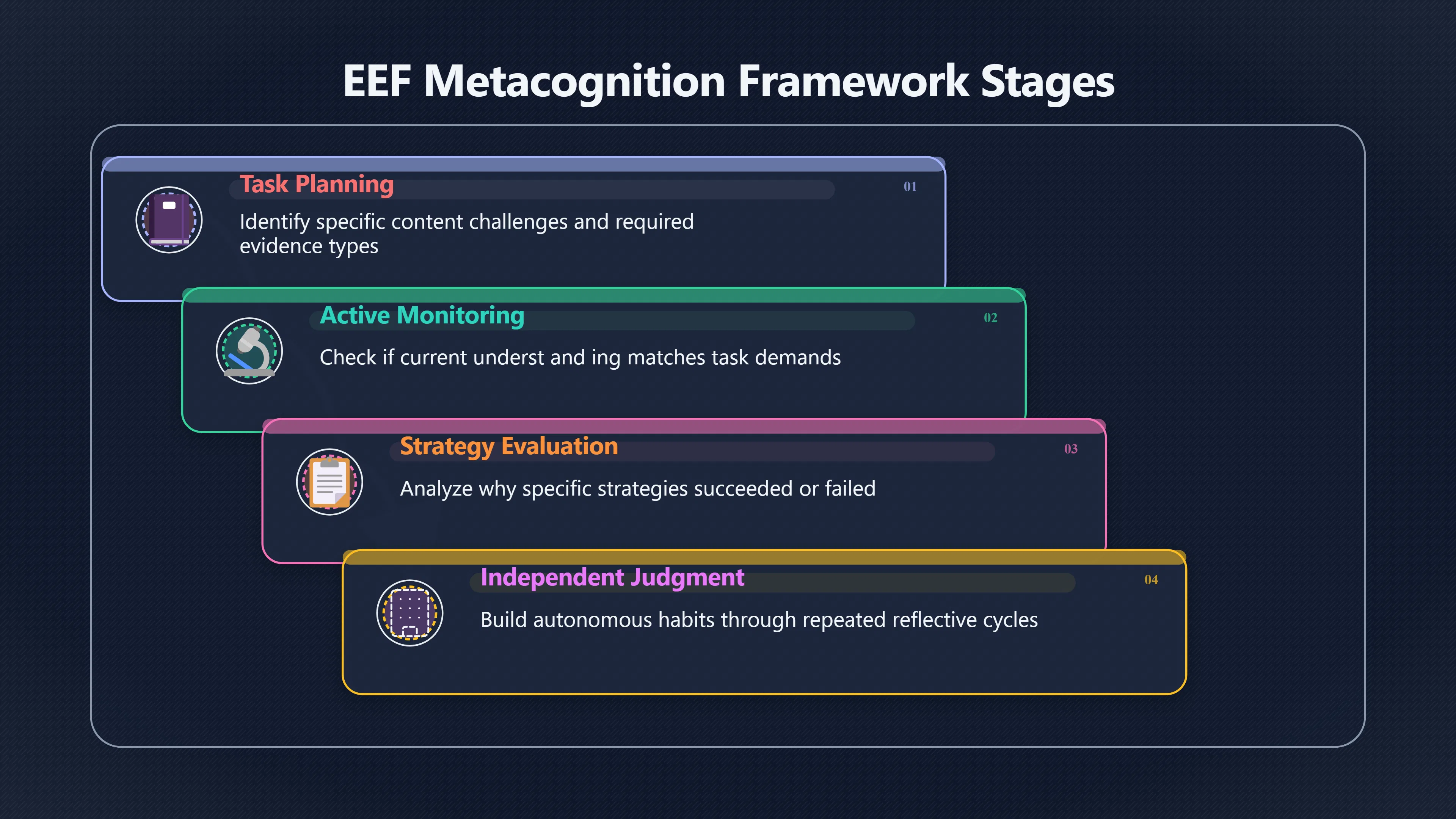
The common framework of planning, monitoring and evaluation does not change across subjects, but the questions asked at each stage do.
Planning begins with the demands of the task
Planning is more than deciding to “work hard”. Effective planning identifies the specific challenges of the content.
Before beginning a history essay, planning may involve identifying the type of evidence that would support a causal claim. Before solving an algebra problem, it may involve deciding whether a diagram or symbolic manipulation is likely to be more useful. Before reading a scientific paper, it may involve predicting what methods should be reported if the conclusions are well supported.
Teachers can make this process visible by modelling their own decisions aloud instead of presenting only polished solutions. Thinking aloud helps students observe expert judgement that would otherwise remain hidden.[CloudFront+2EEF]d2tic4wvo1iusb.cloudfront.netCloud Front Metacognition and Self-Regulated LearningMetacognition and Self-Regulated Learning - Guidance reportThis new evidence review has provided a clear- er picture of the app…
Monitoring happens during the work, not afterwards
Monitoring means checking whether current understanding matches the demands of the task.
Useful questions vary by discipline:
- In mathematics: “Does each step logically follow from the previous one?”
- In reading: “Can I explain this paragraph without looking back?”
- In science: “Does this result fit my prediction, or might there be another explanation?”
- In business analysis: “Am I relying on evidence or simply confirming my first impression?”
These questions are tied directly to the work being completed rather than functioning as generic reminders to “think carefully”.
Evaluation improves future performance
Evaluation asks what should change next time.
Rather than simply asking whether an answer was correct, learners examine why a particular strategy succeeded or failed. They distinguish between mistakes caused by misunderstanding the content, choosing an unsuitable strategy or monitoring their progress poorly.
Repeated cycles of planning, monitoring and evaluation gradually build independent judgement instead of dependence on constant external feedback.[CloudFront+2lifescied.org]d2tic4wvo1iusb.cloudfront.netCloud Front Metacognition and Self-Regulated LearningMetacognition and Self-Regulated Learning - Guidance reportThis new evidence review has provided a clear- er picture of the app…
What effective classroom practice looks like
Research-based guidance consistently recommends explicit instruction rather than assuming metacognitive skills emerge naturally.
Common features include:
- Teachers model their reasoning while solving authentic subject problems.
- Students practise using the same thinking processes with carefully designed scaffolding.
- Prompts become less structured as learners gain independence.
- Reflection focuses on strategy choices within the completed task rather than generic opinions about learning.
The emphasis is not on adding another lesson to the timetable but on making normally invisible expert thinking visible during ordinary teaching. Recent EEF guidance highlights modelling, structured questioning, activating prior knowledge and metacognitive classroom dialogue as practical ways to achieve this integration.[CloudFront+2EEF]d2tic4wvo1iusb.cloudfront.netCloud Front Metacognition and Self-Regulated LearningMetacognition and Self-Regulated Learning - Guidance reportThis new evidence review has provided a clear- er picture of the app…
Examples across different kinds of work
Learning mathematics
Instead of teaching “check your work” as a slogan, a teacher might ask students to predict which solving method will be most efficient before beginning.
While working, students compare intermediate results against their expectations. Afterwards, they analyse whether a different representation—such as a diagram, equation or table—would have reduced errors.
Metacognition becomes inseparable from mathematical reasoning rather than an additional exercise.
Reading and writing
Strong readers do not merely decode words. They notice confusion, identify missing background knowledge and adjust their reading speed.
During writing, learners can pause at key points to ask whether each paragraph actually supports the intended argument or merely repeats information. Reflection is anchored in the quality of the text being produced rather than in vague impressions of effort.
Scientific investigation
Laboratory work naturally supports metacognition because experiments involve prediction, observation and revision.
Students can record:
- what outcome they expected,
- why they expected it,
- whether the evidence matched their prediction,
- and what changes they would make to improve the investigation.
The reflective questions arise directly from scientific practice.
Workplace judgement
The same principles extend beyond formal education.
A financial analyst reviewing market data might document why a forecast appears convincing before seeing later results. A project manager might pause midway through a project to reassess assumptions instead of continuing with an ineffective plan simply because work has already begun.
In each case, metacognition is embedded within the real decision rather than taught separately as a communication or leadership skill.

Why subject knowledge still matters
One misconception is that metacognition can compensate for weak knowledge. Evidence does not support this.
Monitoring depends partly on recognising what counts as good reasoning within a field. Someone with limited biological knowledge may struggle to judge whether an explanation is plausible, regardless of how reflective they try to be. Similarly, evaluating historical evidence requires understanding how historians weigh sources.
Research on learning and transfer therefore argues that metacognitive strategies work alongside strong domain knowledge rather than replacing it. Experts often appear more metacognitive partly because they possess richer knowledge structures that allow them to recognise errors, select strategies and detect meaningful patterns.[National Academies+2Westsächsische Hochschule Zwickau]nationalacademies.orgNational AcademiesChapter: 3 Learning and TransferMetacognitive approaches to instruction have been shown to increase the degree to which…
The balance between guidance and independence
Another misconception is that teaching metacognition means leaving learners to discover effective strategies on their own.
Evidence instead favours a gradual release of responsibility. Teachers initially provide substantial modelling and structured prompts before reducing support as learners gain experience. Without this guidance, reflection can become superficial or inaccurate, especially for novices who lack the knowledge needed to judge their own understanding accurately.[CloudFront+2Digital Education Resource Archive]d2tic4wvo1iusb.cloudfront.netCloud Front Metacognition and Self-Regulated LearningMetacognition and Self-Regulated Learning - Guidance reportThis new evidence review has provided a clear- er picture of the app…
The long-term goal is not constant self-commentary but increasingly automatic regulation. Learners eventually internalise questions that were first supplied by teachers, enabling them to plan, monitor and evaluate their thinking while tackling authentic problems independently across school, higher education and professional work.
Amazon book picks
Further Reading
Books and field guides related to Why Thinking Skills Need Real Problems. Use these as the next step if you want deeper reading beyond the article.
Make It Stick
Explains why durable learning comes from engaging with meaningful tasks rather than isolated study strategies.
How We Learn
Connects cognitive science research to practical learning in authentic contexts.
How People Learn II
Emphasizes the importance of context, knowledge, and authentic learning environments.
Visible Learning for Teachers
Discusses evidence-based classroom practices, including embedding effective learning strategies within subject teaching.
eBay marketplace picks
Marketplace Samples
Example marketplace items related to this page. Use the search link to explore similar finds on eBay.




Endnotes
1.
Source: educationendowmentfoundation.org.uk
Link:https://educationendowmentfoundation.org.uk/education-evidence/teaching-learning-toolkit/metacognition-and-[self-regulation
Source snippet
EEFMetacognition and self-regulationThe research evidence indicates that explicitly teaching strategies to help pupils to plan, monitor a...
2.
Source: d2tic4wvo1iusb.cloudfront.net
Title: Cloud Front Metacognition and Self-Regulated Learning
Link:https://d2tic4wvo1iusb.cloudfront.net/production/eef-guidance-reports/metacognition/metacognition-and-self-regulated-learning_guidance-report.v.2.4.0.pdf
Source snippet
Metacognition and Self-Regulated Learning - Guidance reportThis new evidence review has provided a clear- er picture of the app...
3.
Source: lifescied.org
Link:https://www.lifescied.org/doi/10.1187/cbe.20
Source snippet
Strong metacognitive skills have the power to impact student learning and performance...
4.
Source: educationendowmentfoundation.org.uk
Title: Examples of effective metacognitive strategies which can
Link:https://educationendowmentfoundation.org.uk/news/updated-eef-guide-to-metacognition-and-self-regulation
Source snippet
EEFThe updated EEF guide to metacognition and self-regulation.14 Nov 2025 — Helping pupils plan, monitor, and evaluate learning through m...
5.
Source: educationendowmentfoundation.org.uk
Title: promoting metacognitive talk in the classroom
Link:https://educationendowmentfoundation.org.uk/news/promoting-metacognitive-talk-in-the-classroom
Source snippet
EEFMar 4, 2026 — Recommendation 4 of the EEF's Metacognition and Self-regulated Learning guidance states: promote and develop metacogniti...
6.
Source: nationalacademies.org
Link:https://www.nationalacademies.org/read/9853/chapter/6
Source snippet
National AcademiesChapter: 3 Learning and TransferMetacognitive approaches to instruction have been shown to increase the degree to which...
7.
Source: dera.ioe.ac.uk
Title: itly teach pupils metacognitive strategies, including how to plan, monitor,
Link:https://dera.ioe.ac.uk/id/eprint/31617/1/EEF_Metacognition_and_self-regulated_learning.pdf
Source snippet
Digital Education Resource ArchiveGuidance Report METACOGNITION AND SELF-REGULATED...It offers seven practical, evidence-based key princ...
8.
Source: whz.de
Link:https://www.whz.de/fileadmin/lehre/hochschuldidaktik/docs/dunloskiimprovingstudentlearning.pdf
Source snippet
Materials pertain to the specific content that students are expected to learn, remember, or comprehend. Domain knowledge may enhance the...
9.
Source: educationendowmentfoundation.org.uk
Link:https://educationendowmentfoundation.org.uk/education-evidence/guidance-reports/metacognition
Source snippet
Metacognition and Self-Regulated Learning13 Nov 2025 — Explore an accessible summary of effective, evidence-based strategies to improve s...
10.
Source: educationendowmentfoundation.org.uk
Title: metacognition and self regulation guidance report
Link:https://educationendowmentfoundation.org.uk/education-evidence/evidence-reviews/metacognition-and-self-regulation-guidance-report
Source snippet
Metacognition and self-regulation evidence review9 Sept 2024 — Review of the evidence commissioned by the EEF to inform the Metacognition...
11.
Source: educationendowmentfoundation.org.uk
Title: metacognition and self regulation
Link:https://educationendowmentfoundation.org.uk/education-evidence/evidence-reviews/metacognition-and-self-regulation
Source snippet
Metacognition and Self-regulation: Evidence Review20 Jan 2022 — Review of the evidence commissioned by the EEF to inform the first editio...
12.
Source: educationendowmentfoundation.org.uk
Link:https://educationendowmentfoundation.org.uk/news/scaffolding-independent-learning–metacognitive-strategies
Source snippet
How to use visual, verbal, and written scaffolding to support…14 Jan 2026 — Metacognition and self-regulated learning offer huge potentia...
13.
Source: alexquigley.co.uk
Link:https://alexquigley.co.uk/metacognition-new-and-updated/
Source snippet
New and Updated22 Nov 2025 — Understanding metacognition and self-regulation helps teachers. There is substantive evidence that they offe...
Additional References
14.
Source: researchgate.net
Link:https://www.researchgate.net/publication/364827308Transfer_of_metacognitive_skills_in_self-regulated_learning_effects_on_strategy[application
Source snippet
Transfer of metacognitive skills in self-regulated learningOct 28, 2022 — Metacognitive skills are often considered domain-general, there...
15.
Source: linkedin.com
Link:https://www.linkedin.com/posts/greenshaw-research-school_metacognition-and-self-regulated-learning-activity-7394674207554699264-oUQy
Source snippet
EEF updates guidance on metacognition and self-...The Education Endowment Foundation (EEF) has released updated guidance on Metacognitio...
16.
Source: education.nsw.gov.au
Link:https://education.nsw.gov.au/content/dam/main-education/teaching-and-learning/education-for-a-changing-world/media/documents/Metacognition_Full_Report_FINAL.pdf
Source snippet
nsw.gov.auMetacognition: a key to unlocking learning“A 'metacognitive' approach to instruction can help students learn to take control of...
17.
Source: globalmetacognition.com
Link:https://www.globalmetacognition.com/post/developing-student-metacognitive-skills-using-active-learning-with-embedded-metacognition-instructio
Source snippet
Developing Student Metacognitive Skills Using Active...16 Aug 2025 — Integrating metacognition instruction directly into course content...
18.
Source: d-nb.info
Link:https://d-nb.info/1219420840/34
Source snippet
Training interventions for self-regulated learning foster the use of strategies and skills as well as their transfer to new learning task...
19.
Source: cradall.org
Title: How People Learn Brain Mind Experience and School Expanded Edition
Link:https://cradall.org/sites/default/files/How%20People%20Learn-Brain_Mind_Experience_and%20School%20-%20Expanded%20Edition.pdf
Source snippet
How People Learn: Brain, Mind, Experience, and Schoolby E Edition · Cited by 32939 — riculum emphasizes a metacognitive approach to instr...
20.
Source: structural-learning.com
Link:https://www.structural-learning.com/post/how-to-develop-metacognition
Source snippet
that necessitates age-appropriate strategies and consistent classroom routines: Learners...
21.
Source: twinkl.com.pr
Link:https://www.twinkl.com.pr/blog/teaching-thinking-promoting-metacognition-and-self-regulation-in-the-classroom
Source snippet
7 Dec 2020 — The Education Endowment Foundation (EEF) website is rich with research-driven, evidence-led practical recommendations...
22.
Source: studocu.vn
Link:https://www.studocu.vn/vn/document/vnu-university-of-engineering-and-technology/information-technology/metacognition-self-regulated-learning-guidance-report-eef/155204153
Source snippet
rning and achievement in schools, as outlined by the Education Endowment...
23.
Source: twinkl.com
Title: Metacognition and Self-Regulation EEF Guidance
Link:https://www.twinkl.com/resource/quick-look-metacognition-and-self-regulation-eef-guidance-summary-t-slt-1320
Source snippet
SummaryThe Education Endowment Foundation (EEF) states that self-regulation and metacognition are high-impact, low-cost methodologies, th...
Topic Tree