Within Reasoning Chain
Prompts That Reveal Gaps in Thinking
Self-explanation prompts expose missing links by asking how an answer was reached and where confusion remains.
On this page
- What self explanation adds to a reasoning chain
- Useful prompts for learning and work
- When prompts overload rather than help
Page outline Jump by section
Introduction
Self-explanation prompts are questions that ask you to explain your own reasoning rather than simply state an answer. Their value is not that they generate longer reasoning chains, but that they expose the places where those chains break down. When you try to explain how you reached a conclusion, missing evidence, hidden assumptions and uncertain steps become much easier to notice.
 This makes self-explanation a practical extension of written reasoning. Instead of treating confidence as proof of understanding, it turns understanding into something that can be inspected. Decades of research in cognitive psychology and education show that prompting learners to explain ideas to themselves improves comprehension, transfer of knowledge and metacognitive monitoring, particularly for complex tasks where intuition can outrun careful analysis. [Andy Matuschak+2Gwern]andymatuschak.orgChi et al 1994 Eliciting self explanations improves understandingAndy MatuschakEliciting Self-Explanations Improves Understandingby MTH CHI · 1994 · Cited by 4299 — Here, we explore the generality of th…
What self-explanation adds to a reasoning chain
A written reasoning chain records the path from question to conclusion. Self-explanation adds an active check of whether each step in that path genuinely makes sense.
Without explanation, a chain can remain superficial:
- “I think option A is best because it is cheaper.”
With self-explanation, the reasoning becomes more testable: [researchschool.org.uk]researchschool.org.ukexplaining self explanationResearch Schools NetworkExplaining Self-explanation | Devon Research School7 Jul 2020 — A meta-analysis by Bisra et al (2018) concluded …
- “Why does the lower price matter here?”
- “What assumptions connect price to the outcome I want?”
- “Would the conclusion change if reliability mattered more than cost?”
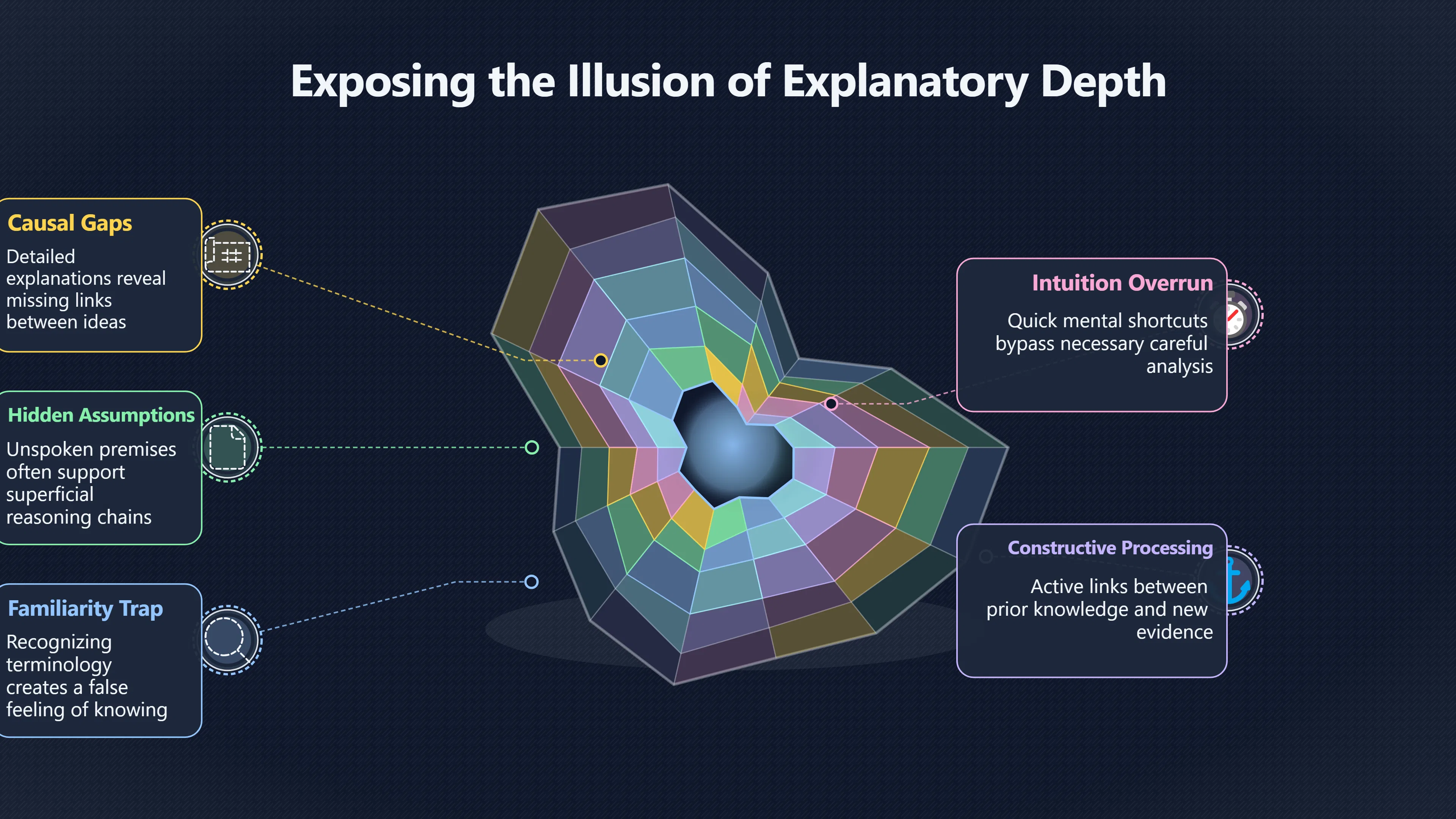
These prompts encourage what psychologists describe as constructive processing: generating connections that are not explicitly present in the material itself. Rather than repeating information, the learner creates links between concepts, prior knowledge and evidence. This constructive activity is one of the mechanisms believed to explain why self-explanation improves learning. [Andy Matuschak]andymatuschak.orgChi et al 1994 Eliciting self explanations improves understandingAndy MatuschakEliciting Self-Explanations Improves Understandingby MTH CHI · 1994 · Cited by 4299 — Here, we explore the generality of th…
Importantly, self-explanation is different from simply talking through thoughts or summarising notes. A summary repeats information. A self-explanation asks why each piece belongs and how it supports the conclusion.
Why explaining reveals gaps that confidence hides
One reason self-explanation works is that people frequently mistake familiarity for understanding. Reading an explanation or recognising terminology creates a feeling of knowing that may disappear when asked to produce an explanation independently.
Psychologists describe a related phenomenon as the illusion of explanatory depth: people often believe they understand complex systems much better than they actually do. When they attempt a detailed explanation, their confidence commonly falls because they discover missing causal links. [Wikipedia]WikipediaIllusion of explanatory depthIllusion of explanatory depth
Self-explanation interrupts this illusion by forcing questions such as: [researchschool.org.uk]researchschool.org.ukexplaining self explanationResearch Schools NetworkExplaining Self-explanation | Devon Research School7 Jul 2020 — A meta-analysis by Bisra et al (2018) concluded …
- What evidence supports this step?
- Why does this follow from the previous statement?
- What mechanism actually connects these ideas?
- Where am I relying on intuition rather than knowledge?
Instead of treating uncertainty as failure, these questions identify exactly where further investigation is needed.
Useful prompts for learning and work
Effective prompts are specific enough to expose weaknesses without prescribing the answer. Different prompts uncover different kinds of reasoning gaps.
Explaining the logic
These prompts test whether the chain itself is coherent.
- How did I arrive at this conclusion?
- Why does this step follow from the previous one?
- Which fact is doing the most work in my argument?
- If someone challenged this step, what evidence would I show first?
These questions often expose unsupported leaps between evidence and conclusion.
Identifying uncertainty
Many people naturally explain only what they know. Better prompts deliberately search for uncertainty.
Useful examples include:
- Which part of this explanation feels least certain?
- Which term or idea could I not define clearly?
- Where did I make an assumption instead of using evidence?
- What would most likely make me change my mind?
These prompts improve metacognitive monitoring by distinguishing confidence from actual understanding. [Eindhoven TU Research Portal]research.tue.nlEindhoven TU Research PortalImproving metacognition through self-explication in a digital…2022 · Cited by 54 — Metacognitive prompts a…

Testing transfer
Understanding is stronger when it survives a change of context.
Helpful prompts include:
- Would this reasoning still work in a slightly different situation?
- Can I explain the same idea without using the original example?
- What principle stays the same if the details change?
Research on self-explanation consistently finds that learners who explain underlying principles transfer knowledge better than those who merely memorise procedures. [Andy Matuschak+2Gwern]andymatuschak.orgChi et al 1994 Eliciting self explanations improves understandingAndy MatuschakEliciting Self-Explanations Improves Understandingby MTH CHI · 1994 · Cited by 4299 — Here, we explore the generality of th…
Challenging assumptions
Some of the most productive prompts deliberately look for hidden premises.
Examples include:
- What must be true for this conclusion to hold?
- Which assumption have I not tested?
- What alternative explanation fits the same evidence?
- Which missing fact would most weaken my conclusion?
These questions shift attention away from defending an answer and towards evaluating its foundations.
A practical example
Suppose someone concludes:
“Remote working reduces productivity.”
Without self-explanation, the reasoning may stop there. [researchschool.org.uk]researchschool.org.ukexplaining self explanationResearch Schools NetworkExplaining Self-explanation | Devon Research School7 Jul 2020 — A meta-analysis by Bisra et al (2018) concluded …
A prompted explanation might unfold as follows:
- What evidence supports this claim?
- Am I referring to every type of work or only particular jobs?
- Could another variable explain the observed results?
- Have I confused short-term adjustment problems with long-term performance?
- What evidence would convince me that I am mistaken?
The conclusion may ultimately remain unchanged. Equally, the person may discover that they possess only isolated examples rather than robust evidence. Either outcome represents an improvement because the quality of the reasoning has become visible.

When prompts overload rather than help
Self-explanation is beneficial when it encourages meaningful reasoning, but more prompting is not always better.
One common mistake is asking learners to explain every tiny step of an already difficult task. Excessive prompting increases cognitive load—the demand placed on working memory—and can interfere with learning instead of supporting it. Research suggests that prompts work best when they fit both the learner’s existing knowledge and the structure of the material being learned. [IJOLTER]ijlter.orgDecember 31, 2020 — The instructional fit hypothesis states that the effect of self-explanation prompts is more powerful when the objecti…
Other situations where prompts become less useful include:
- When answers become formulaic. If people mechanically complete reflection questions without genuine engagement, explanations become routine rather than diagnostic.
- When prompts focus on justification instead of explanation. Asking “Why are you right?” often encourages people to defend existing beliefs. Asking “How does this work?” is more likely to expose missing understanding, particularly for causal topics. [Wikipedia]WikipediaIllusion of explanatory depthIllusion of explanatory depth
- When the learner lacks essential background knowledge. Prompts cannot replace missing information. They help organise and inspect reasoning, but they cannot generate understanding from nothing.
Effective prompting therefore balances challenge with feasibility. It should make thinking visible without overwhelming the learner or encouraging defensive rationalisation.
Making self-explanation a regular habit
The strongest evidence suggests that self-explanation works because it changes how people interact with information, not because it produces longer written responses. Successful learners actively connect ideas, monitor understanding and repair gaps as they emerge instead of discovering misunderstandings only after failure. [Gwern+2Andy Matuschak]gwern.netInducing Self-Explanation: a Meta-AnalysisSelf-explanation is a constructive cognitive activity learners can enact, at will or in re…
A short set of recurring prompts is often enough:
- What is my conclusion?
- How exactly did I reach it?
- Which step is weakest?
- What evidence is missing?
- What remains confusing?
Used alongside written reasoning chains, these prompts transform explanation from a record of what you think into a tool for discovering what you still need to understand.
Amazon book picks
Further Reading
Books and field guides related to Prompts That Reveal Gaps in Thinking. Use these as the next step if you want deeper reading beyond the article.
Make It Stick
Explains evidence-based learning techniques including retrieval, self-testing, and strategies closely aligned with self-explanation prompts.
The Pyramid Principle
Teaches structured reasoning and making thinking explicit, complementing written reasoning and self-explanation practices.
The Art of Learning
Focuses on reflective practice, metacognition, and learning from mistakes through deliberate explanation.
How to Read a Book
Develops disciplined questioning, active reading, and explanatory thinking that help reveal gaps in understanding.
eBay marketplace picks
Marketplace Samples
Live-tested eBay searches with available results related to this page.

Endnotes
-
Source: gwern.net
Link: https://gwern.net/doc/psychology/spaced-repetition/2018-bisra.pdfSource snippet
Inducing Self-Explanation: a Meta-AnalysisSelf-explanation is a constructive cognitive activity learners can enact, at will or in re...
-
Source: Wikipedia
Title: Illusion of explanatory depth
Link: https://en.wikipedia.org/wiki/Illusion_of_explanatory_depth -
Source: Wikipedia
Title: Worked-example effect
Link: https://en.wikipedia.org/wiki/Worked-example_effect -
Source: ijlter.org
Link: https://www.ijlter.org/index.php/ijlter/article/download/2856/pdfSource snippet
December 31, 2020 — The instructional fit hypothesis states that the effect of self-explanation prompts is more powerful when the objecti...
Published: December 31, 2020
-
Source: andymatuschak.org
Title: Chi et al 1994 Eliciting self explanations improves understanding
Link: https://andymatuschak.org/files/papers/Chi%20et%20al%20-%201994%20-%20Eliciting%20self-explanations%20improves%20understanding.pdfSource snippet
Andy MatuschakEliciting Self-Explanations Improves Understandingby MTH CHI · 1994 · Cited by 4299 — Here, we explore the generality of th...
-
Source: research.tue.nl
Link: https://research.tue.nl/files/247202299/s11423_022_10156_2.pdfSource snippet
Eindhoven TU Research PortalImproving metacognition through self-explication in a digital...2022 · Cited by 54 — Metacognitive prompts a...
-
Source: researchschool.org.uk
Title: explaining self explanation
Link: https://researchschool.org.uk/devon/news/explaining-self-explanationSource snippet
Research Schools NetworkExplaining Self-explanation | Devon Research School7 Jul 2020 — A meta-analysis by Bisra et al (2018) concluded ...
Additional References
-
Source: researchgate.net
Link: https://www.researchgate.net/publication/400691667_Self-explanation_Prompts_in_STEM_Comparing_Human_and_AI_Metacognitive_AccuracySource snippet
Self-explanation Prompts in STEM: Comparing Human and...30 Apr 2026 — This study investigates the efficacy of Self-Explanation Prompts (...
-
Source: sciencepublishinggroup.com
Link: https://sciencepublishinggroup.com/article/10.11648/j.ajcst.20260901.13Source snippet
cing problem-solving performance and metacognitive accuracy within STEM...
-
Source: youtube.com
Link: https://www.youtube.com/watch?v=1E248I_DyrgSource snippet
Self-Explanation: Help Students Connect and Deepen Learning...
-
Source: youtube.com
Title: This One Study Technique Changes Everything (Most Students Miss It)
Link: https://www.youtube.com/watch?v=iGBDi1WkofISource snippet
Unlock Better Learning: Understanding Neuroscience and Neurodiversity (HD Re-Upload)...
-
Source: elementsoflearning.home.blog
Link: https://elementsoflearning.home.blog/2022/09/29/enhancing-[worked-examplesSource snippet
worked examples with self-explanation29 Sept 2022 — Self-explaining involves generating an explanation for oneself in order to make sense...
-
Source: youtube.com
Title: Metacognition: The Key to Deeper Learning
Link: https://www.youtube.com/watch?v=GXTFu_aSThUSource snippet
What is Metacognition? (Exploring the Layers of Thinking about Thinking)...
-
Source: youtube.com
Title: Self-Explanation: Help Students Connect and Deepen Learning
Link: https://www.youtube.com/watch?v=hSLPFMiJcQcSource snippet
Metacognition: The Key to Deeper Learning...
-
Source: files.eric.ed.gov
Link: https://files.eric.ed.gov/fulltext/ED618186.pdfSource snippet
It then describes how these prompts are.Read more...
Topic Tree