Within Sharper Thinking
Which Thinking Mistakes Keep Repeating?
Biases and reasoning errors become more manageable when people practice spotting them in real decisions.
On this page
- Common reasoning errors
- Practice examples
- Prevention routines
Page outline Jump by section
Introduction
Common thinking mistakes are not character flaws; they are repeatable patterns in how people search for evidence, estimate risk, explain outcomes and protect previous choices. They matter because the same error can look different in each decision: confirmation bias in a political argument, anchoring in a salary negotiation, base-rate neglect in a medical judgement, or sunk-cost thinking in a failing project. The practical aim is not to memorise a long catalogue of biases, but to practise recognising the few mistakes that keep returning when decisions are uncertain, emotional, socially exposed or hard to reverse.
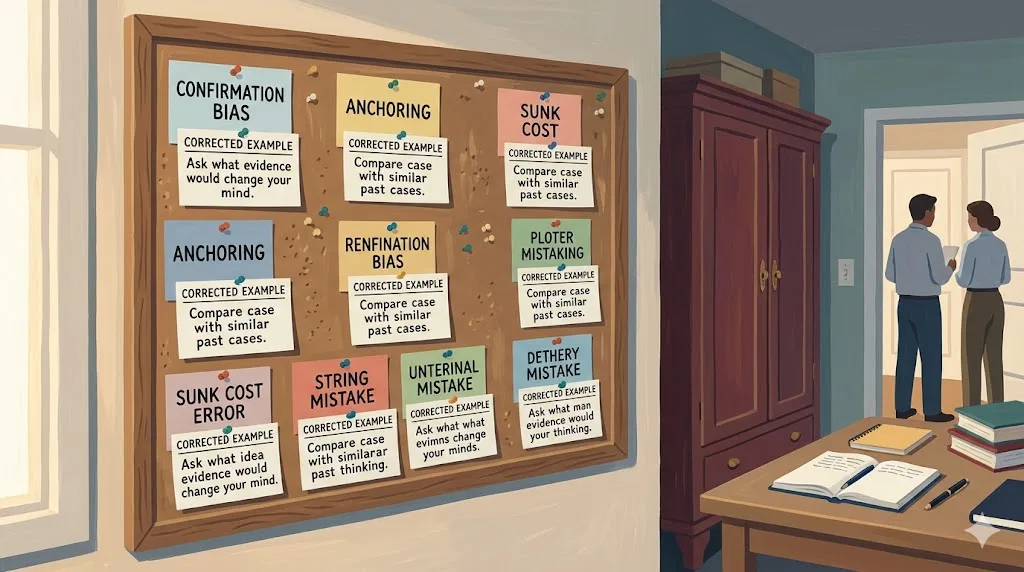
The most useful practice is concrete: write down the claim, name the tempting shortcut, ask what evidence would change your mind, compare the case with similar past cases, and review the decision before the outcome is known. Research on debiasing suggests that warnings alone are usually weak, while structured training, feedback, “consider the opposite” prompts and decision routines can improve judgement in real settings.[PubMed+2Sage Journals]pubmed.ncbi.nlm.nih.govDebiasing Training Improves Decision Making in the Fieldby AL Sellier · 2019 · Cited by 181 — The results provide promising evidenc…
Why the Same Mistakes Keep Repeating
Thinking errors persist because they often start as useful shortcuts. It is sensible to use memory when judging risk, first estimates when planning, and vivid examples when learning from experience. The trouble begins when a shortcut is used in the wrong setting: a vivid anecdote replaces a base rate, a first number becomes a hidden anchor, or a previous investment becomes a reason to keep investing even when the future case has collapsed.
Biases are also hard to notice from the inside. The “bias blind spot” describes people’s tendency to see cognitive and motivational biases more readily in others than in themselves; Pronin, Lin and Ross found this pattern across several surveys, including comparisons with “average” others and peers.[Princeton University]collaborate.princeton.eduthe bias blind spot perceptions of bias in self versus othersPrinceton UniversityThe bias blind spot: Perceptions of bias in self versus othersby E Pronin · 2002 · Cited by 2042 — Three studies sugg… That is why “be less biased” is a poor instruction. A better goal is to build routines that make the mistake visible before it quietly shapes the conclusion.
A useful practice frame is: What is my first answer, and what kind of mistake would make that answer feel too easy? If the answer came quickly, the likely risks are anchoring, availability or overconfidence. If the answer protects a prior belief, the likely risks are confirmation bias and motivated reasoning. If the answer excuses continuing a failing choice, sunk-cost thinking and escalation of commitment are likely suspects.
Common Reasoning Errors
Confirmation bias: looking for evidence that lets you stop thinking
Confirmation bias is the tendency to seek, interpret or remember information in ways that support what you already believe. Raymond Nickerson’s influential review describes it as a broad and persistent phenomenon, not merely a deliberate attempt to distort evidence; people can be selective without realising they are being selective.[UCSD Pages]pages.ucsd.eduPages Confirmation Bias: A Ubiquitous Phenomenon in ManyPages Confirmation Bias: A Ubiquitous Phenomenon in Many
A common everyday version is the “one-sided search”. Someone asks, “Why is this proposal a good idea?” rather than “What would make this proposal fail?” The wording quietly turns analysis into advocacy. In hiring, it might mean treating a strong first impression as the hypothesis and then interpreting later answers through it. In health or finance, it might mean searching only for evidence that supports the action one already wants to take.
The practice move is to make disconfirmation explicit. Before gathering more evidence, write: “The main reason I might be wrong is…” Then look for the strongest contrary case, not the easiest objection to defeat. “Consider the opposite” has experimental support as a corrective strategy: Lord, Lepper and Preston found that prompting people to consider alternative possibilities reduced biased social judgement more effectively than simply telling them to be unbiased.[PubMed]pubmed.ncbi.nlm.nih.govIn two separate but conceptually parallelConsidering the opposite: a corrective strategy for social…by CG Lord · 1984 · Cited by 1170 — Individuals who are induced to co…
Anchoring: letting the first number set the room temperature
Anchoring happens when an initial value, example or framing point pulls later estimates towards it, even when the anchor is arbitrary or weakly relevant. The classic account comes from work by Tversky and Kahneman, and later research has examined why adjustments away from anchors are often insufficient.[PMC]pmc.ncbi.nlm.nih.govOpen source on nih.gov.
This mistake is worth practising against because anchors often enter decisions innocently. A project’s first budget, a seller’s first price, a colleague’s first diagnosis, a forecast in a slide deck or an artificial intelligence output can become the mental reference point. Even when people know the first estimate is rough, later discussion may revolve around “adjusting” it rather than independently rebuilding the estimate.
The practice move is independent estimation. Before seeing other people’s numbers, produce your own estimate and state the basis for it. In group settings, ask each person to write an initial judgement privately before discussion. When using a model, calculator or AI system, first define what evidence would make its answer too high, too low or irrelevant. Research on AI-assisted decision-making has specifically examined de-anchoring strategies because people may over-weight machine suggestions when the system is uncertain or wrong.[arXiv]arxiv.orgOpen source on arxiv.org.
Availability: mistaking memorable for likely
The availability heuristic is the tendency to judge frequency, probability or importance by how easily examples come to mind. It can be useful: recent experience often contains real information. But it misleads when memory is shaped by vividness, recency, media exposure, personal experience or emotional intensity rather than by representative evidence.[The Decision Lab]thedecisionlab.comThe Decision Lab Availability HeuristicThe Decision Lab Availability Heuristic
A manager may overestimate a rare operational risk because a recent failure was painful, while underestimating a dull but common source of loss. A traveller may fear a dramatic accident more than a routine danger. A voter may treat the most shareable story as typical. The problem is not that anecdotes are useless; it is that they need to be placed beside base rates.
The practice move is to ask: “What would I believe if this example had not come easily to mind?” Then look for frequencies, comparison classes and boring denominators. If one case dominates your attention, deliberately collect three ordinary cases from the same category. Availability loses some of its grip when the memorable example is no longer the only mental evidence on the table.
Base-rate neglect: ignoring how common something is before the new clue arrives
Base-rate neglect occurs when people underuse general statistical information about how common something is and overuse vivid case-specific clues. This matters in domains such as medicine, law, hiring, forecasting and data interpretation, where a striking signal can still be misleading if the underlying condition is rare. Research on base rates is nuanced: some studies show neglect, while other work finds that experts can use base rates in real-world sequential decisions when the information is presented in usable ways.[Cambridge University Press & Assessment+2PMC]cambridge.orgOpen source on cambridge.org.
The classic practical trap is confusing “this looks like X” with “this is probably X”. A candidate may resemble a successful employee, a symptom may resemble a serious condition, or a start-up may resemble a famous winner. Without asking how common the category is, the judgement can become a story-matching exercise.
The practice move is to start with the outside number. Ask: “In a relevant comparison group, how often does this happen?” Then update from there. This does not mean ignoring case details; it means giving them the right job. Details should adjust the base rate, not replace it.
Planning fallacy: treating your plan as if friction will take the day off
The planning fallacy is the tendency to underestimate how long tasks will take, even when similar tasks have taken longer before. Research on the inside-outside view explains one reason: people focus on the details of the current plan, while neglecting the distribution of outcomes from comparable past efforts.[ResearchGate]researchgate.netResearch Gate(PDF) The Planning FallacyResearch Gate(PDF) The Planning Fallacy
This error is especially damaging because it feels responsible. A detailed plan can create confidence, even when the plan omits illness, delays, coordination problems, unclear requirements, rework or waiting for other people. The more vivid the imagined path to success, the easier it is to forget the many ordinary ways the path can bend.
The practice move is reference-class forecasting. Instead of asking only, “How long should this take if things go well?”, ask, “How long did similar tasks actually take?” Bent Flyvbjerg’s work on project due diligence argues for using the “outside view” to improve front-end estimates, especially where cost-benefit cases and project approvals can otherwise be built on optimistic assumptions.[arXiv]arxiv.orgOpen source on arxiv.org.
Sunk-cost thinking: making the past vote on the future
The sunk-cost fallacy appears when past, unrecoverable investments of money, time, effort or reputation influence whether to continue, even though only future costs and benefits should matter. Escalation of commitment is the broader pattern in which people keep investing in a failing course after negative feedback.[PMC]pmc.ncbi.nlm.nih.govOpen source on nih.gov.
The emotional force is obvious: stopping can feel like admitting waste. That feeling is strongest when the original decision is tied to identity, status or public accountability. The New Yorker’s discussion of the “sunk-cost feeling” uses sports and the Concorde project to illustrate how previous investment can make withdrawal psychologically and politically difficult even when the forward-looking case is poor.[The New Yorker]newyorker.comThe New Yorker That Sunk-Cost FeelingThe New Yorker That Sunk-Cost Feeling
The practice move is to ask the clean-slate question: “If we had not already spent this, would we choose this option today?” A second useful routine is decision separation: let someone who was not responsible for the original choice review whether to continue. That reduces the reputational pressure to defend the past.
Hindsight and outcome bias: confusing a bad result with a bad decision
Hindsight bias is the tendency to believe, after an outcome is known, that it was more predictable than it really was. Outcome bias is related but different: it judges the quality of a decision too heavily by its result rather than by the information and reasoning available at the time. Safety and aviation explainers emphasise that both can distort incident review by oversimplifying cause and effect after the fact.[SKYbrary]skybrary.aeroOpen source on skybrary.aero.
This mistake damages learning. If a risky decision worked, people may call it wise. If a reasonable decision failed, they may call it foolish. Either way, the review teaches the wrong lesson. The aim is not to excuse poor judgement, but to separate decision quality from luck.
The practice move is to keep a decision record before the result arrives. Write down the options, evidence, assumptions, expected probabilities and what would count as failure. In a review, compare the later outcome with the earlier reasoning. That makes it harder for memory to rewrite uncertainty into inevitability.
Practice Examples
A good way to practise is to use small, ordinary decisions before the stakes are high. The point is not to conduct a full audit every time, but to build recognition.
Choosing between two job offers. Anchoring may appear in the first salary number. Availability may appear if one recent conversation with a charismatic interviewer dominates your judgement. Confirmation bias may appear if you have already decided which company you want and are now collecting reasons. A prevention routine would be to score both offers against pre-written criteria before negotiating, then ask what evidence would make your preferred option the wrong one.
Estimating a project deadline. The planning fallacy appears when the team estimates the task by imagining the smooth path. Base-rate neglect appears when nobody checks how long similar work took before. A prevention routine would be to collect three past examples, use the median actual duration as the starting point, and add a separate risk buffer for dependencies.
Deciding whether to continue a failing course. Sunk-cost thinking appears when the argument for continuing begins with “we have already spent”. Escalation of commitment appears when extra investment is justified mainly to avoid admitting the original plan was wrong. A prevention routine would be to appoint a fresh reviewer and ask whether the future benefits justify the future costs from today onwards.
Assessing a dramatic news story. Availability appears when a vivid case feels typical. Confirmation bias appears when you trust the version that fits your side’s existing story. Base-rate neglect appears when the article gives examples without denominators. A prevention routine would be to ask: “Compared with what? How common is this? What would the strongest careful critic say?”
Reviewing a decision after success or failure. Hindsight bias appears when people say the outcome was obvious all along. Outcome bias appears when the result becomes the verdict on the reasoning. A prevention routine would be to review the original decision note before discussing the outcome, then separate “Was the process good?” from “Did the result go our way?”
Prevention Routines
Slow down only where slowing down pays
Not every decision deserves a formal checklist. Overcorrecting can turn thinking into bureaucracy. The better rule is to slow down when a decision is costly, hard to reverse, emotionally charged, socially pressured or based on uncertain evidence. These are the settings where small reasoning errors can compound.
A simple triage question works well: “Would I be embarrassed to explain this decision process later?” If yes, write the reasoning down. The act of writing exposes vague claims, missing evidence and hidden assumptions. It also creates a record that protects later learning from hindsight bias.
Use prompts that change the search, not slogans that praise objectivity
“Be objective” is too vague to be reliable. Better prompts force a different mental action:
- For confirmation bias: “What evidence would change my mind?”
- For anchoring: “What estimate would I make before seeing this number?”
- For availability: “What is the base rate, not just the vivid example?” * For planning fallacy: “How long did similar cases actually take?”[insidebe.com]insidebe.comSource details in endnotes. * For sunk cost: “Would I start this today?”[newyorker.com]newyorker.comThe New Yorker That Sunk-Cost FeelingThe New Yorker That Sunk-Cost Feeling
- For hindsight bias: “What did we know before the result?”
This matches the broader debiasing lesson: awareness helps, but structured interventions, feedback and repeated practice are more dependable than simply knowing a bias name. Reviews of debiasing and professional decision-making repeatedly stress the value of cognitive tools, training, warnings and feedback, while also noting that biases are stubborn and context-dependent.[PMC+2Frontiers]pmc.ncbi.nlm.nih.govOpen source on nih.gov.

Keep a small decision journal
A decision journal is a low-friction way to practise. For important choices, record the decision, options, assumptions, confidence level, expected outcome and review date. The value is not the diary itself; it is the feedback loop. Without a record, people often remember their uncertainty as confidence when things go well and as foresight when things go badly.
The useful entry is short enough to repeat:
- What am I deciding?
- What do I believe will happen?
- How confident am I?
- What evidence would change my mind?
- What similar cases should I compare this with?
- When will I review the decision?
Over time, this reveals personal patterns. Some people are chronic under-estimators. Others over-trust first impressions, avoid losses too strongly, or change their view only after social proof accumulates. The goal is to find the mistakes you actually make, not the ones that sound impressive in a list.
Practise in real decisions, not only in abstract puzzles
Bias examples are easiest to recognise when they are described after the fact. The harder skill is spotting them while a decision still feels alive. That is why practice should use real choices: purchases, schedules, forecasts, negotiations, hiring decisions, project reviews, meeting agendas and personal commitments.
A weekly “mistake scan” is enough for many people. Choose one decision from the week and ask which shortcut was most tempting. Do not try to diagnose every possible bias. Pick the one that would have changed the action. Then design one prevention step for the next similar decision.
What Not to Overlearn
There is a risk in learning biases badly: every disagreement starts to look like someone else’s cognitive flaw. That can make people more dismissive, not more analytical. The bias blind spot is therefore one of the first mistakes worth practising against. If the lesson is always “they are biased”, the lesson has failed.[UC Press Online]online.ucpress.eduOpen source on ucpress.edu.
It is also important not to treat every heuristic as irrational. Shortcuts can be adaptive under time pressure, limited information or repeated environments where experience gives useful signals. The problem is mismatch: using a shortcut designed for one kind of situation in another kind of situation. Availability can warn you about a real recent hazard; it becomes a problem when a vivid example is mistaken for a frequency estimate. Anchoring can provide a starting point; it becomes a problem when the starting point is arbitrary and insufficiently revised.
The most practical standard is not perfect rationality. It is better error management. Good thinkers still use intuition, stories and first impressions. They just know when to put them on trial.
Amazon book picks
Further Reading
Books and field guides related to Which Thinking Mistakes Keep Repeating?. Use these as the next step if you want deeper reading beyond the article.
Thinking, Fast and Slow
Comprehensive coverage of recurring thinking mistakes across many domains.
The Art of Thinking Clearly
Explains dozens of common cognitive errors in short practical chapters.
eBay marketplace picks
Marketplace Samples
Live-tested eBay searches with available results related to this page.




Endnotes
1.
Source: collaborate.princeton.edu
Title: the bias blind spot perceptions of bias in self versus others
Link:https://collaborate.princeton.edu/en/publications/the-bias-blind-spot-perceptions-of-bias-in-self-versus-others/
Source snippet
Princeton UniversityThe bias blind spot: Perceptions of bias in self versus othersby E Pronin · 2002 · Cited by 2042 — Three studies sugg...
2.
Source: pages.ucsd.edu
Title: Pages Confirmation Bias: A Ubiquitous Phenomenon in Many
Link:https://pages.ucsd.edu/~mckenzie/nickersonConfirmationBias.pdf
3.
Source: pmc.ncbi.nlm.nih.gov
Link:https://pmc.ncbi.nlm.nih.gov/articles/PMC6396698/
4.
Source: arxiv.org
Link:https://arxiv.org/abs/2010.07938
5.
Source: cambridge.org
Link:https://www.cambridge.org/core/journals/behavioral-and-brain-sciences/article/physicians-neglect-base-rates-and-it-matters/48984E851538FA30B5DE4D6D6CC35CA3
6.
Source: pmc.ncbi.nlm.nih.gov
Title: PMCExperts use base rates in real-world sequential decisions
Link:https://pmc.ncbi.nlm.nih.gov/articles/PMC9038831/
7.
Source: researchgate.net
Title: Research Gate(PDF) The Planning Fallacy
Link:https://www.researchgate.net/publication/251449615_The_Planning_Fallacy
8.
Source: resolve.cambridge.org
Link:https://resolve.cambridge.org/core/services/aop-cambridge-core/content/view/CA157EF59A218C2B906A1795089E7650/9780511808098c14_p250-270_CBO.pdf/inside_the_planning_fallacy_the_causes_and_consequences_of_optimistic_time_predictions.pdf
9.
Source: arxiv.org
Link:https://arxiv.org/abs/1302.2544
10.
Source: skybrary.aero
Link:https://skybrary.aero/articles/hindsight-and-outcome-bias
11.
Source: pmc.ncbi.nlm.nih.gov
Link:https://pmc.ncbi.nlm.nih.gov/articles/PMC3786644/
12.
Source: researchgate.net
Link:https://www.researchgate.net/profile/Irene-Scopelliti/publication/365084319_Training_Can_Improve_Decision_Making/links/644003b62eca706c8b6d26e9/Training-Can-Improve-Decision-Making
13.
Source: researchgate.net
Link:https://www.researchgate.net/publication/316486755_Cognitive_Biases_and_Their_Influence_on_Critical_Thinking_and_Scientific_Reasoning_A_Practical_Guide_for_Students_and_Teachers
14.
Source: researchgate.net
Link:https://www.researchgate.net/publication/274798715_Psychologists_at_the_Gate_A_Review_of_Daniel_Kahneman%27s_Thinking_Fast_and_Slow
15.
Source: researchgate.net
Title: 257406325 Kahneman D 2011 Thinking Fast and Slow
Link:https://www.researchgate.net/publication/257406325_Kahneman_D_2011_Thinking_Fast_and_Slow
16.
Source: researchgate.net
Link:https://www.researchgate.net/publication/360499820_Risk_and_Availability_Heuristic_The_Role_of_Availability_in_Risk_Perception_and_Management
17.
Source: researchgate.net
Link:https://www.researchgate.net/publication/247373134_Physicians_neglect_base_rates_and_it_matters
18.
Source: researchgate.net
Link:https://www.researchgate.net/publication/376514312_Exploratory_Analysis_of_Decision-Making_Biases_of_Professional_Red_Teamers_in_a_Cyber-Attack_Dataset
19.
Source: researchgate.net
Title: 16669522 Considering the Opposite A Corrective Strategy for Social Judgment
Link:https://www.researchgate.net/publication/16669522_Considering_the_Opposite_A_Corrective_Strategy_for_Social_Judgment
20.
Source: cambridge.org
Link:https://www.cambridge.org/core/books/cognitive-science-of-belief/training-can-improve-decision-making/1F184B3F07572CE68D071AFD40CE2B79
21.
Source: pubmed.ncbi.nlm.nih.gov
Link:https://pubmed.ncbi.nlm.nih.gov/31347444/
Source snippet
Debiasing Training Improves Decision Making in the Fieldby AL Sellier · 2019 · Cited by 181 — The results provide promising evidenc...
22.
Source: journals.sagepub.com
Link:https://journals.sagepub.com/doi/10.1177/01492063241287188
Source snippet
Sage JournalsMitigating Cognitive Bias to Improve Organizational...by B Fasolo · 2025 · Cited by 75 — Debiasing interventions aim to imp...
23.
Source: pubmed.ncbi.nlm.nih.gov
Title: In two separate but conceptually parallel
Link:https://pubmed.ncbi.nlm.nih.gov/6527215/
Source snippet
Considering the opposite: a corrective strategy for social...by CG Lord · 1984 · Cited by 1170 — Individuals who are induced to co...
24.
Source: frontiersin.org
Link:https://www.frontiersin.org/journals/psychology/articles/10.3389/fpsyg.2022.794135/full
25.
Source: thedecisionlab.com
Title: The Decision Lab Availability Heuristic
Link:https://thedecisionlab.com/biases/availability-heuristic
26.
Source: Wikipedia
Title: Availability heuristic
Link:https://en.wikipedia.org/wiki/Availability_heuristic
27.
Source: pmc.ncbi.nlm.nih.gov
Link:https://pmc.ncbi.nlm.nih.gov/articles/PMC5904751/
28.
Source: thedecisionlab.com
Link:https://thedecisionlab.com/biases/the-sunk-cost-fallacy
29.
Source: newyorker.com
Title: The New Yorker That Sunk-Cost Feeling
Link:https://www.newyorker.com/magazine/2013/01/21/that-sunk-cost-feeling
30.
Source: frontiersin.org
Link:https://www.frontiersin.org/journals/psychology/articles/10.3389/fpsyg.2021.802439/full
31.
Source: online.ucpress.edu
Link:https://online.ucpress.edu/collabra/article/10/1/122158/203038/Theoretical-Maturation-of-the-Bias-Blind-Spot-A
32.
Source: pmc.ncbi.nlm.nih.gov
Link:https://pmc.ncbi.nlm.nih.gov/articles/PMC8763848/
33.
Source: pmc.ncbi.nlm.nih.gov
Link:https://pmc.ncbi.nlm.nih.gov/articles/PMC4703786/
34.
Source: pmc.ncbi.nlm.nih.gov
Link:https://pmc.ncbi.nlm.nih.gov/articles/PMC11892090/
35.
Source: pmc.ncbi.nlm.nih.gov
Link:https://pmc.ncbi.nlm.nih.gov/articles/PMC11393549/
36.
Source: pmc.ncbi.nlm.nih.gov
Link:https://pmc.ncbi.nlm.nih.gov/articles/PMC12696178/
37.
Source: thedecisionlab.com
Link:https://thedecisionlab.com/biases
38.
Source: thedecisionlab.com
Link:https://thedecisionlab.com/thinkers/economics/daniel-kahneman
39.
Source: thedecisionlab.com
Link:https://thedecisionlab.com/reference-guide/philosophy/system-1-and-system-2-thinking
40.
Source: thedecisionlab.com
Link:https://thedecisionlab.com/biases/anchoring-bias
41.
Source: thedecisionlab.com
Link:https://thedecisionlab.com/biases/planning-fallacy
42.
Source: thedecisionlab.com
Link:https://thedecisionlab.com/biases/hindsight-bias
43.
Source: frontiersin.org
Link:https://www.frontiersin.org/journals/psychology/articles/10.3389/fpsyg.2018.01237/full
44.
Source: youtube.com
Title: Consider the Opposite
Link:https://www.youtube.com/watch?v=ieVaeYVaOrc
Additional References
45.
Source: youtube.com
Title: Confirmation Bias: The Reason Smart People Are Usually the Most Wrong
Link:https://www.youtube.com/watch?v=ld0sTjTFL50
Source snippet
How Cognitive Bias Ruins Your Marketing (and How to Outsmart Your Brain)...
46.
Source: youtube.com
Title: Obstacles to Problem Solving (Intro Psych Tutorial #90)
Link:https://www.youtube.com/watch?v=PGvyIZFKtOM
Source snippet
Confirmation Bias: The Reason Smart People Are Usually the Most Wrong...
47.
Source: natecheek.com
Link:https://natecheek.com/wp-content/uploads/2021/06/cheek-pronin-2021-how-we-understand-ourselves-and-others.pdf
48.
Source: insidebe.com
Link:https://insidebe.com/articles/12-examples-of-anchoring-bias/
49.
Source: drpress.org
Link:https://drpress.org/ojs/index.php/HBEM/article/download/29238/28691
50.
Source: yukaichou.com
Link:https://yukaichou.com/behavioral-analysis/availability-heuristic-tversky-kahneman-[recall
51.
Source: beyonduxdesign.com
Link:https://www.beyonduxdesign.com/cognition-catalog/bias-blind-spot/
52.
Source: linkedin.com
Link:https://www.linkedin.com/pulse/cognitive-debiasing-2-impediments-strategies-change-ben-hutchinson
53.
Source: academia.edu
Link:https://www.academia.edu/3723863/Considering_the_opposite_A_corrective_strategy_for_social_judgment
54.
Source: semanticscholar.org
Link:https://www.semanticscholar.org/paper/Considering-the-opposite%3A-a-corrective-strategy-for-Lord-Lepper/e71bbae72f8ad78e97c54f5ec88c9af2c70759f2
Topic Tree