Within Sharper Thinking
Can You Trust This Claim?
Better thinkers ask what the source actually shows before accepting a confident headline or viral claim.
On this page
- Source checks
- Evidence versus headline
- What would verify it
Page outline Jump by section
Introduction
A strong thinker does not ask first, “Do I agree with this?” but “What does the evidence actually show?” That question is especially important for news headlines, social posts, viral screenshots, short videos and confident online claims, because the most shareable version of a story is often not the best-evidenced version. False or misleading information can spread quickly online; a major study of Twitter found that false news travelled farther, faster and more broadly than true news, partly because it tended to feel more novel.[MIT News]news.mit.edustudy twitter false news travels faster true stories 0308MIT NewsStudy: On Twitter, false news travels faster than true stories8 Mar 2018 — A new study by three MIT scholars has found that false…
Evidence quality is not the same as source prestige, tone, popularity or visual polish. A claim is stronger when it can be traced to an identifiable original source, checked against independent evidence, placed in its proper context and corrected if new information changes the picture. This page focuses on a practical skill: learning to separate what a headline or post says from what the underlying evidence can actually support.
Why Confident Claims Deserve a Slower Read
Online claims often arrive already packaged with certainty: a dramatic headline, a cropped chart, a short clip, a screenshot of a “document”, or a post that says “the media will not show you this”. The problem is not simply that some claims are false. It is that the surface cues people use under time pressure are often weak signals of truth. A professional-looking website can be misleading; a rough phone video can be authentic; a real image can be attached to the wrong date, place or event.
Research on digital evaluation helps explain why “just read the page carefully” is not enough. In a study comparing professional fact-checkers, historians and Stanford undergraduates, fact-checkers were better at evaluating unfamiliar online sources because they left the original site quickly and looked across the web for outside evidence. The researchers called this “lateral reading”: checking what other reliable sources say about the source or claim, rather than staying trapped inside one polished page.[Sage Journals]journals.sagepub.comOpen source on sagepub.com.
That matters because many ordinary readers do the opposite. They read vertically: they inspect the page’s design, scroll through its “About” section, notice official-sounding language and decide whether it feels credible. Those signals can help, but they are easy to imitate. Better thinkers treat a webpage as one piece of evidence, not as the whole courtroom.
Source Checks: Who Is Making the Claim, and How Would They Know?
The first evidence-quality question is not “Is this source good or bad?” It is more precise: “Is this source in a position to know this particular thing?” A newspaper may be reliable on reported events but weak on a technical medical claim. A government department may be authoritative for official statistics but self-interested when defending its own performance. A social media account may have genuine footage but no reliable knowledge of what happened before or after the clip.
Useful source checks include:
- Identity: Is the author, organisation or account clearly identifiable?
- Access: Did they witness the event, obtain documents, analyse data, or simply repeat another post?
- Method: Do they explain how they know?
- Independence: Can the claim be confirmed outside the source’s own network?
- Track record: Have reputable outlets, researchers or fact-checkers previously found the source reliable or unreliable?
- Correction behaviour: Does the source correct mistakes visibly?
The SIFT method, developed by Mike Caulfield and widely used in digital literacy teaching, captures this habit in four moves: stop, investigate the source, find better coverage, and trace claims back to their original context. Its value is that it begins with restraint. Before arguing with a claim, sharing it, or dismissing it, the reader pauses long enough to ask what kind of evidence would settle the question.[University of Chicago Library Guides]guides.lib.uchicago.eduUniversity of Chicago Library Guides The SIFT MethodUniversity of Chicago Library Guides The SIFT Method
A source check should not become a lazy shortcut. “This outlet is usually good” is not proof that this article is right. “This account is biased” is not proof that this clip is fake. Evidence quality depends on the relationship between the claim and the support offered for it.

Evidence Versus Headline: What Is Actually Being Proved?
Headlines compress. Social posts exaggerate. Video captions interpret. A claim can be misleading even when every visible element contains a piece of truth. The practical skill is to translate the headline into a testable claim and then compare it with the body of evidence.
For example, a headline might say that a study “proves” a food causes disease. The actual paper may show only a correlation, a small effect, a result in animals, or a finding limited to a particular group. A post might say “Video shows riots today”, while the video is real but from a different city and year. Reuters Fact Check regularly documents this kind of mismatch: authentic footage or real images are often recirculated with a false location, date or explanation.[Reuters]reuters.comOpen source on reuters.com.
Misleading headlines matter because they shape memory and interpretation. A study on subtle misinformation in news headlines found that misleading headlines affected readers’ memory, reasoning, behavioural intentions and impressions, even when the article itself contained more nuanced information.[PubMed]pubmed.ncbi.nlm.nih.govOpen source on nih.gov.
This is why the headline should be treated as a claim about the evidence, not as evidence itself. The reader’s job is to ask:
- Does the article support the headline, or merely gesture towards it?
- Are the strongest words in the headline repeated in the evidence?
- Are uncertainty, caveats or limits hidden lower down?
- Does the claim depend on one anecdote, one expert, one study, or one unnamed source?
- Would the conclusion still hold if the headline were rewritten in plainer, narrower terms?
A careful reader often ends up with a smaller but truer version of the claim. “This proves corruption” may become “this raises a question about a contract award”. “Scientists say X is dangerous” may become “one early study found a possible association that needs replication”. That narrowing is not pedantry. It is the difference between reacting to a story and understanding it.
What Good Evidence Looks Like in News and Online Claims
High-quality evidence has several features. It is traceable, relevant, proportionate, independently checkable and honestly limited. The strongest evidence does not merely sound authoritative; it lets a reader see how the conclusion was reached.
A claim about public spending is stronger when it links to budget documents, official statistics or audited accounts. A claim about a court case is stronger when it refers to filings, judgments or named legal records rather than anonymous summaries. A claim about a scientific issue is stronger when it points to peer-reviewed research, systematic reviews, or expert bodies that explain the state of the evidence. A claim about a fast-moving event is stronger when it distinguishes confirmed facts from early reports.
Good evidence also matches the scale of the claim. A single eyewitness may support “someone saw smoke near the station”; it cannot by itself support “the attack was carried out by X group”. A before-and-after photo may show visible damage; it does not automatically prove who caused it. A survey can describe what its sample said; it cannot safely stand for a whole population unless the sampling method supports that inference.
Professional fact-checking organisations make this logic visible by publishing claim-specific verdicts, methods and corrections policies. The International Fact-Checking Network’s Code of Principles stresses nonpartisanship, source transparency, transparent methodology and open corrections for fact-checking organisations.[IFCN Code of Principles]ifcncodeofprinciples.poynter.orgOpen source on poynter.org. Full Fact likewise describes fact-checking as a process of selecting checkable claims, examining evidence and correcting the public record when claims are wrong or misleading.[Full Fact]fullfact.orgOpen source on fullfact.org.
The lesson for ordinary readers is not that every person must become a professional investigator. It is that a claim deserves more trust when the route from evidence to conclusion is visible.
Viral Images and Videos Need Their Own Evidence Test
Images feel direct. Video feels even more direct. That is exactly why visual claims are so powerful. But a visual item can mislead in several ways: it can be fabricated, edited, staged, cropped, captioned falsely, taken from another event, or presented without the context that would change its meaning.
Verification specialists therefore treat images and videos as sources that need checking, not as automatic proof. The House of Commons Library’s 2026 guide to verifying images and videos recommends reverse image search tools to see whether the material has appeared online before.[House of Commons Library]commonslibrary.parliament.ukHouse of Commons Library How to verify images and videosHouse of Commons Library How to verify images and videos Bellingcat’s investigative guides similarly emphasise reverse image search, geolocation, metadata where available, maps, landmarks and other external clues.[bellingcat]bellingcat.comGuide To Using Reverse Image Search For InvestigationsGuide To Using Reverse Image Search For Investigations
A simple visual-evidence routine is:
- Find the earliest appearance. Has the image or video been posted before?
- Check the caption. Does the caption match the original location, date and event?
- Look for stable clues. Road signs, weather, shadows, architecture, uniforms and language can help confirm or challenge the claimed context.
- Compare with independent reporting. Are reputable outlets, local authorities, journalists or investigators reporting the same event?
- Separate authenticity from interpretation. A real video can still be used to support a false explanation.
This distinction is increasingly important as AI-generated images and videos improve. But the older problem remains just as common: real media attached to the wrong claim. Reuters has debunked AI-generated images falsely presented as aircraft landing at a burning Beirut airport, while AP has documented fabricated and misrepresented images spreading after high-profile incidents.[Reuters]reuters.comImages of aircraft landings into flaming Beirut airport are AI-generatedImages of aircraft landings into flaming Beirut airport are AI-generated
What Would Verify It?
One of the best thinking habits is to ask, “What would I expect to see if this claim were true?” This turns vague scepticism into a practical test.
For a claim that a public figure said something, verification might require the full speech, transcript, uncut interview, official recording or multiple independent reporters who heard it. For a claim about crime or migration numbers, it might require official statistics, clear definitions and comparison with previous periods. For a claim about a scientific finding, it might require the study itself, expert interpretation and whether other studies point the same way. For a claim about a breaking event, it might require time-stamped footage, named witnesses, official statements and corroboration from more than one news organisation.
The point is not to demand impossible certainty before believing anything. It is to match confidence to evidence. A reader can say:
- “This is confirmed.”[apnews.com]apnews.comSource details in endnotes.
- “This is plausible but not yet confirmed.”
- “This is a real document, but the interpretation is disputed.”
- “This video is authentic, but the caption is false.”
- “This claim may be true, but the source has not shown enough evidence.”
- “There is not enough public evidence to know.”
Those middle categories are where better thinking often lives. They prevent the false choice between instant belief and blanket cynicism.
How Online Sharing Weakens Evidence Judgement
Social platforms reward speed, emotion and identity. Evidence checking rewards patience, context and proportion. That mismatch helps explain why low-quality claims travel well.
A Nature Human Behaviour study on sharing without clicking found that the spread of political content on social media, including misinformation, was driven in part by superficial processing of headlines and blurbs.[PubMed]pubmed.ncbi.nlm.nih.govOpen source on nih.gov. This fits the everyday experience of seeing people argue over an article they have not read, a screenshot without a link, or a claim whose original source has disappeared by the time it goes viral.
News consumption patterns make this problem more consequential. Ofcom’s 2024 UK news consumption report found that online sources were used by 71% of UK adults for news, roughly level with television at 70%, and that 52% of UK over-16s used social media as a news source.[www.ofcom.org.uk]ofcom.org.uknews consumption in the uk 2024 reportnews consumption in the uk 2024 report The Reuters Institute’s 2025 Digital News Report describes a news environment shaped by political uncertainty, platform change, fragmentation and pressure on trust.[reutersinstitute.politics.ox.ac.uk]reutersinstitute.politics.ox.ac.ukdnr executivednr executive
The practical implication is simple: the reader is often not seeing “the news” in a neutral order. They are seeing selected fragments promoted by algorithms, friends, influencers, campaigns, outrage, humour and habit. Evidence quality therefore has to be checked at the claim level, not assumed from the feed.
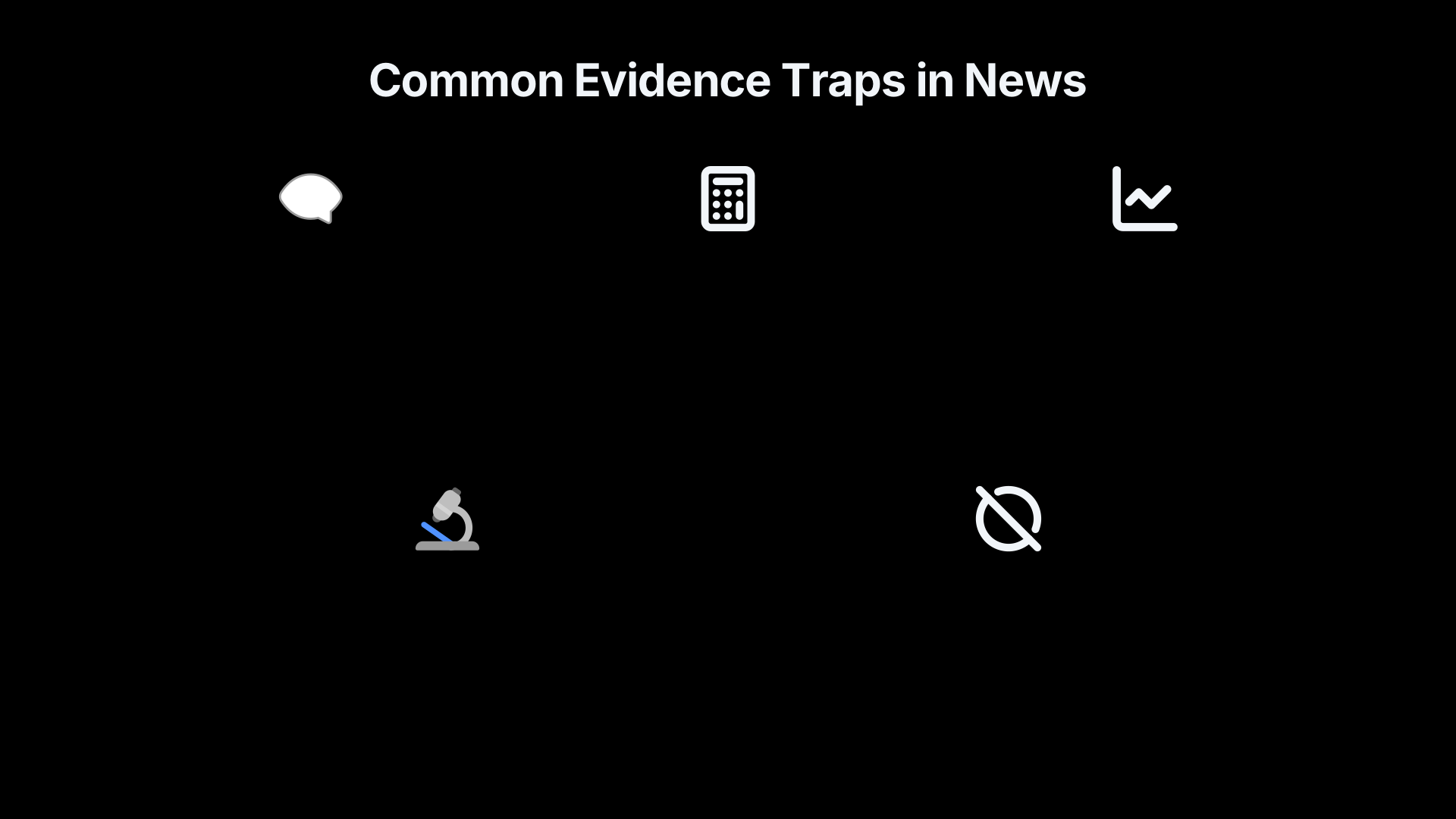
Common Evidence Traps
Many misleading claims do not require a completely fake story. They rely on ordinary evidence traps.
Anecdote as proof. A single vivid case can reveal that something happened, but not how often it happens, whether it is increasing, or what caused it.
Real data, wrong denominator. A number can sound alarming until the relevant population, time period or comparison group is added.
Correlation as causation. Two things moving together does not prove one caused the other.
Expertise drift. A genuine expert in one field may be quoted as though they are equally authoritative in another.
Anonymous sourcing without support. Anonymous sources can be legitimate in journalism, but the reader should look for whether the outlet explains why anonymity was granted and whether the claim is corroborated.
Screenshots without originals. A screenshot is easy to crop, fabricate or detach from context. The original document, post or archive matters.
True quote, missing context. A short clip or sentence may omit the question, qualification, joke, correction or surrounding discussion.
Old material as new. Real images from previous events are frequently recycled during crises because they look emotionally relevant.
These traps are not exotic. They are the everyday mechanics of weak evidence. A better thinker learns to recognise them before deciding how much confidence a claim deserves.

When Fact-Checks Help, and When They Are Not Enough
Fact-checks are valuable because they slow a claim down and expose the evidence trail. Reuters, AP, Full Fact and other organisations often show the original claim, the relevant documents or media, the verification steps and the corrected interpretation.[AP News+2Full Fact]apnews.comOpen source on apnews.com.
But fact-checks are not magic. They arrive after many people have already seen the claim. They may not reach the same audience. Some readers distrust the checking organisation. Some claims are too vague to check cleanly. Others concern emerging events where evidence is still incomplete. Research on fact-checking and misinformation also shows that trust in corrective labels can vary by topic and by users’ political preferences, although the presence of a fact-checking label may still discourage sharing.[arXiv]arxiv.orgOpen source on arxiv.org.
This is why evidence quality should be a reader habit, not only an institutional service. Fact-checkers can help correct the record, but the individual still needs a pre-sharing threshold: “Have I seen enough to pass this on?”
A Practical Evidence Ladder for Everyday Claims
Not every claim deserves the same amount of work. A useful evidence ladder helps match effort to stakes.
Low-stakes claim: a harmless curiosity, joke, entertainment rumour or minor lifestyle claim. A quick source check may be enough.
Medium-stakes claim: a claim that could shape someone’s opinion of a person, group, product, policy or institution. Look for the original source and at least one independent account.
High-stakes claim: health advice, legal allegations, violence, elections, public safety, financial decisions, identity claims about suspects or victims, or anything likely to inflame hostility. Do not rely on a single post, screenshot or clip. Seek primary documents, reputable reporting, expert context and time for confirmation.
Breaking-news claim: treat early information as provisional. Ask whether the claim is confirmed, attributed, independently corroborated, and still current. Early reports often change because witnesses are mistaken, officials revise details, and media organisations update cautiously.
The stronger the potential consequence, the higher the evidence threshold should be. This is not about distrusting everything. It is about refusing to let urgency or emotion set the standard of proof.
How to Read a Claim Like a Better Thinker
A compact routine can improve judgement without turning every article into a research project.
First, identify the exact claim. Strip away outrage, humour and insinuation until the claim can be tested. “They are hiding this” is not a checkable claim; “this policy caused X increase between these dates” is.
Second, locate the best available source. That may be an official dataset, court record, research paper, full video, original post, local reporting, or a specialist fact-check. The House of Commons Library describes fact-checking as following a claim back to its original source or comparing it with other sources.[House of Commons Library]commonslibrary.parliament.ukHouse of Commons Library How to check factsHouse of Commons Library How to check facts
Third, compare the evidence with the wording. Does the evidence prove the claim, partly support it, weaken it, or fail to address it?
Fourth, ask what is missing. Missing context is not always deception, but it is often where the real judgement lies: sample size, date range, definitions, comparison group, uncertainty, omitted footage, or alternative explanations.
Finally, decide how confident to be. A mature answer may be “not enough evidence yet”. In public reasoning, that is often better than a fast wrong answer.
The Real Skill: Calibrated Trust
Evidence quality is not a call to become cynical. Cynicism says nothing can be trusted. Good judgement says trust should be earned in degrees.
A reliable claim is one where the source is identifiable, the evidence is relevant, the method is visible, the context is not misleading, and independent checks point in the same direction. A weak claim may still turn out to be true, but it has not yet earned strong belief. A polished claim may still fail if its evidence is thin. A messy early report may deserve attention while remaining provisional.
This habit strengthens analytical thinking because it keeps confidence connected to reasons. Instead of asking whether a claim feels true, sounds clever, flatters your side or angers your opponents, the better question is: “What would I have to see to know?”
Amazon book picks
Further Reading
Books and field guides related to Can You Trust This Claim?. Use these as the next step if you want deeper reading beyond the article.
The Skeptics' Guide to the Universe
Covers evaluating evidence, misinformation and logical errors.
Calling Bullshit
Directly teaches readers how to evaluate misleading claims and evidence.
eBay marketplace picks
Marketplace Samples
Example marketplace items related to this page. Use the search link to explore similar finds on eBay.

Endnotes
1.
Source: news.mit.edu
Title: study twitter false news travels faster true stories 0308
Link:https://news.mit.edu/2018/study-twitter-false-news-travels-faster-true-stories-0308
Source snippet
MIT NewsStudy: On Twitter, false news travels faster than true stories8 Mar 2018 — A new study by three MIT scholars has found that false...
2.
Source: reuters.com
Link:https://www.reuters.com/fact-check/
3.
Source: bellingcat.com
Title: Guide To Using Reverse Image Search For Investigations
Link:https://www.bellingcat.com/resources/how-tos/2019/12/26/guide-to-using-reverse-image-search-for-investigations/
4.
Source: bellingcat.com
Title: metadata metauseful metacreepy
Link:https://www.bellingcat.com/resources/how-tos/2015/04/24/metadata-metauseful-metacreepy/
5.
Source: reuters.com
Title: Images of aircraft landings into flaming Beirut airport are AI-generated
Link:https://www.reuters.com/fact-check/images-aircraft-landings-into-flaming-beirut-airport-are-ai-generated-2024-10-29/
6.
Source: ofcom.org.uk
Title: news consumption in the uk 2024 report
Link:https://www.ofcom.org.uk/siteassets/resources/documents/research-and-data/tv-radio-and-on-demand-research/tv-research/news/news-consumption-2024/news-consumption-in-the-uk-2024-report.pdf?v=379621
7.
Source: reutersinstitute.politics.ox.ac.uk
Title: dnr executive
Link:https://reutersinstitute.politics.ox.ac.uk/digital-news-report/2025/dnr-executive-summary
8.
Source: arxiv.org
Link:https://arxiv.org/abs/2410.00866
9.
Source: ed.stanford.edu
Title: it doesn t take long learn how spot misinformation online stanford study finds
Link:https://ed.stanford.edu/news/it-doesn-t-take-long-learn-how-spot-misinformation-online-stanford-study-finds
10.
Source: news.stanford.edu
Title: fact checkers outperform historians evaluating online information
Link:https://news.stanford.edu/stories/2017/10/fact-checkers-outperform-historians-evaluating-online-information
11.
Source: purl.stanford.edu
Link:https://purl.stanford.edu/fv751yt5934
12.
Source: stacks.stanford.edu
Title: Wineburg Mc Grew Lateral Reading and the Nature of Expertise
Link:https://stacks.stanford.edu/file/druid%3Ayk133ht8603/Wineburg%20McGrew_Lateral%20Reading%20and%20the%20Nature%20of%20Expertise.pdf
13.
Source: stacks.stanford.edu
Title: COR Curriculum Evaluation
Link:https://stacks.stanford.edu/file/druid%3Axr124mv4805/COR%20Curriculum%20Evaluation.pdf
14.
Source: ed.stanford.edu
Title: researchers find students have trouble judging credibility information online
Link:https://ed.stanford.edu/news/stanford-researchers-find-students-have-trouble-judging-credibility-information-online
15.
Source: reutersinstitute.politics.ox.ac.uk
Title: how public checks information it thinks might be wrong
Link:https://reutersinstitute.politics.ox.ac.uk/digital-news-report/2025/how-public-checks-information-it-thinks-might-be-wrong
16.
Source: reutersinstitute.politics.ox.ac.uk
Title: Digital News Report 2025
Link:https://reutersinstitute.politics.ox.ac.uk/sites/default/files/2025-06/Digital_News-Report_2025.pdf
17.
Source: reutersinstitute.politics.ox.ac.uk
Title: digital news report
Link:https://reutersinstitute.politics.ox.ac.uk/digital-news-report/2026
18.
Source: reutersinstitute.politics.ox.ac.uk
Link:https://reutersinstitute.politics.ox.ac.uk/digital-news-report/interactive
19.
Source: reutersinstitute.politics.ox.ac.uk
Title: digital news report
Link:https://reutersinstitute.politics.ox.ac.uk/digital-news-report/2025
20.
Source: reuters.com
Link:https://www.reuters.com/fact-check/about/
21.
Source: ofcom.org.uk
Title: attitudes to news
Link:https://www.ofcom.org.uk/media-use-and-attitudes/attitudes-to-news
22.
Source: ofcom.org.uk
Title: top trends from our latest look at the uks news habits
Link:https://www.ofcom.org.uk/media-use-and-attitudes/attitudes-to-news/top-trends-from-our-latest-look-at-the-uks-news-habits
23.
Source: ofcom.org.uk
Title: online nation 2024 report
Link:https://www.ofcom.org.uk/siteassets/resources/documents/research-and-data/online-research/online-nation/2024/online-nation-2024-report.pdf?v=386238
24.
Source: ofcom.org.uk
Link:https://www.ofcom.org.uk/siteassets/resources/documents/consultations/category-1-10-weeks/consultation-ofcoms-three-year-media-literacy-strategy/responses/full-fact.pdf?v=370080
25.
Source: bellingcat.com
Title: shadow geolocate geolocation locate image tool open source bellingcat measure
Link:https://www.bellingcat.com/resources/2024/08/22/shadow-geolocate-geolocation-locate-image-tool-open-source-bellingcat-measure/
26.
Source: bellingcat.com
Title: can ai chatbots be used for geolocation
Link:https://www.bellingcat.com/resources/2023/07/14/can-ai-chatbots-be-used-for-geolocation/
27.
Source: bellingcat.com
Link:https://www.bellingcat.com/tag/metadata/
28.
Source: ide.mit.edu
Title: 2017 IDE Research Brief False News
Link:https://ide.mit.edu/wp-content/uploads/2018/12/2017-IDE-Research-Brief-False-News.pdf
29.
Source: medium.com
Link:https://medium.com/1st-draft/are-you-a-journalist-download-this-free-guide-for-verifying-photos-and-videos-f39022fe9c3b
30.
Source: sinanaral.medium.com
Link:https://sinanaral.medium.com/fake-news-about-our-fake-news-study-spread-faster-than-its-truth-just-as-we-predicted-77db6d9ca8c8
31.
Source: medium.com
Link:https://medium.com/%40effenok/bellingcat-challenge-fully-stocked-e88614eea260
32.
Source: nature.com
Link:https://www.nature.com/articles/s41562-024-01884-x
33.
Source: nature.com
Link:https://www.nature.com/articles/s44271-025-00379-3
34.
Source: arxiv.org
Link:https://arxiv.org/html/2505.07486v1
35.
Source: journals.sagepub.com
Link:https://journals.sagepub.com/doi/10.1177/016146811912101102
36.
Source: guides.lib.uchicago.edu
Title: University of Chicago Library Guides The SIFT Method
Link:https://guides.lib.uchicago.edu/c.php?g=1241077&p=9082322
37.
Source: pubmed.ncbi.nlm.nih.gov
Link:https://pubmed.ncbi.nlm.nih.gov/25347407/
38.
Source: ifcncodeofprinciples.poynter.org
Link:https://ifcncodeofprinciples.poynter.org/
39.
Source: fullfact.org
Link:https://fullfact.org/how-we-fact-check/
40.
Source: commonslibrary.parliament.uk
Title: House of Commons Library How to verify images and videos
Link:https://commonslibrary.parliament.uk/research-briefings/cbp-10816/
41.
Source: apnews.com
Link:https://apnews.com/article/1cd447e8963456af2be9a24d660ed1d6
42.
Source: pubmed.ncbi.nlm.nih.gov
Link:https://pubmed.ncbi.nlm.nih.gov/39562798/
43.
Source: apnews.com
Link:https://apnews.com/ap-fact-check
44.
Source: fullfact.org
Link:https://fullfact.org/
45.
Source: commonslibrary.parliament.uk
Title: House of Commons Library How to check facts
Link:https://commonslibrary.parliament.uk/research-briefings/cbp-10820/
46.
Source: fullfact.org
Title: getting started with the misinformation toolkit
Link:https://fullfact.org/toolkit/getting-started-with-the-misinformation-toolkit/
47.
Source: bellingcat.gitbook.io
Title: io Reverse Image Search
Link:https://bellingcat.gitbook.io/toolkit/categories/image-video/reverse-image-search
48.
Source: apnews.com
Title: misinformation fact checking day ai iran war 760d91b9658b4e40e653e84de09b27d6
Link:https://apnews.com/article/misinformation-fact-checking-day-ai-iran-war-760d91b9658b4e40e653e84de09b27d6
49.
Source: apnews.com
Title: ap fact check 234264975049
Link:https://apnews.com/article/ap-fact-check-234264975049
50.
Source: apnews.com
Link:https://apnews.com/article/fact-check-politics-trump-verification-misinformation-00bc57b4a3c348a1363610c1cbbfd8ca
51.
Source: pmc.ncbi.nlm.nih.gov
Link:https://pmc.ncbi.nlm.nih.gov/articles/PMC10606871/
52.
Source: pubmed.ncbi.nlm.nih.gov
Link:https://pubmed.ncbi.nlm.nih.gov/29590045/
53.
Source: pmc.ncbi.nlm.nih.gov
Link:https://pmc.ncbi.nlm.nih.gov/articles/PMC13188179/
54.
Source: pmc.ncbi.nlm.nih.gov
Link:https://pmc.ncbi.nlm.nih.gov/articles/PMC12980526/
55.
Source: ifcncodeofprinciples.poynter.org
Link:https://ifcncodeofprinciples.poynter.org/signatories
56.
Source: poynter.org
Link:https://www.poynter.org/ifcn/
57.
Source: poynter.org
Link:https://www.poynter.org/international-fact-checking-network-transparency-statement/
58.
Source: ifcncodeofprinciples.poynter.org
Title: the commitments
Link:https://ifcncodeofprinciples.poynter.org/the-commitments
59.
Source: poynter.org
Link:https://www.poynter.org/ifcn/fact-checkers-safety/
60.
Source: poynter.org
Link:https://www.poynter.org/news/fact-checking/
61.
Source: ifcncodeofprinciples.poynter.org
Title: [application]({{ ‘application/’ | relative_url }}) process
Link:https://ifcncodeofprinciples.poynter.org/application-process
62.
Source: library.cod.edu
Link:https://library.cod.edu/speech/evaluating
63.
Source: reutersagency.com
Link:https://reutersagency.com/solutions/verification-services/
64.
Source: committees.parliament.uk
Link:https://committees.parliament.uk/writtenevidence/448/html/
65.
Source: researchbriefings.files.parliament.uk
Title: POST PN 0727
Link:https://researchbriefings.files.parliament.uk/documents/POST-PN-0727/POST-PN-0727.pdf
66.
Source: instagram.com
Link:https://www.instagram.com/reel/DMPzqSdtH_m/?hl=en
67.
Source: archive.comsuregroup.com
Title: Bellingcats Digital Toolkit
Link:https://archive.comsuregroup.com/wp-content/uploads/2018/06/Bellingcats-Digital-Toolkit.pdf
68.
Source: journals.sagepub.com
Link:https://journals.sagepub.com/doi/10.1177/00936502241262377
69.
Source: journals.sagepub.com
Link:https://journals.sagepub.com/doi/10.1177/00936502251411467
70.
Source: scribd.com
Title: Bellingcat s Online Investigation Toolkit
Link:https://www.scribd.com/document/784989239/Bellingcat-s-Online-Investigation-Toolkit
71.
Source: guides.slv.vic.gov.au
Title: slv.vic.gov.au Navigating the web
Link:https://guides.slv.vic.gov.au/misinformation/theweb
72.
Source: ebu.ch
Title: reuters institute digital news report 2025 webinar
Link:https://www.ebu.ch/events/2025/06/reuters-institute-digital-news-report-2025-webinar
73.
Source: fullfact.ai
Title: Full Fact AI
Link:https://fullfact.ai/
74.
Source: library.csum.edu
Link:https://library.csum.edu/NAU330/SIFT
75.
Source: mythdetector.com
Link:https://mythdetector.com/en/ifcn-code-of-principles/
Additional References
76.
Source: youtube.com
Link:https://www.youtube.com/watch?v=GoQG6Tin-1E
Source snippet
Evaluating Evidence: Crash Course Navigating Digital Information #6...
77.
Source: science.org
Link:https://www.science.org/doi/10.1126/science.aap9559
Source snippet
revealed that false news spreads faster than true news (1). Meanwhile, since the Great East Japan Earthquake in 2011...Read more...
78.
Source: youtube.com
Title: How Professional Fact Checkers spot FAKE NEWS
Link:https://www.youtube.com/watch?v=-YLrj-_U3K0
Source snippet
"Lateral reading" fact-checkers wineburg What Fact Checkers Do That You Don't Benjamin Keep, PhD, JD...
79.
Source: youtube.com
Title: MIT Fake News Study: Why Lies Spread 70% Faster Than Truth (It’s Not Bots)
Link:https://www.youtube.com/watch?v=_ZeFzlg0w8U
Source snippet
How Professional Fact Checkers spot FAKE NEWS...
80.
Source: youtube.com
Title: What Fact Checkers Do That You Don’t
Link:https://www.youtube.com/watch?v=xC3Sl9Y86kQ
Source snippet
MIT Fake News Study: Why Lies Spread 70% Faster Than Truth (It's Not Bots)...
81.
Source: pressbooks.pub
Link:https://pressbooks.pub/ailit/chapter/methods-that-can-help-lateral-reading/
82.
Source: researchgate.net
Link:https://www.researchgate.net/publication/356330143_Lateral_Reading_and_the_Nature_of_Expertise_Reading_Less_and_Learning_More_When_Evaluating_Digital_Information
83.
Source: researchgate.net
Link:https://www.researchgate.net/publication/375081144_Using_the_SIFT_strategy_to_enhance_the_Lateral_Reading_skills_of_undergraduate_students_for_detecting_digital_misinformation
84.
Source: x.com
Link:https://x.com/APFactCheck?lang=en
85.
Source: chequeado.com
Link:https://chequeado.com/code-of-principles/
Topic Tree