Within Critical Thinking
Are Remote Workers Really Less Productive?
The remote-work productivity debate shows why critical thinkers define terms, compare evidence, and test alternative explanations.
On this page
- Defining productivity before measuring it
- Separating data from workplace impressions
- Alternative explanations that change the decision
Page outline Jump by section
Introduction
Are remote workers really less productive? The strongest evidence suggests that there is no simple yes-or-no answer. Productivity depends on what is being measured, which jobs are being examined, how work is organised, and whether the comparison is between fully remote, hybrid, or office-based work. That makes the debate an excellent test of purposeful judgement. Rather than accepting confident claims from either side, a critical thinker begins by defining terms, comparing like with like, and asking whether alternative explanations better account for the evidence.
 The remote-work debate demonstrates a central lesson in critical thinking: disagreements often arise not because people are looking at different facts, but because they are measuring different things. Before deciding whether remote work “works”, it is necessary to ask what “productive” actually means.
Defining productivity before measuring it
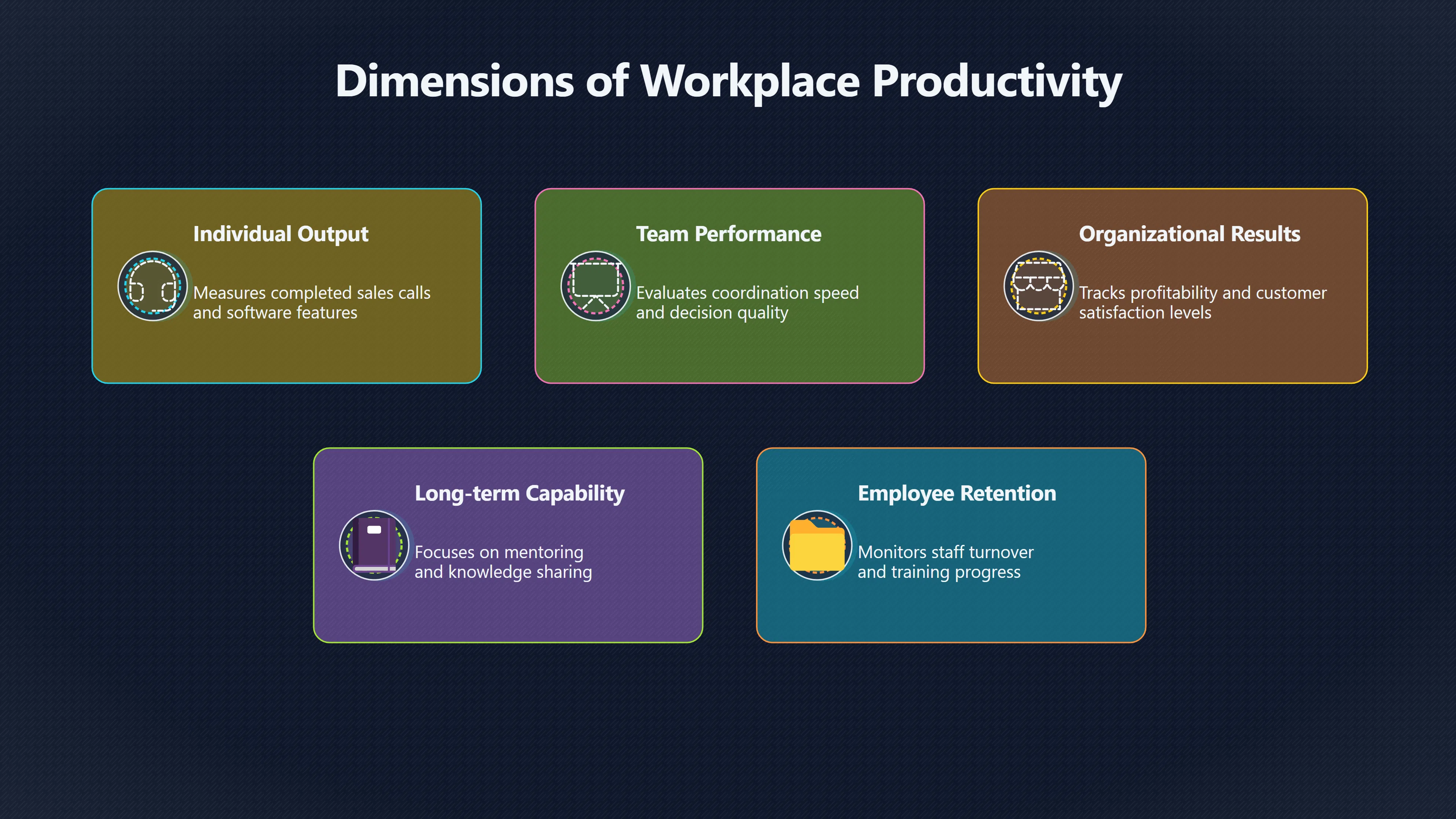
One of the most common reasoning errors in workplace debates is treating productivity as though it were a single, obvious quantity. In reality, it can refer to several different outcomes:
- Individual output, such as completed sales calls, software features, reports or cases processed.
- Team performance, including coordination, quality of decisions and speed of delivery.
- Organisational performance, such as profitability, innovation, customer satisfaction or revenue.
- Long-term capability, including employee retention, training, mentoring and knowledge sharing.
These measures do not always move together. A remote worker may complete more individual tasks because there are fewer interruptions, while a team may find brainstorming or onboarding new colleagues more difficult. Both observations can be true simultaneously.
Evidence from the UK and US labour statistics and research reviews reflects this complexity. Randomised experiments at individual firms have often found small positive effects of remote or hybrid work on measurable individual productivity alongside reduced staff turnover, but these findings cannot automatically be generalised to every occupation or organisation.[Bureau of Labor Statistics]bls.govremote work productivityBureau of Labor StatisticsThe rise in remote work since the pandemic and its impact…Oct 31, 2024 — A few randomized experiments at ind…
For a critical thinker, the first question is therefore not “Is remote work productive?” but “Productive according to which definition?”
Separating data from workplace impressions
The debate is also a reminder that personal impressions are weaker evidence than carefully designed comparisons.
Managers may sincerely believe employees are less productive because they cannot directly observe them. Employees may sincerely believe they are more productive because they experience fewer interruptions and less commuting stress. Neither perception is sufficient evidence on its own.
Better evidence comes from studies that compare similar workers under controlled conditions.
One influential example is the randomised trial conducted at Trip.com, where more than 1,600 employees were randomly assigned either to hybrid working or to full-time office attendance. The study found that employees working from home two days each week maintained similar performance and promotion rates while experiencing substantially lower resignation rates and greater job satisfaction. Because assignment was random, the researchers could attribute differences more confidently to the work arrangement rather than to employee preferences or ability.[Nature]nature.comproductivity, hybrid remote work can leave performance unchanged.Read more…
Earlier work by the same research group studying call-centre employees found a sizeable increase in measured performance during full-time home working, largely because workers took fewer breaks and experienced fewer distractions in quieter environments. However, that improvement occurred in a highly structured job with easily measured output, illustrating why evidence from one occupation should not automatically be extended to another.[Stanford Graduate School of Business]gsb.stanford.eduGraduate School of Business Does Working from Home Work?Evidence from a Chinese…Home working led to a 13% performance increase, of which about 9% was from working more minutes per shift (few…
The lesson for critical thinking is that anecdotes—even thousands of them—cannot substitute for research designs that reduce bias.
Why different studies reach different conclusions
Conflicting headlines do not necessarily indicate that researchers disagree. Often they are answering different questions.
Several factors commonly explain why studies report different findings:
Different occupations. Measuring productivity is relatively straightforward for call centres or administrative processing but much harder for research, design, management or creative work.
Different time horizons. A worker may produce more today while a company loses opportunities for mentoring, innovation or relationship building over several years.
Different work arrangements. Fully remote work is not the same as hybrid work. Many studies find hybrid arrangements outperform either extreme because they combine focused work at home with regular face-to-face collaboration.[OECD+2Stanford News]oecd.org7fe47de2 enthe role of telework for productivity during and post- covid-…by C CRISCUOLO · 2021 · Cited by 174 — Respondents, on average, find…
Different outcome measures. One study may focus on output, another on retention, another on collaboration or well-being.
A critical judgement therefore depends on recognising that apparently contradictory findings may simply be measuring different aspects of organisational performance.

Alternative explanations that change the decision
Purposeful judgement also requires asking whether another explanation fits the evidence better than the obvious one.
Suppose a company reports falling productivity after adopting remote work. Several explanations are possible:
- Remote working genuinely reduced effectiveness.
- Managers introduced remote work during a broader organisational disruption.[bls.gov]bls.govremote work productivityBureau of Labor StatisticsThe rise in remote work since the pandemic and its impact…Oct 31, 2024 — A few randomized experiments at ind…
- Employees were adapting to unfamiliar digital tools.
- Economic conditions reduced demand.
- New recruits received weaker mentoring.
- Performance measures changed.
Similarly, higher productivity among remote workers may not result solely from working at home. Employees choosing remote roles may already be more experienced, more autonomous or better suited to independent work.
Researchers therefore value experiments, natural experiments and statistical methods that account for these competing explanations rather than simply comparing one group with another. Studies examining collaboration during the pandemic illustrate this point well: simple before-and-after comparisons suggested collaboration increased, but more careful causal analysis showed that broader pandemic effects and changing work patterns explained much of the difference, with remote working itself shifting effort towards more focused individual work and less spontaneous collaboration.[arXiv]arxiv.orgHow Work From Home Affects Collaboration: A Large-Scale Study of Information Workers in a Natural Experiment During COVID-19July 30…
The critical-thinking habit is to ask not merely “What happened?” but “What else could explain what happened?”
Hidden assumptions behind strong opinions
The intensity of the remote-work debate often comes from assumptions that remain unstated.[bls.gov]bls.govremote work productivityBureau of Labor StatisticsThe rise in remote work since the pandemic and its impact…Oct 31, 2024 — A few randomized experiments at ind…
For example:
- Seeing employees means they are working.
- Collaboration always requires physical presence.
- Quiet concentration is always more valuable than spontaneous interaction.
- All jobs require similar patterns of communication.
- Every organisation has identical goals.
Once these assumptions are made explicit, many disagreements become easier to analyse.
An engineering team building software, a hospital emergency department, a legal practice and a sales organisation all rely on different kinds of productivity. Judging them by a single measure is unlikely to produce reliable conclusions.
A better judgement than “remote versus office”
Current evidence increasingly suggests that the most useful question is not whether remote work is good or bad, but under what conditions each arrangement performs best.
Large reviews and policy analyses indicate that hybrid models frequently provide a balance between focused individual work, collaboration, employee satisfaction and lower turnover. However, success depends heavily on management practices, communication systems, digital infrastructure and the nature of the work itself rather than on location alone.[OECD+2OECD]oecd.org7fe47de2 enthe role of telework for productivity during and post- covid-…by C CRISCUOLO · 2021 · Cited by 174 — Respondents, on average, find…
This reframing is itself an exercise in critical thinking. Instead of accepting a false choice between “everyone remote” and “everyone in the office”, purposeful judgement asks which arrangement best fits a particular problem, workforce and objective.
What this debate teaches about critical thinking
The remote-work productivity debate is valuable not because it settles a workplace policy, but because it exposes the mechanics of sound judgement.
A careful thinker learns to:
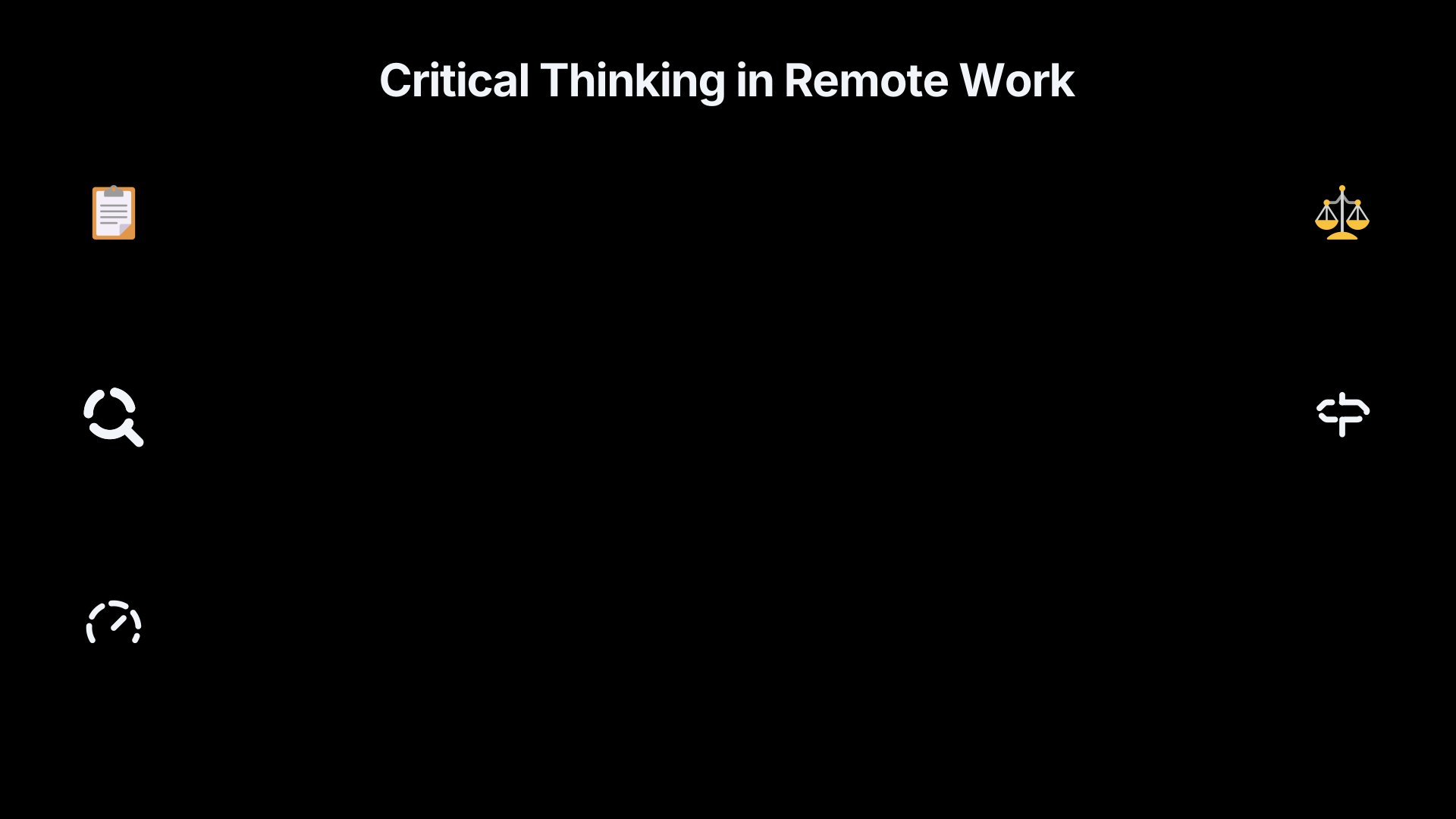
- Define key terms before evaluating claims.
- Distinguish measurable evidence from personal impressions.
- Compare like with like rather than mixing different contexts.
- Look for alternative explanations before accepting a preferred conclusion.
- Match confidence to the strength of the available evidence.
Seen in this way, remote work becomes more than a management issue. It is a practical demonstration that good critical thinking is less about finding quick answers than about asking the questions that make reliable answers possible.
Amazon book picks
Further Reading
Books and field guides related to Are Remote Workers Really Less Productive?. Use these as the next step if you want deeper reading beyond the article.
eBay marketplace picks
Marketplace Samples
Example marketplace items related to this page. Use the search link to explore similar finds on eBay.




Endnotes
1.
Source: nature.com
Link:https://www.nature.com/articles/s41586-024-07500-2
Source snippet
productivity, hybrid remote work can leave performance unchanged.Read more...
2.
Source: news.stanford.edu
Title: hybrid work is a win win win for companies workers
Link:https://news.stanford.edu/stories/2024/06/hybrid-work-is-a-win-win-win-for-companies-workers
Source snippet
Stanford NewsStudy finds hybrid work benefits companies and employeesJun 12, 2024 — Bloom finds that employees who work from home for two...
3.
Source: gsb.stanford.edu
Title: Graduate School of Business Does Working from Home Work?
Link:https://www.gsb.stanford.edu/faculty-research/working-papers/does-working-home-work-evidence-chinese-experiment
Source snippet
Evidence from a Chinese...Home working led to a 13% performance increase, of which about 9% was from working more minutes per shift (few...
4.
Source: oecd.org
Title: 7fe47de2 en
Link:https://www.oecd.org/content/dam/oecd/en/publications/reports/2021/12/the-role-of-telework-for-productivity-during-and-post-covid-19_dbbfb20e/7fe47de2-en.pdf
Source snippet
the role of telework for productivity during and post- covid-...by C CRISCUOLO · 2021 · Cited by 174 — Respondents, on average, find...
5.
Source: siepr.stanford.edu
Link:https://siepr.stanford.edu/publications/working-paper/evolution-working-home
Source snippet
Evolution of Working from HomeThe productivity of remote work depends critically on the mode. Fully remote work is associated with about...
6.
Source: arxiv.org
Link:https://arxiv.org/abs/2007.15584
Source snippet
How Work From Home Affects Collaboration: A Large-Scale Study of Information Workers in a Natural Experiment During COVID-19July 30...
7.
Source: oecd.org
Title: the role of telework for productivity during and post covid 19 7fe47de2 en
Link:https://www.oecd.org/en/publications/the-role-of-telework-for-productivity-during-and-post-covid-19_7fe47de2-en.html
Source snippet
The role of telework for productivity during and post-COVID...by C Criscuolo · 2021 · Cited by 174 — To meet the challenges of this...
8.
Source: oecd.org
Link:https://www.oecd.org/en.html
Source snippet
The Organisation for Economic Co-operation and...The OECD designs international standards and guidelines for development co-operat...
9.
Source: oecd.org
Title: pay working conditions and remote working arrangements 1b18ae6b
Link:https://www.oecd.org/en/publications/workforce-insights-from-central-governments_2f9080b1-en/full-report/pay-working-conditions-and-remote-working-arrangements_1b18ae6b.html
Source snippet
Workforce Insights from Central Governments11 Sept 2025 — At the same time, the nature of work has evolved, with remote and hybrid workin...
10.
Source: oecd.org
Link:https://www.oecd.org/en/topics/sub-issues/human-capital-and-educational-policies/Telework-and-productivity.html
Source snippet
Telework and ProductivityThe analysis finds that both managers and workers generally view teleworking positively, noting benefits for fir...
11.
Source: bls.gov
Title: remote work productivity
Link:https://www.bls.gov/opub/btn/volume-13/remote-work-productivity.htm
Source snippet
Bureau of Labor StatisticsThe rise in remote work since the pandemic and its impact...Oct 31, 2024 — A few randomized experiments at ind...
12.
Source: Wikipedia
Link:https://en.wikipedia.org/wiki/Working
Source snippet
WorkingWorking may refer to: Work (human activity), intentional activity people perform to support themselves, others, or the communit...
13.
Source: dictionary.cambridge.org
Link:https://dictionary.cambridge.org/dictionary/english/working
Source snippet
English meaning - Cambridge Dictionary5 days ago — WORKING definition: 1. relating to work: 2. having work: 3. operating:. Learn more...
14.
Source: vocabulary.com
Link:https://www.vocabulary.com/dictionary/working
Source snippet
Definition, Meaning & Synonymshaving your services engaged for; or having a job especially one that pays wages or a salary. adjective. ad...
Additional References
15.
Source: linkedin.com
Link:https://www.linkedin.com/posts/nick-bloom-stanford_new-paper-showing-a-12-productivity-increase-activity-7299078320627793920-DNw1
Source snippet
Productivity increases 12% with hybrid WFH in public sectorNew paper showing a 12% productivity increase from hybrid WFH in the public se...
16.
Source: oecdecoscope.blog
Link:https://oecdecoscope.blog/2021/07/28/telework-after-covid-19-survey-evidence-from-managers-and-workers-on-implications-for-productivity-and-well-being/
Source snippet
Telework after COVID-19: survey evidence from managers...28 Jul 2021 — Most managers and workers report telework had a positive impact o...
17.
Source: merriam-webster.com
Link:https://www.merriam-webster.com/dictionary/working
18.
Source: sipotra.it
Link:https://www.sipotra.it/wp-content/uploads/2021/01/TELEWORK-BEFORE-THE-COVID-19-PANDEMIC-TRENDS-AND-DRIVERS-OF-DIFFERENCES-ACROSS-THE-EU.pdf
Source snippet
OECD PRODUCTIVITY WORKING PAPERSby S MILASI · 2021 · Cited by 180 — This paper provides an overview of the trends and differences in the...
19.
Source: researchgate.net
Link:https://www.researchgate.net/publication/378302969_THE_IMPACT_OF_REMOTE_WORK_ON_WORK-LIFE_BALANCE_AND_EMPLOYEE_PRODUCTIVITY
Source snippet
(PDF) THE IMPACT OF REMOTE WORK ON WORK-LIFE...19 Feb 2024 — The analysis encompasses various dimensions, including the influence of rem...
20.
Source: researchgate.net
Link:https://www.researchgate.net/publication/386248972_Exploring_the_Impact_of_Remote_Work_on_Productivity_A_Systematic_Review
Source snippet
(PDF) Exploring the Impact of Remote Work on Productivity29 Nov 2024 — This review emphasises productivity determinants for remote worker...
21.
Source: cepr.org
Title: teleworking here stay and may raise productivity if implemented appropriately
Link:https://cepr.org/voxeu/columns/teleworking-here-stay-and-may-raise-productivity-if-implemented-appropriately
Source snippet
Teleworking is here to stay and may raise productivity if...10 Feb 2022 — This column argues that teleworking is here to stay – for most...
22.
Source: hbs.edu
Link:https://www.hbs.edu/faculty/Pages/item.aspx?num=66633
Source snippet
ductivity gains and some workers' preferences as reasons for the persistence of remote work in the years...Read more...
23.
Source: pubmed.ncbi.nlm.nih.gov
Link:https://pubmed.ncbi.nlm.nih.gov/38867040/
Source snippet
working from home improves retention without...Jun 12, 2024 — We found that hybrid working improved job satisfaction and reduced quit ra...
24.
Source: imf.org
Link:https://www.imf.org/en/publications/fandd/issues/2024/09/working-from-home-is-powering-productivity-bloom
Source snippet
Working From Home Is Powering ProductivityStanford University's Nicholas Bloom was studying the potential impact of remote work long befo...
Topic Tree