Within Decision Stakes
Write the Reasoning Before You Commit
A short decision note can capture assumptions, tradeoffs, regret risks, and review points before a hard-to-reverse choice is made.
On this page
- What a decision note should record
- Assumptions, constraints, and tradeoffs
- How review points turn judgment into learning
Page outline Jump by section
Introduction
A written decision note is a short record created before committing to a high-stakes or difficult-to-reverse choice. Its purpose is not to predict the future perfectly, but to capture what you currently believe, why you believe it, what could prove you wrong, and how you will judge the outcome later. This simple practice separates the quality of the decision from the quality of the eventual outcome, making hindsight bias less likely and future learning more reliable. Research on judgement and decision-making consistently shows that people reconstruct their past reasoning after outcomes become known, making contemporaneous records especially valuable for improving future judgement.[Noba+2Wikipedia]nobaproject.comNobaJudgment and Decision MakingThis module provides an overview of decision making and includes discussion of many of the common biases…
 Within a broader framework of checking decision stakes and reversibility, a decision note adds deliberate friction only where it is worthwhile. Instead of trying to eliminate uncertainty, it makes uncertainty visible.
Write the Reasoning Before You Commit
High-stakes decisions often involve large consequences, uncertain evidence, conflicting objectives, and irreversible commitments. Examples include accepting a job requiring relocation, making a major investment, entering a business partnership, signing a long-term contract, undertaking a significant medical choice, or making a public organisational decision.
Without a written record, memory tends to simplify events into a story that feels inevitable. After learning the outcome, people frequently believe they “knew it all along”, even when their original confidence or assumptions were very different. Recording the reasoning before acting provides a benchmark against which later reflection can be measured, reducing hindsight distortion and encouraging more accurate self-evaluation.[Noba]nobaproject.comNobaJudgment and Decision MakingThis module provides an overview of decision making and includes discussion of many of the common biases…
A useful decision note is intentionally brief. The goal is clarity rather than documentation for its own sake.
What a Decision Note Should Record
A practical decision note usually fits on one page. It should answer the questions that future you will no longer remember accurately.
Record:
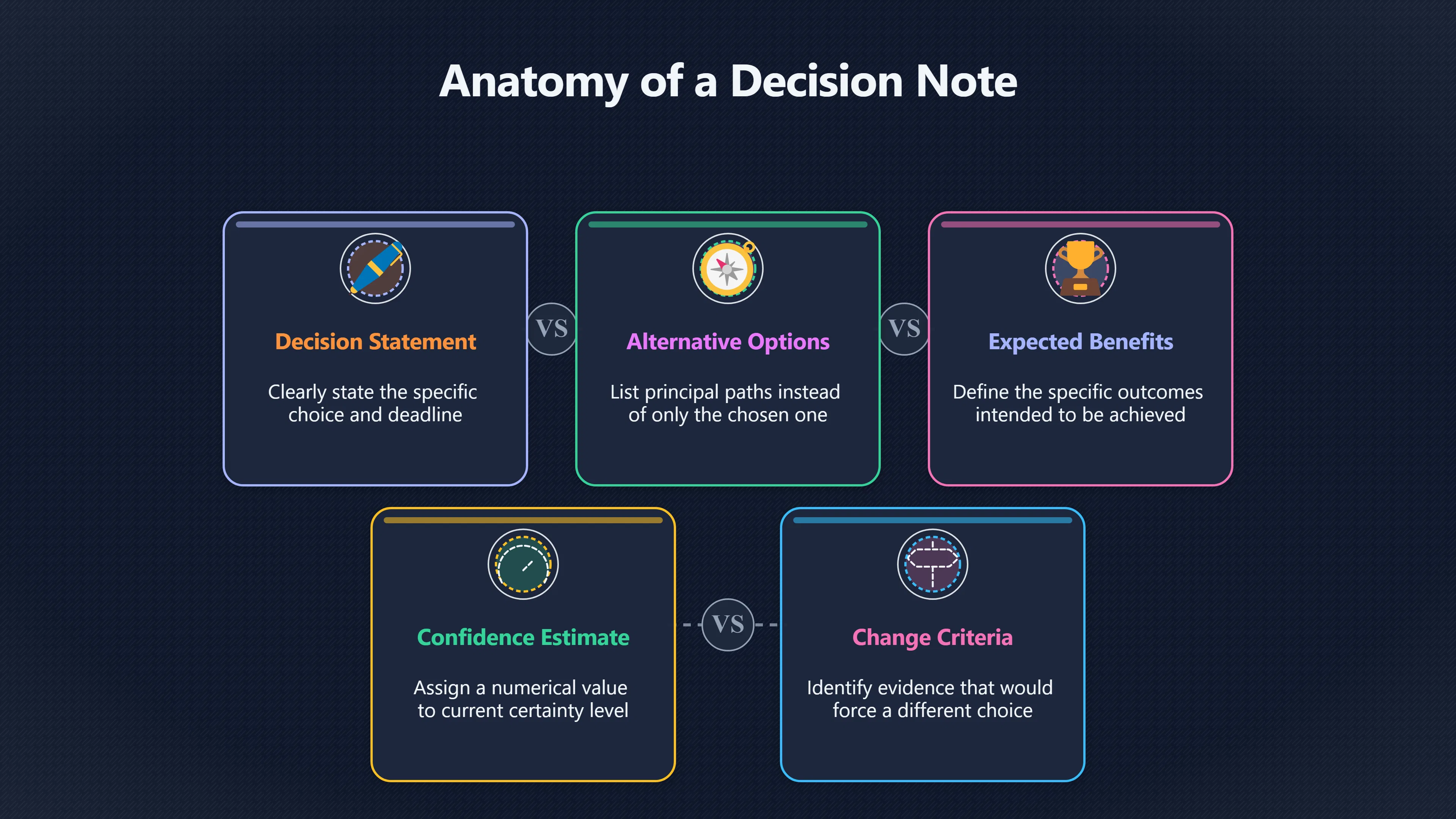
- The decision being made. State exactly what is being decided and by when.
- The options considered. Include the principal alternatives rather than only the chosen path.
- The objective. What problem is the decision intended to solve?
- The expected benefits. What outcomes are you hoping to achieve?
- The principal risks. What are the most plausible ways the decision could fail?
- Your confidence. Estimate how confident you are, preferably numerically rather than using vague language.
- Information gaps. Identify what remains uncertain and why you are deciding despite incomplete information.
- What would change your mind. Specify evidence that would have led you to choose differently.
The emphasis is on recording reasoning, not producing exhaustive analysis. If the note becomes lengthy enough that it discourages use, it loses much of its practical value.
Assumptions, Constraints, and Trade-offs
The most valuable part of a decision note is often not the conclusion but the assumptions that support it.
Assumptions
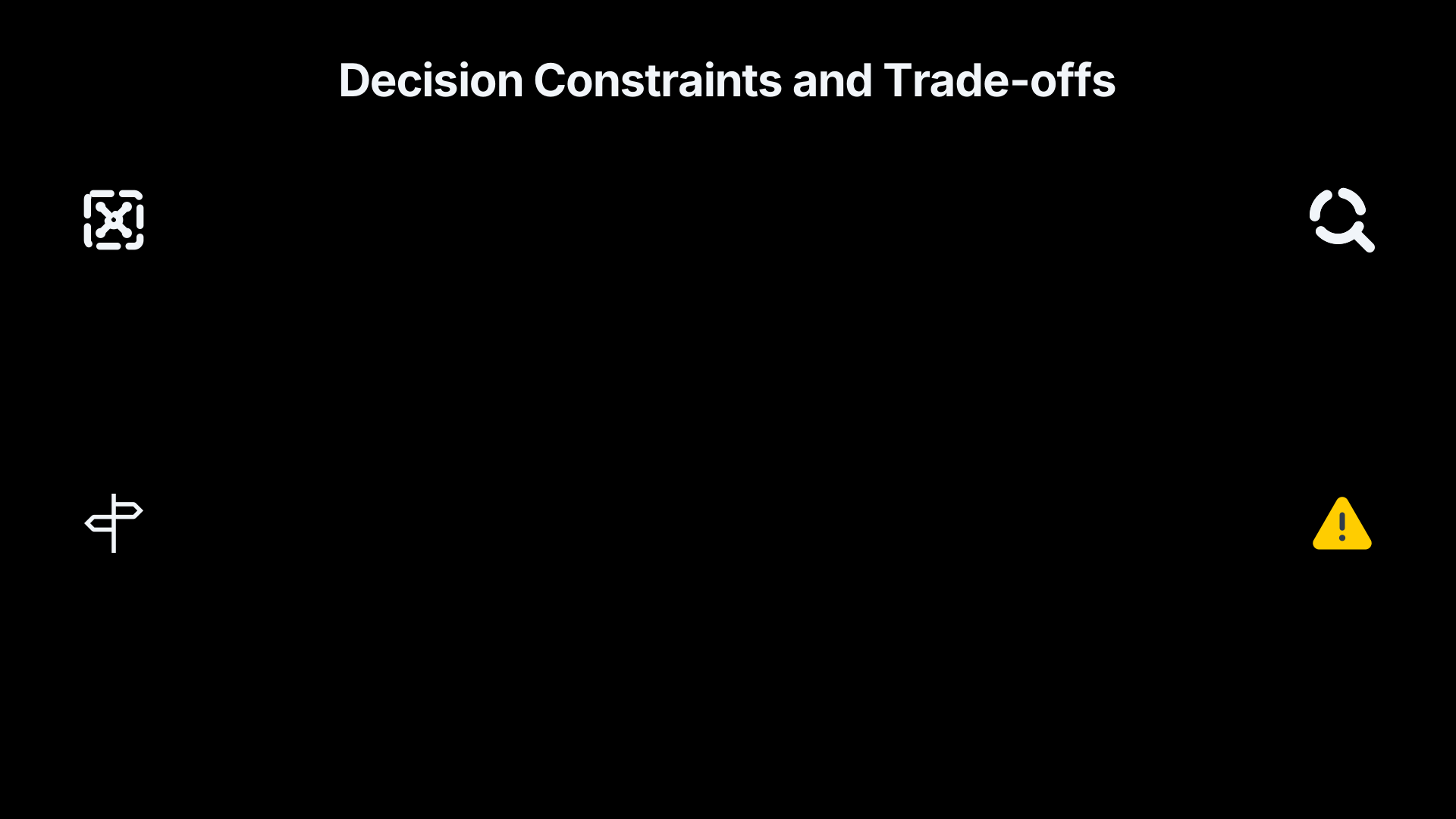
Every important decision depends on beliefs about facts that may later prove incorrect. Writing assumptions explicitly makes them easier to challenge before commitment.
Examples include:
- expected market conditions
- estimated project costs
- likely behaviour of other people
- health prognosis
- future availability of resources
- legal or regulatory stability
When assumptions remain implicit, they are difficult for others—or even your future self—to examine critically.
Constraints
Good decisions are made within real limits rather than ideal conditions. Record constraints such as:
- budget
- available time
- legal obligations
- ethical commitments
- organisational policies
- family or personal responsibilities
Making constraints explicit prevents later criticism based on options that were never realistically available.
Trade-offs
High-quality decisions rarely maximise every objective simultaneously.
A useful note states the trade-offs directly:
- choosing speed over completeness
- accepting higher cost for lower risk
- sacrificing short-term gains for long-term flexibility
- prioritising reliability over innovation
Explicit trade-offs reduce the temptation to pretend that one option was simply “best” in every respect. Decision-quality frameworks similarly emphasise clear values, feasible alternatives, reliable information, and logically consistent reasoning rather than judging decisions solely by eventual outcomes.[Wikipedia]WikipediaDecision qualityDecision quality
Record the Main Sources of Regret Risk
One practical addition is to ask:
“If this turns out badly, what will I most likely wish I had considered?”
Potential regret risks include:
- ignoring contradictory evidence
- relying too heavily on optimistic forecasts
- underestimating implementation difficulty
- overlooking impacts on other people
- assuming conditions will remain stable
This exercise encourages consideration of failure modes before commitment rather than after disappointment.
Importantly, regret risk is different from predicting failure. It identifies where additional thinking or information could genuinely improve the decision instead of merely increasing confidence.
How Review Points Turn Judgement into Learning
A decision note becomes far more valuable when paired with predetermined review points.
Instead of asking only whether the decision “worked”, schedule specific future questions:
- After one month, have the expected indicators appeared?
- After six months, which assumptions proved incorrect?
- Were warning signs visible but ignored?
- Did success or failure result from skill, luck, or external events?
Separating these reviews from the emotional aftermath improves calibration—the ability to judge uncertainty accurately over time. Good calibration develops by comparing predicted outcomes with actual results across many decisions rather than evaluating isolated successes or failures.[Frontiers]frontiersin.orgFrontiersThe Impact of Cognitive Biases on Professionals' Decision…by V Berthet · 2022 · Cited by 305 — The author reviewed the resear…
Avoid Judging Decisions Only by Outcomes
A fortunate outcome does not necessarily imply a good decision.
Likewise, a poor outcome does not automatically mean the reasoning was flawed.
For example:
- An investment based on careful research may lose value because of an unforeseen geopolitical event.
- A poorly researched investment may generate profits simply because markets moved favourably.
Evaluating only the outcome encourages outcome bias—the tendency to judge decisions by results rather than by the quality of reasoning available at the time. Written decision notes preserve the original evidence base, making later evaluation substantially fairer.[Noba]nobaproject.comNobaJudgment and Decision MakingThis module provides an overview of decision making and includes discussion of many of the common biases…

Keep the Process Lightweight
Decision notes should scale with the stakes.
For routine, easily reversible decisions, a written note is unnecessary.
For one-way-door decisions, however, even ten minutes spent writing can expose hidden assumptions, reveal missing alternatives, or prompt a final conversation with someone who sees the problem differently.
A concise structure often works well:
- Decision.[Wikipedia]WikipediaDecision qualityDecision quality
- Objective.
- Alternatives considered.
- Key assumptions.
- Constraints.
- Trade-offs accepted.
- Biggest risks.
- Confidence estimate.
- Evidence that would change the decision.
- Review date and success criteria.
The value lies less in producing documentation than in slowing thought just enough to improve judgement where mistakes are expensive and difficult to reverse.
From Documentation to Better Thinking
Over time, a collection of decision notes becomes a personal learning archive rather than a record of successes and failures. Patterns begin to emerge: recurring assumptions that prove unreliable, situations where confidence consistently exceeds accuracy, trade-offs that repeatedly create problems, or warning signs that were overlooked.
This transforms major decisions from isolated events into opportunities for systematic improvement. Instead of relying on memory—which is highly susceptible to hindsight and reconstruction—a written decision note creates an honest snapshot of reasoning at the moment commitment was made, making future judgement progressively more disciplined and better calibrated.[Frontiers]frontiersin.orgFrontiersThe Impact of Cognitive Biases on Professionals' Decision…by V Berthet · 2022 · Cited by 305 — The author reviewed the resear…
Amazon book picks
Further Reading
Books and field guides related to Write the Reasoning Before You Commit. Use these as the next step if you want deeper reading beyond the article.
Thinking in Bets
Promotes documenting reasoning and separating decisions from outcomes.
eBay marketplace picks
Marketplace Samples
Example marketplace items related to this page. Use the search link to explore similar finds on eBay.




Endnotes
1.
Source: Wikipedia
Title: Decision quality
Link:https://en.wikipedia.org/wiki/Decision_quality
2.
Source: Wikipedia
Title: Decision making
Link:https://en.wikipedia.org/wiki/Decision-making
Source snippet
Decision-makingThe decision-making process is a reasoning process based on assumptions of values, preferences and beliefs of the decis...
3.
Source: youtube.com
Title: The decision-log.md File That Gave My AI Sessions Memory
Link:https://www.youtube.com/watch?v=LOhEpCTqPnI
Source snippet
Decision Matrix Analysis: How to Make a Good Decision by Weighing Up Different Factors...
4.
Source: youtube.com
Link:https://www.youtube.com/watch?v=xO7xJ1sTyPI
5.
Source: nobaproject.com
Link:https://nobaproject.com/modules/judgment-and-decision-making
Source snippet
NobaJudgment and Decision MakingThis module provides an overview of decision making and includes discussion of many of the common biases...
6.
Source: frontiersin.org
Link:https://www.frontiersin.org/journals/psychology/articles/10.3389/fpsyg.2021.802439/full
Source snippet
FrontiersThe Impact of Cognitive Biases on Professionals' Decision...by V Berthet · 2022 · Cited by 305 — The author reviewed the resear...
7.
Source: thedecisionlab.com
Title: decision making
Link:https://thedecisionlab.com/reference-guide/design/decision-making
Source snippet
Decision-Making11 Mar 2025 — Decision-making is the cognitive and psychological process of evaluating alternatives, assessing potential o...
Additional References
8.
Source: researchgate.net
Link:https://www.researchgate.net/publication/394886141_The_Impact_of_Cognitive_Biases_on_Decision-Making_in_High-Stakes_Environments
Source snippet
The Impact of Cognitive Biases on Decision-Making in...8 Aug 2025 — This study investigates the impact of cognitive biases—specifically...
9.
Source: youtube.com
Link:https://www.youtube.com/watch?v=ReetUAwTDKk
10.
Source: web.mit.edu
Title: Kahneman Tversky 1979 Prospect theory
Link:https://web.mit.edu/curhan/www/docs/Articles/15341_Readings/Behavioral_Decision_Theory/Kahneman_Tversky_1979_Prospect_theory.pdf
Source snippet
This paper presents a critique of expected utility theory as a descriptive model of decision making under risk...Read more...
11.
Source: youtube.com
Link:https://www.youtube.com/watch?v=_nX16BHnDbo
Source snippet
The decision-log.md File That Gave My AI Sessions Memory...
12.
Source: youtube.com
Link:https://www.youtube.com/watch?v=IQrHM6wnjiw
Source snippet
How to Make High-Stakes Decisions with Only 10% Information ft Hiten Shah (@hitenshow)...
13.
Source: pmc.ncbi.nlm.nih.gov
Link:https://pmc.ncbi.nlm.nih.gov/articles/PMC5543983/
Source snippet
nih.govDecision-Making Processes in Social Contexts - PMCby E Bruch · 2017 · Cited by 421 — Sociological research on choice emphasizes ho...
14.
Source: mindalpha.co.uk
Title: human decisions
Link:https://www.mindalpha.co.uk/insights/human-decisions
Source snippet
Understanding Human Decision Making5 Jul 2024 — In this article we look into the way we make judgements and decisions and the things whic...
15.
Source: youtube.com
Title: Building a Mental Model Toolbox with Shane Parrish
Link:https://www.youtube.com/watch?v=QxSO3bz3MzY
Source snippet
How To Use Obsidian for Decision Making 2026 (Step-By-Step)...
Topic Tree