Within Teaching
Why Thinking Skills Do Not Travel Easily
Thinking moves transfer more reliably when learners apply the same principle across varied real contexts.
On this page
- Why context locks in reasoning habits
- Using varied examples to teach underlying principles
- Designing transfer tasks without generic drills
Page outline Jump by section
Introduction
Teaching a thinking skill once does not guarantee that learners will use it elsewhere. A student who carefully evaluates evidence in a history lesson may fail to do the same when interpreting a scientific claim or making a financial decision. This failure is known as a problem of transfer: applying knowledge or reasoning learned in one context to a different one. Research consistently shows that transfer, especially between different subjects or real-world situations, is much harder than educators often assume.[rapunselshair.pbworks.com+2Taylor & Francis Online]rapunselshair.pbworks.comWhen and Where Do We Apply What We Learn?SM Barnett · 2002 · Cited by 3474 — Despite a century's worth of research, arguments surrounding the question of whether far tran…
 Within explicit thinking-skills instruction, transfer is therefore not an optional final step but a teaching objective in its own right. The most successful approaches deliberately help learners recognise the underlying principle that connects apparently different problems, rather than expecting them to notice those connections independently.
Why context locks in reasoning habits
People rarely store knowledge as isolated, abstract rules. Instead, they remember ideas together with the situations in which they were learned. When a familiar context reappears, the associated reasoning strategy is triggered. When the context changes substantially, the learner may fail to recognise that the same thinking process still applies.[rapunselshair.pbworks.com]rapunselshair.pbworks.comWhen and Where Do We Apply What We Learn?SM Barnett · 2002 · Cited by 3474 — Despite a century's worth of research, arguments surrounding the question of whether far tran…
This explains why transfer often fails even when learners understand the original lesson perfectly. The obstacle is frequently not lack of knowledge but failure to recognise that previous knowledge is relevant.
Researchers distinguish between:
- Near transfer, where the new problem closely resembles the original learning situation.
- Far transfer, where the new situation looks different on the surface even though the same reasoning principle applies.[rapunselshair.pbworks.com]rapunselshair.pbworks.comWhen and Where Do We Apply What We Learn?SM Barnett · 2002 · Cited by 3474 — Despite a century's worth of research, arguments surrounding the question of whether far tran…
For example:
- Comparing two newspaper articles and comparing two historical eyewitness accounts both require evaluating evidence quality.
- Diagnosing a fault in an engineering system and identifying the cause of declining business sales both require testing alternative explanations before settling on a conclusion.
Although the surface details differ, the underlying thinking move is identical.
Barnett and Ceci argued that transfer cannot simply be described as either present or absent because new situations differ along many dimensions simultaneously, including subject area, physical setting, time elapsed, social context and task purpose. The greater these differences become, the more difficult successful transfer usually becomes.[rapunselshair.pbworks.com]rapunselshair.pbworks.comWhen and Where Do We Apply What We Learn?SM Barnett · 2002 · Cited by 3474 — Despite a century's worth of research, arguments surrounding the question of whether far tran…
Using varied examples to teach underlying principles
One of the strongest ways to improve transfer is to teach the same thinking principle repeatedly across deliberately varied examples.
If students only evaluate evidence in science lessons, they may unconsciously conclude that “evaluating evidence” is something people do only in science. If they encounter the same reasoning process in history, geography, economics, media studies and everyday decision-making, they begin to recognise the principle itself rather than merely remembering the original lesson.
Variation helps learners separate:
- superficial features of a problem,
- from the deeper structure that determines how it should be solved.
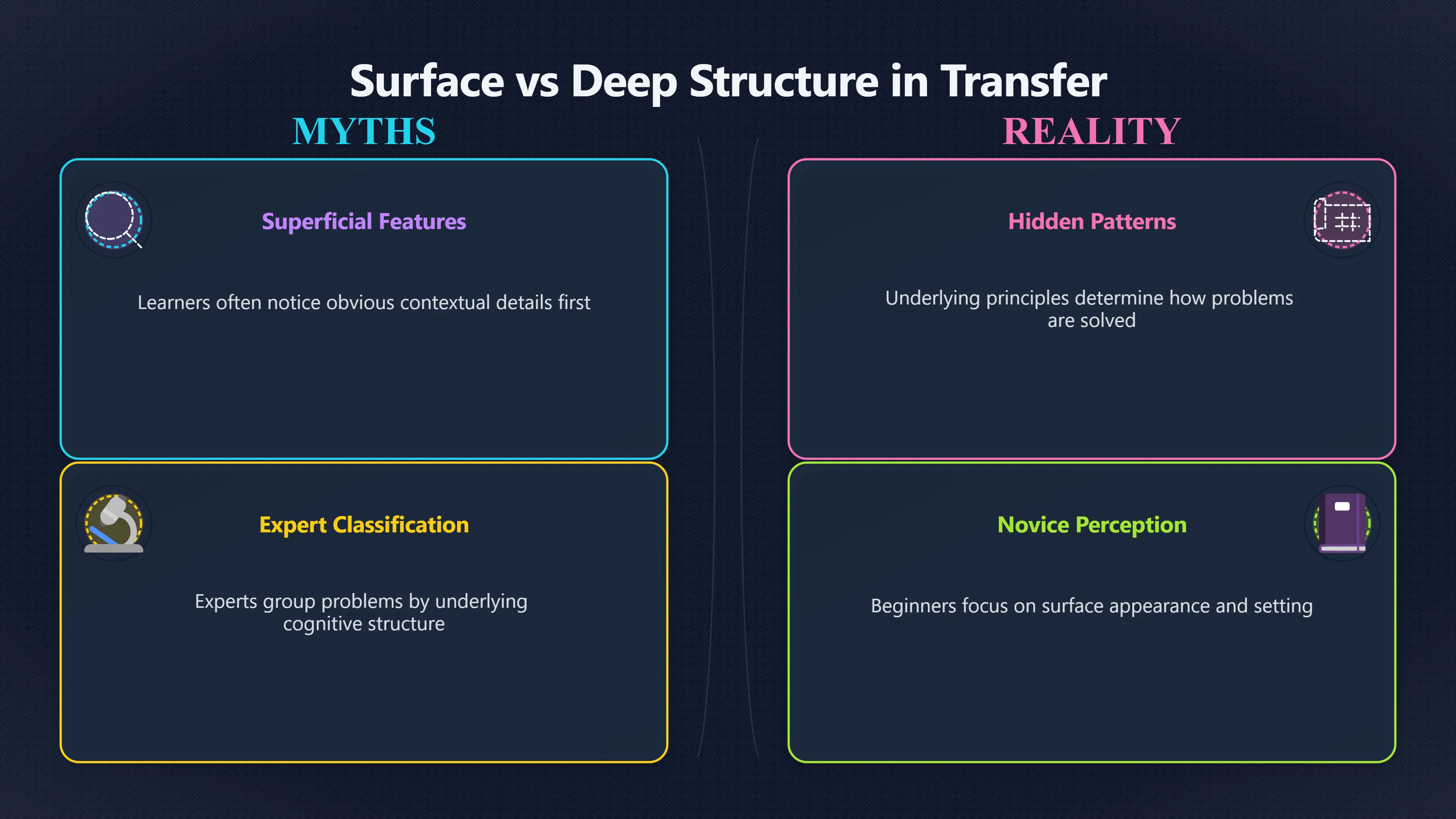
This distinction has been central to transfer research for decades. Learners often notice obvious contextual details while overlooking the deeper relationships that actually determine successful reasoning. Teaching should therefore deliberately draw attention to those hidden common patterns.[rapunselshair.pbworks.com]rapunselshair.pbworks.comWhen and Where Do We Apply What We Learn?SM Barnett · 2002 · Cited by 3474 — Despite a century's worth of research, arguments surrounding the question of whether far tran…
For example, a teacher introducing causal reasoning might use:
Surface contextShared thinking principleWhy did a bridge fail?Evaluate competing causal explanations using evidence.Why did a business lose customers?Evaluate competing causal explanations using evidence.Why did an ancient civilisation collapse?Evaluate competing causal explanations using evidence.Why did a medical treatment succeed?Evaluate competing causal explanations using evidence.
The learner is repeatedly practising one cognitive operation rather than memorising isolated subject-specific routines.

Designing transfer tasks without generic drills
Transfer improves less from generic “critical thinking exercises” than from carefully designed tasks that preserve an authentic problem while changing the surrounding context.
Instead of asking learners to solve dozens of nearly identical questions, teachers can vary only one important dimension at a time.
For example, after introducing source evaluation, successive tasks might change:
- the subject matter,
- the type of evidence,
- the intended audience,
- the amount of uncertainty,
- or the consequences of making a poor judgement.
Because the reasoning principle remains constant while contextual details change, learners gradually learn to recognise when the principle should be applied.
Research also suggests that learners benefit from being explicitly told that transfer is expected. Simply asking questions such as:
- “Where else could this reasoning help?”
- “What makes this problem similar to one you solved last week?”
- “What is different here, and what remains the same?”
encourages learners to search for deeper structural similarities rather than stopping at obvious differences.[ERIC]files.eric.ed.govERICA Review of Transfer Theories and Effective Instructional…by S Hajian · 2019 · Cited by 292 — One of the primary goals of educatio…
Helping learners recognise deep structure
One reason transfer fails is that experts and novices notice different features of problems.
Experts tend to classify problems according to their underlying structure. Novices often classify them according to surface appearance.
For instance, experienced scientists may immediately recognise that two experiments both test competing hypotheses, even if one concerns climate change and the other medicine. A beginner may instead see only that one involves weather and the other hospitals.
Teaching can narrow this gap by making deep structure explicit through techniques such as:
- comparing multiple cases side by side,
- asking learners to explain why two unrelated problems require the same reasoning,
- requiring students to justify which thinking strategy they selected,
- discussing why an apparently similar problem actually requires different reasoning.
These activities help learners build abstract mental representations that are more likely to survive changes in context.

Balancing subject knowledge and general thinking skills
Transfer research also cautions against assuming that general thinking skills can be taught independently of subject knowledge.
Critical thinking depends on understanding the content of the problem as well as knowing appropriate reasoning strategies. A learner cannot evaluate medical evidence effectively without some understanding of medicine, nor analyse economic claims without basic economic concepts.
Successful transfer therefore combines two elements:
- explicit teaching of transferable thinking strategies, and
- repeated opportunities to apply those strategies within rich subject knowledge.
Rather than treating thinking as separate from disciplines, effective instruction helps learners discover that common reasoning principles appear repeatedly across different domains while still respecting the specialised knowledge each field requires.[Taylor & Francis Online]tandfonline.comTaylor & Francis OnlineIdentifying obstacles to transfer of critical thinking skillsby LM van Peppen · 2022 · Cited by 39 — This study in…
What successful transfer looks like
Evidence suggests that transfer is not an automatic consequence of learning but an achievement that must be deliberately cultivated. It becomes more likely when teachers repeatedly expose learners to the same reasoning principle across varied contexts, explicitly highlight deep similarities between problems, and ask learners to explain why a familiar thinking strategy applies in an unfamiliar setting.[rapunselshair.pbworks.com+2Taylor & Francis Online]rapunselshair.pbworks.comWhen and Where Do We Apply What We Learn?SM Barnett · 2002 · Cited by 3474 — Despite a century's worth of research, arguments surrounding the question of whether far tran…
The goal is not to produce students who merely perform well within individual subjects. It is to develop learners who recognise when a reasoning habit—such as evaluating evidence, testing assumptions or considering alternative explanations—belongs to the problem itself rather than to the classroom in which they first encountered it.
eBay marketplace picks
Marketplace Samples
Example marketplace items related to this page. Use the search link to explore similar finds on eBay.




Endnotes
1.
Source: rapunselshair.pbworks.com
Title: When and Where Do We Apply What We Learn?
Link:https://rapunselshair.pbworks.com/f/barnett_2002.pdf
Source snippet
SM Barnett · 2002 · Cited by 3474 — Despite a century's worth of research, arguments surrounding the question of whether far tran...
2.
Source: tandfonline.com
Link:https://www.tandfonline.com/doi/full/10.1080/20445911.2021.1990302
Source snippet
Taylor & Francis OnlineIdentifying obstacles to transfer of critical thinking skillsby LM van Peppen · 2022 · Cited by 39 — This study in...
3.
Source: files.eric.ed.gov
Link:https://files.eric.ed.gov/fulltext/EJ1217940.pdf
Source snippet
ERICA Review of Transfer Theories and Effective Instructional...by S Hajian · 2019 · Cited by 292 — One of the primary goals of educatio...
Additional References
4.
Source: nifdi.org
Link:https://www.nifdi.org/resources/88-news/kerry-hempenstall/758-near-and-far-transfer-in-cognitive-training.html
5.
Source: strath.ac.uk
Title: transferringskillsandknowledgebetweencontextsimplicationsforplay basedlearning
Link:https://www.strath.ac.uk/humanities/education/blog/transferringskillsandknowledgebetweencontextsimplicationsforplay-basedlearning/
Source snippet
University of StrathclydeTransferring skills and knowledge between contextsby W Strathclyde — Research (Barnett & Ceci, 2002) suggests th...
6.
Source: firth.substack.com
Title: the vital role of transfer in education
Link:https://firth.substack.com/p/the-vital-role-of-transfer-in-education
Source snippet
Vital Role of Transfer in Education (Part 1)'Far transfer' relates to the impact of study on more abstractly related tasks. If, for examp...
7.
Source: structural-learning.com
Link:https://www.structural-learning.com/post/transfer-learning-complete-guide-teachers
Source snippet
Transfer of Learning: A Complete Guide5 days ago — Research from Barnett and Ceci (2002) shows near transfer works better than far transfer...
8.
Source: pmc.ncbi.nlm.nih.gov
Link:https://pmc.ncbi.nlm.nih.gov/articles/PMC9902256/
Source snippet
Erring Improves Far Transfer of Learning More...by SSH Wong · 2023 · Cited by 28 — In three experiments, the present study tested whethe...
9.
Source: edworkingpapers.com
Title: ai26 1376
Link:https://edworkingpapers.com/sites/default/files/ai26-1376.pdf
Source snippet
Mapping the Mechanisms of Interdisciplinary Learning...by JB Gilbert · 2025 — The purpose of the present study is to evaluate reading ac...
10.
Source: youtube.com
Title: What is ‘transfer of learning’? | Julie Stern
Link:https://www.youtube.com/watch?v=q3rH5mLQfRw
Source snippet
Transfer of Learning | Taking Learning Seriously...
11.
Source: youtube.com
Title: Transfer of Learning | Taking Learning Seriously
Link:https://www.youtube.com/watch?v=xEx6wHszmIg
Source snippet
Teaching for Transfer by Dr Nicholas Lee...
12.
Source: youtube.com
Title: Transfer of Learning in Education
Link:https://www.youtube.com/watch?v=hzvid3G6XTc
Source snippet
How to Become an Expert at ANYTHING | Scott Young...
13.
Source: youtube.com
Title: Teaching for Transfer by Dr Nicholas Lee
Link:https://www.youtube.com/watch?v=EVB0Eyh9yn4
Source snippet
Transfer of Learning in Education...
Topic Tree