Within Humility
How to Test a Belief Fairly
Looking for contrary evidence is useful because it tests confidence, not because every claim deserves equal weight.
On this page
- The difference between testing and surrendering
- When both sides framing misleads
- How to use strong objections without false balance
Page outline Jump by section
Introduction
Testing your own beliefs against contrary evidence is one of the most reliable ways to improve judgement. The goal, however, is not to perform neutrality by acting as though every position deserves equal confidence. Instead, the aim is to ask whether your current belief survives the strongest available objections. Good thinking distinguishes between actively searching for disconfirming evidence and pretending that all claims are equally plausible.
 This distinction sits at the heart of intellectual humility. Humility means recognising that you can be mistaken and deliberately looking for information that would reveal such mistakes. It does not require suspending confidence in conclusions that are already supported by strong, converging evidence. Research on intellectual humility consistently defines it as awareness of the limits of one’s knowledge rather than indiscriminate doubt, while work in philosophy argues that humility and evidence-based confidence can coexist.[PMC]pmc.ncbi.nlm.nih.govPMCPredictors and consequences of intellectual humilityby T Porter · 2022 · Cited by 359 — Intellectual humility involves acknowledging the limitations of one's knowledge and that one's bel…
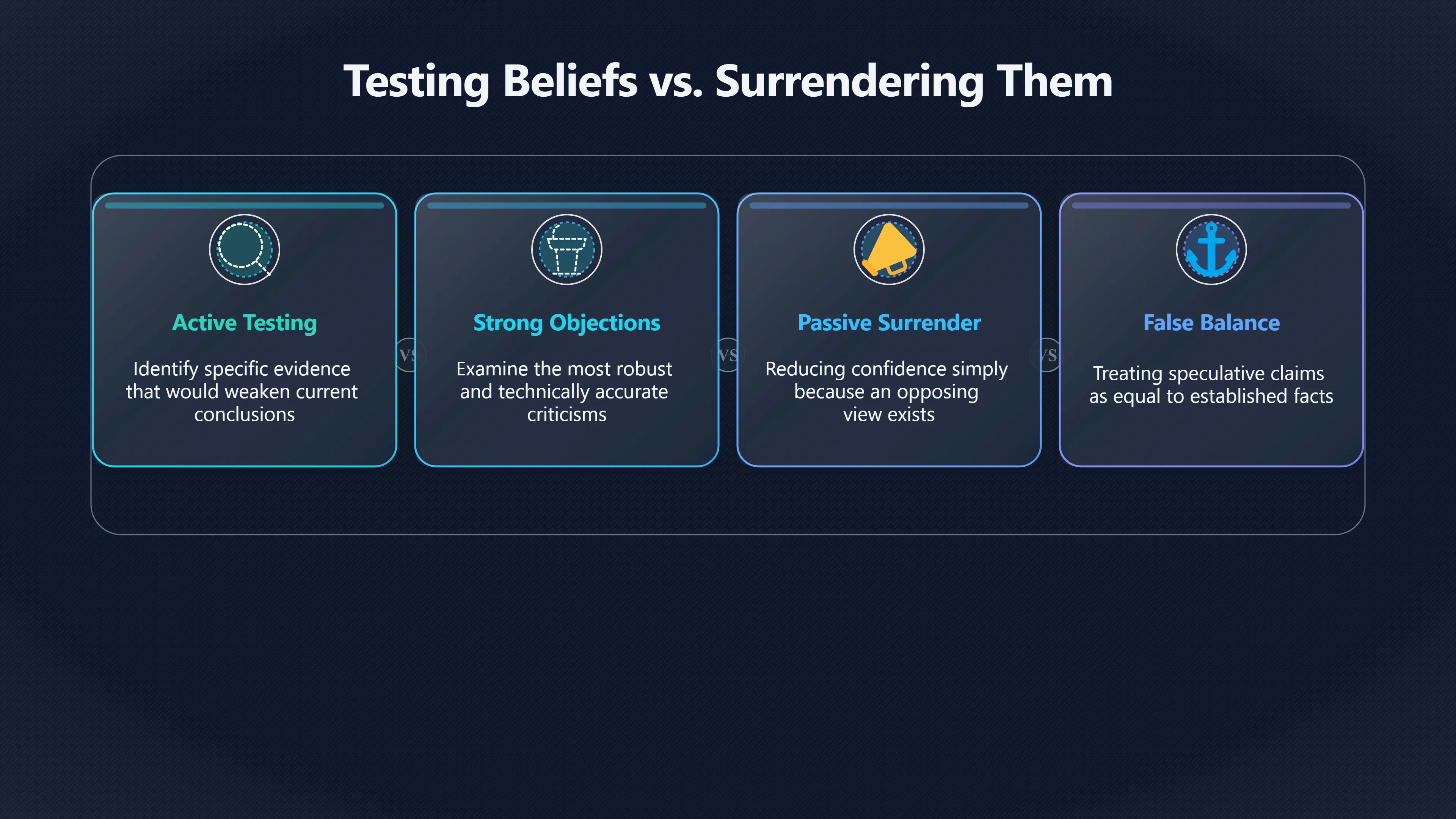
Why Testing a Belief Is Different from Surrendering It
People often confuse openness to criticism with unwillingness to reach conclusions. These are different intellectual activities.
Testing a belief asks:
- What evidence would genuinely weaken my conclusion?
- Have I examined the strongest objections?
- Would I recognise if reality contradicted my expectations?
Surrendering a belief asks something else entirely:
- Should I reduce confidence simply because someone disagrees?
The answer to the second question is often “no”. Disagreement alone is not evidence that confidence should fall. What matters is the quality, independence and explanatory power of the opposing evidence.
This distinction becomes especially important once evidence has accumulated unevenly. A well-tested scientific explanation and a speculative alternative are not entitled to equal confidence simply because they occupy opposite sides of a debate. Intellectual humility requires openness to better evidence, not permanent indecision.[PMC]pmc.ncbi.nlm.nih.govPMCPredictors and consequences of intellectual humilityby T Porter · 2022 · Cited by 359 — Intellectual humility involves acknowledging the limitations of one's knowledge and that one's bel…
The Difference Between Looking for Objections and Giving Equal Weight
The practical habit worth developing is not “hear every side equally” but “hear the strongest criticism available.”
These approaches produce very different thinking.
Testing beliefs fairlyFalse balanceSeeks the strongest counter-evidenceGives equal attention to weak and strong claimsWeighs evidence by qualityWeighs positions by symmetryChanges confidence when warrantedTreats disagreement itself as evidenceDistinguishes uncertainty from settled knowledgeSuggests every issue remains equally open
False balance often arises from a social instinct rather than an epistemic one. Presenting “both sides” can appear fair even when the available evidence is overwhelmingly one-sided. In journalism this has long been recognised as a source of public misunderstanding in areas where expert consensus is strong, and the same mistake appears in everyday reasoning.
Fairness therefore concerns how objections are evaluated, not whether every objection receives identical status.
Why “Consider the Opposite” Works
One of the most influential findings in judgement research is that simply telling people to “be objective” has relatively little effect. A more effective intervention is to ask them to actively construct the best case against their current conclusion.
Classic experiments by Charles Lord, Mark Lepper and Elizabeth Preston showed that asking participants to “consider the opposite” reduced several forms of confirmation bias more effectively than general instructions to be fair or unbiased. Rather than merely encouraging neutrality, the intervention forced people to generate plausible alternative explanations and test whether their preferred interpretation was uniquely supported.[PubMed]pubmed.ncbi.nlm.nih.govConsidering the opposite: a corrective strategy for social…by CG Lord · 1984 · Cited by 1163 — It is proposed that several biase…
Subsequent research has extended this idea into other settings, including legal decision-making, where structured “consider-the-opposite” procedures have been shown to improve the generation of alternative hypotheses during investigations.[Sage Journals]journals.sagepub.comSage Journals Have you considered the opposite?A debiasing strategy…14 Aug 2021 — Drawing on Lord and colleagues work (1984), this study examines the potential debiasing effect of c…
The important lesson is that good reasoning does not emerge from suppressing conviction. It emerges from deliberately exposing conviction to meaningful tests.
When Both-Sides Framing Misleads
Not every disagreement deserves identical investigation.
Imagine three situations:
- A colleague challenges your interpretation of a dataset with an alternative statistical explanation.
- A medical guideline is criticised using a handful of anecdotes.
- An established physical law is rejected without reproducible evidence.
These situations all involve disagreement, but they do not create equal reasons to revise confidence.
Evidence should be judged according to factors such as:
- methodological quality
- reproducibility
- explanatory power
- independence of sources
- consistency with broader evidence
When these factors overwhelmingly favour one position, presenting both positions as equally credible creates a distorted picture rather than a balanced one.
Intellectual humility therefore requires proportionality. Confidence should increase or decrease in proportion to evidence, not in proportion to the number of competing opinions.

Strong Objections Are More Valuable Than Many Weak Ones
Many people unintentionally protect their beliefs by engaging only with poor criticisms.
Rejecting obviously weak arguments can create an illusion that the underlying belief has survived serious testing. It has not.
A more demanding practice is to search for what philosophers sometimes call the strongest available objection. This means seeking critics who understand the position well enough to identify its genuine vulnerabilities rather than its caricatures.
The process looks something like this:
- State your own position as clearly as possible.
- Identify the strongest published criticism.
- Ask whether that criticism would change your judgement if true.
- Examine whether existing evidence answers it.
- Adjust confidence only if the objection genuinely weakens the evidence.
This approach increases confidence when a belief survives demanding scrutiny, while also making genuine errors easier to detect.
Intellectual Humility Does Not Require Endless Open-Mindedness
One recent philosophical argument draws an important distinction between intellectual humility and open-mindedness. The authors argue that there are situations—such as evaluating demonstrably false or extremist claims—where a person can remain intellectually humble without treating those claims as live possibilities.
Humility may require acknowledging one’s own limitations, avoiding unwarranted assumptions about other people, and remaining attentive to evidence. It does not require becoming willing to revise beliefs that are already justified by overwhelming evidence merely because someone asserts the opposite.[Cambridge University Press & Assessment]cambridge.orgCambridge University Press & AssessmentIntellectual Humility Without Open-Mindedness: How to…by K Peters · Cited by 8 — There are seve…
This helps explain why humility is compatible with confidence.
A person can honestly say:
“I recognise that I can be mistaken, but I have also examined the strongest objections and do not currently see evidence sufficient to overturn this conclusion.”
That statement expresses revisability without pretending uncertainty where the evidence does not support it.

Practical Habits for Testing Beliefs Fairly
The following habits strengthen reasoning without drifting into performative neutrality:
- Ask what would change your mind. If no conceivable evidence could alter your view, you are defending identity rather than evaluating evidence.
- Seek expert disagreement before public disagreement. Specialists usually identify the strongest technical objections more effectively than popular debate.
- Distinguish criticism of reasoning from criticism of people. Personal disagreement does not automatically undermine factual claims.
- Look for converging evidence. Multiple independent lines of support matter more than repeated versions of the same argument.
- Update confidence proportionally. Small objections should produce small revisions; major contradictory evidence should produce larger ones.
- Revisit settled conclusions occasionally, not constantly. Repeatedly reopening well-established questions can waste attention without improving judgement.
A Better Standard Than “Keeping an Open Mind”
The familiar advice to “keep an open mind” is incomplete because it says little about how long, how widely or under what evidential conditions openness should continue.
A better standard is:
- remain open to better evidence
- actively search for the strongest contrary case
- judge competing claims in proportion to their evidential support
- revise confidence when warranted, but not merely because disagreement exists
That approach captures the practical value of intellectual humility. It keeps beliefs answerable to reality without confusing fairness with false balance. By treating objections as tests rather than performances of neutrality, you become more capable of correcting genuine mistakes while remaining appropriately confident in conclusions that have already survived serious scrutiny.
Amazon book picks
Further Reading
Books and field guides related to How to Test a Belief Fairly. Use these as the next step if you want deeper reading beyond the article.
Mistakes Were Made (but Not by Me)
Shows why people resist evidence that challenges existing beliefs.
Thinking, Fast and Slow
Explains confirmation bias, evidence evaluation, and testing beliefs.
The Demon-Haunted World
Rating: 4.5/5 from 43 Google Books ratings
Promotes evidence-based skepticism rather than false balance.
eBay marketplace picks
Marketplace Samples
Example marketplace items related to this page. Use the search link to explore similar finds on eBay.


Endnotes
1.
Source: pmc.ncbi.nlm.nih.gov
Title: PMCPredictors and consequences of intellectual humility
Link:https://pmc.ncbi.nlm.nih.gov/articles/PMC9244574/
Source snippet
by T Porter · 2022 · Cited by 359 — Intellectual humility involves acknowledging the limitations of one's knowledge and that one's bel...
2.
Source: cambridge.org
Link:https://www.cambridge.org/core/journals/episteme/article/intellectual-humility-without-openmindedness-how-to-respond-to-extremist-views/2FB33B15521127B2EB763FE24D73B394
Source snippet
Cambridge University Press & AssessmentIntellectual Humility Without Open-Mindedness: How to...by K Peters · Cited by 8 — There are seve...
3.
Source: pubmed.ncbi.nlm.nih.gov
Link:https://pubmed.ncbi.nlm.nih.gov/6527215/
Source snippet
Considering the opposite: a corrective strategy for social...by CG Lord · 1984 · Cited by 1163 — It is proposed that several biase...
4.
Source: journals.sagepub.com
Title: Sage Journals Have you considered the opposite?
Link:https://journals.sagepub.com/doi/10.1177/0032258X211038888
Source snippet
A [debiasing]({{ 'debiasing/' | relative_url }}) strategy...14 Aug 2021 — Drawing on Lord and colleagues work (1984), this study examines the potential debiasing effect of c...
5.
Source: youtube.com
Title: Consider the Opposite
Link:https://www.youtube.com/watch?v=ieVaeYVaOrc
Source snippet
A Debiasing StrategyThis exercise works by forcing you to consciously visualize different outcomes or different scenarios than what you n...
6.
Source: pmc.ncbi.nlm.nih.gov
Link:https://pmc.ncbi.nlm.nih.gov/articles/PMC10541816/
Source snippet
humble for words - PMCby N Levy · 2023 · Cited by 18 — I show that inducing intellectual humility causes people inappropriately to lower...
Additional References
7.
Source: academia.edu
Link:https://www.academia.edu/21797047/Open_Mindedness_and_Intellectual_Humility
Source snippet
(PDF) Open-Mindedness and Intellectual HumilityThe findings suggest that intellectual humility, or recognizing one's fallibility, promote...
8.
Source: medium.com
Link:https://medium.com/%40alexfiliakov/uncovering-truth-embracing-diverse-perspectives-and-intellectual-humility-78a9a1714291
Source snippet
Embracing Diverse Perspectives and Intellectual HumilityThe journey towards intellectual growth begins with understanding the cognitive b...
9.
Source: templeton.org
Link:https://www.templeton.org/discoveries/intellectual-humility
Source snippet
Intellectual HumilityThe study of Intellectual Humility has shown recognizing and owning our limitations in the service of pursuing deepe...
10.
Source: philpeople.org
Link:https://philpeople.org/profiles/katie-peters-1/publications?app=null%27%27%27a%3D0&order=viewings
Source snippet
Katie Peters (University of Connecticut): PublicationsHow should we respond to extremist views that we know are false? This paper propose...
11.
Source: semanticscholar.org
Link:https://www.semanticscholar.org/paper/18fc270f0133355dda618283cb2d08e4204f6203
Source snippet
[PDF] Intellectual Humility Without Open-MindednessHow should we respond to extremist views that we know are false? This paper proposes t...
12.
Source: researchgate.net
Link:https://www.researchgate.net/publication/372577153_Links_Between_Intellectual_Humility_and_Open-Mindedness_Does_Strength_of_Belief_Matter
Source snippet
Without Open-Mindedness: How to Respond to Extremist Views. Article. Full-text available. Mar 2025; Episteme. Katie Peters · Cody Turner...
13.
Source: aura.american.edu
Link:https://aura.american.edu/articles/thesis/Consider_the_opposite_An_[application
Source snippet
the opposite: An application of scientific thinking...by DD Laughlin · 2001 · Cited by 1 — In 1984, Lord, Lepper and Preston suggested a...
14.
Source: communicationcache.com
Title: multiple explanation a consider an alternative strategy for debiasing judgments
Link:https://www.communicationcache.com/uploads/1/0/8/8/10887248/multiple_explanation-_a_consider-an-alternative_strategy_for_debiasing_judgments.pdf
Source snippet
A Consider-an-Alternative Strategy for Debiasing Judgmentsby ER Hirt · 1995 · Cited by 469 — Previous research has suggested that an effe...
15.
Source: researchgate.net
Link:https://www.researchgate.net/publication/258194201_Open-mindedness_and_Intellectual_Humility
Source snippet
This paper proposes that we should be intellectually humble, but not open-minded. We should own...Read more...
16.
Source: apcz.umk.pl
Link:https://apcz.umk.pl/SetF/article/download/37568/33924/102109
Source snippet
Second, they view intellectual agents and communities as the primary focus of epis- temic...Read more...
Topic Tree