Within Problem Framing
When People Cannot Agree on the Problem
Some problems stay hard because people disagree about what the problem even is.
On this page
- Why wicked problems resist final wording
- Values, trade offs, and disputed success
- How framing can make disagreement visible
Page outline Jump by section
Introduction
Some problems remain difficult not because the facts are unknown, but because people cannot agree on what the problem actually is. This is a defining feature of many “wicked problems” — complex social, organisational and public-policy challenges where different groups hold different values, priorities and interpretations of reality. In these situations, disagreement begins before solutions are discussed. Stakeholders may frame the same situation as a safety issue, a fairness issue, an economic issue, a rights issue or a governance issue, with each framing implying a different path forward. Rittel and Webber’s foundational work on wicked problems highlighted that there is no definitive formulation of such problems and that different explanations lead to different responses.[Urban Policy]urbanpolicy.netRittel Webber 1973 DilemmasInAGeneralTheoryOfPlanning160. III. Planning Problems are Wicked Problems. A great many barriers keep us from…Read more…
 For anyone seeking to improve their thinking and analytical skills, this matters because reasoning quality depends heavily on how the problem is framed. If stakeholders are arguing about different versions of the problem, evidence alone rarely resolves the conflict.
Why Wicked Problems Resist Final Wording
Many technical problems can be defined with reasonable precision. A machine either fails to meet a specification or it does not. Wicked problems are different because their boundaries, causes and goals are themselves disputed.
Rittel and Webber argued that there is no definitive formulation of a wicked problem. The way a problem is described depends on which stakeholders are consulted, which consequences are emphasised and which values are treated as important. In practice, defining the problem is inseparable from proposing a solution.[Urban Policy]urbanpolicy.netRittel Webber 1973 DilemmasInAGeneralTheoryOfPlanning160. III. Planning Problems are Wicked Problems. A great many barriers keep us from…Read more…
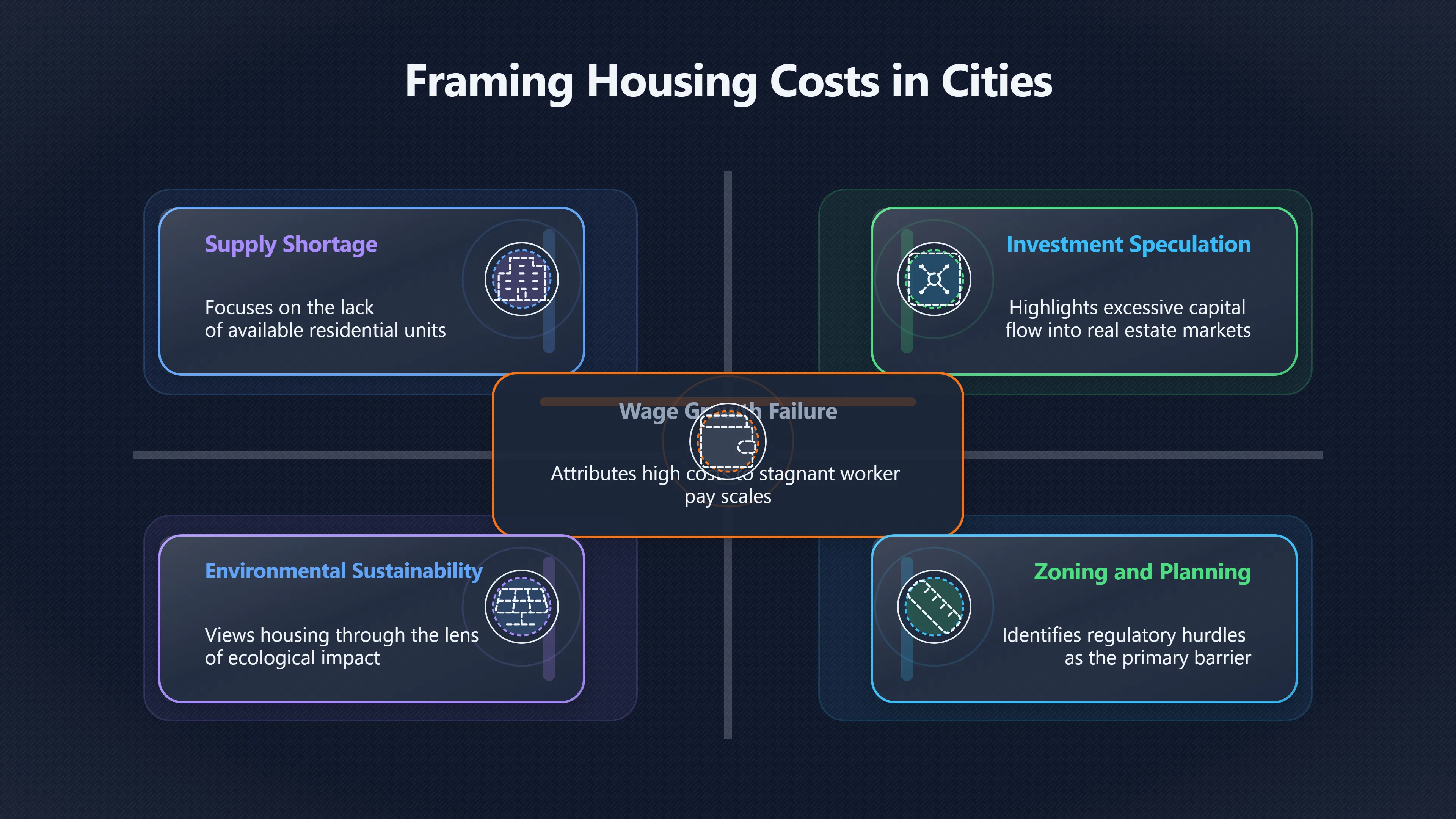
Consider a city facing rising housing costs. Different stakeholders might frame the issue as:
- A shortage of housing supply.
- Excessive speculation and investment.
- A failure of wage growth.
- An environmental sustainability challenge.
- A planning and zoning problem.
- A social justice issue.
Each framing highlights some facts and downplays others. None is necessarily false, but each creates a different decision agenda.
Research on wicked problems consistently emphasises that stakeholder perceptions, interests and values shape how issues are scoped and prioritised. The conflict is not merely about evidence; it is about which interpretation deserves to guide action.[OUP Academic+2Taylor & Francis Online]academic.oup.comOUP AcademicForty years of wicked problems literature: forging closer links…by BW Head · 2019 · Cited by 740 — The wicked problems per…
This explains why debates over climate policy, urban development, healthcare reform or organisational change often appear to stall. Participants may seem to be discussing solutions while actually disagreeing about the nature of the underlying problem.
Values, Trade-Offs, and Disputed Success
A central reason for stakeholder conflict is that wicked problems contain value judgements that cannot be settled scientifically.
For many organisational and social issues, stakeholders care about different outcomes:
- Efficiency versus equity.
- Security versus privacy.
- Economic growth versus environmental protection.
- Short-term stability versus long-term resilience.
- Individual freedom versus collective welfare.
These are not simply factual disagreements. They reflect competing views about what ought to matter.
The wicked-problems literature repeatedly notes that solutions are rarely judged as true or false. Instead, they are judged as better or worse according to different stakeholder values. Because people use different standards of evaluation, they can look at the same outcome and reach opposite conclusions.[Wikipedia+2Taylor & Francis Online]WikipediaWicked problemWicked problem
For example, a new public transport project may be celebrated by environmental advocates because it reduces emissions, criticised by local residents because it changes neighbourhood character, and questioned by taxpayers because of cost. The disagreement is not merely about transport engineering. It concerns what success should mean.
This is why attempts to produce a single “objective” definition of many social problems often fail. Stakeholders are not only disagreeing about facts; they are disagreeing about which goals deserve priority. Research on governance and systems thinking highlights that wicked problems commonly involve actors with conflicting interests and values, making consensus on problem definition inherently difficult.[OECD]oecd.orgSystemic Thinking for Policy Making (ENSystemic Thinking for Policy Making (EN)May 15, 2025 — complex and ill-defined problems with multiple interacting actors, often with…
How Frames Create Winners and Losers
Problem framing is not neutral. Every frame highlights certain interests and makes others less visible.
A useful way to understand stakeholder conflict is to ask three questions:
- Who benefits if this framing becomes dominant?
- Whose concerns become central?
- Which alternatives become easier or harder to consider?
Suppose an organisation experiences declining employee morale.
If leaders frame the issue as a productivity problem, the response may focus on performance management and incentives. If employees frame it as a workload problem, attention may shift towards staffing levels and expectations. If human resources frames it as a culture problem, solutions may focus on leadership behaviour and communication.
The same observable situation can produce different interventions because each frame identifies a different root cause.
This dynamic is particularly important in governance contexts. Policy scholars note that pluralistic societies naturally contain multiple legitimate viewpoints. Wicked problems emerge partly because stakeholders possess different experiences, interests and moral commitments, making competing frames unavoidable rather than exceptional.[OUP Academic]academic.oup.comOUP AcademicForty years of wicked problems literature: forging closer links…by BW Head · 2019 · Cited by 740 — The wicked problems per…
Recognising this helps analysts avoid a common mistake: assuming that disagreement reflects ignorance. Often the disagreement reflects genuine differences in priorities and worldviews.
How Framing Can Make Disagreement Visible
The goal is not always to force agreement on a single definition. In many cases, better thinking begins by making competing frames explicit.
Problem-structuring approaches were developed partly to help groups work with uncertainty and conflict before rushing into solution design. Rather than asking participants to agree immediately, these methods encourage them to surface assumptions, concerns and interpretations.[ResearchGate+2cci.drexel.edu]researchgate.netResearchGate(PDF) Problem Structuring MethodsProblem structuring methods (PSMs) are a broad group of model-based problem handling approac…
Useful questions include:
- What problem do different stakeholders believe they are facing?
- What outcomes does each group consider successful?
- Which values are driving those preferences?
- What assumptions support each framing?
- What evidence would change minds, and what disagreements are fundamentally value-based?
Answering these questions often reveals that apparent factual disputes are actually conflicts over goals or priorities.
For example, a debate about whether a company should require office attendance may initially appear to concern productivity data. Closer examination may reveal competing values: flexibility, collaboration, autonomy, fairness, career development and organisational identity. Once those values are visible, the disagreement becomes easier to understand even if it is not fully resolved.
Thinking Better When Frames Conflict
When faced with a wicked problem, analytical skill involves more than collecting evidence. It requires recognising that multiple stakeholders may be reasoning from different definitions of the situation.
Several habits improve judgement:
- Separate factual disputes from value disputes. Evidence can help with the former but not fully resolve the latter.
- Treat problem definitions as hypotheses rather than facts. Ask what assumptions each frame contains.
- Look for excluded stakeholders. Missing perspectives often reveal hidden dimensions of the problem.
- Compare success criteria. Different groups frequently disagree because they are measuring different outcomes.
- Expect reframing over time. As conditions change, stakeholders may redefine both the problem and the desired solution.
The key lesson is that wicked problems are often sustained by conflicts in framing rather than by a lack of intelligence or information. Better reasoning begins when analysts recognise that the first challenge is not choosing a solution. It is understanding why different people believe they are trying to solve different problems in the first place.[Taylor & Francis Online+2OUP Academic]tandfonline.comTaylor & Francis OnlineFull article: Forty years of wicked problems literatureby BW Head · 2019 · Cited by 740 — The wicked problems pers…
Amazon book picks
Further Reading
Books and field guides related to When People Cannot Agree on the Problem. Use these as the next step if you want deeper reading beyond the article.
Dialogue Mapping
Directly addresses wicked problems and techniques for making competing problem framings visible and discussable.
Super Thinking
Encourages examining issues through multiple lenses, which is central when stakeholders disagree about the nature of a problem.
Thinking in Systems
Helps readers understand why complex problems are framed differently by different actors and why interventions create trade-offs.
The Fifth Discipline
Introduces systems thinking and shared mental models, helping readers understand conflicting perspectives in complex organizational probl...
eBay marketplace picks
Marketplace Samples
Example marketplace items related to this page. Use the search link to explore similar finds on eBay.

Endnotes
1.
Source: Wikipedia
Title: Wicked problem
Link:https://en.wikipedia.org/wiki/Wicked_problem
2.
Source: academic.oup.com
Link:https://academic.oup.com/policyandsociety/article/38/2/180/6407919
Source snippet
OUP AcademicForty years of wicked problems literature: forging closer links...by BW Head · 2019 · Cited by 740 — The wicked problems per...
3.
Source: oecd.org
Title: Systemic Thinking for Policy Making (EN)
Link:https://www.oecd.org/content/dam/oecd/en/publications/reports/2020/02/systemic-thinking-for-policy-making_a95b3226/879c4f7a-en.pdf
Source snippet
Systemic Thinking for Policy Making (EN)May 15, 2025 — complex and ill-defined problems with multiple interacting actors, often with...
Published: May 15, 2025
4.
Source: oecd.org
Link:https://www.oecd.org/en/publications/systemic-thinking-for-policy-making_879c4f7a-en.html
Source snippet
Systemic Thinking for Policy MakingWe have to identify actions that will shape change for the better, and help to build resilience to the...
5.
Source: researchgate.net
Link:https://www.researchgate.net/publication/283311585_Problem_Structuring_Methods
Source snippet
ResearchGate(PDF) Problem Structuring MethodsProblem structuring methods (PSMs) are a broad group of model-based problem handling approac...
6.
Source: cci.drexel.edu
Link:https://cci.drexel.edu/faculty/sgasson/SSM/Process.html
Source snippet
Process of Soft Systems MethodologySSM provides a philosophy and a set of techniques for investigating a "real-world" problem situation...
7.
Source: researchgate.net
Link:https://www.researchgate.net/publication/358986199_Wicked_Problems_in_Public_Policy_Understanding_and_Responding_to_Complex_Challenges
Source snippet
introduction to the concept and management of 'wicked' problems: the kind of poorly-structured, intractable policy problems with...Read...
8.
Source: researchgate.net
Link:https://www.researchgate.net/publication/320883976The_enduring_challenge_of%27wicked_problems%27_revisiting_Rittel_and_Webber
Source snippet
(PDF) The enduring challenge of 'wicked problems'6 Nov 2017 — This review revisits Rittel and Webber's work and its enduring significance...
9.
Source: anzsog.edu.au
Title: seven strategies for wicked problems
Link:https://anzsog.edu.au/insights/seven-strategies-for-wicked-problems
Source snippet
Apr 6, 2022 — Seven strategies for wicked problems · 1. Avoidance and denial · 2. Coercion · 3. Compartmentalised micro-management · 4. T...
10.
Source: urbanpolicy.net
Title: Rittel Webber 1973 DilemmasInAGeneralTheoryOfPlanning
Link:https://urbanpolicy.net/wp-content/uploads/2015/06/Rittel-Webber_1973_DilemmasInAGeneralTheoryOfPlanning.pdf
Source snippet
160. III. Planning Problems are Wicked Problems. A great many barriers keep us from...Read more...
11.
Source: tandfonline.com
Link:https://www.tandfonline.com/doi/full/10.1080/14494035.2018.1488797
Source snippet
Taylor & Francis OnlineFull article: Forty years of wicked problems literatureby BW Head · 2019 · Cited by 740 — The wicked problems pers...
12.
Source: tandfonline.com
Link:https://www.tandfonline.com/doi/full/10.1080/13504509.2020.1859415
Source snippet
Wicked problems have no stopping rule, i.e. there is no point in time at which the process of addressing...Read more...
13.
Source: tandfonline.com
Link:https://www.tandfonline.com/doi/full/10.1080/14494035.2019.1617971
Source snippet
A critical assessment of the wicked problem conceptby CJAM Termeer · 2019 · Cited by 374 — The concept of wicked problems has served as a...
14.
Source: improvisingdesign.com
Title: Wicked Problems
Link:https://www.improvisingdesign.com/wicked-problems/
Source snippet
Improvising DesignA wicked problem is one that is just too complex and messy (comprising multiple problem-elements) to be easily defined...
15.
Source: systemsthinkingalliance.org
Title: wicked problems
Link:https://systemsthinkingalliance.org/wicked-problems/
Source snippet
They are ill-defined, rely on elusive political judgment rather than definitive solutions.Read more...
16.
Source: youtube.com
Title: Wicked Problems
Link:https://www.youtube.com/watch?v=6QaVW_nNMaE
Source snippet
No Easy Solutions Explained (18 Minutes)Wicked problems are complex challenges that don't have clear straightforward solutions they requi...
17.
Source: whispersandgiants.com
Title: wicked problems
Link:https://www.whispersandgiants.com/2022/12/13/wicked-problems/
Source snippet
Whispers & GiantsDec 13, 2022 — These issues are characterized by conflicting stakeholder values, incomplete or contradictory information...
18.
Source: leanessays.com
Title: wicked problems
Link:https://www.leanessays.com/2002/01/wicked-problems.html
Source snippet
10 Jan 2002 — Wicked problems, according to Horst and Webber, have ten characteristics:[1]. There is no definitive formulation of a wicke...
Additional References
19.
Source: medium.com
Link:https://medium.com/age-of-awareness/facing-complexity-wicked-design-problems-ee8c71618966
Source snippet
Facing Complexity: Wicked Design ProblemsWicked problems are real world problems that acknowledge t he complex interdependence of diverse...
20.
Source: swemorph.com
Link:https://www.swemorph.com/pdf/wp.pdf
Source snippet
Wicked Problemsby T Ritchey · 2013 · Cited by 300 — Above all, WPs are about people as stakeholders: competing and cooperating...
21.
Source: linkedin.com
Link:https://www.linkedin.com/posts/budiarso-budiarso-b6577917_wicked-problems-and-the-soft-systems-methodology-activity-7301647847270010880-cPKc
Source snippet
Problems are interconnected, often [symptoms]({{ 'symptoms/' | relative_url }}) of larger issues. - Multiple valid explanations exist...Read more...
22.
Source: ux.stackexchange.com
Title: what does it mean that wicked problems have no stopping rule
Link:https://ux.stackexchange.com/questions/121247/what-does-it-mean-that-wicked-problems-have-no-stopping-rule
Source snippet
One of the concepts is Wicked Problems. I don't understand, re: Wicked Problems: No Stopping Rule I looked up further and found: "...
23.
Source: paconsulting.com
Link:https://www.paconsulting.com/insights/wicked-problems-using-a-collaborative-approach-to-find-effective-solutions
Source snippet
ders engage in a collaborative journey of consultation and engagement.Read more...
24.
Source: ioconsulting.com
Link:https://ioconsulting.com/do-you-know-you-have-a-wicked-problem-and-do-you-know-how-to-solve-it
Source snippet
t ordinary problems, including: Ordinary problems have a solution...Read more...
25.
Source: learn1.open.ac.uk
Title: When is a problem ‘wicked’ as opposed to ‘tame’?
Link:https://learn1.open.ac.uk/mod/oublog/viewpost.php?post=60027
Source snippet
learn110 Feb 2012 — Wicked problems have no stopping rule. Solutions to wicked problems are not true-or-false, but better or worse. The...
26.
Source: oecd-opsi.org
Link:https://oecd-opsi.org/wp-content/uploads/2018/07/Systems-Approaches-to-Public-Sector-Challenges_Working-with-Change.pdf
Source snippet
Framing such wicked problems is important, as many competing...Read more...
27.
Source: studeersnel.nl
Link:https://www.studeersnel.nl/nl/document/vrije-universiteit-amsterdam/beleid-en-besluitvorming/summary-policy-and-decision-webber-wicked-problems/159242
Source snippet
never solved. At best they are only re-solved, over and over again a)...
28.
Source: waldencroft.com
Title: value conflict in wicked problems
Link:https://waldencroft.com/value-conflict-in-wicked-problems/
Source snippet
12 Jul 2023 — A conflict of values amongst stakeholders isn't just a by-product of the problem's wickedness; it's actually a core reason...
Topic Tree