Within Gut vs Analysis
Can simple rules beat careful calculation?
Good rules of thumb can simplify decisions when they are built around the few cues that usually matter.
On this page
- What makes a rule of thumb fit its environment
- Spending, sleep and conversation rules that reduce regret
- When simple rules become too rigid
Page outline Jump by section
Introduction
Simple rules of thumb can sometimes outperform painstaking calculation—not because they are magical, but because they focus attention on the few cues that matter most. In everyday life, people rarely have unlimited time, information or mental energy. Under those conditions, a well-designed shortcut can reduce decision fatigue, speed action and even improve consistency. The key is that these rules are built through earlier reflection and experience rather than replacing thinking altogether. They represent analysis done in advance, ready to be applied when routine choices arise. Research on bounded rationality and fast-and-frugal heuristics argues that the effectiveness of a rule depends less on its complexity than on whether it fits the environment in which it is used.[MPG.PuRe+2PubMed]pure.mpg.deHeuristicsby T Make — Our premise is that much of human reasoning and decision making can be modeled by fast and frugal heuristics that m…
 Within the broader question of intuition versus analysis, simple rules occupy a middle ground. Instead of relying on momentary impulses or attempting exhaustive optimisation every time, they provide stable decision policies that reduce unnecessary deliberation while leaving room to slow down when the stakes are unusually high.
What makes a rule of thumb fit its environment?
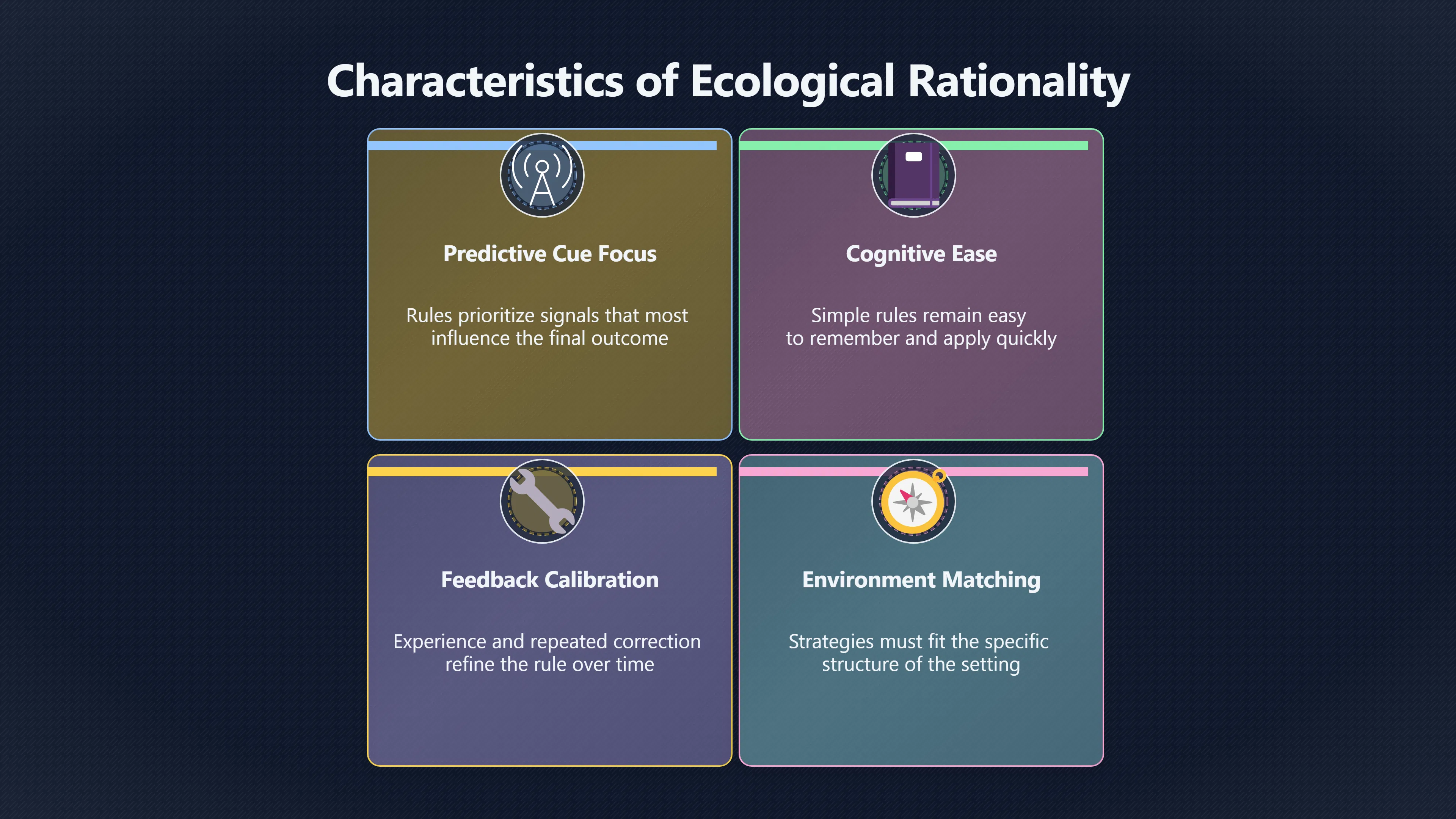
A useful rule of thumb is not universally true. It works because it exploits regular patterns in a particular setting. Researchers studying fast-and-frugal heuristics describe this as ecological rationality: a decision strategy should match the structure of the environment rather than satisfy an abstract ideal of perfect calculation. Under genuine uncertainty, gathering more information can sometimes add noise instead of clarity, making a simple rule more reliable than an elaborate analysis.[spds.uni-konstanz.de+2MPG.PuRe]spds.uni-konstanz.deOpen source on uni-konstanz.de.
Three characteristics distinguish effective everyday rules:
- They rely on highly predictive cues. A rule should ignore details that rarely change the outcome and attend to the few signals that usually do.
- They are easy to remember and apply. If a rule requires pages of exceptions, it no longer reduces cognitive effort.
- They have been calibrated through feedback. Good rules evolve after repeated experience, correction and refinement rather than remaining fixed forever.
This perspective differs from the common assumption that heuristics are merely sources of bias. The heuristics-and-biases tradition demonstrated many situations in which mental shortcuts produce systematic errors, especially when judging probabilities or interpreting random events. The fast-and-frugal programme complements rather than rejects this work by showing that some simple heuristics are remarkably accurate when they are matched to the right kinds of uncertainty.[Google Books+2MPG.PuRe]books.google.comGoogle BooksHeuristics and Biases: The Psychology of Intuitive JudgmentThis book compiles the most influential research in the heuristics…
One practical implication follows: instead of asking whether a shortcut is “rational”, ask whether it reliably works in this specific recurring situation.
Spending, sleep and conversation rules that reduce regret
Many everyday decisions are repeated hundreds of times. Creating a policy in advance often produces better outcomes than making each choice from scratch.
Spending
Financial decisions are especially vulnerable to emotion, marketing and fatigue. Instead of evaluating every purchase independently, people often benefit from rules that remove unnecessary debate.
Examples include:
- Waiting 24 hours before making non-essential purchases above a chosen amount.
- Automatically saving a fixed percentage of income before discretionary spending.
- Comparing purchases by hours of work rather than by price alone.
- Requiring one meaningful reason to buy rather than many weak justifications.
These rules do not guarantee perfect financial decisions, but they reduce impulsive spending by shifting effort from repeated momentary temptation to a single deliberate policy.
Sleep
Sleep often suffers because nightly decisions are made when self-control is already depleted. A simple routine can outperform repeated attempts to negotiate with oneself.
Useful examples include:
- Maintaining a consistent bedtime on most days.
- Avoiding work-related decisions after a predetermined evening cut-off.
- Treating insufficient sleep as a reason to postpone major commitments where practical.
Here the rule removes the need for nightly bargaining. The decision has already been made.

Conversations
Interpersonal situations frequently generate regret because responses are immediate while consequences last.
Simple conversational rules include:[causeweb.org]causeweb.orgFast and Frugal Heuristics; the adaptive toolbox This book provides such a viewIt is about fast and frugal heuristics-simple rules for making decisions with realistic mental resources. These heuristics can…Read more…
- Pause briefly before replying when emotionally activated.
- Ask one clarifying question before disagreeing.
- Avoid sending important emails or messages while angry.
- Criticise behaviour rather than personal character.
These policies do not eliminate conflict. Instead, they reduce preventable errors created by haste and emotional escalation.
Across all three domains, the underlying mechanism is similar: the rule limits the number of decisions requiring fresh analysis, preserving attention for situations that genuinely differ from the norm.
Why advance policies often work better than case-by-case choices
Repeated decisions consume mental resources. Although the idea of “decision fatigue” has generated debate about the size and consistency of its effects, there is broad agreement that repeatedly reconsidering the same questions creates unnecessary cognitive load. Pre-committed rules reduce this burden by eliminating low-value deliberation and increasing behavioural consistency.[GOV.UK]assets.publishing.service.gov.ukreview of optimism bias, planning fallacy, sunk cost…The main insight is that System 1, which draws upon a variety of heuristics (ment…
An advance policy also weakens the influence of temporary moods. If the rule says, “I never make major purchases on the day I first see them,” then excitement no longer determines the outcome. The decision becomes less dependent on circumstances and more dependent on values established in calmer moments.
This is one reason experienced professionals often rely on checklists, standard operating procedures and predefined thresholds. Such tools do not replace expertise; they preserve it by preventing routine mistakes.
When simple rules become too rigid
A good rule should simplify recurring decisions without becoming an unquestioned law. Every shortcut has conditions under which it ceases to fit the environment.
Warning signs include:
- Ignoring obvious exceptions. A rule should not override strong new evidence.
- Applying one rule everywhere. A strategy that works for grocery shopping may be unsuitable for choosing a career.
- Confusing convenience with accuracy. Easy decisions are not automatically good decisions.
- Continuing after circumstances change. Rules created for one stage of life may become outdated.
Researchers describe decision making as an adaptive toolbox rather than a single universal strategy. The goal is not to find one perfect heuristic but to maintain a collection of simple rules suited to different recurring situations.[MPG.PuRe+2causeweb.org]pure.mpg.dePu Re Bounded RationalityRationality - The Adaptive Toolboxby G Gigerenzer · 2001 · Cited by 5297 — They are designed for specific goals-domain specific rather th…
An effective habit is to review important rules occasionally. Ask:
- Is this rule still reducing mistakes?
- Have the conditions changed?
- Do repeated exceptions suggest the rule needs revising?
Treating rules as hypotheses rather than permanent truths keeps them useful without becoming dogmatic.

Can simple rules beat careful calculation?
Sometimes they can—but only under the right conditions.
Careful optimisation is valuable when decisions are rare, consequences are large and reliable analysis is available. Simple rules become more attractive when decisions are frequent, information is incomplete and the same kinds of situations recur. Under those conditions, a thoughtfully designed shortcut often delivers most of the benefit at a fraction of the mental cost. Research on bounded rationality suggests that success comes not from ignoring information indiscriminately but from identifying which information can safely be ignored.[MPG.PuRe+2PubMed]pure.mpg.deHeuristicsby T Make — Our premise is that much of human reasoning and decision making can be modeled by fast and frugal heuristics that m…
The practical lesson is not to choose between intuition and analysis. Instead, invest analytical effort once to build sound decision policies, then rely on those policies for routine choices while remaining willing to slow down when the situation falls outside the rule’s intended range.
Amazon book picks
Further Reading
Books and field guides related to Can simple rules beat careful calculation?. Use these as the next step if you want deeper reading beyond the article.
Simple Rules
Directly explores how well-designed simple rules outperform unnecessary complexity.
Thinking, Fast and Slow
Explains when fast intuitive thinking succeeds or fails compared with deliberate analysis.
Risk Savvy
Covers fast-and-frugal heuristics and ecological rationality in accessible language.
The Art of Thinking Clearly
Helps readers recognize when simple rules help and when biases mislead.
eBay marketplace picks
Marketplace Samples
Live-tested eBay searches with available results related to this page.




Endnotes
1.
Source: pure.mpg.de
Link:https://pure.mpg.de/rest/items/item_2102905/component/file_2102904/content
Source snippet
Heuristicsby T Make — Our premise is that much of human reasoning and decision making can be modeled by fast and frugal heuristics that m...
2.
Source: pure.mpg.de
Title: Pu Re Bounded Rationality
Link:https://pure.mpg.de/rest/items/item_2102373/component/file_2102372/content
Source snippet
Rationality - The Adaptive Toolboxby G Gigerenzer · 2001 · Cited by 5297 — They are designed for specific goals-domain specific rather th...
3.
Source: spds.uni-konstanz.de
Link:https://spds.uni-konstanz.de/en/node/1121
4.
Source: books.google.com
Link:https://books.google.com/books/about/Heuristics_and_Biases.html?id=FfTVDY-zrCoC
Source snippet
Google BooksHeuristics and Biases: The Psychology of Intuitive JudgmentThis book compiles the most influential research in the heuristics...
5.
Source: assets.publishing.service.gov.uk
Link:https://assets.publishing.service.gov.uk/media/5a821602ed915d74e3401a64/lit-review-exploration-of-behavioural-biases.pdf
Source snippet
review of optimism bias, planning fallacy, sunk cost...The main insight is that System 1, which draws upon a variety of heuristics (ment...
6.
Source: causeweb.org
Title: Fast and Frugal Heuristics; the adaptive toolbox This book provides such a view
Link:https://causeweb.org/cause/research/literature/fast-and-frugal-heuristics-adaptive-toolbox
Source snippet
It is about fast and frugal heuristics-simple rules for making decisions with realistic mental resources. These heuristics can...Read more...
7.
Source: scholar.google.com
Link:https://scholar.google.com/citations?hl=vi&user=iw7cepUAAAAJ
Source snippet
GigerenzerBounded rationality: The adaptive toolbox. G Gigerenzer, R Selten. MIT press, 2002. 5944*, 2002; Reasoning the fast and frugal...
8.
Source: pubmed.ncbi.nlm.nih.gov
Link:https://pubmed.ncbi.nlm.nih.gov/35778774/
Source snippet
fast-and-frugal heuristicsby Y Wang · 2022 · Cited by 21 — The research program on fast-and-frugal heuristics studies formal models of he...
9.
Source: jstor.org
Link:https://www.jstor.org/stable/173995
Source snippet
AUTHOR'S NOTE: I... KAHNEMAN, (1974) "Judgment Under Uncertainty: Heuristics and. Biases...
10.
Source: users.cs.utah.edu
Title: Fast and frugal
Link:https://users.cs.utah.edu/~miriah/uncertainty/Fast-and-frugal.pdf
Source snippet
and frugal heuristics: The adaptive toolbox....an adaptive toolbox filled with fast and frugal heuristics. Let us briefly... decision m...
Additional References
11.
Source: researchgate.net
Link:https://www.researchgate.net/publication/228509269_Fast_and_frugal_heuristics
Source snippet
(PDF) Fast and frugal heuristicsFast and frugal heuristics yield decisions that are ecologically rational rather than logically consisten...
12.
Source: linkedin.com
Link:https://www.linkedin.com/pulse/tversky-kahneman-biographical-sketch-richard-m-adler
Source snippet
Tversky and Kahneman: A Biographical SketchThese mental rules of thumb, or heuristics, enable us to size up people, situations, and risks...
13.
Source: exploring-economics.org
Link:https://www.exploring-economics.org/en/discover/bounded-rationality-heuristics/
14.
Source: investigationsquality.com
Link:https://investigationsquality.com/2025/09/08/harnessing-the-adaptive-toolbox-how-gerd-gigerenzers-approach-to-decision-making-works-within-quality-risk-management/
Source snippet
Harnessing the Adaptive Toolbox: How Gerd Gigerenzer's...Sep 8, 2025 — Gerd Gigerenzer's decades of research on bounded rationality and...
15.
Source: audible.co.uk
Link:https://www.audible.co.uk/author/Daniel-Kahneman/B001ILFNQG
Source snippet
Daniel Kahneman Audiobooks | Audible.co.ukDaniel Kahneman (Hebrew: דניאל כהנמן, born March 5, 1934) is an Israeli-American psychologist...
Published: March 5, 1934
16.
Source: princeton.edu
Link:https://www.princeton.edu/news/2024/03/28/daniel-kahneman-pioneering-behavioral-psychologist-nobel-laureate-and-giant-field
Source snippet
Daniel Kahneman, pioneering behavioral psychologist...28 Mar 2024 — Daniel Kahneman, a professor emeritus of psychology and public affai...
17.
Source: innerview.co
Title: Heuristics: A Comprehensive Guide to Efficient Problem-Solving
Link:https://innerview.co/blog/the-ultimate-guide-to-heuristics-mastering-quick-decision-making
Source snippet
term goal. These mental rules of thumb are based on experience, intuition, or educated guesses rather than exhaustive analysis. Heuristic...
18.
Source: dangoldstein.com
Title: Gigerenzer Hoffrage Goldstein Fast Frugal Plausible Psych Rev08
Link:https://www.dangoldstein.com/papers/GigerenzerHoffrageGoldstein_FastFrugalPlausible_PsychRev08.pdf
Source snippet
Fast and Frugal Heuristics Are Plausible Models of Cognitionby G Gigerenzer · 2008 · Cited by 217 — The simplest rule––to imitate the cue...
19.
Source: scribd.com
Link:https://www.scribd.com/document/1009893435/Fast-and-Frugal-Heuristics-the-Adaptive-Toolbox
Source snippet
w individuals to make quick and effective choices under constraints of...Read more...
20.
Source: researchgate.net
Link:https://www.researchgate.net/publication/330904195_Ecological_Rationality_Fast-and-Frugal_Heuristics_for_Managerial_Decision_Making_under_Uncertainty
Source snippet
ative to current views about the nature of heuristics in managerial decisions...
Topic Tree