Within Tradeoffs
Set the Line Before You Compare
Thresholds stop attractive extras from disguising the fact that an option fails a core requirement.
On this page
- Must haves, preferences and nice extras
- Why small benefits should not offset core failures
- A simple threshold routine for housing, work and study choices
Page outline Jump by section
Introduction
Tradeoff thinking only works after you decide what is not negotiable. Before comparing prices, features or convenience, first define the minimum requirements that every acceptable option must satisfy. These requirements are your must-have thresholds. Any option that fails one of them is rejected, even if it performs exceptionally well elsewhere.
 This distinction prevents a common analytical mistake: allowing many small advantages to outweigh one decisive failure. A flat with an ideal location is still unsuitable if you cannot afford the rent. A job with excellent pay may still be the wrong choice if it requires an impossible commute or conflicts with essential family commitments. In decision analysis, this reflects the difference between non-compensatory screening (minimum standards) and compensatory comparison (weighing strengths and weaknesses among acceptable options). [analysisfunction.civilservice.gov.uk]analysisfunction.civilservice.gov.ukan introductory guide to mcdaAn Introductory Guide to Multi-Criteria Decision Analysis…1 May 2024 — MCDA is a way of helping decision-makers rationally choose betw…
Must-haves, preferences and nice extras
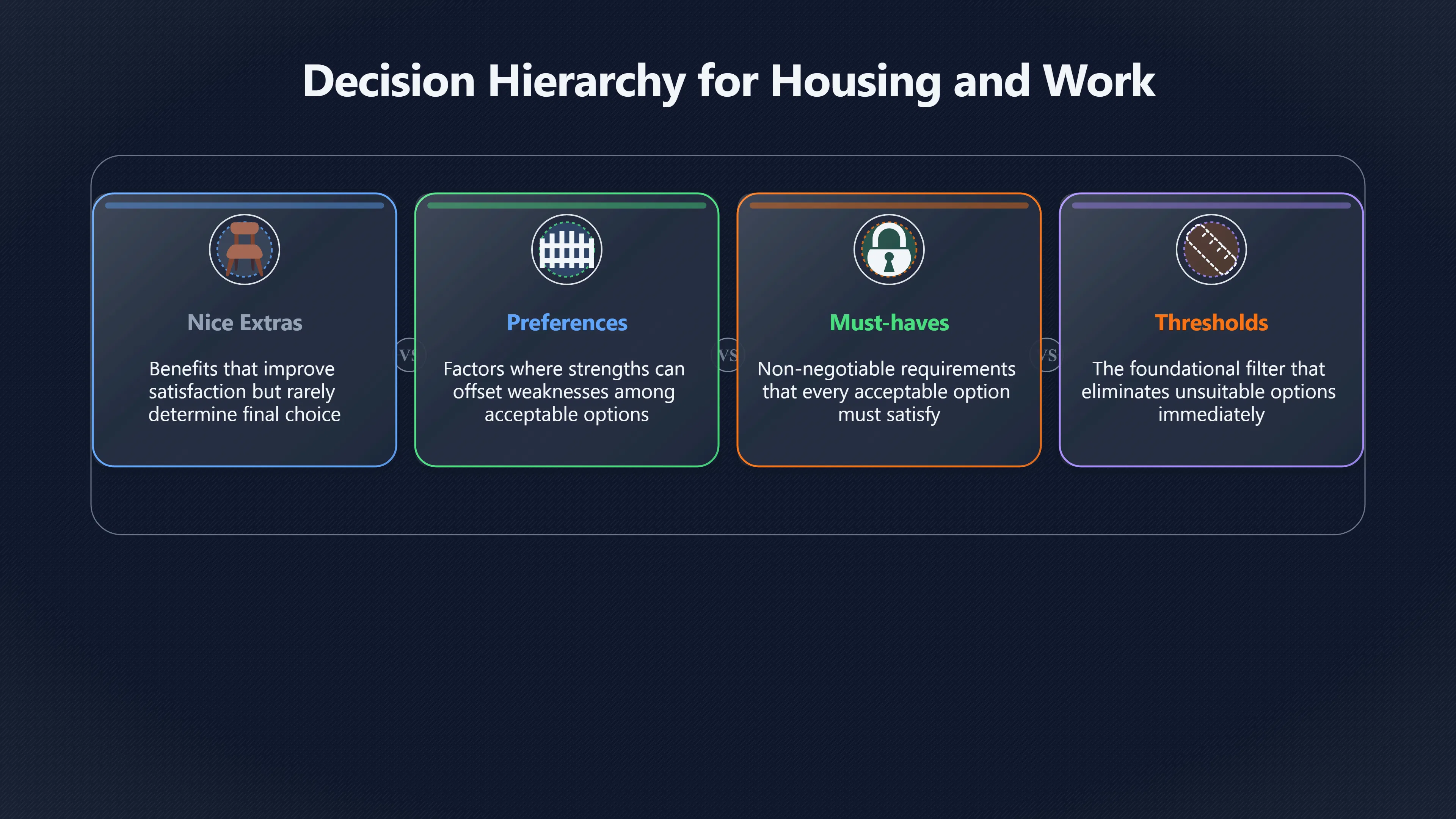
A practical decision becomes much clearer when every criterion belongs in one of three groups.
- Must-haves: Requirements that every acceptable option must meet. Failure on any one of these removes the option from consideration.
- Preferences: Factors that influence which acceptable option is better, but where strengths in one area may reasonably offset weaknesses in another.
- Nice extras: Benefits that improve satisfaction but should rarely determine the decision on their own.
The important point is that these groups are treated differently. A weighted comparison of preferences only begins after every option has passed the must-have screen. This reflects established decision-analysis practice, where difficult choices are often structured into stages rather than treated as one large scoring exercise. [analysisfunction.civilservice.gov.uk+2GOV.UK]analysisfunction.civilservice.gov.ukan introductory guide to mcdaAn Introductory Guide to Multi-Criteria Decision Analysis…1 May 2024 — MCDA is a way of helping decision-makers rationally choose betw…
For example:
CategoryHousing exampleMust-haveWithin budget, structurally safe, commute under one hourPreferenceLarger garden, quieter street, newer kitchenNice extraAttractive view, nearby cafés, decorative features
Without this separation, attractive extras can distract attention from whether an option is fundamentally viable.
Why small benefits should not offset core failures
Many informal decision methods rely on long lists of pros and cons. This creates a hidden problem: numerous minor advantages can appear to outweigh one critical disadvantage.
Imagine comparing two jobs.
- Job A pays slightly more, offers free lunches, modern offices and flexible dress.
- Job B offers fewer perks but provides stable hours compatible with childcare.
If predictable working hours are genuinely essential, Job A should not remain in contention simply because its list of minor benefits is longer.
Researchers describe this distinction as non-compensatory versus compensatory decision-making. In a non-compensatory stage, alternatives failing key criteria are eliminated. Only afterwards does compensatory thinking compare the remaining options by balancing multiple strengths and weaknesses. This reduces mental effort while protecting decisions from being distorted by irrelevant positives. [Nielsen Norman Group]nngroup.comNielsen Norman GroupCompensatory vs Noncompensatory: 2 Decision-Making…25 Oct 2020 — A noncompensatory decision-making strategy elimin…
Decision matrices illustrate the same danger. If every criterion receives a numerical score, enough small advantages may mathematically outweigh a missing essential requirement. For that reason, many decision-analysis guides recommend identifying mandatory requirements before applying weighted comparisons. [Wikipedia]WikipediaDecision-matrix methodDecision-matrix method
Set thresholds that are concrete rather than emotional
A threshold works best when it can be tested objectively.
Instead of writing:
- “Reasonably affordable”
- “Good commute”
- “Interesting work”
write:
- Monthly housing cost below 35% of take-home pay.
- Commute no longer than 50 minutes each way.
- Role includes at least two days each week working on technical problems.
Concrete thresholds reduce the temptation to reinterpret your standards after becoming emotionally attached to one option.
They also make discussions easier when multiple people are deciding together. Rather than debating vague impressions, participants can first ask whether each option satisfies agreed minimum conditions.

A simple threshold routine for housing, work and study choices
The process does not need to be complicated.
- List all possible criteria. Write down everything that seems relevant.
- Identify genuine deal-breakers. Ask, “If this requirement is missing, would I reject the option regardless of its other strengths?”
- Convert deal-breakers into measurable thresholds. Replace vague language with observable conditions whenever possible.
- Screen every option. Eliminate any option that fails even one must-have threshold.
- Compare only the survivors. Use tradeoffs, weighting or ranking only among options that already satisfy every essential requirement.
This two-stage approach keeps tradeoff analysis focused where it belongs: comparing viable alternatives rather than trying to rescue unsuitable ones with extra points elsewhere. [Nielsen Norman Group]nngroup.comNielsen Norman GroupCompensatory vs Noncompensatory: 2 Decision-Making…25 Oct 2020 — A noncompensatory decision-making strategy elimin…
Practical examples
Housing
Suppose your thresholds are:
- Rent within your budget.
- Safe neighbourhood.
- Commute under one hour.
- Lease permits pets.
A beautiful flat with excellent transport links but a rent well beyond your budget is rejected immediately. There is no value in debating whether its balcony compensates for financial strain.
Employment
Your must-haves might include:
- Permanent contract.
- Minimum salary required to meet living costs.
- Reasonable working hours.
- Location compatible with family responsibilities.
Once these conditions are satisfied, you can compare culture, promotion prospects, training and flexibility.
Study
Essential thresholds could include:
- Accredited qualification.
- Affordable fees.
- Course content aligned with career goals.
- Attendance requirements compatible with existing commitments.
After those are satisfied, preferences such as campus facilities, optional modules or accommodation become meaningful comparison points.
Common mistakes when setting thresholds
Thresholds improve decisions only when used carefully.
A threshold is probably too strict if almost no realistic option can satisfy it. In that case, the requirement may actually be a preference disguised as a necessity.
Conversely, a threshold is probably too weak if you regularly accept options that later create predictable problems. Raising the minimum standard may prevent repeated mistakes.
Another error is changing thresholds midway through a decision because one attractive option fails them. Revising criteria is sometimes justified when new information emerges, but changing them simply to accommodate a favourite option undermines the purpose of setting them in advance.
The analytical advantage
Separating must-have thresholds from ordinary preferences improves judgement in several ways. It reduces cognitive overload by eliminating unsuitable options early, prevents minor benefits from masking major deficiencies, and makes later tradeoff comparisons more meaningful. Instead of asking which option has the longest list of positives, you first ask the more important question: which options are genuinely acceptable?
Only after that question has been answered does weighing tradeoffs become a useful analytical exercise rather than an attempt to justify an option that never met your essential requirements in the first place. Nielsen Norman Group+2analysisfunction.civilservice.gov.uk [nngroup.com]nngroup.comNielsen Norman GroupCompensatory vs Noncompensatory: 2 Decision-Making…25 Oct 2020 — A noncompensatory decision-making strategy elimin…
eBay marketplace picks
Marketplace Samples
Live-tested eBay searches with available results related to this page.



Endnotes
-
Source: analysisfunction.civilservice.gov.uk
Title: an introductory guide to mcda
Link: https://analysisfunction.civilservice.gov.uk/policy-store/an-introductory-guide-to-mcda/Source snippet
An Introductory Guide to Multi-Criteria Decision Analysis...1 May 2024 — MCDA is a way of helping decision-makers rationally choose betw...
Published: May 2024
-
Source: GOV.UK
Title: use of multi criteria decision analysis in options appraisal of economic cases
Link: https://www.gov.uk/government/publications/green-book-supplementary-guidance-multi-criteria-decision-analysis/use-of-multi-criteria-decision-analysis-in-options-appraisal-of-economic-casesSource snippet
of Multi-Criteria Decision Analysis in options appraisal...16 May 2024 — MCDA is a technique that helps decision-makers make rational ch...
Published: May 2024
-
Source: Wikipedia
Title: Decision-matrix method
Link: https://en.wikipedia.org/wiki/Decision-matrix_method -
Source: nngroup.com
Link: https://www.nngroup.com/articles/compensatory-noncompensatory-decisions/Source snippet
Nielsen Norman GroupCompensatory vs Noncompensatory: 2 Decision-Making...25 Oct 2020 — A noncompensatory decision-making strategy elimin...
Additional References
-
Source: mitsloan.mit.edu
Link: https://mitsloan.mit.edu/shared/ods/documents?DocumentID=4054Source snippet
MIT SloanNON-COMPENSATORY (AND COMPENSATORY)...The researcher postulates a two-stage consider-then-choose decision process and postulate...
-
Source: researchgate.net
Title: A Practical Guide to Multi Criteria Analysis
Link: https://www.researchgate.net/profile/Marco-Dean/publication/358131153_A_Practical_Guide_to_Multi-Criteria_Analysis/links/61f198a98d338833e398624c/A-Practical-Guide-to-Multi-Criteria-Analysis.pdfSource snippet
A Practical Guide to Multi-Criteria Analysis26 Jan 2022 — Comparison of Compensatory and non-Compensatory Multi Criteria Decision Making...
-
Source: pure.qub.ac.uk
Title: Thresholds theory Final accepted 19.4.24
Link: https://pure.qub.ac.uk/files/606934557/Thresholds_theory-Final_accepted_19.4.24.pdfSource snippet
decisions in social work: using theory to support...by D Turney · 2024 · Cited by 11 — We argue that although these threshold concepts a...
-
Source: youtube.com
Title: Elimination by Aspects: Goal-Oriented Decision Making
Link: https://www.youtube.com/watch?v=FvqUfneMjDQSource snippet
Multi-Criteria Decision Analysis, Part 1: Non-Compensatory Methods...
-
Source: youtube.com
Title: What is the Conjunctive Decision Rule?
Link: https://www.youtube.com/watch?v=czQfy8t0lNQSource snippet
What is the Elimination-by-Aspects Decision Rule?...
-
Source: youtube.com
Title: Multi-Criteria Decision Analysis, Part 1: Non-Compensatory Methods
Link: https://www.youtube.com/watch?v=SiktHMjDdUwSource snippet
What is the Conjunctive Decision Rule?...
-
Source: youtube.com
Title: What is the Elimination-by-Aspects Decision Rule?
Link: https://www.youtube.com/watch?v=nPOHD4njosgSource snippet
What is the Compensatory Decision Rule?...
-
Source: youtube.com
Title: What is the Compensatory Decision Rule?
Link: https://www.youtube.com/watch?v=6N6EuqIVR4U
Topic Tree