Within Sharper Thinking
What Else Could Explain This?
A strong explanation is not just plausible; it has survived comparison with serious alternatives.
On this page
- Generate rival explanations
- Compare fit with evidence
- Avoid satisfying stories
Page outline Jump by section
Introduction
A strong explanation is not simply the first story that makes sense. It is the explanation that still looks good after being compared with serious rivals. In practical thinking, this means asking: what else could explain this evidence, and what evidence would separate the possibilities? The habit matters because coherent stories are easy to build after the fact. People often stop once they have a plausible account, then collect supporting details around it. Better analysis deliberately generates alternatives, looks for evidence that would count against each one, and resists the comfort of a tidy conclusion when several explanations remain live. Research on confirmation bias, “consider the opposite” interventions, scientific hypothesis-testing, intelligence analysis, forensic reasoning and diagnostic error all points to the same mechanism: judgement improves when explanations compete against each other rather than being defended one at a time.[PubMed+2Springer Nature Link]pubmed.ncbi.nlm.nih.govConsidering the opposite: a corrective strategy for social…by CG Lord · 1984 · Cited by 1165 — Individuals who are induced to co…
Why the first coherent story is often too easy to believe
The mind is good at turning scattered evidence into a narrative. That ability is useful: it helps us infer motives, diagnose everyday problems, and act before every uncertainty is resolved. The danger is that plausibility can arrive before comparison. Once a story explains several facts, it can feel stronger than it really is, even if another explanation would explain the same facts just as well.
This is the central warning behind “inference to the best explanation”: the aim is to infer the hypothesis that best explains the evidence, not merely one that explains it. Contemporary overviews of the idea stress that explanatory virtues such as simplicity, scope and unification are useful but contested; philosophers still debate whether these virtues reliably track truth. That caveat is important for everyday reasoning. A simpler story may be cleaner, but a messier rival may fit the evidence better.[Springer Nature Link]link.springer.comSpringer Nature LinkInference to the Best Explanation: An Overview | Springer Nature Link…
A familiar example is a delayed reply to an important message. One explanation is that the recipient is annoyed. But rival explanations are immediately available: they are travelling, busy, ill, avoiding all messages, unsure how to answer, or never saw it. The evidence “no reply” fits all of them. The explanation becomes stronger only when more diagnostic evidence appears: a pattern of avoidance, a later apology, a read receipt, a mutual friend’s update, or a reply to someone else on the same topic.
The practical point is not to become paralysed by endless possibilities. It is to notice when a fact is compatible with a favoured story but not selective enough to support it over alternatives.
Generate rival explanations before judging the evidence
Rival hypotheses are not objections added at the end. They should be created early, before a preferred explanation hardens into the default. T. C. Chamberlin’s method of multiple working hypotheses, later discussed in modern scientific-method debates, was designed to avoid the “ruling theory” problem: once a single hypothesis becomes personally or professionally attractive, the thinker may unconsciously arrange the evidence around it.[Auburn University]auburn.eduUniversity The Method of Multiple Working Hypotheses Author(s1964). Platt wrote: "This charming paper deserves to be reprinted." Several readers, having…Read more…
A useful rival explanation has three features. It is plausible enough to deserve testing, different enough to make distinct predictions, and specific enough that evidence could count against it. “Anything is possible” is not a useful alternative. “The sales drop came from a tracking error rather than lower demand” is useful because it points to different evidence: analytics logs, payment data, customer traffic, refund rates, and comparisons with unaffected channels.
Good alternative generation often starts with a small set of prompts:
- Different cause: What other mechanism could produce the same observation?
- Different actor: Who else could have caused or influenced the outcome?
- Different timescale: Is this a temporary fluctuation rather than a trend?
- Different measurement: Could the evidence reflect how the data was collected?
- Different base rate: Is this event common enough that no special cause is needed?
- Different incentive: Who benefits from one interpretation being accepted?
- Different missing fact: What fact, if discovered, would make the current story collapse?
The value of these questions is that they change the task from defending an answer to exploring a space of possibilities. That shift is especially important in ambiguous problems, where the available facts often fit several accounts at once.

Compare fit, not just support
The most common mistake in judging explanations is to ask only, “Does this evidence support my hypothesis?” A better question is, “Does this evidence support my hypothesis more than the alternatives?” This difference is the heart of serious evidential reasoning.
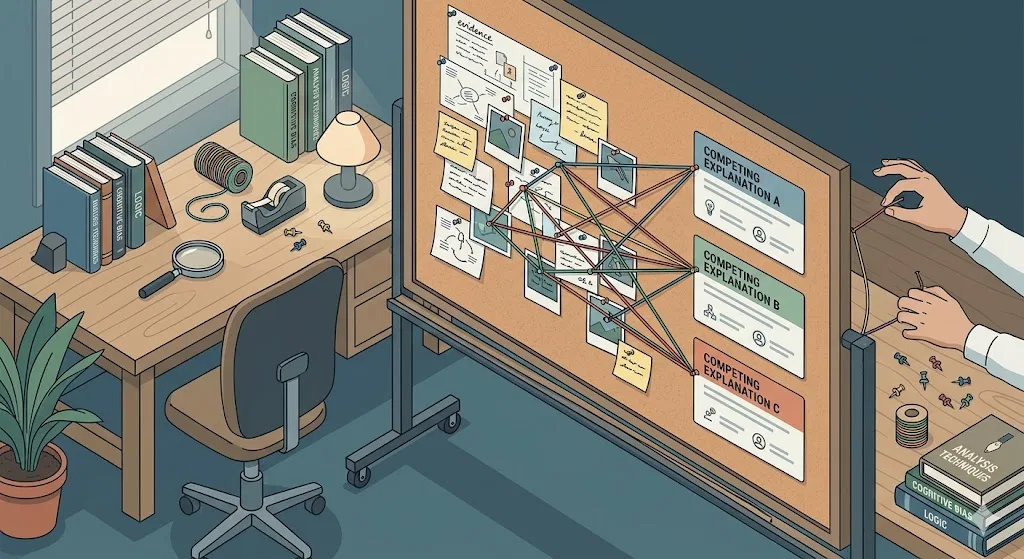
Richards Heuer’s work on Analysis of Competing Hypotheses, developed for intelligence analysis, makes this point sharply. The method asks analysts to list plausible hypotheses, compare each piece of evidence against each hypothesis, and pay special attention to disconfirming evidence. Heuer argues that the most probable hypothesis is often the one with the least evidence against it, not the one with the most evidence in favour of it.[IALEIA]ialeia.orgPsychology of Intelligence AnalysisPsychology of Intelligence Analysis
That principle is powerful because much evidence is non-diagnostic. Suppose a company launches a new product and revenue rises. The increase is consistent with “the launch worked”, but it may also be consistent with seasonality, a competitor’s outage, a pricing change, a one-off bulk purchase, a reporting change, or an advertising campaign that began earlier. The evidence matters most when it separates these explanations. For example, if new customers came mainly from the product’s target segment and began converting after launch exposure, the product explanation gains strength. If revenue rose across unrelated products and regions at the same time, the product story weakens.
A compact comparison can prevent premature certainty:
Evidence questionFavoured explanationRival explanationWhat would discriminate?Does the evidence uniquely fit one story?“The new training improved performance.”“The task got easier.”Compare with a control group or unchanged task.Does timing line up?“The policy caused the change.”“The trend had already begun.”Look at pre-policy trend and comparable cases.Is the measure trustworthy?“Complaints fell.”“Reporting became harder.”Check independent measures, not just complaint counts.What evidence is missing?“The person intended harm.”“They made a mistake under pressure.”Look for prior warnings, incentives, communications, and context.
This style of comparison does not require formal mathematics. It requires treating evidence as a filter. The best evidence is not the most vivid evidence; it is the evidence that rules out live alternatives.
Look for disconfirmation without pretending certainty is easy
Many people think “being objective” means looking for more evidence. Often it means looking for a different kind of evidence: evidence that could show the explanation is wrong. The classic Wason rule-discovery task illustrates the problem. Participants given the sequence “2-4-6” often tested examples that matched their current rule rather than examples that might falsify it. Recent research using a related task found that prompting people to think in opposites nearly doubled success and reduced repeated testing of the same hypothesis.[PMC]pmc.ncbi.nlm.nih.govOpen source on nih.gov.
The older “consider the opposite” research in social judgement found a similar corrective effect. Lord, Lepper and Preston argued that several biases arise from failing to consider possibilities at odds with the current belief, and their experiments found that inducing people to consider the opposite reduced biased assimilation and biased hypothesis-testing.[PubMed]pubmed.ncbi.nlm.nih.govConsidering the opposite: a corrective strategy for social…by CG Lord · 1984 · Cited by 1165 — Individuals who are induced to co…
Disconfirmation does not mean trying to destroy every idea. It means asking what the world should look like if the idea is false. A manager who believes “the team is resistant to change” might look for cases where the same team adopted changes quickly. A reader who believes “this article is propaganda” might ask whether it includes concessions, primary evidence, and details that cut against its apparent line. A doctor considering one diagnosis must keep asking which symptoms are absent, unusual, or better explained by another condition.
This habit is difficult because supportive evidence feels productive. Disconfirming evidence feels like delay, self-doubt or disloyalty. In reality, it is a way to spend less time being confidently wrong.
Learn from fields where rival hypotheses are built into the process
Some professions have turned alternative explanations into formal safeguards because the cost of a single satisfying story can be high.
In accident investigation, the US National Transportation Safety Board describes a process that begins with fact gathering, including records, interviews and technical data, before specialists analyse the sequence of events and determine probable cause. The structure matters because early reports after accidents often seize on one visible factor, while final investigations may identify a chain of mechanical, human, organisational and environmental contributors.[NTSB]ntsb.govThe Investigative Process…
In medicine, diagnostic reasoning uses the idea of a differential diagnosis: a set of possible conditions that could explain the patient’s presentation. Reviews of diagnostic error repeatedly identify premature closure as a major failure mode, where the clinician accepts a diagnosis before the diagnostic process has been adequately completed.[Swiss Medical Weekly]smw.chOpen source on smw.ch.
In forensic science, the likelihood ratio framework explicitly compares the probability of observations under two propositions, often a prosecution proposition and a defence proposition. UK guidance on DNA mixture interpretation states that meaningful evaluation requires both propositions and that the weight assigned to evidence depends critically on how those propositions are framed. It also warns that presenting only one side of the likelihood ratio can be unbalanced and biased.[GOV.UK]GOV.UKDN A mixture interpretation (accessibleDN A mixture interpretation (accessible
These fields differ, but the thinking pattern is shared. The analyst does not ask, “Can I tell a story that fits?” The analyst asks, “Which story survives comparison with the other serious stories, and where is the comparison still weak?”

Avoid satisfying stories that explain too much
A satisfying explanation can become dangerous when it is elastic enough to absorb any evidence. If a theory explains success as proof of competence and failure as proof of sabotage, it has stopped taking evidential risk. If a workplace story explains every awkward interaction as “politics”, it may feel worldly but become too vague to test. If a health claim treats improvement as proof the remedy worked and deterioration as proof of “detox”, the explanation cannot lose.
Good rival-hypothesis thinking therefore asks whether an explanation makes risky predictions. What would you expect to see if it were true? What would surprise you? What would make you lower confidence? This is where simplicity alone is not enough. A simple story can be unfalsifiable; a more complex story can be more testable.
The same caution applies to elegant narratives about people. “She is lazy”, “he is manipulative”, “they hate change”, “customers do not care about quality” and “the public is irrational” may each explain a few observations. But they often compete with less character-based explanations: unclear incentives, bad instructions, fatigue, fear of embarrassment, poor design, missing information, conflicting goals or a different interpretation of the situation.
A useful explanation should narrow attention without closing it. It should help you predict, investigate and act. If it mainly helps you feel finished, it may be a satisfying story rather than a tested one.
A practical routine for everyday analysis
For ordinary decisions, a full formal matrix is often too much. A lighter routine can still capture the core discipline.
Start by writing the favoured explanation in one sentence. Then force at least two serious rivals. They should not be straw men; each should be something a thoughtful person could believe from the same starting evidence. Next, list the strongest evidence and mark whether it supports one explanation more than the others, fits all of them, or raises a problem for one. Finally, identify the next piece of evidence that would most change your mind.
For example, imagine a project is late:
- Hypothesis A: The team underestimated the work.
- Hypothesis B: Requirements changed after planning.
- Hypothesis C: Decision bottlenecks slowed progress.
- Hypothesis D: One dependency outside the team failed.
The evidence “the deadline was missed” fits all four. Task estimates, change logs, approval timestamps, dependency records and interviews would separate them. The resulting action changes with the diagnosis: improve estimation, freeze scope, change decision rights, or manage suppliers differently. The point is not just to be fair; it is to avoid solving the wrong problem.
This routine is especially valuable when the stakes are high, the issue is emotionally loaded, the evidence is incomplete, or the first explanation flatters your side. Those are precisely the conditions under which a coherent story becomes most seductive.
How to know when a rival hypothesis deserves attention
Not every alternative deserves equal time. Some are too vague, too remote, or already contradicted by strong evidence. Analytical skill includes filtering alternatives without dismissing them merely because they are inconvenient.
A rival hypothesis deserves attention when it meets at least one of these tests:
- It explains the same key evidence with fewer strained assumptions.
- It predicts something different that can be checked.
- It is supported by a relevant base rate or known mechanism.
- It accounts for evidence the favoured explanation ignores.
- It would change the decision if true.
- It is held by informed people who have access to different evidence or incentives.
A rival can be rejected when it repeatedly fails diagnostic tests, depends on ad hoc patches, conflicts with reliable evidence, or makes no distinct predictions. The goal is not permanent open-mindedness. The goal is earned closure.
That distinction matters. Poor thinking closes before comparison. Better thinking compares, tests, and then closes provisionally: “This is the best current explanation, these alternatives were considered, this is why they are weaker, and this is what would change the assessment.”
The real skill is disciplined uncertainty
Alternative explanations are not a decorative sign of open-mindedness. They are a mechanism for improving judgement. They slow down the move from evidence to conclusion, expose weak assumptions, and turn vague doubt into targeted inquiry.
The most useful mindset is neither gullibility nor reflexive scepticism. It is disciplined uncertainty: the willingness to hold several explanations long enough to compare them, while still making decisions when the evidence is good enough. A thinker who can say “this fits, but it also fits two other stories” is not being indecisive. They are noticing the exact point at which better evidence is needed.
In everyday life, that habit changes the quality of decisions. You stop asking only whether your explanation is plausible. You ask whether it has beaten its rivals.
Amazon book picks
Further Reading
Books and field guides related to What Else Could Explain This?. Use these as the next step if you want deeper reading beyond the article.
Thinking, Fast and Slow
Explains confirmation bias, overconfidence, and why comparing alternative explanations improves judgement.
The Scout Mindset
Directly advocates considering rival explanations and testing beliefs against evidence.
The Demon-Haunted World
Rating: 4.5/5 from 43 Google Books ratings
Promotes skeptical inquiry, hypothesis testing, and resisting attractive but unsupported stories.
How to Think About Weird Things: Critical Thinking for a New Age
Covers evaluating competing explanations, evidence quality, and common reasoning errors.
eBay marketplace picks
Marketplace Samples
Example marketplace items related to this page. Use the search link to explore similar finds on eBay.




Endnotes
1.
Source: link.springer.com
Link:https://link.springer.com/article/10.3758/s13421-025-01691-3
Source snippet
Springer Nature LinkThinking in opposites improves hypothesis testing performance in Wason’s rule-discovery task | Memory & Cognition | S...
2.
Source: ialeia.org
Title: Psychology of Intelligence Analysis
Link:https://www.ialeia.org/docs/Psychology_of_Intelligence_Analysis.pdf
3.
Source: link.springer.com
Link:https://link.springer.com/rwe/10.1007/978-3-031-10135
Source snippet
Springer Nature LinkInference to the Best Explanation: An Overview | Springer Nature Link...
4.
Source: auburn.edu
Title: University The Method of Multiple Working Hypotheses Author(s)
Link:https://www.auburn.edu/~tds0009/Articles/Chamberlain%201965.pdf
Source snippet
1964). Platt wrote: "This charming paper deserves to be reprinted." Several readers, having...Read more...
5.
Source: ntsb.gov
Link:https://www.ntsb.gov/investigations/process/Pages/default.aspx
Source snippet
The Investigative Process...
6.
Source: pmc.ncbi.nlm.nih.gov
Title: PMCErrors in clinical diagnosis: a narrative review
Link:https://pmc.ncbi.nlm.nih.gov/articles/PMC10467407/
7.
Source: GOV.UK
Title: DN A mixture interpretation (accessible)
Link:https://www.gov.uk/government/publications/dna-mixture-interpretation-fsr-g-222/dna-mixture-interpretation-accessible
8.
Source: link.springer.com
Link:https://link.springer.com/article/10.1186/s41235-022-00453-y
9.
Source: link.springer.com
Link:https://link.springer.com/article/10.1186/s41235-022-00460-z
10.
Source: atsb.gov.au
Link:https://www.atsb.gov.au/sites/default/files/media/27767/ar2007053.pdf
11.
Source: pubmed.ncbi.nlm.nih.gov
Link:https://pubmed.ncbi.nlm.nih.gov/6527215/
Source snippet
Considering the opposite: a corrective strategy for social...by CG Lord · 1984 · Cited by 1165 — Individuals who are induced to co...
12.
Source: pmc.ncbi.nlm.nih.gov
Link:https://pmc.ncbi.nlm.nih.gov/articles/PMC11561113/
13.
Source: smw.ch
Link:https://smw.ch/index.php/smw/article/download/1609/2103?inline=1
14.
Source: Wikipedia
Title: Analysis of competing hypotheses
Link:https://en.wikipedia.org/wiki/Analysis_of_competing_hypotheses
15.
Source: Wikipedia
Title: Confirmation bias
Link:https://en.wikipedia.org/wiki/Confirmation_bias
16.
Source: pmc.ncbi.nlm.nih.gov
Title: govclinical decision-making in a case of aortic dissection
Link:https://pmc.ncbi.nlm.nih.gov/articles/PMC3189641/
17.
Source: pmc.ncbi.nlm.nih.gov
Link:https://pmc.ncbi.nlm.nih.gov/articles/PMC12194747/
18.
Source: pmc.ncbi.nlm.nih.gov
Link:https://pmc.ncbi.nlm.nih.gov/articles/PMC7339646/
19.
Source: youtube.com
Title: Consider the Opposite
Link:https://www.youtube.com/watch?v=ieVaeYVaOrc
20.
Source: dictionary.cambridge.org
Link:https://dictionary.cambridge.org/us/dictionary/english/consider
21.
Source: frontiersin.org
Link:https://www.frontiersin.org/journals/medicine/articles/10.3389/fmed.2022.900543/full
Additional References
22.
Source: youtube.com
Link:https://www.youtube.com/watch?v=Y-J0FYOQRMY
Source snippet
Analysis of Competing Hypotheses (ACH): Finding Plausible Answers details a structured methodology for weighing multiple explanations and...
23.
Source: youtube.com
Title: Occam’s Razor
Link:https://www.youtube.com/watch?v=7lSKiqgOER4
Source snippet
Analysis of Competing Hypotheses (ACH): A Structured Analytic Technique (SAT) for FinCrime...
24.
Source: youtube.com
Title: Analysis of Competing Hypotheses (ACH): Finding Plausible Answers
Link:https://www.youtube.com/watch?v=xt4EnzvGA4w
Source snippet
This CIA Manual Trains the World's Sharpest Analytical Minds...
25.
Source: faa.gov
Link:https://www.faa.gov/sites/faa.gov/files/2022-11/Boeing%20review%20of%20NTSB%20probable%20cause.pdf
26.
Source: youtube.com
Title: This CIA Manual Trains the World’s Sharpest Analytical Minds
Link:https://www.youtube.com/watch?v=NMElghTG_kI
Source snippet
Abduction (Inference to the Best Explanation)...
27.
Source: youtube.com
Title: Abduction (Inference to the Best Explanation)
Link:https://www.youtube.com/watch?v=7TeM7rBhRmw
Source snippet
Occam's Razor - Definition & Examples (4 Minute Explainer)...
28.
Source: researchgate.net
Link:https://www.researchgate.net/publication/331942237_The_analysis_of_competing_hypotheses_in_intelligence_analysis
29.
Source: futuribles.com
Link:https://www.futuribles.com/wp-content/uploads/related-documents/analysis-of-competing-hypotheses.pdf?postId=73706
30.
Source: quizlet.com
Link:https://quizlet.com/79374016/ch-9-inference-to-the-best-explanation-flash-cards/
31.
Source: merriam-webster.com
Link:https://www.merriam-webster.com/dictionary/consider
Topic Tree