Within Intuition
When Should You Trust Expert Intuition?
Gut feelings become more trustworthy when repeated practice is paired with fast, clear correction from the real world.
On this page
- Kind versus wicked learning environments
- Practice, feedback, and calibrated confidence
- Everyday tests before trusting a gut feeling
Page outline Jump by section
Introduction
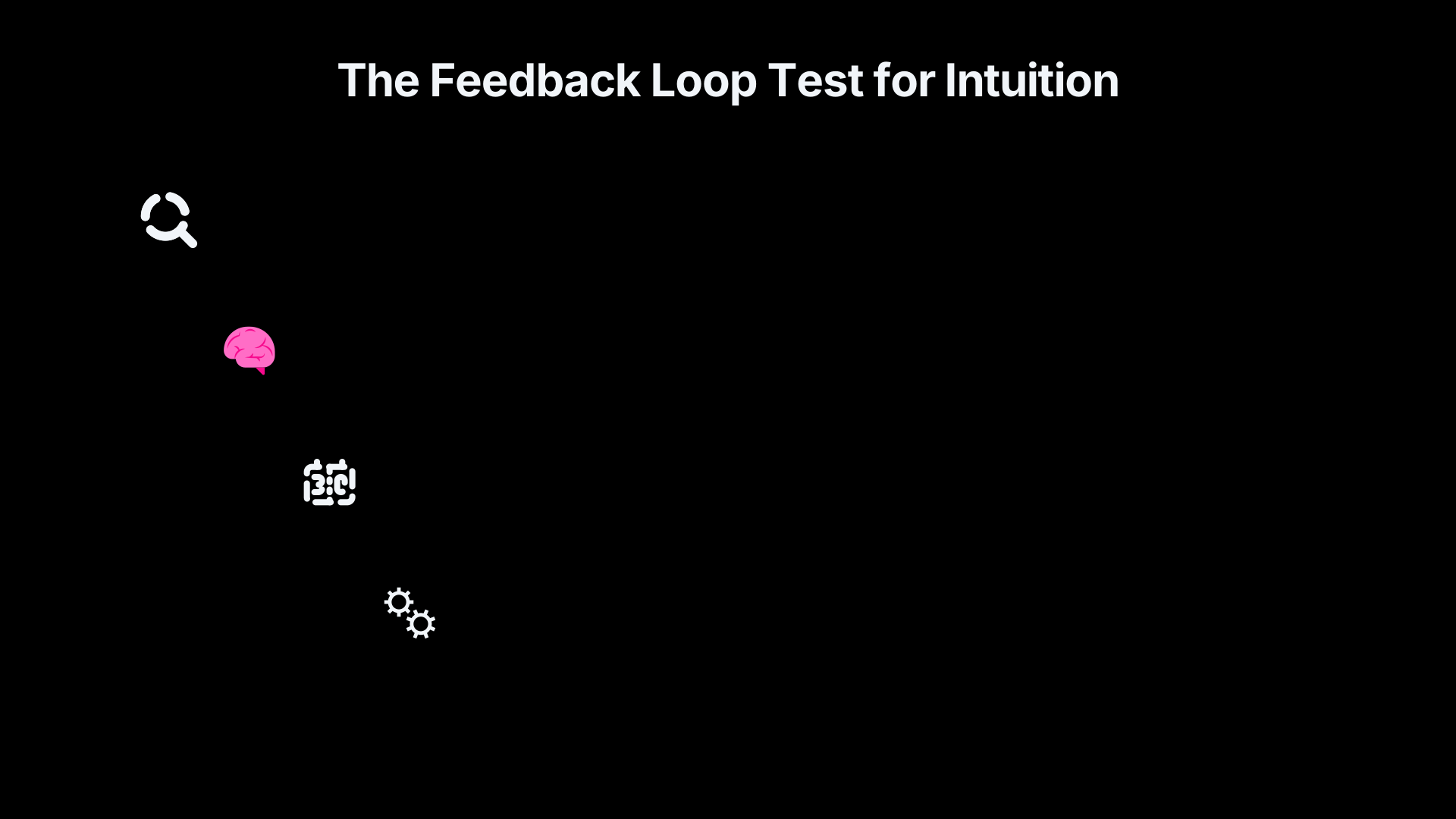
A useful rule for improving your thinking is that intuition should be trusted only after it has passed a feedback loop test. The feeling of certainty is not enough. What matters is whether repeated experience has given you accurate, corrective feedback that allows your brain to learn reliable patterns.
 Research on expertise shows that highly skilled intuition is real. Experienced firefighters, nurses, pilots, chess players, and craftspeople often recognise important signals before they can explain them. However, the same research shows that intuition becomes unreliable when the environment is noisy, unpredictable, or slow to provide feedback. The key question is not “Does this feel familiar?” but “Has this intuition been trained by reality?”[PubMed]nih.govpubmed.ncbi.nlm.nih.govPubMedConditions for intuitive expertise: a failure to disagreeby D Kahneman · 2009 · Cited by 4040 — This article reports on an effort t…
This distinction explains why some gut feelings deserve respect while others require a deliberate second pass.

When Should You Trust Expert Intuition?
Daniel Kahneman and Gary Klein approached intuition from different traditions. Kahneman became famous for documenting judgement errors and cognitive biases, while Klein studied experts making rapid decisions under pressure. Despite their disagreements, they reached a notable point of consensus: expert intuition is trustworthy only under specific conditions.[PubMed]nih.govpubmed.ncbi.nlm.nih.govPubMedConditions for intuitive expertise: a failure to disagreeby D Kahneman · 2009 · Cited by 4040 — This article reports on an effort t…
Their shared answer centred on two requirements:
- The environment must contain stable patterns that can actually be learned.
- The person must receive sufficient practice and clear feedback about whether their judgments were correct. PubMed+2LinkedIn
Without these conditions, experience alone can create confidence without improving accuracy. Someone may spend twenty years making forecasts, hiring staff, or picking investments and still fail to develop reliable intuition if the feedback is weak or misleading.
The feedback loop test therefore asks a simple question:
Has reality repeatedly corrected this judgement in a way that allows learning?
If the answer is unclear, caution is warranted.
Kind Versus Wicked Learning Environments
Psychologist Robin Hogarth described the difference between “kind” and “wicked” learning environments. This distinction helps explain why expertise develops rapidly in some domains and poorly in others. preview-prod-production.gurooproducer.com+2ResearchGate
Kind environments teach accurate intuition
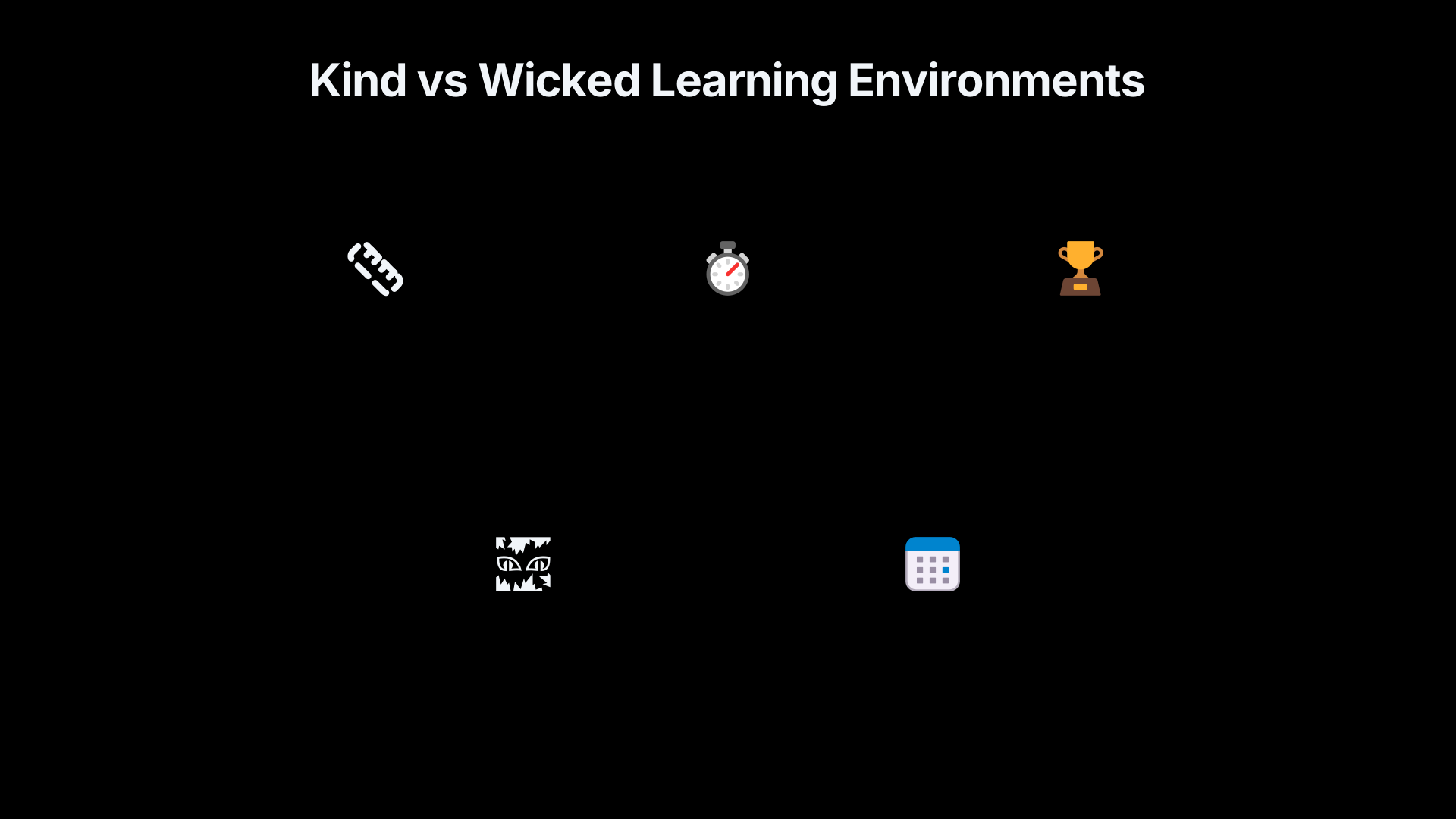
A kind environment has several characteristics:
[* Patterns are relatively stable.](#endnote-5 “
Source snippet
Hogarth characterized 'kind' learning environments as situations that are governed by stable rules and repetitive patterns; feedback is q...")...
- Cause and effect are connected.
- Feedback arrives quickly.
- Success and failure are visible.
- Similar situations occur repeatedly. preview-prod-production.gurooproducer.com+2LinkedIn
Chess is a classic example. A player makes a move and quickly discovers whether it improved or weakened the position. Tennis provides similar feedback. The player sees the result immediately and can adjust on the next point. Over thousands of repetitions, the brain learns dependable patterns. Psychology Today
Many forms of emergency response also contain enough regularity to build intuition. Experienced firefighters often recognise danger because previous situations repeatedly taught them which cues mattered. ResearchGate
Wicked environments create misleading confidence
A wicked environment looks very different:
[* Feedback is delayed.](#endnote-1 “
Source snippet
ResearchGate(PDF) Conditions for Intuitive ExpertiseKahneman and Klein (2009) show, for example, that intuitive expertise breaks down in")...
- Outcomes are influenced by luck. [* Important information is hidden.](#endnote-18 “
Source snippet
In “wicked” learning environments often some information is hidden. Even when it isn't, feedback...Read more")...
- Causes and effects are difficult to separate.
- Success can reinforce the wrong lesson. Driverless Crocodile+2YouTube
Financial markets illustrate the problem. An investor may make a poor decision and still earn money because the market rises. Another may make a sound decision and lose money because of events beyond their control. The outcome alone does not clearly teach the correct lesson. ResearchGate
Long-term business forecasting often suffers from the same issue. Predictions may take years to resolve, and by the time results appear it can be difficult to identify which assumptions were right or wrong. The feedback loop is too weak to train intuition effectively. ResearchGate+2McKinsey & Company
The danger is that people still accumulate experience in wicked environments. What they do not necessarily accumulate is expertise.
Practice, Feedback, and Calibrated Confidence
Many people assume that confidence signals competence. Research on expertise suggests the opposite relationship is often more useful: confidence becomes informative only when it has been calibrated against repeated feedback. PubMed
Consider two professionals:
- A radiologist who reviews thousands of scans and later learns whether the diagnosis was correct.
- A commentator who makes broad predictions about future economic trends and rarely receives precise scorekeeping.
Both may sound equally confident. Only one operates within a strong feedback system.
This is why deliberate practice matters. Repetition alone is insufficient. Improvement comes from repetition combined with correction. A musician improves by hearing mistakes. A surgeon improves through outcome tracking and review. An athlete improves because performance is measured continuously. Feedback closes the loop between action and reality. merlin.rebrovic.net+2preview-prod-production.gurooproducer.com
Kahneman and Klein argued that evaluating intuition requires evaluating the environment in which it was formed. The central question is not whether someone is experienced but whether their experience occurred in a setting that supports genuine learning. PubMed+2Semantic Scholar
Why experience sometimes fails
Several factors can prevent intuition from improving:
- Outcomes are rare, making learning slow.
- Feedback arrives months or years later.
- Success depends heavily on chance.
- People remember wins more vividly than mistakes.
- Incorrect beliefs are never systematically checked. ResearchGate+2Driverless Crocodile
Under these conditions, confidence can increase while accuracy remains unchanged. The person feels wiser because they have accumulated stories, but the stories have not necessarily taught valid lessons.
Everyday Tests Before Trusting a Gut Feeling
Most decisions do not require extensive analysis. However, before relying on instinct in an important situation, it is worth running a few quick checks.
Has this judgement been tested repeatedly?
Ask whether your intuition comes from many comparable situations with known outcomes.
A project manager who has overseen dozens of similar projects may have useful intuition about schedules. A first-time founder predicting the future of a new market probably has much weaker grounds for instinctive certainty.
Did feedback arrive clearly and quickly?
The shorter the delay between judgement and outcome, the easier it is to learn.
Cooking, sports, and many technical skills provide rapid correction. Strategic forecasting, politics, and long-term investing often do not. preview-prod-production.gurooproducer.com
Could luck explain the outcome?
A correct prediction is not always evidence of skill.
If a judgement succeeded once, ask whether the same reasoning would work repeatedly under similar conditions. One successful outcome may reflect chance rather than expertise.
Is the environment stable?
Patterns learned in one environment may fail when conditions change.
A manager’s instincts developed during rapid growth may become unreliable during recession. A clinician’s experience with common cases may not apply to unusual presentations. Expertise is often more specific than people realise. ResearchGate
Have you kept score?
One of the simplest ways to improve intuition is to track predictions and decisions.
Recording expectations before outcomes are known creates a personal feedback system. Over time, it becomes easier to identify where intuition is genuinely accurate and where it consistently overreaches.
The Practical Takeaway
The strongest intuition is not mysterious. It is the product of countless encounters with reality, each followed by information about what happened next. When feedback is rapid, accurate, and repeated, the brain becomes an effective pattern detector. When feedback is delayed, distorted, or absent, intuition can become little more than a persuasive feeling. PubMed+2preview-prod-production.gurooproducer.com
For decisions that matter, the feedback loop test offers a useful filter: trust intuition most when it was trained in a kind environment with clear correction, and become more sceptical when the environment is wicked, uncertain, or resistant to learning. That distinction often separates genuine expertise from overconfident guesswork. ResearchGate+2preview-prod-production.gurooproducer.com
Amazon book picks
Further Reading
Books and field guides related to When Should You Trust Expert Intuition?. Use these as the next step if you want deeper reading beyond the article.
Thinking, Fast and Slow
Discusses the debate over intuition, expertise, feedback, and when intuitive judgments can be trusted.
Peak
Explains how practice and feedback create reliable expert performance and intuition.
Sources of Power
Explains recognition-primed decision making and the conditions under which expert intuition becomes reliable.
eBay marketplace picks
Marketplace Samples
Example marketplace items related to this page. Use the search link to explore similar finds on eBay.



Endnotes
1.
Source: researchgate.net
Title: 26798603 Conditions for Intuitive Expertise
Link:https://www.researchgate.net/publication/26798603_Conditions_for_Intuitive_Expertise
Source snippet
ResearchGate(PDF) Conditions for Intuitive ExpertiseKahneman and Klein (2009) show, for example, that intuitive expertise breaks down in...
2.
Source: linkedin.com
Link:https://www.linkedin.com/posts/yuliia-drobot_pdf-conditions-for-intuitive-expertise-activity-7137409442857259008-4_mX
Source snippet
(PDF) Conditions for Intuitive Expertise A Failure to DisagreeGary Klein and Daniel Kahneman defined conditions for situations where intu...
3.
Source: preview-prod-production.gurooproducer.com
Title: hogarth et al 2015
Link:https://preview-prod-production.gurooproducer.com/learntolead2021/hogarth-et-al-2015.pdf
Source snippet
The Two Settings of Kind and Wicked Learning Environmentsby RM Hogarth · 2015 · Cited by 252 — Kind learning environments are a necessary...
4.
Source: researchgate.net
Title: 283828207 The Two Settings of Kind and Wicked Learning Environments
Link:https://www.researchgate.net/publication/283828207_The_Two_Settings_of_Kind_and_Wicked_Learning_Environments
Source snippet
A "kind" learning environment is one where...Read more...
5.
Source: linkedin.com
Title: Linked In How to improve feedback in wicked environments | Lisa F
Link:https://www.linkedin.com/posts/lisa-forestieri_wicked-vs-kind-learning-environments-activity-7312891653302685697-rApl
Source snippet
Hogarth characterized 'kind' learning environments as situations that are governed by stable rules and repetitive patterns; feedback is q...
6.
Source: youtube.com
Link:https://www.youtube.com/watch?v=KDWfsxfRKXc
Source snippet
The Myth of Experience: Kind and Wicked Learning...... kind” and “wicked” learning environments. In a kind learning environment, feedbac...
7.
Source: mckinsey.com
Title: strategic decisions when can you trust your gut
Link:https://www.mckinsey.com/capabilities/strategy-and-corporate-finance/our-insights/strategic-decisions-when-can-you-trust-your-gut
Source snippet
McKinsey & CompanyStrategic decisions: When can you trust your gut?1 Mar 2010 — “Conditions for intuitive expertise: A failure to disagre...
8.
Source: merlin.rebrovic.net
Link:https://merlin.rebrovic.net/blog/conditions-for-expert-intuition/
Source snippet
Conditions for expert intuition - Merlin RebrovićFeb 25, 2021 — Environments provide opportunities for learning through feedback...
9.
Source: linkedin.com
Link:https://www.linkedin.com/pulse/summary-daniel-kahneman-gary-kleins-article-called-failure-herbert-zq9be
Source snippet
A summary of Daniel Kahneman and Gary Klein's article...The article is based on one simple question: Under what conditions are the intui...
10.
Source: youtube.com
Title: Kind vs. Wicked
Link:https://www.youtube.com/watch?v=uFbxL2JTa6c
Source snippet
The Myth of Experience #1In The Myth of Experience, behavioral scientists Emre Soyer and Robin Hogarth take a transformative look at expe...
11.
Source: youtube.com
Title: Intuition Is Experience Speaking — with Gary Klein
Link:https://www.youtube.com/watch?v=BR3kfG6STZI
Source snippet
The Mind That Knows Before You Do...
12.
Source: youtube.com
Title: The Mind That Knows Before You Do
Link:https://www.youtube.com/watch?v=am-Qmlgz7RY
Source snippet
Dr Gary Klein: Decision Making under Uncertainty and the Role of Intuition...
13.
Source: youtube.com
Title: Dr Gary Klein: Decision Making under Uncertainty and the Role of Intuition
Link:https://www.youtube.com/watch?v=siGx2yawJdU
Source snippet
This video exploration clarifies how expert intuition requires specific environmental conditions to develop accurately, specifically cont...
15.
Source: semanticscholar.org
Link:https://www.semanticscholar.org/paper/Conditions-for-intuitive-expertise%3A-a-failure-to-Kahneman-Klein/f1a5fb0c4b9703b3213bc3bd2dfe1f79ee35d511
Source snippet
[PDF] Conditions for intuitive expertise: a failure to disagree.Evaluating the likely quality of an intuitive judgment requires an assess...
16.
Source: psychologytoday.com
Title: experience kind vs wicked
Link:https://www.psychologytoday.com/ca/blog/experience-studio/202007/experience-kind-vs-wicked
Source snippet
Psychology TodayExperience: Kind vs. WickedJul 24, 2020 — Tennis offers decision-makers a kind learning environment. This means that the...
17.
Source: driverlesscrocodile.com
Link:https://www.driverlesscrocodile.com/books-and-recommendations/learning-environments-kind-wicked-and-fiendish/
Source snippet
fiendish?Jan 31, 2021 — These games are kind learning environments in that they share high levels of constraint, unambiguous success crit...
18.
Source: driverlesscrocodile.com
Title: david epstein on kind and wicked learning environments
Link:https://www.driverlesscrocodile.com/books-and-recommendations/david-epstein-on-kind-and-wicked-learning-environments/
Source snippet
In “wicked” learning environments often some information is hidden. Even when it isn't, feedback...Read more...
19.
Source: Wikipedia
Title: Daniel Kahneman
Link:https://en.wikipedia.org/wiki/Daniel_Kahneman
Source snippet
Daniel KahnemanDaniel Kahneman was an Israeli-American psychologist best known for his work on the psychology of judgment and decision...
21.
Source: econlib.org
Title: Daniel Kahneman
Link:https://www.econlib.org/library/Enc/bios/Kahneman.html
Source snippet
Kahneman was born in Tel Aviv, Israel, and grew up in France. He earned his B.A. in psychology and mathematics at Hebrew Universit...
22.
Source: umsetzungsberatung.de
Link:https://www.umsetzungsberatung.de/service/read.php?nr=323
Source snippet
Literaturhinweise und Rezensionen4 Feb 2013 — Kahneman, Daniel; Klein, Gary (2009): Conditions for Intuitive Expertise A Failure to Disag...
23.
Source: mikeaponte.com
Title: wicked learning environments
Link:https://mikeaponte.com/uncategorized/wicked-learning-environments/
Source snippet
Oct 21, 2019 — The concept of “Kind” vs “Wicked” learning environments was studied and penned by cognitive psychologist Robin Hogarth. A...
Additional References
24.
Source: scribd.com
Link:https://www.scribd.com/document/689600086/Conditions-for-Intuitive-Expertise-A-Failure-to-Disagree
Source snippet
Conditions for Intuitive Expertise | PDF | Decision MakingHigh-validity environments provide stable and statistically significant cues th...
25.
Source: medium.com
Link:https://medium.com/big-self-society/heres-when-you-can-actually-trust-your-gut-decisions-1ecf2a191102
Source snippet
Here's When You Can Actually Trust Your Gut DecisionsKahneman thinks intuition doesn't work well in not-high-enough validity environments...
26.
Source: chegg.com
Link:https://www.chegg.com/homework-help/questions-and-answers/three-conditions-necessary-trust-intuition-regularity-exposure-feedback-exposure-confidenc-q136096422
Source snippet
What are the three conditions necessary to trust intuition?31 Jan 2024 — What are the three conditions necessary to trust intuition?regul...
27.
Source: princeton.edu
Link:https://www.princeton.edu/news/2024/03/28/daniel-kahneman-pioneering-behavioral-psychologist-nobel-laureate-and-giant-field
Source snippet
Daniel Kahneman, pioneering behavioral psychologist...Mar 28, 2024 — Daniel Kahneman, a professor emeritus of psychology and public affa...
28.
Source: studocu.com
Title: 591878 kind and wicked learning environments insights from hogarth et al
Link:https://www.studocu.com/en-us/document/university-of-california-los-angeles/fundamentals-of-learning/591878-kind-and-wicked-learning-environments-insights-from-hogarth-et-al/142632744
Source snippet
591878 Kind and Wicked Learning EnvironmentsThis article explores the distinction between kind and wicked learning environments, emphasiz...
29.
Source: connectedpapers.com
Link:https://www.connectedpapers.com/main/f1a5fb0c4b9703b3213bc3bd2dfe1f79ee35d511/Conditions-for-intuitive-expertise%3A-a-failure-to-disagree./graph
Source snippet
D. Kahneman, Gary Klein. 2009, American Psychologist. PDF · S2 logo Semantic Scholar · doi logo...Read more...
30.
Source: entrepreneur.com
Title: How to Prosper in the Wicked Learning Environment of Young
Link:https://www.entrepreneur.com/leadership/how-to-prosper-in-the-wicked-learning-environment-of-young/424277
Source snippet
May 13, 2022 — In his research, the psychologist Robin Hogarth introduced the concepts of a wicked and a kind learning environment to ill...
Published: May 13, 2022
31.
Source: sciencex.cc
Title: Intuition in Decision-Making: Good or Bad?
Link:https://www.sciencex.cc/articles/intuition-decision-making
Source snippet
Kahneman and Klein found that the best performers aren't those who are most certain, but those who can effectively hold multiple...
32.
Source: davidepstein.substack.com
Title: kind and wicked learning environments
Link:https://davidepstein.substack.com/p/kind-and-wicked-learning-environments
Source snippet
substack.com"Kind" and "Wicked" Learning EnvironmentsIn what Hogarth called “kind” learning environments, experience led to predictable i...
33.
Source: commoncog.com
Title: ill structured domains not wicked
Link:https://commoncog.com/ill-structured-domains-not-wicked/
Source snippet
Ill-Structured Domains Aren't Necessarily WickedFeb 23, 2022 — In his 2001 book Educating Intuition, psychologist Robin Hogarth introduce...
Topic Tree