Within Calibration
A Simple Scorecard for Forecasting Skill
Brier scores give prediction journals a simple way to compare stated probabilities with what actually happened.
On this page
- What the Brier score measures
- How lower scores reflect better probability forecasts
- Limits of scoring small personal samples
Page outline Jump by section
Introduction
A prediction journal becomes much more valuable when it includes a consistent way to score forecasts after the outcome is known. The Brier score is one of the simplest and most widely used methods for doing this. Instead of asking only whether a prediction was right or wrong, it measures how close your stated probability was to reality. That makes it especially useful for improving judgement: a confident mistake is penalised more heavily than a cautious one, while a well-calibrated probability is rewarded even if certainty was impossible. Originally developed for weather forecasting, the Brier score is now widely used across forecasting research because it encourages honest probability estimates rather than exaggerated confidence.[Wikipedia]WikipediaBrier scoreBrier score
 Within a personal prediction journal, the score provides a running record of forecasting skill. Rather than remembering a few memorable successes or failures, you accumulate evidence about whether your confidence levels actually match the world.
What the Brier score measures
For a binary prediction—an event either happens or it does not—the Brier score is the average squared difference between the probability you assigned and the outcome that occurred. Outcomes are coded as either 1 (the event happened) or 0 (it did not).
For a single prediction:
- Forecast 90%, event occurs → score = (0.9 − 1)² = 0.01
- Forecast 90%, event does not occur → score = (0.9 − 0)² = 0.81
- Forecast 50%, regardless of outcome → score = 0.25
The score ranges from 0 (perfect) to 1 (worst possible under the modern binary formulation). Lower scores are always better.[Wikipedia]WikipediaBrier scoreBrier score
The squared-error design matters because it reflects the cost of overconfidence. Predicting an event with 99% confidence that then fails is treated as a much larger error than assigning 60% confidence and being wrong. Likewise, assigning 40% to an event that does happen is not considered disastrous because you acknowledged substantial uncertainty from the outset.
This property makes the Brier score a proper scoring rule: over many forecasts, the best strategy is to record your genuine beliefs rather than systematically inflating or hedging probabilities.[OUP Academic]academic.oup.comOUP AcademicProbabilistic Forecasts, Calibration and Sharpnessby T Gneiting · 2007 · Cited by 2513 — Like all proper scoring rules for bi…
How lower scores reflect better probability forecasts
A personal prediction journal is not trying to reward boldness or caution. It is trying to reward probabilities that correspond well with reality.
Imagine two people each making 100 forecasts.
- Forecaster A often predicts 95% confidence, but many of those predictions fail.
- Forecaster B usually predicts between 60% and 80%, matching uncertainty more realistically.
Forecaster A may appear impressive because of occasional highly confident successes, yet repeated overconfidence will produce a worse average Brier score. Forecaster B is likely to score better because the stated probabilities more closely reflect actual frequencies.
Over many predictions, the score naturally combines two desirable qualities:
- Calibration: Do events predicted at roughly 70% actually occur about 70% of the time?
- Resolution (or sharpness): Are you willing to move away from 50% when the evidence genuinely supports stronger probabilities?
Forecasting research emphasises that excellent forecasters are not simply cautious. They distinguish situations where evidence justifies high confidence from those where uncertainty remains. Proper scoring rules such as the Brier score reward this combination of good calibration and informative forecasts.[OUP Academic]academic.oup.comOUP AcademicProbabilistic Forecasts, Calibration and Sharpnessby T Gneiting · 2007 · Cited by 2513 — Like all proper scoring rules for bi…
For a prediction journal, this means that improvement is visible even before overall accuracy changes dramatically. You may still experience many incorrect predictions, but your confidence can become progressively better matched to reality.
Using the score in a personal prediction journal
The mechanics are straightforward.
For every prediction:

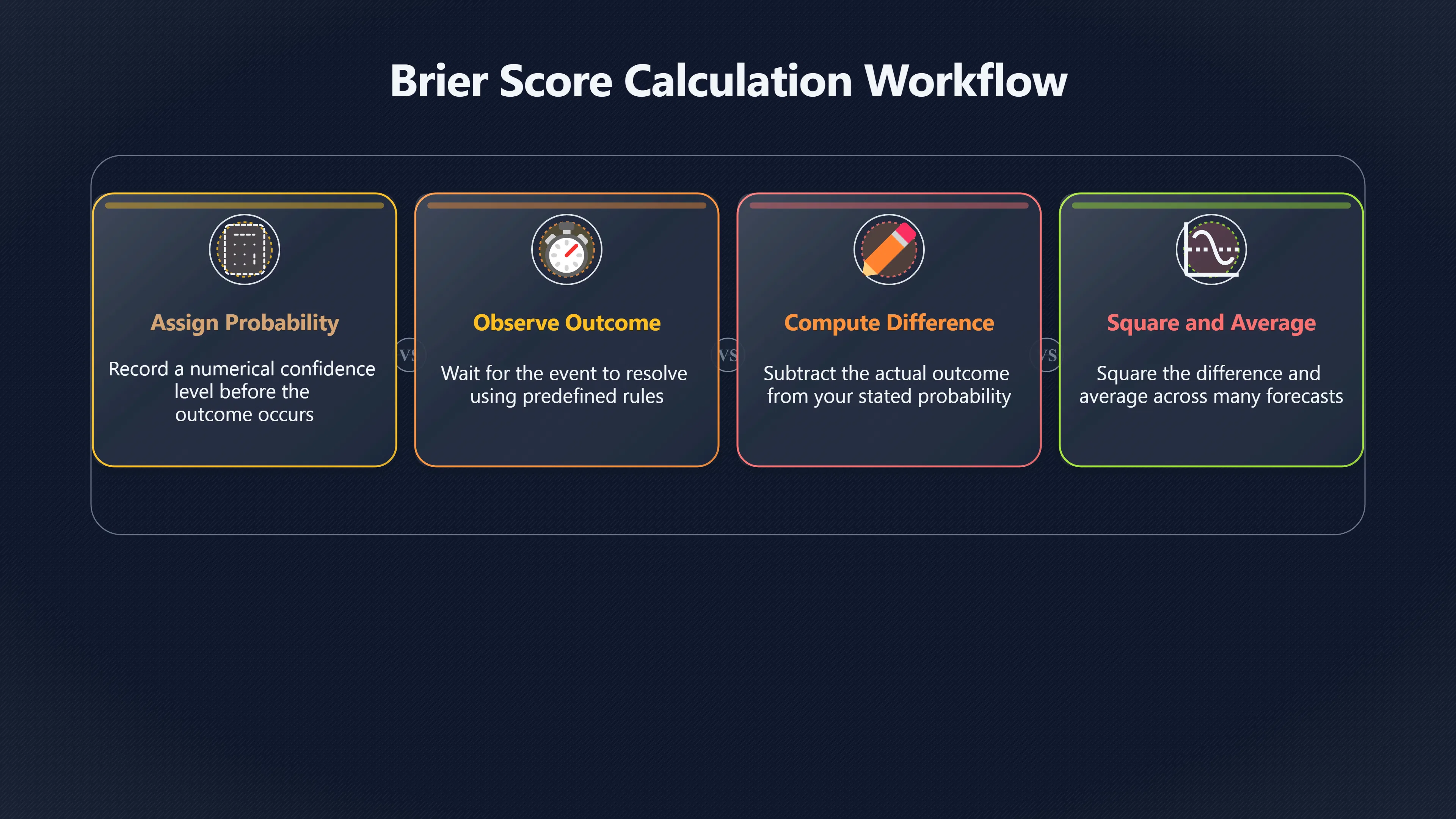
- Record a probability before the outcome is known.
- Wait until the event resolves using a predefined resolution rule.
- Calculate the Brier score for that prediction.[Wikipedia]WikipediaBrier scoreBrier score
- Average scores across many predictions.
A spreadsheet can automate the calculation using the formula:
(Predicted probability − Actual outcome)²
where the outcome is 1 if the event occurred and 0 otherwise.
The average is more informative than individual scores. A single unfortunate forecast tells little about forecasting skill, but dozens or hundreds begin to reveal consistent patterns.
Reviewing the highest-scoring (worst) forecasts is particularly valuable. Questions worth asking include:
- Was I consistently too confident?
- Did I ignore important base rates?
- Did I update too slowly when new evidence appeared?
- Did I use probabilities like 95% or 99% too freely?
This shifts post-mortems away from simply asking whether a prediction succeeded and towards understanding whether the confidence level itself was justified.
Limits of scoring small personal samples
Although the Brier score is mathematically simple, interpreting it requires caution when the number of forecasts is small.
With only twenty or thirty predictions, randomness can dominate. A few surprising outcomes may substantially change your average score even if your judgement has not changed much. This is particularly true for rare events, where meaningful comparisons often require much larger datasets before differences in forecasting skill become statistically reliable. Meteorological verification research has shown that evaluating rare-event forecasts may require very large sample sizes, especially when distinguishing between already strong forecasters.[Wikipedia]WikipediaBrier scoreBrier score
Several practical limitations follow.
- Small samples are noisy. Avoid drawing strong conclusions from only a few months of predictions.
- Rare events distort comparisons. If you mostly forecast unusual events, average scores may fluctuate considerably.
- Question difficulty matters. A journal dominated by extremely hard predictions will naturally produce different scores from one containing routine operational forecasts.
Because of these issues, comparing your own scores over time is usually more informative than comparing them with someone else’s unless both people forecast similar questions over similar periods.
What the score does not tell you
A low Brier score does not mean every prediction was correct.(#endnote-1 “Endnote 1”)[Wikipedia]WikipediaBrier scoreBrier score
Likewise, a high score does not necessarily mean your reasoning was poor. Unexpected events happen, and a well-justified 70% prediction will still be wrong about three times out of ten.
The score also cannot explain why a forecast succeeded or failed. A prediction journal should therefore preserve the reasoning behind each probability. Reviewing assumptions alongside the numerical score often reveals recurring judgement errors—such as neglecting base rates, relying on vivid anecdotes, or failing to update after new information—that the score alone cannot diagnose.
Researchers have also pointed out that the Brier score reflects not only forecasting quality but, in some settings, characteristics of the underlying data and outcome distribution. More recent methodological work therefore recommends interpreting scores alongside the context in which predictions were made rather than treating a single number as a complete measure of forecasting ability.[PMC]pmc.ncbi.nlm.nih.govOn misconceptions about the Brier score in binary prediction…by L Hoessly · 2026 · Cited by 19 — The Brier score was shown to refle…
Why Brier scores strengthen deliberate thinking
The greatest value of the Brier score is not mathematical precision but behavioural feedback. It converts vague memories into measurable evidence. Over months or years, a prediction journal stops being a collection of anecdotes and becomes a record of how accurately your confidence tracks reality.
That feedback encourages more disciplined habits: expressing uncertainty numerically, avoiding unjustified certainty, updating beliefs when evidence changes, and evaluating yourself against outcomes rather than hindsight. In that sense, the Brier score serves as a simple scorecard for thinking itself, making gradual improvements in calibration visible through accumulated experience rather than isolated wins or losses.
Amazon book picks
Further Reading
Books and field guides related to A Simple Scorecard for Forecasting Skill. Use these as the next step if you want deeper reading beyond the article.
Thinking, Fast and Slow
Helps readers understand the cognitive biases that forecasting scorecards are designed to reveal.
The Signal and the Noise
Provides broad context for probabilistic forecasts and evaluating predictive performance.
How to Measure Anything
Encourages quantitative evaluation of uncertain judgments and decisions, complementing forecast scoring.
Superforecasting: The Art and Science of Prediction
Explains forecasting accuracy, calibration, and the mindset behind scoring predictions such as the Brier score.
eBay marketplace picks
Marketplace Samples
Example marketplace items related to this page. Use the search link to explore similar finds on eBay.



Endnotes
1.
Source: Wikipedia
Title: Brier score
Link:https://en.wikipedia.org/wiki/Brier_score
2.
Source: academic.oup.com
Link:https://academic.oup.com/jrsssb/article/69/2/243/7109375
Source snippet
OUP AcademicProbabilistic Forecasts, Calibration and Sharpnessby T Gneiting · 2007 · Cited by 2513 — Like all proper scoring rules for bi...
3.
Source: pmc.ncbi.nlm.nih.gov
Link:https://pmc.ncbi.nlm.nih.gov/articles/PMC12818272/
Source snippet
On misconceptions about the Brier score in binary prediction...by L Hoessly · 2026 · Cited by 19 — The Brier score was shown to refle...
Additional References
4.
Source: dataopsschool.com
Title: What is Brier Score?
Link:https://dataopsschool.com/blog/brier-score/
Source snippet
Meaning, Architecture, Examples, Use...17 Feb 2026 — The Brier Score is a proper scoring rule for binary or categorical probabilistic fo...
5.
Source: arxiv.org
Link:https://arxiv.org/html/2407.00650v1
Source snippet
Proper Scoring Rules for Multivariate Probabilistic...30 Jun 2024 — The Brier score (BS; Brier 1950) was initially introduced for binar...
6.
Source: youtu.be
Link:https://youtu.be/5mbX6ITznHk
Source snippet
"Multivariate Normal Distribution: [https://youtu.be/UVvuwv-ne1I](https://youtu.be/UVvuwv-ne1I) Estimated Calibrated Error (ECE): [https://youtu.be/NDY2fH1FitQ..."](https://youtu.be/NDY2fH1FitQ...")...
7.
Source: youtu.be
Link:https://youtu.be/NDY2fH1FitQ
Source snippet
*Contents* ▬▬▬▬▬▬▬▬▬▬▬▬▬▬▬▬▬▬▬▬▬▬▬▬ 00:00 - Problem Introduction...
8.
Source: youtube.com
Title: Episode 2: Decision Making
Link:https://www.youtube.com/watch?v=SZX5cQXuQvI
Source snippet
Model Calibration - Brier Score Explained - YouTube Model Calibration - Brier Score Explained - YouTube DataMListic...
9.
Source: youtu.be
Link:https://youtu.be/UVvuwv-ne1I
Source snippet
"Estimated Calibrated Error (ECE): [https://youtu.be/NDY2fH1FitQ..."](https://youtu.be/NDY2fH1FitQ...")...
10.
Source: journals.ametsoc.org
Title: waf1034 1.xml
Link:https://journals.ametsoc.org/view/journals/wefo/22/5/waf1034_1.xml
Source snippet
American Meteorological Society JournalsComparing Probabilistic Forecasting Systems with the Brier...by CAT Ferro · 2007 · Cited by 120...
11.
Source: youtube.com
Title: Measuring Accuracy: the Brier Score
Link:https://www.youtube.com/watch?v=RU1XoKcwdsE
Source snippet
4 Prof. Hans-Georg HEINRICH. Forecasting Without Magic: Metrics, Scenarios, Bayes...
12.
Source: youtube.com
Title: Model Calibration
Link:https://www.youtube.com/watch?v=BiaebXlgfNQ
Source snippet
2 Improve Your Decision-Making with Your Own Brier Score...
13.
Source: youtube.com
Title: Prof. Hans-Georg HEINRICH. Forecasting Without Magic: Metrics, Scenarios, Bayes
Link:https://www.youtube.com/watch?v=tmKp9c1fWVg
Source snippet
5 Episode 2: Decision Making...
Topic Tree