Within Gut vs Analysis
Should you sleep on hard decisions?
When options have too many attributes, the better move is not to stop thinking but to simplify the structure first.
On this page
- What the unconscious thought debate did and did not show
- Reducing too many attributes to a few real criteria
- Combining preference with structured comparison
Page outline Jump by section
Introduction
Should you sleep on a hard decision? The answer is more nuanced than popular advice suggests. Early psychological studies appeared to show that people made better complex decisions after being distracted rather than consciously analysing their options. This became known as the unconscious thought advantage and helped popularise the idea that stepping away from a difficult choice allows the mind to continue working in the background. However, a decade of replications, larger experiments and meta-analyses has substantially weakened that claim. The best-supported lesson today is not that unconscious thinking is useless, but that difficult decisions improve most when you first simplify the problem, identify the few criteria that genuinely matter, and then combine reflective judgement with appropriate breaks rather than relying on unconscious processing alone. [Cambridge University Press & Assessment+2UCL Discovery]cambridge.orgA further examination. Judgment and Decision Making, 4, 235–247.Read moreCambridge University Press & AssessmentOn making the right choice: A meta-analysis and large…by MR Nieuwenstein · 2015 · Cited by 145…

What the unconscious thought debate did and did not show
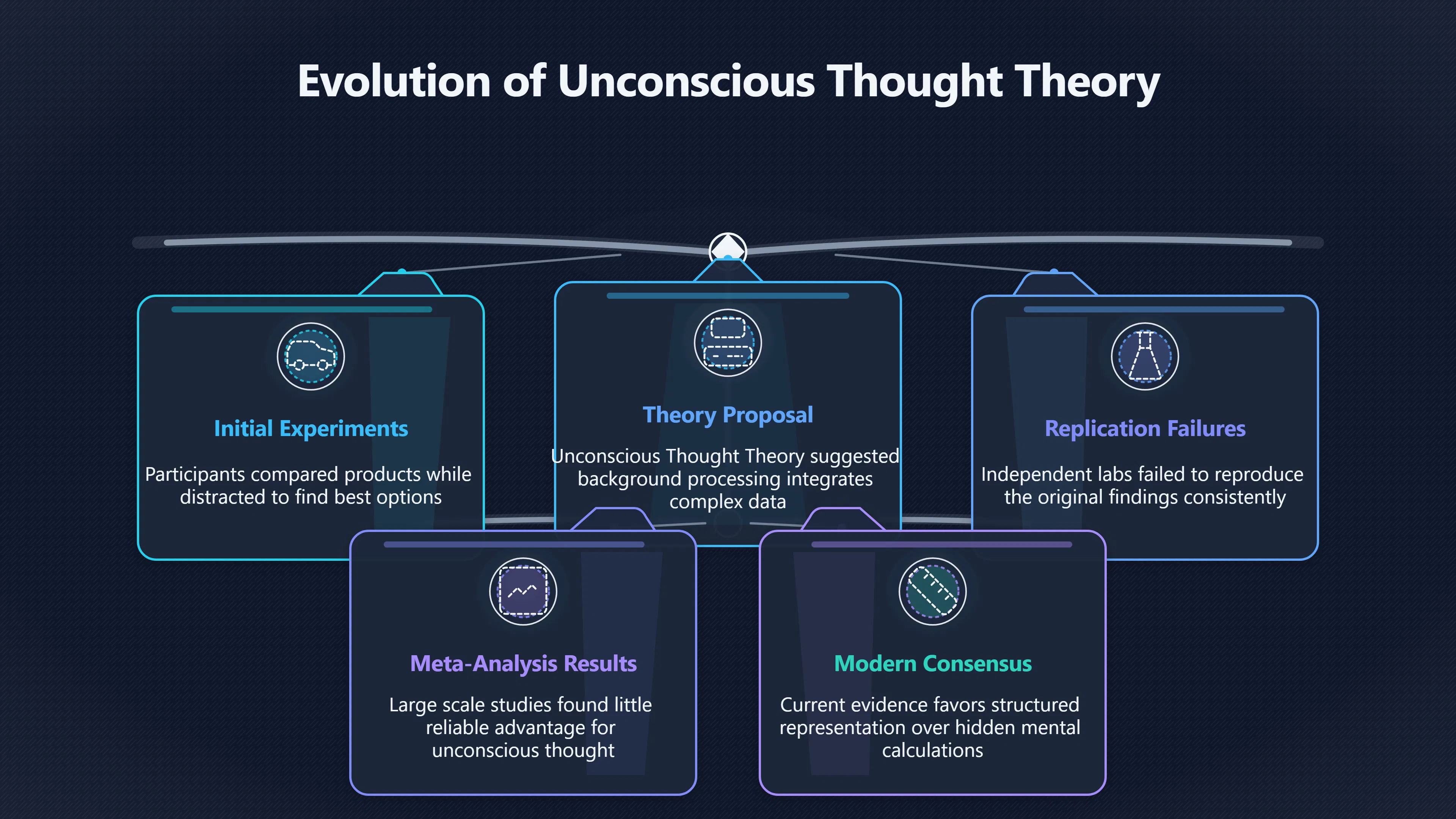
The debate began with experiments in which participants compared products such as cars or apartments described by many positive and negative attributes. Those who were distracted before deciding sometimes chose the objectively “best” option more often than participants instructed to consciously deliberate. The proposed explanation was that conscious attention has limited capacity, whereas unconscious processing could integrate many pieces of information simultaneously. This became known as Unconscious Thought Theory (UTT). [acmelab.yale.edu]acmelab.yale.eduUNCONSCIOUS THOUGHT THEORY AND ITS DISCONTENTSNovember 23, 2011 — by JA Bargh · 2011 · Cited by 122 — Unconscious thought was posited to…
The original findings attracted enormous attention because they seemed to challenge the common assumption that more deliberate thinking always improves difficult decisions. They also appeared to support familiar advice such as “sleep on it” or “stop thinking about it”.
Subsequent research painted a more complicated picture. Independent laboratories frequently failed to reproduce the effect under similar conditions, and larger studies found little or no reliable advantage for unconscious thought. A major meta-analysis combined previous studies with a large preregistered replication and concluded that the original effect largely disappeared once publication bias and small-study effects were considered. [Cambridge University Press & Assessment+2ejwagenmakers.com]cambridge.orgA further examination. Judgment and Decision Making, 4, 235–247.Read moreCambridge University Press & AssessmentOn making the right choice: A meta-analysis and large…by MR Nieuwenstein · 2015 · Cited by 145…
This does not mean every original experiment was wrong. Instead, it illustrates an important lesson from modern psychological science: striking findings based on relatively small samples often become weaker when tested repeatedly across different laboratories. The unconscious thought debate is now widely discussed as an example of why replication matters when evaluating advice about thinking and decision-making. [UCL Discovery]discovery.ucl.ac.ukNewell & Shanks Final CopyeditedUCL DiscoveryUnconscious influences on decision making: A critical reviewby BR Newell · 2014 · Cited by 882 — Our critical analysis point…
Why “sleep on it” can still help without proving unconscious optimisation
The weakening of UTT does not imply that taking a break is pointless. Rest can improve decisions through several mechanisms that do not require the unconscious mind to perform sophisticated optimisation.
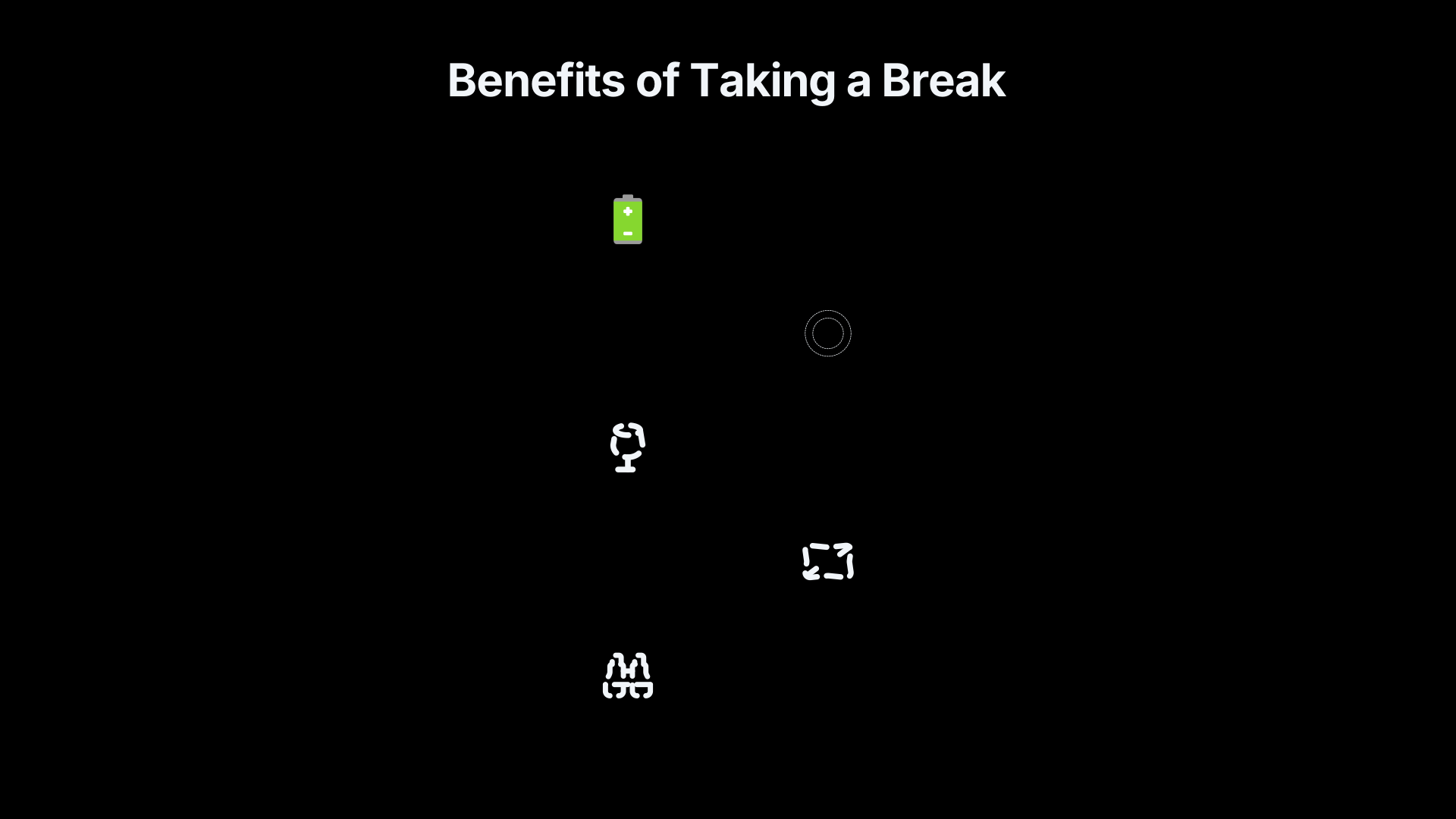
A pause may help because it:
- reduces fatigue and mental overload;
- interrupts unproductive rumination;
- allows emotional reactions to settle;
- improves memory consolidation after sleep;
- creates psychological distance, making priorities easier to recognise.
These mechanisms differ from claiming that the unconscious computes the best answer while attention is elsewhere. Current evidence supports the benefits of rest and incubation for some creative tasks far more strongly than it supports a general unconscious advantage for evaluating complex alternatives. [UCL Discovery+2The MIT Press Reader]discovery.ucl.ac.ukNewell & Shanks Final CopyeditedUCL DiscoveryUnconscious influences on decision making: A critical reviewby BR Newell · 2014 · Cited by 882 — Our critical analysis point…
The practical distinction is important. Taking a break is valuable because it refreshes your thinking, not because you should expect hidden mental calculations to solve the problem automatically.
Reducing too many attributes to a few real criteria
One reason the original experiments attracted attention is that they involved choices containing dozens of attributes. Real life often looks similar: buying a house, selecting a university, choosing between job offers or comparing insurance policies.
The modern lesson is that when a decision feels overwhelming, the problem is often not excessive analysis but excessive complexity.
Instead of attempting to weigh twenty or thirty separate features simultaneously, simplify the choice by identifying a handful of genuinely important dimensions. For example, when comparing jobs, dozens of details can usually be organised into broader categories such as:
- long-term career development;
- daily work enjoyment;
- financial security;
- flexibility;
- location and lifestyle.
This restructuring reduces cognitive load without ignoring important information. Rather than expecting unconscious thought to integrate every detail perfectly, you intentionally build a clearer representation of the decision.
Research on judgement consistently shows that structured representations often improve consistency because they reduce accidental overemphasis on vivid but relatively unimportant features. [UCL Discovery+2The MIT Press Reader]discovery.ucl.ac.ukNewell & Shanks Final CopyeditedUCL DiscoveryUnconscious influences on decision making: A critical reviewby BR Newell · 2014 · Cited by 882 — Our critical analysis point…
Combining preference with structured comparison
Complex personal decisions rarely have objectively correct answers. Choosing between two attractive cities, career paths or homes involves both measurable facts and personal values.
A practical approach combines intuition with explicit comparison:
- Clarify your non-negotiable criteria before comparing options.
- Group many attributes into a small number of meaningful dimensions.
- Compare alternatives against those dimensions rather than against dozens of isolated facts.
- Take a break if you become mentally overloaded.
- Return and ask whether your intuitive preference still matches the structured comparison.
This process allows intuition to contribute where it is strongest—highlighting what feels important—while preventing first impressions from dominating simply because they are emotionally vivid.
What later evidence says about expert decisions
Some researchers explored whether unconscious thought might still benefit experts, particularly in medicine or other domains involving complex information. The evidence has remained mixed at best.
A systematic review and meta-analysis examining medical decision-making found no reliable improvement in diagnostic accuracy from unconscious thought, whether among experts or novices. If anything, the findings suggested that expertise depends primarily on well-developed knowledge, pattern recognition built through experience, and deliberate evaluation when cases become ambiguous. [PMC]pmc.ncbi.nlm.nih.govA critical review and meta-analysis of the unconscious thought…by MA Vadillo · 2015 · Cited by 31 — In the present study, we report…
This aligns with broader research on expertise: experienced professionals often make rapid initial judgements, but they also verify those judgements when the stakes are high or conflicting evidence appears.
What this changes about everyday decision-making
The unconscious thought debate changed how psychologists think about complex choices, even though its central claim has weakened.
The lasting insights are more modest but more useful:
- Complex decisions can overload working memory.
- Simply thinking harder is not always better if your thinking is poorly organised.
- Taking breaks can improve judgement by restoring attention and reducing emotional noise.
- There is little convincing evidence that unconscious processing reliably outperforms careful conscious evaluation across complex choices.
- The most effective improvement is usually to redesign the decision itself by reducing unnecessary complexity before making the final comparison. [UCL Discovery+2Cambridge University Press & Assessment]discovery.ucl.ac.ukNewell & Shanks Final CopyeditedUCL DiscoveryUnconscious influences on decision making: A critical reviewby BR Newell · 2014 · Cited by 882 — Our critical analysis point…
For improving thinking and analytical skills, this leads to a practical rule. If a decision contains too many moving parts, resist the temptation either to analyse every detail endlessly or to abandon the problem entirely in the hope that your unconscious will solve it. First simplify the structure of the choice, then allow both reflection and appropriate breaks to work together. That approach is supported far more consistently than the original claim that merely sleeping on a difficult decision produces better answers. [Cambridge University Press & Assessment+2UCL Discovery]cambridge.orgA further examination. Judgment and Decision Making, 4, 235–247.Read moreCambridge University Press & AssessmentOn making the right choice: A meta-analysis and large…by MR Nieuwenstein · 2015 · Cited by 145…

Amazon book picks
Further Reading
Books and field guides related to Should you sleep on hard decisions?. Use these as the next step if you want deeper reading beyond the article.
Decisive
Teaches structured comparison, reality-testing, and decision routines rather than relying only on deliberation or gut feel.
Thinking in Bets
Encourages probabilistic thinking and reflective breaks before treating a feeling of preference as a final answer.
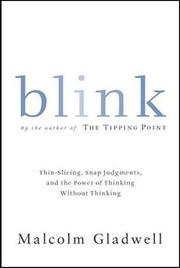
Blink
Useful contrast for the page's discussion of unconscious processing, snap judgement, and its limits.
Smart Choices
Shows how to reduce complex choices into objectives, alternatives, consequences, trade-offs, and uncertainty.
eBay marketplace picks
Marketplace Samples
Live-tested eBay searches with available results related to this page.


Endnotes
-
Source: cambridge.org
Title: A further examination. Judgment and Decision Making, 4, 235–247.Read more
Link: https://www.cambridge.org/core/journals/judgment-and-decision-making/article/on-making-the-right-choice-a-metaanalysis-and-largescale-replication-attempt-of-the-unconscious-thought-advantage/A31405A97BC221C10153E9CF78A94DB6Source snippet
Cambridge University Press & AssessmentOn making the right choice: A meta-analysis and large...by MR Nieuwenstein · 2015 · Cited by 145...
-
Source: acmelab.yale.edu
Link: https://acmelab.yale.edu/sites/default/files/2011_unconscious_thought_theory_and_its_discontents.pdfSource snippet
UNCONSCIOUS THOUGHT THEORY AND ITS DISCONTENTSNovember 23, 2011 — by JA Bargh · 2011 · Cited by 122 — Unconscious thought was posited to...
Published: November 23, 2011
-
Source: ejwagenmakers.com
Title: Nieuwenstein et al. JDM 2015
Link: https://www.ejwagenmakers.com/2015/Nieuwenstein%20et%20al.%20JDM%202015.pdfSource snippet
A meta-analysis and large-scale replication attempt of the...by MR Nieuwenstein · 2015 · Cited by 145 — This account was proposed in a r...
-
Source: thereader.mitpress.mit.edu
Title: what the science actually says about unconscious decision making
Link: https://thereader.mitpress.mit.edu/what-the-science-actually-says-about-unconscious-decision-making/Source snippet
The MIT Press ReaderWhat the Science Actually Says About Unconscious...Sep 22, 2023 — The science actually says about unconscious decisi...
-
Source: ejwagenmakers.com
Link: https://ejwagenmakers.com/2012/HuizengaEtAl2012.pdfSource snippet
Four empirical tests of Unconscious Thought Theoryby HM Huizenga · 2012 · Cited by 96 — According to Unconscious Thought Theory, people m...
-
Source: cambridge.org
Link: https://www.cambridge.org/core/journals/judgment-and-decision-making/article/methodological-pitfalls-of-the-unconscious-thought-paradigm/6C70BC9928D8F4EE0A4437AA227270EESource snippet
Methodological pitfalls of the Unconscious Thought paradigmby L Waroquier · 2009 · Cited by 72 — According to Unconscious Thought Theory...
-
Source: discovery.ucl.ac.uk
Title: Newell & Shanks Final Copyedited
Link: https://discovery.ucl.ac.uk/1419217/1/Newell_%26_Shanks_Final_Copyedited.pdfSource snippet
UCL DiscoveryUnconscious influences on decision making: A critical reviewby BR Newell · 2014 · Cited by 882 — Our critical analysis point...
-
Source: pmc.ncbi.nlm.nih.gov
Link: https://pmc.ncbi.nlm.nih.gov/articles/PMC4436803/Source snippet
A critical review and meta-analysis of the unconscious thought...by MA Vadillo · 2015 · Cited by 31 — In the present study, we report...
-
Source: Wikipedia
Title: Unconscious thought theory
Link: https://en.wikipedia.org/wiki/Unconscious_thought_theorySource snippet
Unconscious thought theoryUnconscious thought theory (UTT) posits that the unconscious mind is capable of performing tasks outside of...
-
Source: pmc.ncbi.nlm.nih.gov
Link: https://pmc.ncbi.nlm.nih.gov/articles/PMC8264051/Source snippet
Fresh Look at the Unconscious Thought Effect: Using Mind...by L Steindorf · 2021 · Cited by 9 — Unconscious Thought Theory (Dijksterhuis...
Additional References
-
Source: pure.uvt.nl
Link: https://pure.uvt.nl/ws/portalfiles/portal/7412223/supplement.pdfSource snippet
meta-analysis and large-scale replication attempt of the...This account was proposed in a recent meta-analysis that was conducted by pro...
-
Source: researchgate.net
Title: 265160970 Failure to Replicate the Unconscious Thought Advantages
Link: https://www.researchgate.net/publication/265160970_Failure_to_Replicate_the_Unconscious_Thought_AdvantagesSource snippet
Failure to Replicate the Unconscious Thought AdvantagesAug 29, 2014 — In this study we tried to replicate the unconscious thought advanta...
-
Source: researchgate.net
Link: https://www.researchgate.net/publication/5140662_New_findings_on_unconscious_versus_conscious_thought_in_decision_making_Additional_empirical_data_and_meta-analysisSource snippet
tter normative decision making performance than conscious thought, which is...Read more...
-
Source: researchgate.net
Link: https://www.researchgate.net/publication/235686744_The_unconscious_thought_advantage_Further_replication_failures_from_a_search_for_confirmatory_evidenceSource snippet
iod of distraction can lead to better decision quality than deciding either...Read more...
-
Source: verso.uidaho.edu
Title: Experiment 1 attempted to replicate and extend past
Link: https://verso.uidaho.edu/esploro/outputs/journalArticle/Does-unconscious-thought-outperform-conscious-thought/996860960201851Source snippet
unconscious thought outperform conscious...by TJ Thorsteinson · 2009 · Cited by 84 — Two experiments examined the benefits of unconsciou...
-
Source: papers.ssrn.com
Link: https://papers.ssrn.com/sol3/Delivery.cfm/SSRN_ID2064496_code1846318.pdf?abstractid=2064496&mirid=1Source snippet
A theory of unconscious thought. Perspectives on. Psychological...Read more...
-
Source: pdfs.semanticscholar.org
Link: https://pdfs.semanticscholar.org/c62e/140cecc9fd56d03ca6eaac2d246ddc721eaa.pdfSource snippet
unconscious thought advantage: Further replication...by M Nieuwenstein · 2012 · Cited by 34 — This hypothesis claims that the processing...
-
Source: replicationindex.com
Title: rr22 unconscious thought
Link: https://replicationindex.com/2022/02/16/rr22-unconscious-thought/Source snippet
Unconscious Thought Theory in Decline16 Feb 2022 — An article by Ap Dijksterhuis (2004) proposed that unconscious process are better than...
-
Source: youtube.com
Title: Do We Consciously Pick Our Choices?
Link: https://www.youtube.com/watch?v=1gBb1TWn4VcSource snippet
Unconscious thought theory decision making The Hidden Patterns That Control Your Mind | Unconscious Decision Making Explained The Hidden...
-
Source: research-portal.uu.nl
Title: a meta analysis on unconscious thought effects
Link: https://research-portal.uu.nl/en/publications/a-meta-analysis-on-unconscious-thought-effects/Source snippet
All available published and unpublished data on unconscious thought were included...
Topic Tree