Within Change Mind
Can a Premortem Reveal When You Should Reconsider?
Imagining a future failure helps identify early warning signs before a decision becomes difficult to reverse.
On this page
- Imagining the failed outcome
- Turning warning signs into triggers
- Using premortems without creating pessimism
Page outline Jump by section
Introduction
A premortem is one of the most practical ways to answer the question, “What would change my mind?” Instead of asking whether a plan seems sensible, a premortem asks participants to imagine that the decision has already failed and then explain why. That shift in perspective makes it easier to identify the observations that should cause a team—or an individual—to reconsider before a failure becomes irreversible. Rather than treating belief revision as an emotional reaction to bad news, a premortem turns it into a planned part of decision-making. Research on “prospective hindsight”, the psychological principle behind premortems, suggests that imagining a future outcome as certain helps people generate more concrete explanations for what could go wrong, making blind spots easier to detect.[homepages.se.edu]homepages.se.eduPerforming a Project Premortem by Gary KleinJuly 18, 2011 — By making it safe for dissenters who are knowledgeable about the undertaking and worried about its weaknesses to speak up…
 Within a broader practice of asking “What would change my mind?”, the distinctive value of a premortem is that it converts imagined causes of failure into predefined signals for changing course. The exercise is therefore not merely about listing risks. It is about deciding in advance which warning signs deserve action.
Imagining the failed outcome
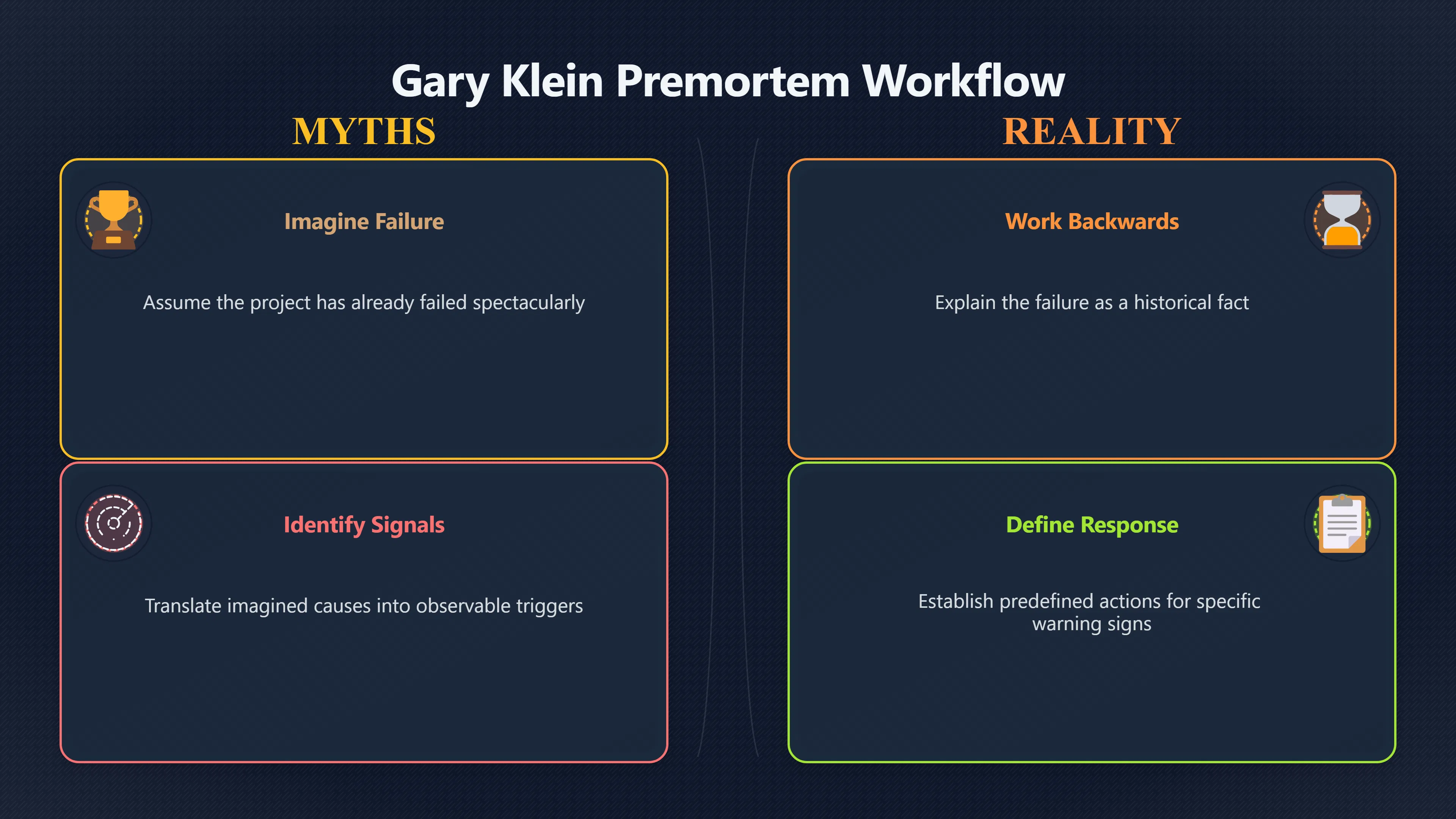
The premortem technique was introduced by cognitive psychologist Gary Klein as an alternative to conventional risk reviews. Instead of asking, “What might go wrong?”, participants are told to imagine that the project has already failed spectacularly. They then work backwards to explain the failure as though it were a historical fact. This framing reduces the social pressure to defend the existing plan and gives people permission to voice concerns that might otherwise remain unspoken.[Harvard Business Review]hbr.orgHarvard Business Review Performing a Project PremortemHarvard Business ReviewPerforming a Project PremortemSeptember 1, 2007 — Reprint: F0709A In a premortem, team members assume that the pro…
This seemingly small change matters because ordinary planning meetings often reward confidence. Team members may hesitate to challenge a proposal that appears to have broad support, particularly when senior decision-makers are present. By assuming failure has already happened, the discussion shifts from criticism of colleagues to diagnosis of an imagined event. That makes dissent feel less personal and more constructive.[McKinsey & Company]mckinsey.combias busters premortems being smart at the startMcKinsey & CompanyBias Busters: Premortems: Being smart at the start3 Apr 2019 — Despite their best intentions, executives fall prey to c…
For someone trying to improve their thinking, the key insight is that a premortem is not an exercise in predicting the future. It is an exercise in expanding the range of possibilities considered before committing to a course of action.
Turning warning signs into change-my-mind triggers
A premortem becomes especially valuable when its outputs are translated into explicit reconsideration criteria. Many teams stop after generating a list of possible failure causes. A stronger approach is to ask a second question for every plausible failure:
If this cause were beginning to happen in real life, what would we actually observe?
Those observations become practical “change-my-mind” signals.
For example, imagine a software team concludes during a premortem that its launch failed because customers found onboarding confusing. Instead of merely recording “poor onboarding” as a risk, the team could define measurable triggers such as:
- activation rates falling below a predetermined threshold
- support requests about account setup doubling over two consecutive weeks
- usability testing repeatedly exposing the same navigation problem
- abandonment rates rising after a specific onboarding screen
None of these observations proves the strategy has failed. However, each is a pre-agreed signal that the original assumptions deserve re-examination.
The same principle applies outside project management:
- Career decisions: “If I still have no meaningful opportunities after six months despite following the plan, I will reconsider the strategy.”
- Investment decisions: “If earnings consistently diverge from the assumptions that justified the investment, I will review whether the original thesis still holds.”
- Health goals: “If objective progress stalls despite following the programme as planned, I will reassess rather than simply trying harder.”
The important feature is that the trigger is specified before emotions, sunk costs and commitment begin to distort judgement.
Why prospective hindsight works
Premortems rely on a psychological effect known as prospective hindsight. Research by Deborah Mitchell, Jay Russo and Nancy Pennington found that imagining a future event as already having occurred helped participants generate substantially more explanations for why that outcome happened than conventional forecasting approaches. Gary Klein later drew on this work when developing the premortem technique for organisational decision-making.[homepages.se.edu]homepages.se.eduPerforming a Project Premortem by Gary KleinJuly 18, 2011 — By making it safe for dissenters who are knowledgeable about the undertaking and worried about its weaknesses to speak up…
Several mechanisms appear to contribute:
- Reduced overconfidence. Imagining failure makes optimistic assumptions easier to question.
- More complete causal thinking. People search for interacting causes rather than isolated problems.
- Greater psychological safety. Team members gain permission to express reservations without appearing obstructive.
- Attention to leading indicators. Thinking backwards naturally encourages discussion of the early events that would precede major failure.
These mechanisms align closely with the purpose of “What would change my mind?” questions. Both practices encourage people to define conditions under which confidence should decrease instead of merely collecting reasons to remain confident.[McKinsey & Company]mckinsey.combias busters premortems being smart at the startMcKinsey & CompanyBias Busters: Premortems: Being smart at the start3 Apr 2019 — Despite their best intentions, executives fall prey to c…
Designing effective reconsideration triggers
Not every imagined failure should become a change-my-mind signal. Useful triggers share several characteristics.
They are observable. A trigger should depend on something that can actually be noticed or measured, not on a vague feeling that “things seem wrong”.
They appear early. Waiting until complete failure occurs defeats the purpose. Good triggers identify developments while meaningful alternatives still exist.
They relate to critical assumptions. The strongest triggers monitor the beliefs that justified the decision in the first place. If those assumptions weaken, the decision itself deserves review.
They specify a response. A trigger should not automatically require abandoning the project. Instead, it should initiate a predefined review: gather more evidence, reduce confidence, pause implementation or reconsider the decision.
For example:
Weak triggerStrong trigger”If morale seems lower.”“If employee turnover exceeds our expected range for two consecutive quarters.”“If customers complain.”“If customer retention drops below the threshold assumed in our business case.”“If the market changes.”“If a competing technology achieves widespread adoption before our launch.”
The stronger version makes belief revision operational rather than aspirational.
Using premortems without creating pessimism
A common misconception is that premortems encourage excessive negativity. In practice, the opposite is often true. Their purpose is not to convince people that failure is inevitable, but to increase confidence that important risks have been examined honestly before resources are committed.[Forbes]forbes.comhow to improve your strategic planning through a premortem analysisHow To Improve Your Strategic Planning Through A…24 Apr 2023 — By conducting a premortem analysis along the lines of these ten s…
Several implementation choices help preserve this balance:
- Conduct the exercise before final commitment, when changes remain feasible.
- Invite people with different perspectives, including those closest to day-to-day implementation.
- Generate failure reasons individually before group discussion to reduce conformity pressures.
- Translate concerns into specific monitoring indicators rather than leaving them as abstract worries.
- Finish by identifying both preventive actions and the conditions that would justify revisiting the decision.
In this way, a premortem strengthens rather than weakens commitment. Participants commit not only to the original plan but also to an agreed process for recognising when reality no longer matches the assumptions that justified it.

From imagined failure to disciplined learning
The greatest contribution of a premortem is not that it predicts failure more accurately. It is that it creates an explicit bridge between planning and later evidence.
Without predefined reconsideration signals, people often explain away early warning signs because changing course feels like admitting a mistake. With a premortem, those same observations become expected checkpoints that were identified before anyone became invested in defending the decision.
Seen this way, the exercise transforms “What would change my mind?” from an abstract commitment to open-mindedness into a concrete implementation practice. Instead of waiting until failure forces reconsideration, it identifies the evidence that should prompt reassessment while there is still time to respond intelligently.
eBay marketplace picks
Marketplace Samples
Live-tested eBay searches with available results related to this page.



Endnotes
1.
Source: homepages.se.edu
Title: Performing a Project Premortem by Gary Klein
Link:https://homepages.se.edu/cvonbergen/files/2013/01/Performing-a-Project-Premortem.pdf
Source snippet
July 18, 2011 — By making it safe for dissenters who are knowledgeable about the undertaking and worried about its weaknesses to speak up...
Published: July 18, 2011
2.
Source: mckinsey.com
Title: bias busters premortems being smart at the start
Link:https://www.mckinsey.com/capabilities/strategy-and-corporate-finance/our-insights/bias-busters-premortems-being-smart-at-the-start
Source snippet
McKinsey & CompanyBias Busters: Premortems: Being smart at the start3 Apr 2019 — Despite their best intentions, executives fall prey to c...
3.
Source: forbes.com
Title: how to improve your strategic planning through a premortem analysis
Link:https://www.forbes.com/sites/jeroenkraaijenbrink/2023/04/24/how-to-improve-your-strategic-planning-through-a-premortem-analysis/
Source snippet
How To Improve Your Strategic Planning Through A...24 Apr 2023 — By conducting a premortem analysis along the lines of these ten s...
4.
Source: hbr.org
Title: Harvard Business Review Performing a Project Premortem
Link:https://hbr.org/2007/09/performing-a-project-premortem
Source snippet
Harvard Business ReviewPerforming a Project PremortemSeptember 1, 2007 — Reprint: F0709A In a premortem, team members assume that the pro...
Published: September 1, 2007
5.
Source: enterpriseriskmag.com
Title: imagining a future
Link:https://enterpriseriskmag.com/2019/02/imagining-a-future/
Source snippet
Enterprise Risk MagazineImagining a future22 Feb 2019 — Pro-mortems and [pre-mortems]({{ 'pre-mortems/' | relative_url }}) are a simple and highly effective technique for teams...
6.
Source: linkedin.com
Title: Prospective Hindsight
Link:https://www.linkedin.com/pulse/prospective-hindsight-critical-leadership-life-practice-todd-zipper
Source snippet
A Critical Leadership and Life...We know that the data says prospective hindsight, or premortem, significantly boosts our ability to cor...
Additional References
7.
Source: researchgate.net
Link:https://www.researchgate.net/publication/355070855_Project_Pre-mortem_using_Prospective_Hindsight_An_Unexplored_Tool_to_address_Healthcare_Projects_Implementation_barriers
Source snippet
(PDF) Project Pre-mortem using Prospective Hindsight20 Jun 2021 — The Targeted Premortem (TPM) is a variant of Klein's Premortem Techniqu...
8.
Source: strategy-engine.pages.dev
Link:https://strategy-engine.pages.dev/chapters/chapter-04-strategic-[intuition
Source snippet
Chapter 4: Developing Strategic IntuitionWhich cognitive biases most frequently destroy strategic thinking? How can red teaming and pre-m...
9.
Source: nesslabs.com
Link:https://nesslabs.com/pre-mortem-anticipate-failure-with-prospective-hindsight
Source snippet
Pre-mortem: how to anticipate failure with prospective...A pre-mortem is an exercise where we imagine that a project has failed, and whe...
10.
Source: cognitivebiaslab.com
Link:https://www.cognitivebiaslab.com/pre-mortem/
Source snippet
Pre-Mortem Analysis Tool: Predict Project FailuresOvercome Cognitive Biases. Pre-mortems help combat planning fallacy, optimism bias, and...
11.
Source: static1.squarespace.com
Link:https://static1.squarespace.com/static/5f251c861a3dc74c86c18048/t/6073b58e57e7cf58a4b95785/1618195866277/Prospective%2BHindsight%2B-%2BMark%2BEasdown%2B-%2Bby%2BWhiteark.pdf
Source snippet
Prospective Hindsight and the Pre-MortemWe analyse the past often to draw meaning and insights to apply to forward thinking. S...
12.
Source: researchgate.net
Link:https://www.researchgate.net/publication/318013212_The_Premortem_Technique
Source snippet
(PDF) The Premortem TechniqueThe Premortem technique raises awareness of possibilities, including their likely consequences, to enrich pl...
13.
Source: theuncertaintyproject.org
Link:https://www.theuncertaintyproject.org/tools/pre-mortem
Source snippet
Pre-MortemThe pre-mortem analysis is a tool intended to increase the probability of a project's success. It is based on 'prospective hind...
14.
Source: medium.com
Link:https://medium.com/%40shreyashere/how-to-use-pre-mortems-to-prevent-problems-blunders-and-disasters-6ecc6df6e22a
Source snippet
novel technique of using Tigers, Paper Tigers, and Elephants to run effective...
15.
Source: metalformingmagazine.com
Link:https://www.metalformingmagazine.com/article/?%2Fmanagement%2Fconsulting-and-training%2Fprospective-hindsight-why-you-should-plan-to-fail=
Source snippet
Prospective Hindsight Why You Should Plan to Fail1 Jan 2012 — A failure strategy, better known as premortems, is a process by which a com...
16.
Source: youtube.com
Link:https://www.youtube.com/watch?v=G-m6dKMS3kc
Source snippet
How to prevent product failure — Anu Jagga Narang (AT&T)...
Topic Tree
Follow this branch
Parent topic
Change Mind What Evidence Would Change Your Mind?Related pages 5
- Confidence Updates Why Changing Your Mind Can Mean Changing Your Confidence
- Disconfirming Evidence Why Contradictory Evidence Is More Useful Than More Proof
- Review Triggers How Review Triggers Make Changing Course Easier
- Revision Rules What Would Actually Make You Change Your Mind?
- Wason 2 4 6 What the 2 4 6 Experiment Teaches About Better Decisions