Within Metacognition
When Confidence Gets Ahead of Evidence
Confidence becomes more useful when it is checked against the quality of the evidence behind it.
On this page
- Why fluent explanations can feel true
- Questions that separate evidence from ease
- Using predictions and outcomes to improve calibration
Page outline Jump by section
Introduction
Confidence is useful only when it tracks reality. In metacognition, one of the most important skills is learning to match how certain you feel to the strength of the evidence you actually possess. When confidence rises faster than evidence, judgement becomes vulnerable to error. When confidence is lower than the evidence warrants, good opportunities can be missed. The goal is not to become less confident, but to become better calibrated.
 Calibration refers to the relationship between confidence and accuracy. A well-calibrated thinker who is 70% confident in a set of judgements should be correct roughly 70% of the time. A poorly calibrated thinker may feel 95% certain while being right only half the time. Research on overconfidence consistently finds that people often express greater certainty than their accuracy justifies, especially in difficult tasks and uncertain environments.[Wikipedia]WikipediaOverconfidence effectOverconfidence effect
Within metacognition, calibration matters because it acts as a quality-control mechanism. It forces a distinction between feeling convinced and being well supported.
Why Fluent Explanations Can Feel True
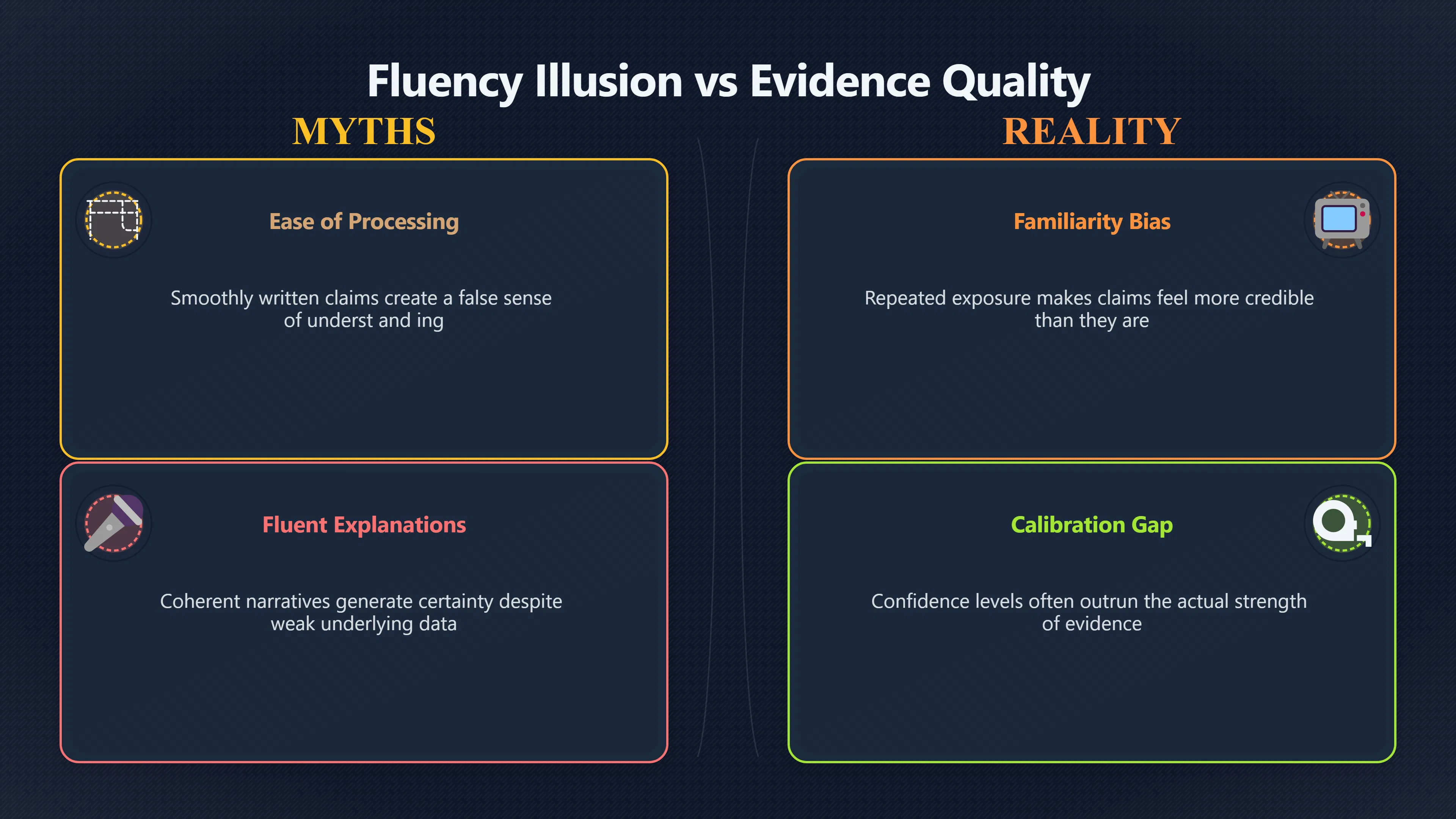
One reason confidence often outruns evidence is that the human mind uses mental shortcuts when judging certainty. A particularly important shortcut is processing fluency: the subjective feeling that something is easy to understand.
Information that is clear, familiar, smoothly written, or repeatedly encountered often feels more credible than information that is difficult to process. The problem is that ease of processing and quality of evidence are not the same thing. Research on metacognitive illusions shows that fluency can create an “illusion of knowing”, leading people to believe they understand or remember material better than they actually do.[PMC+2PubMed]pmc.ncbi.nlm.nih.govPMCMetacognitive Illusion in Category LearningNIHby J Wang · 2019 · Cited by 18 — This study revealed that processing fluency and held beliefs were two factors that cause this m…
This creates a common pattern:
- A claim is presented clearly.
- Understanding feels effortless.
- The feeling of ease is mistaken for evidence.
- Confidence increases without a corresponding increase in justification.
Studies of learning repeatedly find that people often overestimate future recall when information feels easy to process during study. Learners can leave a session feeling highly confident yet perform poorly when tested later.[PubMed]pubmed.ncbi.nlm.nih.govIllusions of Competence and Overestimation of Associative…by AD Castel · 2007 · Cited by 211 — We hypothesized that encoding flu…
The same mechanism appears outside education. A persuasive presentation, a confident speaker, or a coherent narrative can generate strong feelings of certainty even when the underlying evidence is weak. The mind unconsciously substitutes one question—“How easy does this feel?”—for a harder question—“How well supported is this?”[MDPI]mdpi.comFor example, high fluency with shallowMetacognitive Monitoring in Reading Comprehensionby V Markovich · 2026 — This may result in an “illusion of knowing”, particularly wh…
This is why metacognitive monitoring requires attention not only to conclusions but also to the source of confidence. A feeling of certainty is itself evidence about a mental state, not necessarily evidence about reality.
Questions That Separate Evidence from Ease
A practical way to improve calibration is to challenge confidence before accepting it. The key is to examine whether confidence is being generated by evidence or by psychological comfort.
Several questions are especially useful.
What observations would change my mind?
Confidence based on evidence should be responsive to new evidence. If no imaginable observation could alter a conclusion, certainty may be resting on commitment rather than justification.
What is the strongest evidence against my view?
People naturally search for supporting information. Calibration improves when confidence is tested against contradictory evidence rather than built exclusively from confirming examples.
Am I recalling evidence or explanations?
A detailed explanation can create a powerful sense of understanding. Yet being able to repeat an explanation is not the same as possessing independent evidence for it. The distinction becomes important when evaluating forecasts, diagnoses, interpretations, and strategic decisions.
How much of my confidence comes from familiarity?
Repeated exposure increases perceived truthfulness. Familiar claims often feel more credible simply because they have been encountered before, not because they have stronger support.
Could I assign a probability instead of using a certainty label?
Statements such as “definitely”, “obviously”, or “there is no doubt” hide uncertainty. Numerical probabilities force greater precision. A thinker who says “I am 65% confident” is making a claim that can later be evaluated against outcomes.
These questions work because they redirect attention away from the feeling of knowing and back towards the reasons for knowing.
Using Predictions and Outcomes to Improve Calibration
The most reliable way to improve calibration is to compare confidence with what actually happens.
Prediction creates accountability. Before an outcome is known, a person records a judgement and attaches a probability to it. Later, the outcome provides feedback. Over time, patterns emerge.
If events assigned an 80% probability occur only half the time, confidence is too high. If events assigned a 40% probability occur far more often than expected, confidence is too low. Calibration improves when these mismatches become visible.[PMC+2ResearchGate]pmc.ncbi.nlm.nih.govPMCAccuracy of forecasts in strategic intelligenceNIHby DR Mandel · 2014 · Cited by 161 — Overconfidence, in contrast, indicates that forecasts are communicated with unwarranted cer…
Forecasting research provides a clear example. Philip Tetlock’s work on expert judgement found that many experts expressed confidence levels that exceeded their actual predictive accuracy. Later forecasting tournaments showed that performance improved when forecasters regularly updated beliefs, expressed uncertainty probabilistically, and received continuous feedback on outcomes.[ResearchGate+2Cambridge University Press & Assessment]researchgate.netResearch Gate Expert Political Judgment: How Good is It?How can We…Here, Philip E. Tetlock explores what constitutes good judgment in predicting future events, and looks at why experts are o…
The strongest forecasters do not simply gather more information. They continually compare belief strength with evidence strength. Research from forecasting competitions found that training, feedback, and explicit probability judgements improved forecasting accuracy and calibration.[Cambridge University Press & Assessment+2Good Judgment]cambridge.orgCambridge University Press & AssessmentThe impact of training and practice on judgmental accuracy…by W Chang · 2016 · Cited by 150 — T…
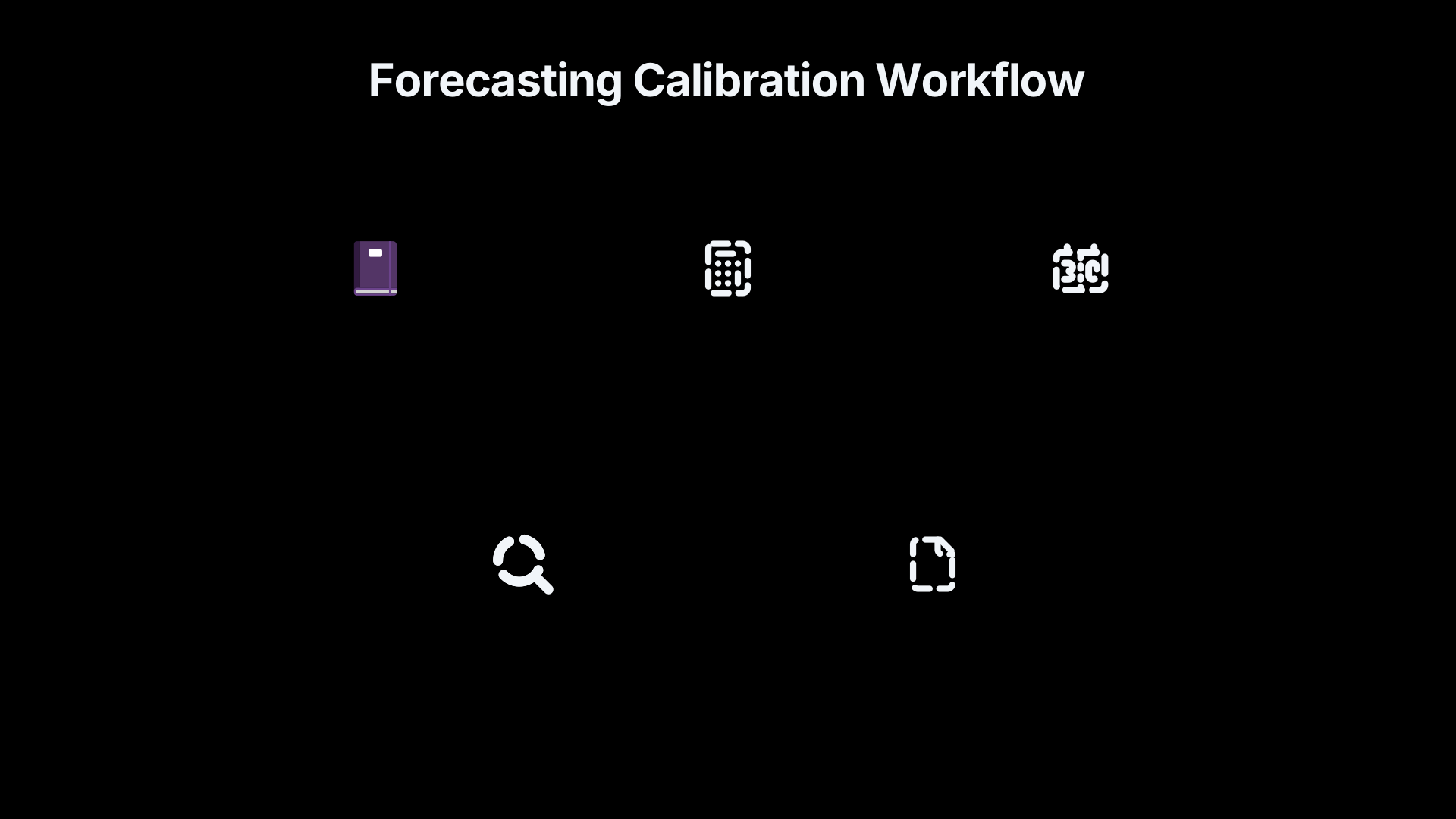
A simple personal version of this process can be applied to everyday thinking:
- Make a prediction.
- Assign a probability.
- Record it.
- Check the outcome later.
- Compare confidence with reality.
- Adjust future confidence accordingly.
This transforms confidence from a feeling into a measurable skill.
When Confidence Gets Ahead of Evidence
The most dangerous mistakes often occur not when evidence is absent but when confidence becomes detached from evidence quality.
Several warning signs suggest this has happened:
- Certainty increases without new information.
- Confidence is justified by familiarity rather than verification.
- Contradictory evidence is ignored or dismissed.
- Explanations become more elaborate while evidence remains unchanged.
- Predictions are not tracked against outcomes.
Overconfidence is not merely excessive optimism. It is a calibration failure: the level of certainty exceeds what the evidence supports. Studies of judgement repeatedly find that people can be highly confident and still systematically wrong.[Wikipedia+2PMC]WikipediaOverconfidence effectOverconfidence effect
The metacognitive goal is therefore not confidence reduction. Excessive doubt can be as misleading as excessive certainty. The aim is alignment. Strong evidence should support strong confidence. Weak evidence should support tentative confidence. As evidence changes, confidence should change with it.
That alignment is what turns confidence from a feeling into a tool for better thinking.

Amazon book picks
Further Reading
Books and field guides related to When Confidence Gets Ahead of Evidence. Use these as the next step if you want deeper reading beyond the article.
Superforecasting
Focuses on calibration, probabilistic thinking, prediction accuracy, and learning from outcomes.
The Scout Mindset
Emphasizes aligning beliefs with evidence instead of defending confident opinions.
The Art of Thinking Clearly
Covers common thinking errors, including overconfidence and misleading feelings of certainty.
How to Measure Anything
Demonstrates how evidence can replace intuition and unsupported certainty in decision-making.
eBay marketplace picks
Marketplace Samples
Example marketplace items related to this page. Use the search link to explore similar finds on eBay.



Endnotes
1.
Source: Wikipedia
Title: Overconfidence effect
Link:https://en.wikipedia.org/wiki/Overconfidence_effect
2.
Source: pmc.ncbi.nlm.nih.gov
Title: PMCAccuracy of forecasts in strategic intelligence
Link:https://pmc.ncbi.nlm.nih.gov/articles/PMC4121776/
Source snippet
NIHby DR Mandel · 2014 · Cited by 161 — Overconfidence, in contrast, indicates that forecasts are communicated with unwarranted cer...
3.
Source: pmc.ncbi.nlm.nih.gov
Title: PMCMetacognitive Illusion in Category Learning
Link:https://pmc.ncbi.nlm.nih.gov/articles/PMC7284536/
Source snippet
NIHby J Wang · 2019 · Cited by 18 — This study revealed that processing fluency and held beliefs were two factors that cause this m...
4.
Source: mdpi.com
Title: For example, high fluency with shallow
Link:https://www.mdpi.com/2079-3200/14/3/42
Source snippet
Metacognitive Monitoring in Reading Comprehensionby V Markovich · 2026 — This may result in an “illusion of knowing”, particularly wh...
5.
Source: mdpi.com
Link:https://www.mdpi.com/2078-2489/17/3/299
Source snippet
Fluency Illusion: A Review on Influence of ChatGPT in...by S Kumar · 2026 — The fluency illusion, as used in this review, refers more sp...
6.
Source: researchgate.net
Link:https://www.researchgate.net/publication/320911494_Confidence_Calibration_in_a_Multiyear_Geopolitical_Forecasting_Competition
Source snippet
Although overconfidence has been studied in many...Read more...
7.
Source: researchgate.net
Title: Research Gate Expert Political Judgment: How Good is It?
Link:https://www.researchgate.net/publication/286362106_Expert_Political_Judgment_How_Good_is_It_How_can_We_Know
Source snippet
How can We...Here, Philip E. Tetlock explores what constitutes [good judgment]({{ 'good-judgment/' | relative_url }}) in predicting future events, and looks at why experts are o...
8.
Source: cambridge.org
Link:https://www.cambridge.org/core/journals/judgment-and-decision-making/article/developing-expert-political-judgment-the-impact-of-training-and-practice-on-judgmental-accuracy-in-geopolitical-forecasting-tournaments/123EB18425391D05FA6581FDBB3F309F
Source snippet
Cambridge University Press & AssessmentThe impact of training and practice on judgmental accuracy...by W Chang · 2016 · Cited by 150 — T...
9.
Source: pmc.ncbi.nlm.nih.gov
Title: Participants overestimated the likelihood of their guess being
Link:https://pmc.ncbi.nlm.nih.gov/articles/PMC12730000/
Source snippet
An Experimental Study of Overconfidence Biases in Young...by DG Gültekin · 2025 · Cited by 3 — Overall, the findings show consistent...
10.
Source: Wikipedia
Link:https://en.wikipedia.org/wiki/Metacognition
Source snippet
MetacognitionMetacognition is an awareness of one's thought processes and an understanding of the patterns behind them. It is "thinkin...
11.
Source: Wikipedia
Title: The Good Judgment Project
Link:https://en.wikipedia.org/wiki/The_Good_Judgment_Project
Source snippet
The Good Judgment ProjectIt was co-created by Philip E. Tetlock (author of Superforecasting: The Art and Science of Prediction and Exp...
12.
Source: researchgate.net
Link:https://www.researchgate.net/publication/369607328Lying_by_telling_the_truth-_The_Risks_of_Deception_by_Paltering_and_Hypocrisy_in_Corporate_Social_Responsibilities_context
Source snippet
(PDF) Lying by telling the truth – The Risks of Deception...12 May 2023 — The novelty of this research lies in its focus on paltering-ba...
Published: May 2023
13.
Source: researchgate.net
Link:https://www.researchgate.net/publication/339988953_Metacognitive_Illusion_in_Category_Learning_Contributions_of_Processing_Fluency_and_Beliefs
Source snippet
(PDF) Metacognitive Illusion in Category Learning9 Apr 2020 — The current study simultaneously assessed all four metamemory illusions fro...
14.
Source: researchgate.net
Link:https://www.researchgate.net/publication/7979599_Illusions_of_Competence_in_Monitoring_One%27s_Knowledge_During_Study
Source snippet
repancy between study and test situations.Read more...
15.
Source: cambridge.org
Link:https://www.cambridge.org/core/journals/judgment-and-decision-making/article/when-deciding-creates-overconfidence/CFBE92B067A3DF55E5DB9A05CF497064
Source snippet
When deciding creates overconfidence | Judgment and...by PJ Boyle · 2025 · Cited by 6 — We demonstrate how the distortion of information...
16.
Source: cambridge.org
Title: How generalizable is good judgment?
Link:https://www.cambridge.org/core/journals/judgment-and-decision-making/article/how-generalizable-is-good-judgment-a-multitask-multibenchmark-study/EF0490D9631D0D6061F0414DF502AD16
Source snippet
A multi-task...by BA Mellers · 2017 · Cited by 67 — Good judgment is often gauged against two gold standards – coherence and corresponde...
17.
Source: pubmed.ncbi.nlm.nih.gov
Link:https://pubmed.ncbi.nlm.nih.gov/17546739/
Source snippet
Illusions of Competence and Overestimation of Associative...by AD Castel · 2007 · Cited by 211 — We hypothesized that encoding flu...
18.
Source: goodjudgment.com
Link:https://goodjudgment.com/
Source snippet
Good JudgmentGood Judgment: See the future sooner with SuperforecastingReports that Superforecasters were 30% more accurate than intellig...
19.
Source: pmc.ncbi.nlm.nih.gov
Link:https://pmc.ncbi.nlm.nih.gov/articles/PMC8525769/
Source snippet
Self-deception, paranoia, and overconfidence involve misbeliefs about the self, others, and world. They are often considered mistaken.Rea...
20.
Source: pmc.ncbi.nlm.nih.gov
Link:https://pmc.ncbi.nlm.nih.gov/articles/PMC7333631/
Source snippet
reality check: Evidence from a small pool of...by I Katsagounos · 2020 · Cited by 23 — The project was led by Tetlock and Mellers based...
21.
Source: pmc.ncbi.nlm.nih.gov
Link:https://pmc.ncbi.nlm.nih.gov/articles/PMC7259623/
Source snippet
intents to educate can misinform: Inadvertent paltering...by D Powell · 2020 · Cited by 17 — Paltering is a form of deception whereby tr...
22.
Source: pmc.ncbi.nlm.nih.gov
Link:https://pmc.ncbi.nlm.nih.gov/articles/PMC6016031/
Source snippet
Illusion of Knowing in Metacognitive Monitoring - PMCby MM Avhustiuk · 2018 · Cited by 75 — The research has shown that the illusion of k...
23.
Source: goodjudgment.com
Title: How Distinct Is a “Distinct Possibility”?
Link:https://goodjudgment.com/vague-verbiage-forecasting/
Source snippet
Vague Verbiage in ForecastingThe story of the 1961 Bay of Pigs invasion is recounted in Good Judgment co-founder Philip Tetlock's Superfo...
24.
Source: goodjudgment.com
Link:https://goodjudgment.com/wp-content/uploads/2021/10/Superforecasters-A-Decade-of-Stochastic-Dominance.pdf
Source snippet
ypical over-confident pattern observed across many other forecasting studies[4], where they forecast...Read more...
25.
Source: sk.sagepub.com
Link:https://sk.sagepub.com/ency/edvol/encyclopedia-of-deception/chpt/overconfidence
Source snippet
Encyclopedia of DeceptionGenerally, overconfidence is seen as a form of self-deception or illusion that people sincerely believe, but in...
26.
Source: thedecisionlab.com
Title: Philip Tetlock
Link:https://thedecisionlab.com/thinkers/political-science/philip-tetlock
Source snippet
The Decision LabHe coined the term “superforecaster” to refer to individuals with particularly good judgment, who are able to foresee fut...
Additional References
27.
Source: bi.team
Link:https://www.bi.team/wp-content/uploads/2024/08/WPS-7-1.pdf
Source snippet
The UK is overconfidentWhen you test people's knowledge and check how confident they are in their answers, they tend to come out as 'over...
28.
Source: youtube.com
Link:https://www.youtube.com/watch?v=pedNak4S9IE
Source snippet
Superforecasting | Philip TetlockThe pundits we all listen to are no better at predictions than a “dart-throwing chimp,” and they are rou...
29.
Source: structural-learning.com
Link:https://www.structural-learning.com/post/fluency-illusions-students-think-they-know
Source snippet
Research on fluency illusions shows that learners can mistake easy processing for durable learning.Read more...
30.
Source: goodreads.com
Title: 23995360.Superforecasting The Art and Science of Prediction
Link:https://goodreads.com/book/show/23995360.Superforecasting_The_Art_and_Science_of_Prediction
Source snippet
Superforecasting: The Art and Science of PredictionSummarizing 20 years of research on forecasting accuracy conducted from 1984 through 2...
31.
Source: studycardsai.com
Title: Illusion of Competence: Definition & How AI Fixes Learning
Link:https://studycardsai.com/blog/illusions-of-competence-ai-flashcards
Source snippet
May 19, 2025 — Research basis: Incorporates metacognitive research showing that targeting high-confidence errors yields 3x greater learni...
Published: May 19, 2025
32.
Source: improvewithmetacognition.com
Link:https://www.improvewithmetacognition.com/processing-fluency-really-matter-metacognition-actual-learning-situations-2/
Source snippet
lings of fluency or disfluency that are neither related to their level of...Read more...
33.
Source: go.gale.com
Link:https://go.gale.com/ps/i.do?id=GALE%7CA651842395&issn=15479684&it=r&linkaccess=abs&p=AONE&sid=googleScholar&sw=w&v=2.1
Source snippet
gale.comDECEPTION: TYPES, PRINCIPLES, AND TACTICS.by E Cohen · 2019 · Cited by 8 — Politics, business, literature, cinema, and magic tric...
34.
Source: reit.com
Title: phil tetlock explains art and science superforecasting
Link:https://www.reit.com/news/reit-magazine/march-april-2016/phil-tetlock-explains-art-and-science-superforecasting
Source snippet
Phil Tetlock Explains the Art and Science of SuperforecastingMar 21, 2016 — His research has focused on “the challenges of assessing 'goo...
35.
Source: journals.physiology.org
Link:https://journals.physiology.org/doi/10.1152/advan.00244.2025
Source snippet
illusion of learning: turning studying into thinkingby HL Lujan · 2026 · Cited by 4 — The very sense of fluency that accompanies rereadin...
36.
Source: meta-reasoning.net.technion.ac.il
Link:https://meta-reasoning.net.technion.ac.il/files/2023/06/Undorf2020_MemoryQuirks.pdf
Source snippet
learning and remember- ing (Koriat, 1997; Undorf et al., 2018).Read more...
Topic Tree