Within Tradeoffs
When Tired Minds Stop Comparing
When attention is depleted, people may avoid tradeoffs, default too quickly or let someone else choose.
On this page
- How fatigue weakens tradeoff judgement
- Defaulting, delaying and copying as relief strategies
- Which decisions deserve protection from fatigue
Page outline Jump by section
Introduction
Tradeoff thinking depends on comparing options carefully, but that comparison becomes harder when mental effort has already been spent on many earlier decisions. Decision fatigue describes the tendency for the quality of decisions to deteriorate after prolonged or repeated choice-making. Rather than weighing costs and benefits, people are more likely to seek relief by accepting the default, postponing the decision, or copying what someone else has chosen. These shortcuts are not always irrational—sometimes they save effort without much cost—but they become risky when they replace thoughtful judgement in decisions that genuinely matter. Research suggests that decision fatigue is a real phenomenon across many settings, although researchers continue to debate its precise psychological mechanisms and how broadly it applies. [PMC+2Frontiers]pmc.ncbi.nlm.nih.govPMCDecision Fatigue: A Conceptual Analysisby GA Pignatiello · 2018 · Cited by 317 — Our understanding of the literature suggests that decision fatigue is a symptom or phenotypi…

How fatigue weakens tradeoff judgement
Evaluating tradeoffs is mentally demanding because it requires holding several competing goals in mind at once. A realistic choice rarely has a clear winner: one option may save money while sacrificing quality, another may reduce risk while slowing progress. Comparing these competing outcomes requires sustained attention.
As mental effort accumulates, people often become less willing to invest the cognitive work needed for careful comparison. Instead of asking, “Which option best matches my priorities?”, they begin asking, “Which option lets me stop deciding?” The result is not necessarily worse intelligence but reduced willingness or capacity to perform effortful evaluation. Recent reviews describe decision fatigue as arising from a combination of individual, organisational and situational pressures rather than from a single depleted mental resource. [Frontiers]frontiersin.orgOpen source on frontiersin.org.
This distinction matters because the older idea of ego depletion—the claim that self-control relies on a limited resource that becomes exhausted—has faced substantial replication challenges. Many researchers now argue that motivation, attention, perceived effort and opportunity costs all contribute to the observed decline in decision quality, rather than a single “willpower reservoir”. The existence of poorer decisions after sustained cognitive effort is supported in many contexts, but the exact explanation remains an active scientific debate. [ResearchGate]researchgate.netResearchGate(PDF) From Ego Depletion to Self-Control FatigueEgo depletion theory suggests that for high school students, frequent decisio…
For practical thinking, the implication is straightforward: regardless of the underlying mechanism, prolonged decision-making increases the likelihood that people stop making careful tradeoff comparisons.
Defaulting, delaying and copying as relief strategies
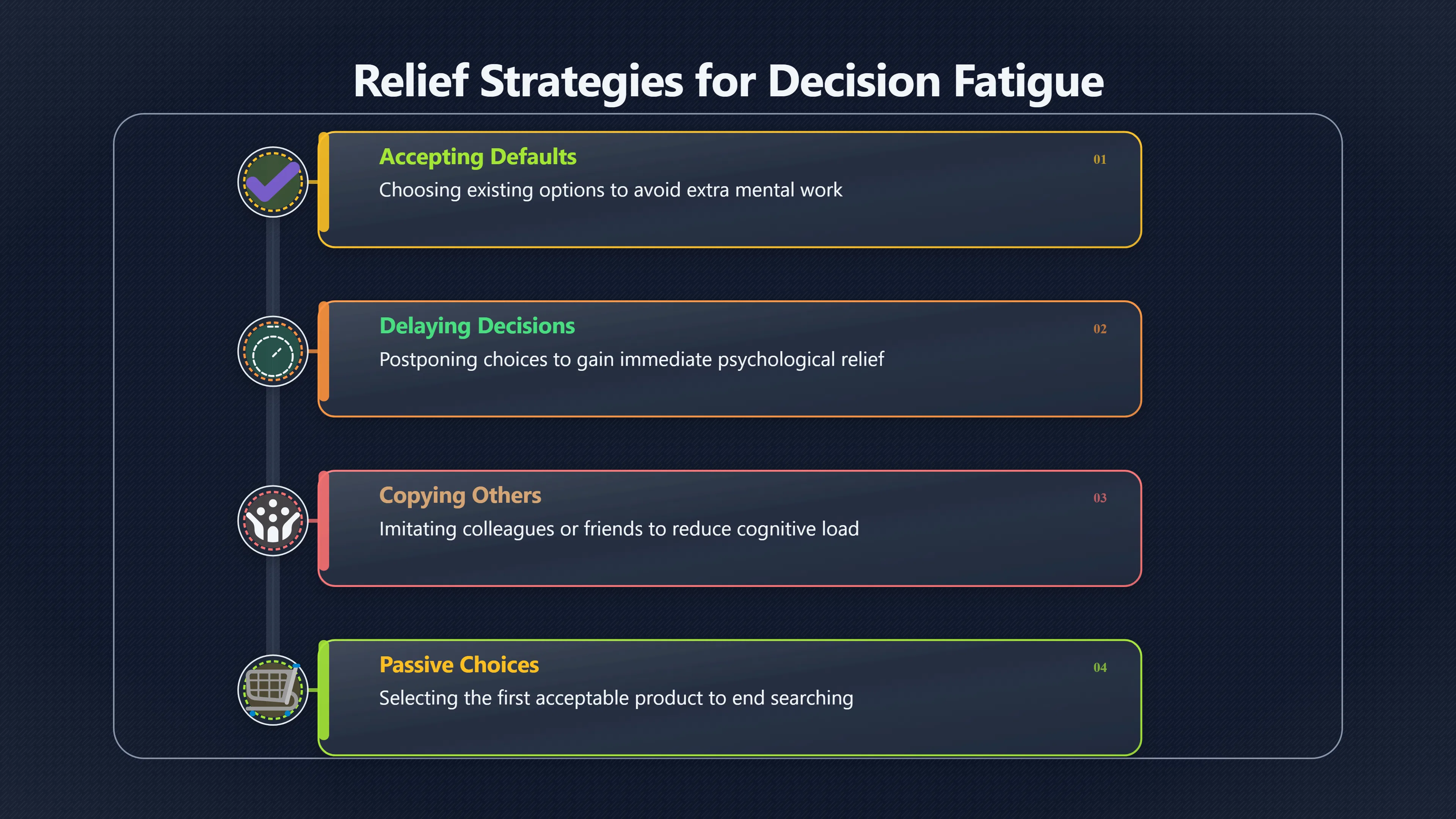
When people become mentally tired, they often reduce effort by simplifying decisions. Three patterns appear repeatedly.
- Accepting the default. The existing option becomes attractive simply because changing it requires more thought. Defaults can sometimes improve outcomes—for example, when experts have designed them well—but they can also leave people with choices they would have rejected if they had compared alternatives more carefully. [PMC]pmc.ncbi.nlm.nih.govPMCDecision Fatigue: A Conceptual Analysisby GA Pignatiello · 2018 · Cited by 317 — Our understanding of the literature suggests that decision fatigue is a symptom or phenotypi…
- Delaying the decision. Postponement offers immediate psychological relief. Unfortunately, delay can itself become a costly choice when opportunities expire, deadlines approach or uncertainty increases.
- Following someone else’s judgement. Copying a colleague, friend or majority opinion reduces cognitive effort. This is often sensible when others possess better information, but fatigue increases the risk of imitation replacing independent evaluation rather than complementing it.
These responses share a common feature: they reduce mental workload. The problem is that they also reduce active comparison between alternatives, making hidden tradeoffs easier to overlook.
A familiar everyday example is online shopping after a demanding day. Rather than comparing prices, delivery times, warranties and reviews, a tired buyer may purchase the first acceptable product, reuse a previous order or abandon the purchase entirely. None of these responses necessarily reflects the person’s genuine preferences; they reflect a desire to end the decision process.

Why passive choices can become costly
Passive decisions are attractive because they minimise immediate effort, but they can create larger costs later.
In financial decisions, repeatedly accepting default subscription renewals or failing to compare providers may gradually increase spending. In workplace settings, managers facing many sequential decisions may increasingly rely on familiar routines rather than questioning whether circumstances have changed. Healthcare research has also examined decision fatigue among clinicians and family members making difficult medical choices, where sustained cognitive demands can make careful comparison especially challenging. [PMC+2PMC]pmc.ncbi.nlm.nih.govDecision fatigue of surrogate decision-makers: a scoping reviewby S Cai · 2025 · Cited by 1 — Surrogate decision-makers are prone to d…
The important analytical point is that “doing nothing” is rarely neutral. Keeping the current arrangement, delaying action or accepting another person’s recommendation are all decisions with opportunity costs, even if they feel effortless.
Which decisions deserve protection from fatigue
Not every decision requires maximum analytical effort. Protecting important choices means distinguishing between decisions that deserve careful tradeoff thinking and those that can safely be simplified.
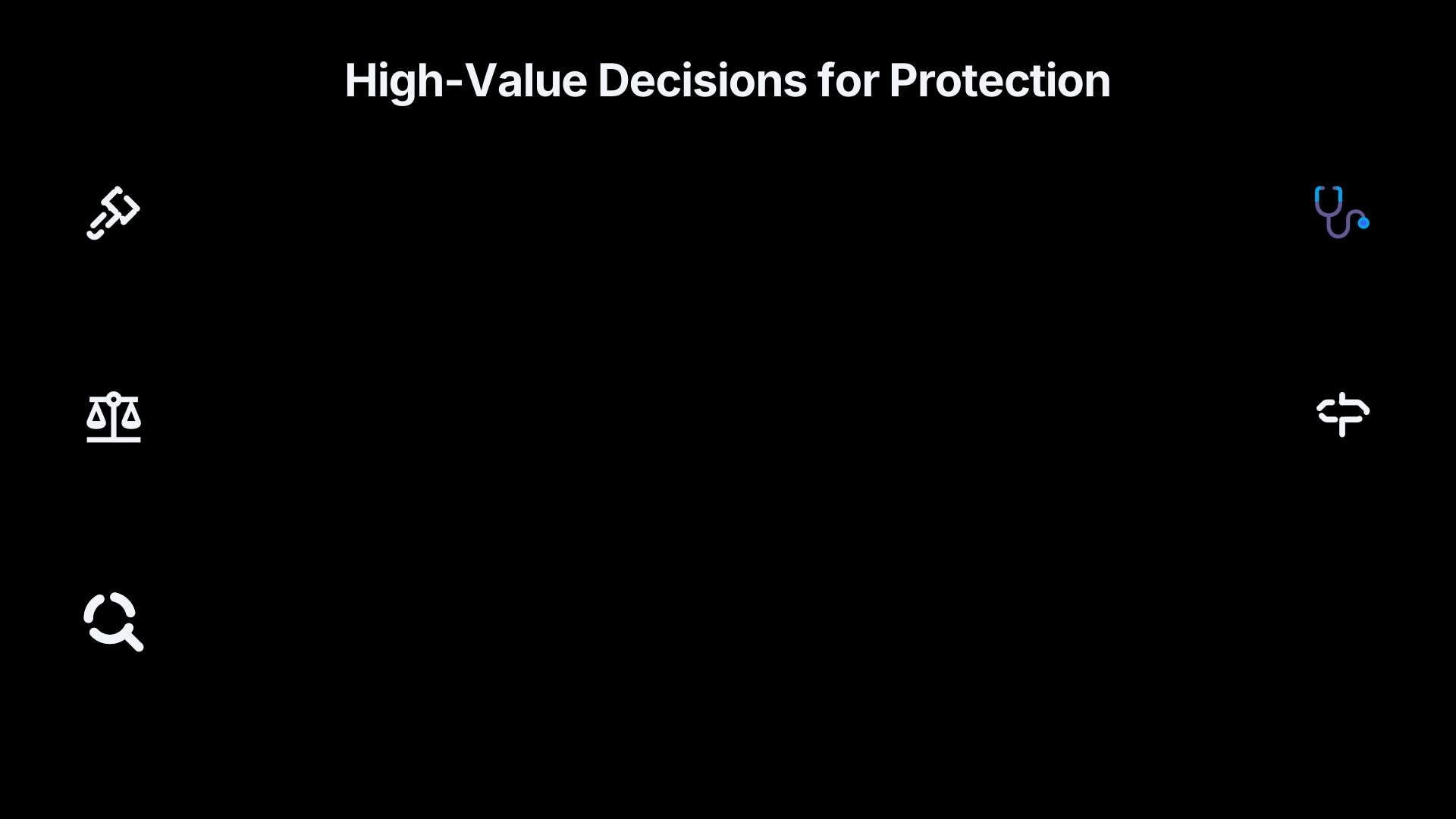
High-value decisions typically involve one or more of the following:
- Long-term consequences that are difficult to reverse.
- Significant financial, legal or health implications.
- Conflicting objectives where priorities genuinely matter.
- Situations in which there is no obvious default that serves your interests.
By contrast, many routine decisions benefit from simplification. Standardising meals, clothing, recurring purchases or administrative routines can preserve attention for choices where comparison genuinely changes the outcome.
Another useful strategy is to separate information gathering from commitment. Comparing options while mentally fresh and postponing the final commitment until after reflection is often more effective than trying to analyse complex alternatives under time pressure after an exhausting day.
A balanced view of the evidence
Decision fatigue has become a popular explanation for poor choices, but it should not be treated as a universal law.
The strongest evidence supports a modest claim: sustained cognitive demands can make people less likely to engage in effortful comparison, increasing reliance on simple heuristics such as defaults, postponement or imitation. There is considerably less agreement about why this happens. Early theories emphasised depletion of a limited self-control resource, whereas more recent work points towards changing motivation, attention allocation, perceived effort and contextual factors. Reviews increasingly recommend treating decision fatigue as a multifaceted phenomenon rather than a single biological process. [ResearchGate+2Frontiers]researchgate.netResearchGate(PDF) From Ego Depletion to Self-Control FatigueEgo depletion theory suggests that for high school students, frequent decisio…
For improving analytical skill, this debate changes less than it might appear. Whether the limiting factor is depleted self-control, shifting motivation or cognitive overload, the practical lesson is similar: protect important tradeoff decisions from unnecessary mental exhaustion. When attention is scarce, people do not merely think less carefully—they often stop comparing alternatives altogether, allowing passive choices to replace deliberate judgement.
Amazon book picks
Further Reading
Books and field guides related to When Tired Minds Stop Comparing. Use these as the next step if you want deeper reading beyond the article.
Decisive
Provides methods for improving important choices despite cognitive limitations.
Algorithms to Live By
Shows efficient decision strategies when mental resources are limited.
The Art of Thinking Clearly
Covers common thinking errors that become more likely under fatigue.
eBay marketplace picks
Marketplace Samples
Live-tested eBay searches with available results related to this page.



Endnotes
-
Source: pmc.ncbi.nlm.nih.gov
Title: PMCDecision Fatigue: A Conceptual Analysis
Link: https://pmc.ncbi.nlm.nih.gov/articles/PMC6119549/Source snippet
by GA Pignatiello · 2018 · Cited by 317 — Our understanding of the literature suggests that decision fatigue is a symptom or phenotypi...
-
Source: researchgate.net
Link: https://www.researchgate.net/publication/358734161_From_Ego_Depletion_to_Self-Control_Fatigue_A_Review_of_Criticisms_Along_With_New_Perspectives_for_the_Investigation_and_Replication_of_a_Multicomponent_PhenomenonSource snippet
ResearchGate(PDF) From Ego Depletion to Self-Control FatigueEgo depletion theory suggests that for high school students, frequent decisio...
-
Source: pmc.ncbi.nlm.nih.gov
Link: https://pmc.ncbi.nlm.nih.gov/articles/PMC12481925/Source snippet
Decision fatigue of surrogate decision-makers: a scoping reviewby S Cai · 2025 · Cited by 1 — Surrogate decision-makers are prone to d...
-
Source: researchgate.net
Link: https://www.researchgate.net/publication/237738528Decision_Fatigue_Exhausts_Self-Regulatory_Resources-_But_So_Does_Accommodating_to_Unchosen_AlternativesSource snippet
(PDF) Decision Fatigue Exhausts Self-Regulatory Resources27 Jan 2005 — Making decision from different alternatives for various criteria r...
-
Source: frontiersin.org
Link: https://www.frontiersin.org/journals/cognition/articles/10.3389/fcogn.2025.1719312/full -
Source: pmc.ncbi.nlm.nih.gov
Link: https://pmc.ncbi.nlm.nih.gov/articles/PMC12736114/Source snippet
Effect of Decision Fatigue on Food Choices: A Narrative...by N Brasington · 2025 · Cited by 1 — This narrative review examines the relat...
-
Source: reachlink.com
Title: decision fatigue
Link: https://www.reachlink.com/advice/stress/decision-fatigue/Source snippet
How Too Many Choices Exhaust YouMar 26, 2026 — Decision fatigue occurs when your ability to make quality decisions deteriorates after pro...
-
Source: Wikipedia
Title: Decision fatigue
Link: https://en.wikipedia.org/wiki/Decision_fatigueSource snippet
Decision fatigueDecision fatigue refers to the deteriorating quality of decisions made by an individual after a long session of decisi...
Additional References
-
Source: thedecisionlab.com
Link: https://thedecisionlab.com/biases/decision-fatigueSource snippet
Decision FatigueDecision fatigue describes how the quality of our decision-making declines as we make additional choices, as our cognitiv...
-
Source: insidebe.com
Link: https://insidebe.com/articles/decision-fatigue/Source snippet
Decision Fatigue – Everything You Need to KnowDecision fatigue is a lowered ability to make good decisions as the number of choices a per...
-
Source: firmsconsulting.com
Link: https://firmsconsulting.com/willpower-reduce-decision-fatigue/ -
Source: cell.com
Link: https://www.cell.com/trends/cognitive-sciences/fulltext/S1364-6613%2825%2900056-7Source snippet
he propensity to choose immediate rewards that can be obtained without effort...Read more...
-
Source: news-medical.net
Link: https://www.news-medical.net/health/What-is-Decision-Fatigue-and-How-Does-it-Affect-Your-Brain-and-Daily-Choices.aspxSource snippet
itive efficiency, leading individuals to rely on simpler, less effortful...Read more...
-
Source: gc-bs.org
Title: the neuroscience of decision fatigue
Link: https://gc-bs.org/articles/the-neuroscience-of-decision-fatigue/Source snippet
Why We Make...2 Jun 2025 — In the context of decision fatigue, this means that exercising self-control to make optimal choices during ea...
-
Source: welcometothejungle.com
Title: ego depletion decision fatigue
Link: https://www.welcometothejungle.com/en/articles/ego-depletion-decision-fatigueSource snippet
Ego depletion: The more decisions you make, the worse...27 Mar 2024 — During the decision-making process, decision fatigue sets in and l...
-
Source: bozemancounseling.org
Title: navigating decision fatigue
Link: https://www.bozemancounseling.org/blog/2024/8/4/navigating-decision-fatigueSource snippet
Bozeman, MT TherapyAug 4, 2024 — Decision fatigue refers to the deteriorating quality of decisions made by an individual after a prolonge...
-
Source: papers.ssrn.com
Link: https://papers.ssrn.com/sol3/Delivery.cfm/6459743.pdf?abstractid=6459743&mirid=1Source snippet
Overload, Decision Fatigue, and the Case for...Section 3 examines the decision fatigue mechanism, including the ego depletion model, the...
-
Source: youtube.com
Link: https://www.youtube.com/watch?v=AIO4cIHE1-MSource snippet
How Decision Fatigue Affects Decision Quality...
Topic Tree