Within Calibration
Why Probably Is Not Precise Enough
Numbers make confidence testable in a way that words like likely, doubtful, or probably cannot.
On this page
- Why vague confidence words hide disagreement
- How to choose practical probability ranges
- When 60 percent and 85 percent mean different beliefs
Page outline Jump by section
Introduction
Confidence calibration improves when you stop saying “probably”, “unlikely” or “I’m fairly sure” and instead assign explicit probabilities. Numbers force you to state how strongly you believe a claim and make it possible to compare that belief with what eventually happens. If you record that an event has a 70% chance of occurring, you can later ask whether events you rated around 70% actually happened about seven times out of ten. Vague language cannot be tested in the same way because different people often attach very different meanings to the same words. Research in psychology, forecasting and intelligence analysis consistently shows that numerical probabilities reduce ambiguity, improve communication and create better feedback for learning.[ResearchGate]researchgate.netResearch Gate(PDF) Words or Numbers?Communicating Probability in…July 23, 2020 — 8 Apr 2020 — We review the benefits and drawbacks of this approach, drawing on psychologi…
 Within a prediction journal, replacing verbal confidence with numbers is one of the simplest changes that produces measurable improvement. It turns confidence from a feeling into something that can be evaluated, criticised and refined over time.
Why vague confidence words hide disagreement
Words that sound precise are often interpreted very differently by different people. If two colleagues both describe a project as “likely”, one may mean there is roughly a 60% chance of success while the other imagines something closer to 90%. They appear to agree while holding substantially different beliefs.
Studies of linguistic probability repeatedly find wide variation in how people interpret common expressions such as “likely”, “possible” and “unlikely”. Context matters as well. The same word can receive different numerical interpretations depending on whether it refers to a medical diagnosis, a business forecast or an intelligence assessment.[Sage Journals]journals.sagepub.comOpen source on sagepub.com.
This ambiguity creates several practical problems.
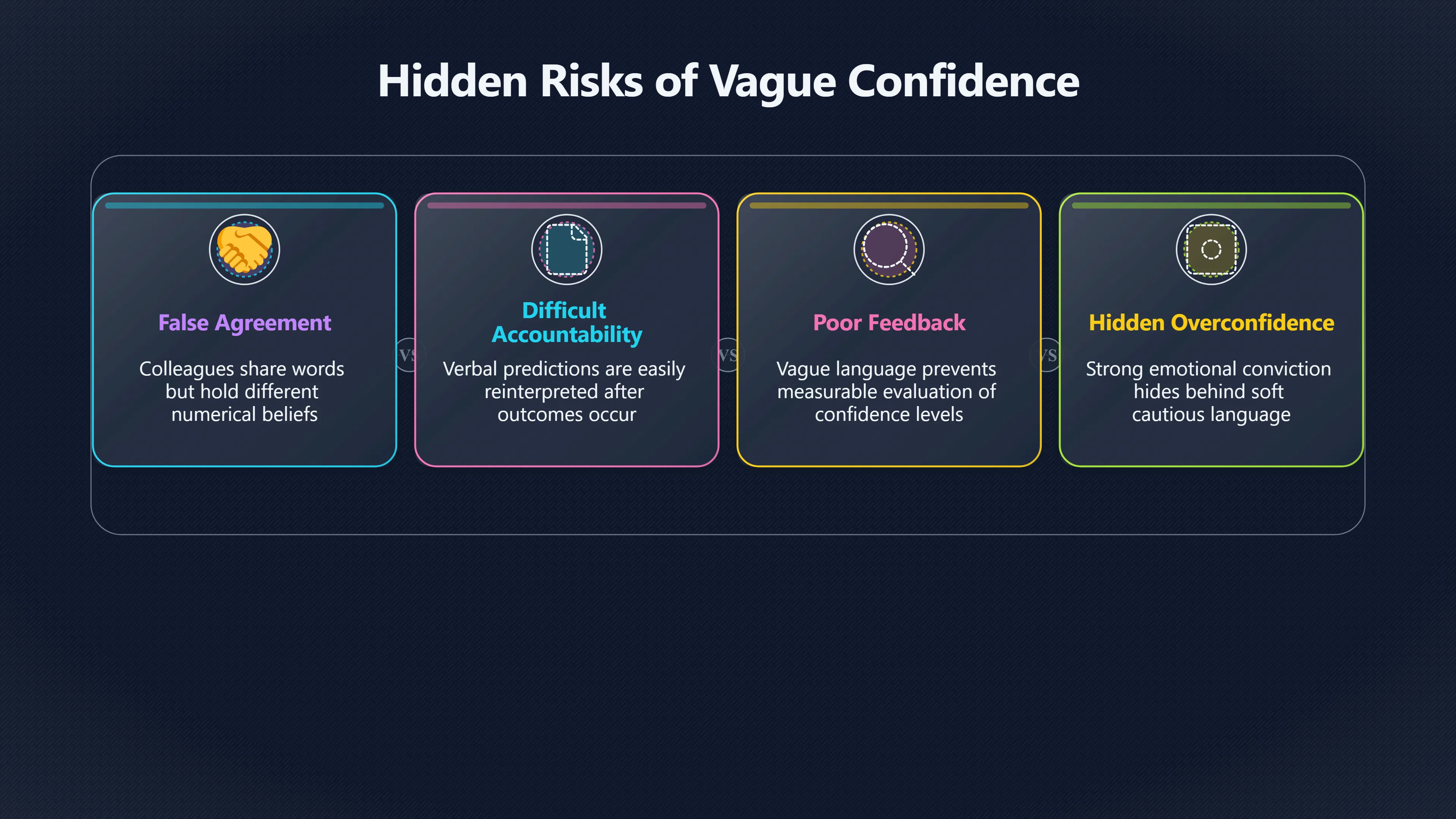
- False agreement. People think they share the same expectation when they do not.
- Difficult accountability. After the outcome is known, almost any verbal prediction can be reinterpreted.
- Poor feedback. You cannot easily evaluate whether “probably” was appropriately confident because no measurable prediction was ever recorded.
- Hidden overconfidence. Strong emotional conviction can hide behind soft language that sounds appropriately cautious.
Numerical probabilities expose these differences immediately. Saying “I think there is a 62% chance” communicates a noticeably different judgement from saying “I think there is an 88% chance”, even though both might otherwise have been described simply as “likely”.
How to choose practical probability ranges
The goal is not to pretend you can estimate every probability with scientific precision. Instead, probabilities should express the strength of your current belief as honestly as possible.
Many experienced forecasters avoid assigning arbitrary decimal precision unless they genuinely believe it is meaningful. Practical ranges often communicate uncertainty more faithfully than pretending to distinguish between, for example, 73% and 74%.
A useful working scale is:
ProbabilityPractical interpretation50%Evidence is balanced; either outcome seems equally plausible.60%Slightly more likely than not, but substantial doubt remains.70%A clear favourite, though failure is still common.80%Strong expectation with meaningful uncertainty remaining.90%Very confident, reserved for unusually strong evidence.95% or aboveShould be used sparingly because errors become especially informative.
Some people prefer fixed probability bands such as 5%, 20%, 40%, 60%, 80% and 95%. Others use increments of five percentage points. The exact system matters less than using it consistently enough that your forecasts can later be compared with reality.
When evidence is weak, saying “I don’t know” often corresponds to assigning a probability near 50%, not because both outcomes are equally attractive, but because your available information does not justify greater confidence.

When 60% and 85% mean different beliefs
The difference between 60% and 85% is much larger than it first appears.
A 60% prediction says that failure is expected almost two times in five. Someone hearing that forecast should prepare seriously for both outcomes.
An 85% prediction implies failure should occur only about once in every six or seven similar cases. Acting as though these two probabilities express the same confidence leads to poor decisions.
Imagine three project managers estimating whether a software release will meet its deadline.
- Manager A: 60%
- Manager B: 75%
- Manager C: 90%
All three might casually say the release will “probably” ship on time. Yet their expectations are dramatically different. Manager C is effectively saying that missing the deadline would be an unusual surprise, while Manager A expects delays to remain entirely plausible.
Recording numerical probabilities makes these differences visible before events unfold instead of allowing everyone to remember having held the “correct” opinion afterwards.
Why prediction journals benefit from numbers
A prediction journal works because it creates repeated opportunities for calibration.
Suppose you record one hundred forecasts over a year.
- Predictions around 60% should succeed roughly six times out of ten.
- Predictions around 80% should succeed roughly eight times out of ten.
- Predictions around 95% should almost always succeed.
If your 90% predictions fail one-third of the time, you are systematically overconfident. If your 60% predictions succeed almost every time, you may be underconfident. Numerical forecasts reveal these patterns in a way verbal forecasts never can.
This is also why scoring methods such as the Brier score evaluate probabilistic forecasts rather than simple right-or-wrong answers. They reward assigning probabilities that accurately reflect real uncertainty instead of expressing excessive certainty.[Harvard App Extension]appext.hks.harvard.edu1964-1994 found that 96 percent of key judgments expressed probability in ways that…Read more…
Lessons from fields that depend on uncertainty
Several professions have adopted numerical probability systems because misunderstanding uncertainty can have serious consequences.
Intelligence organisations have spent decades studying “words of estimative probability” after discovering that policymakers interpreted expressions such as “likely” and “probable” very differently. Numerous organisations now pair verbal expressions with numerical ranges or encourage direct numerical estimates to reduce misunderstanding.[Gwern+2Sage Journals]gwern.netVerbal Probability Expressions In National IntelligenceVerbal Probability Expressions In National Intelligence…May 12, 2008 — 2 May 2008 — Sherman Kent's classic work “Words of Estimat…
Climate science follows a similar approach. Reports by the Intergovernmental Panel on Climate Change (IPCC) attach explicit probability ranges to phrases such as “very likely” or “likely” so that readers share a common interpretation rather than relying on personal intuition.[Wikipedia]WikipediaWords of estimative probabilityWords of estimative probability
These examples illustrate a broader principle: whenever important decisions depend on uncertain information, standardised probabilities communicate more reliably than ordinary language alone.
Practical habits that improve probability estimates
Using numerical probabilities becomes easier with regular practice.
- Before writing a forecast, ask what probability would genuinely surprise you if the opposite occurred.
- Avoid defaulting to 50% simply because estimating feels difficult; use it only when evidence is genuinely balanced or insufficient.
- Reserve probabilities above about 95% for situations where you would be genuinely shocked to be wrong.
- Review resolved predictions in groups rather than individually so you can detect systematic overconfidence or underconfidence.
- When discussing forecasts with others, ask them to state their own numerical estimate before revealing yours. This exposes genuine disagreement instead of encouraging convergence around vague language.
Over time, this habit changes how uncertainty feels. Instead of asking whether something is “likely”, you begin asking exactly how likely it is and what evidence would justify moving that estimate higher or lower. That shift is the core mechanism through which replacing vague confidence words with probabilities improves judgement.
Amazon book picks
Further Reading
Books and field guides related to Why Probably Is Not Precise Enough. Use these as the next step if you want deeper reading beyond the article.
Superforecasting
Emphasizes explicit probabilities rather than vague confidence language.
How to Measure Anything
Teaches translating subjective judgments into numerical estimates.
Thinking, Fast and Slow
Provides the psychological foundation for improving probabilistic judgment.
eBay marketplace picks
Marketplace Samples
Live-tested eBay searches with available results related to this page.

Top pick
critical thinking card game
Open a targeted eBay search for items related to this topic.
Browse eBay
Related search
critical thinking game
Open a targeted eBay search for items related to this topic.
Browse eBay

Related search
not memorabilia
Open a targeted eBay search for items related to this topic.
Browse eBayEndnotes
1.
Source: researchgate.net
Title: Research Gate(PDF) Words or Numbers?
Link:https://www.researchgate.net/publication/340375795_Words_or_Numbers_Communicating_Probability_in_Intelligence_Analysis
Source snippet
Communicating Probability in...July 23, 2020 — 8 Apr 2020 — We review the benefits and drawbacks of this approach, drawing on psychologi...
Published: July 23, 2020
2.
Source: appext.hks.harvard.edu
Link:https://appext.hks.harvard.edu/publications/getFile.aspx?Id=1326
Source snippet
1964-1994 found that 96 percent of key judgments expressed probability in ways that...Read more...
3.
Source: gwern.net
Title: Verbal Probability Expressions In National Intelligence
Link:https://gwern.net/doc/statistics/bayes/2008-kesselman.pdf
Source snippet
Verbal Probability Expressions In National Intelligence...May 12, 2008 — 2 May 2008 — Sherman Kent's classic work “Words of Estimat...
Published: May 12, 2008
4.
Source: Wikipedia
Title: Words of estimative probability
Link:https://en.wikipedia.org/wiki/Words_of_estimative_probability
5.
Source: youtube.com
Title: Words of estimative probability
Link:https://www.youtube.com/watch?v=XdojqZ1AerY
Source snippet
Why Predictions Fail | Use Probabilities Instead of Certainty is highly relevant because it covers how assigning exact numerical probabil...
6.
Source: journals.sagepub.com
Link:https://journals.sagepub.com/doi/10.1177/2372732215602907
7.
Source: medium.com
Title: Words of Estimative Probability
Link:https://medium.com/%40chris.cooley/words-of-estimative-probability-an-analytical-language-reference-be84b8625628
Source snippet
A Threat Intelligence...Words of estimative probability (WEPs) are words or terms that can (and should) be used by threat intelligence a...
8.
Source: globalsecurity.org
Link:https://www.globalsecurity.org/intell/ops/probability.htm
Source snippet
Statements of Estimative ProbabilityIn his seminal 1964 article "Words of Estimative Probability," Kent identified a fundamental disconne...
Additional References
9.
Source: youtube.com
Title: Superforcasting: How to [Predict]({{ ‘predict/’ | relative_url }}) the Future
Link:https://www.youtube.com/watch?v=rV5Gicb66WA
Source snippet
3 'Superforecasting': The people that predict the future – BBC REEL...
10.
Source: youtu.be
Link:https://youtu.be/5mbX6ITznHk
Source snippet
"Multivariate Normal Distribution: [https://youtu.be/UVvuwv-ne1I](https://youtu.be/UVvuwv-ne1I) Estimated Calibrated Error (ECE): [https://youtu.be/NDY2fH1FitQ..."](https://youtu.be/NDY2fH1FitQ...")...
11.
Source: cyberwar.nl
Link:https://cyberwar.nl/d/fromForeknowledge/Analystsjudgementofprobability.pdf
Source snippet
od odds. Do you like those.Read more...
12.
Source: youtu.be
Link:https://youtu.be/NDY2fH1FitQ
Source snippet
*Contents* ▬▬▬▬▬▬▬▬▬▬▬▬▬▬▬▬▬▬▬▬▬▬▬▬ 00:00 - Problem Introduction...
13.
Source: youtu.be
Link:https://youtu.be/UVvuwv-ne1I
Source snippet
"Estimated Calibrated Error (ECE): [https://youtu.be/NDY2fH1FitQ..."](https://youtu.be/NDY2fH1FitQ...")...
14.
Source: youtube.com
Title: ‘Superforecasting’: The people that predict the future – BBC REEL
Link:https://www.youtube.com/watch?v=SAzTP2A634g
Source snippet
4 Model Calibration - Brier Score Explained...
15.
Source: youtube.com
Title: Model Calibration
Link:https://www.youtube.com/watch?v=BiaebXlgfNQ
Source snippet
5 Words of estimative probability...
Topic Tree