Within Calibration
What Superforecasting Teaches Everyday Thinkers
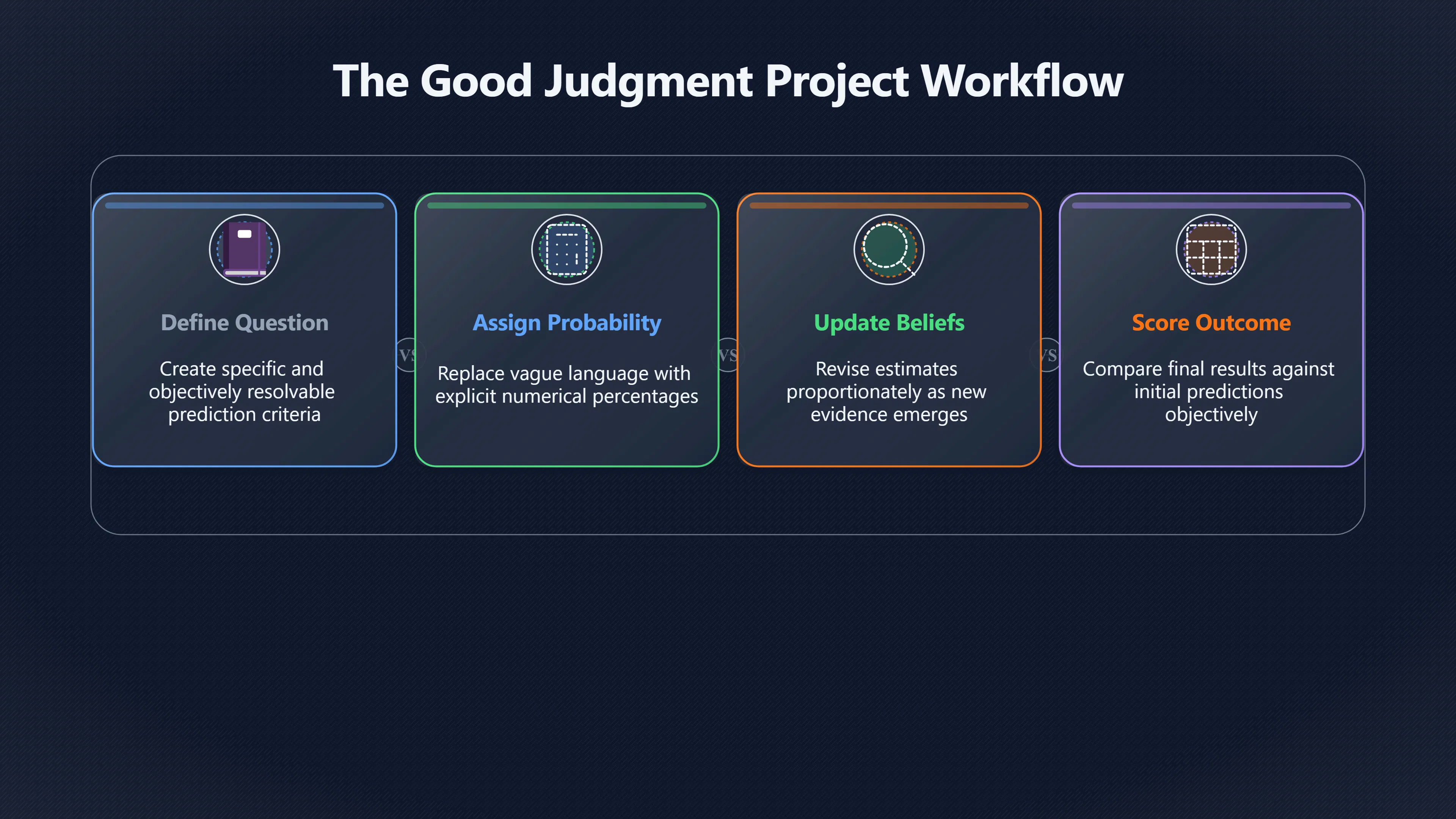
The Good Judgment Project shows how explicit probabilities, feedback, updating, and scoring can improve real-world judgement.
On this page
- Why forecasting tournaments matter
- Training, updating, teamwork, and aggregation
- What individuals can borrow without a tournament
Page outline Jump by section
Introduction
The Good Judgment Project showed that better judgement is not mainly about having exceptional intelligence or privileged information. Instead, it comes from making explicit probabilistic forecasts, updating them as evidence changes, and learning systematically from feedback. Originally developed as part of a large forecasting tournament for the US intelligence community, the project demonstrated that ordinary people could substantially improve their predictive accuracy through training, disciplined thinking, teamwork, and careful measurement. These lessons translate surprisingly well to everyday decisions, from planning projects and assessing business risks to judging whether a news story will develop as expected. Rather than trying to predict everything perfectly, the project teaches people how to become better calibrated: more confident when the evidence is strong, less certain when it is weak, and quicker to revise beliefs when reality changes.[Stanford University+2iarpa.gov]web.stanford.eduIntelligence Community sponsored a series of forecasting tournaments designed to explore the best… The Good Judgment Project (GJP). In…

Why forecasting tournaments matter
The Good Judgment Project emerged from the Intelligence Advanced Research Projects Activity (IARPA) Aggregative Contingent Estimation (ACE) programme, which asked competing research teams to improve geopolitical forecasting. Participants answered hundreds of clearly defined questions such as whether a country would hold an election by a particular date or whether a political agreement would be reached within a specified period. Every forecast received a numerical probability and was later scored against reality.[iarpa.gov]iarpa.govACEThe goal of the ACE Program is to dramatically enhance the accuracy, precision, and timeliness of intelligence forecasts for a broad r…
This structure matters because it removes many of the excuses that normally protect poor judgement. Forecasts must be:
- specific enough to be resolved;
- probabilistic rather than vague;
- made before outcomes are known;
- scored objectively after the event.
Unlike ordinary opinions, forecasts cannot quietly evolve in memory after the fact. The continual cycle of prediction, outcome and feedback allows genuine improvement.
Perhaps the project’s most important finding was that forecasting ability varied far more than many researchers expected. Some participants consistently outperformed both experts and other volunteers over multiple years. These “superforecasters” were not simply lucky. Their advantage persisted across different questions and forecasting seasons, suggesting that better judgement reflected repeatable habits rather than isolated successes.[Stanford University+2Wharton Faculty Platform]web.stanford.eduIntelligence Community sponsored a series of forecasting tournaments designed to explore the best… The Good Judgment Project (GJP). In…
Training, updating, teamwork, and aggregation
The Good Judgment Project identified several practical behaviours that repeatedly distinguished stronger forecasters. None require participation in a forecasting tournament.
Think in probabilities, not certainties
Everyday conversations encourage words such as “probably”, “unlikely” or “almost certain”. Superforecasters instead attached explicit numerical probabilities to claims.
Doing so forces clearer thinking. Saying there is a 65% chance that a supplier will deliver on time communicates much more information than simply saying the delivery is “likely”. It also makes later evaluation possible.
Repeated use of numerical probabilities gradually improves calibration because forecasters discover whether their 70% predictions really occur about seven times out of ten.[Stanford University]web.stanford.eduIntelligence Community sponsored a series of forecasting tournaments designed to explore the best… The Good Judgment Project (GJP). In…
Update beliefs frequently
One of the strongest findings from the project was that successful forecasters revised their estimates more often than weaker participants.
Updating did not mean constantly changing one’s mind for trivial reasons. Instead, it meant responding proportionately to genuinely new evidence. Rather than treating an initial prediction as something to defend, superforecasters viewed it as a temporary estimate that should improve over time.
This contrasts with a common psychological tendency to anchor on first impressions and adjust too little afterwards.[Stanford University+2Good Judgment]web.stanford.eduIntelligence Community sponsored a series of forecasting tournaments designed to explore the best… The Good Judgment Project (GJP). In…
Break difficult questions into smaller ones
Large uncertain questions become easier when divided into manageable components.
Instead of asking:
“Will this new product succeed?”
a forecaster might separately estimate:
- whether development finishes on schedule;
- whether regulators approve it;
- whether competitors launch alternatives;
- whether customer demand reaches a specified level.
Thinking through each component often produces better overall judgement than relying on intuition about the whole problem. This “outside view plus inside view” style of reasoning became a recurring theme in the project’s training.[Corporate Research Forum]crforum.co.ukIntelligence Advanced Research Projects Activity tournament.Read morerporate Research ForumSuperforecasting: How to Upgrade Your Company's…by PJH Schoemaker · 2016 · Cited by 71 — The Good Judgment Pro…
Use base rates before unique stories
Superforecasters typically began with historical frequencies before considering special circumstances.
Suppose someone wants to estimate whether a software project will finish on time. A useful first question is not “How motivated is this team?” but “How often do comparable software projects finish on schedule?”
Starting with similar past cases helps prevent compelling narratives from overwhelming statistical reality. Individual details still matter, but they are interpreted relative to an evidence-based baseline rather than replacing it altogether.[Good Judgment]goodjudgment.comGood JudgmentTen Commandments for Aspiring SuperforecastersThese commandments describe behaviors that have been “experimentally demonstra…
Learn collaboratively without seeking consensus
An interesting finding from the Good Judgment Project was that carefully designed teamwork improved forecasting.
The most successful teams did not simply vote or compromise. Members challenged one another’s assumptions, shared evidence and independently revised their probabilities. Diversity of perspective proved valuable when combined with respectful disagreement and independent judgement.
Aggregation algorithms then combined many individual forecasts, usually producing predictions that outperformed most single forecasters. This illustrates a refined version of the “wisdom of crowds”: crowds become especially effective when individuals think independently and update from shared information rather than merely copying one another.[Stanford University+2Wharton Faculty Platform]web.stanford.eduIntelligence Community sponsored a series of forecasting tournaments designed to explore the best… The Good Judgment Project (GJP). In…
What individuals can borrow without a tournament
Most people do not need sophisticated software or hundreds of forecasting questions to benefit from these ideas. The habits can be incorporated into an ordinary prediction journal.
Useful questions include:
- Will this project finish before the deadline?
- Will inflation fall below a stated figure by year-end?
- Will I complete this course within six months?
- Will this customer renew their contract?
Each prediction should include:
- a precise resolution criterion;
- a numerical probability;
- key assumptions;
- the date for review.
After the outcome becomes known, compare the prediction with reality rather than with memory.
Over time, patterns emerge. Some people discover they consistently assign probabilities that are too high. Others realise they update too slowly when new evidence arrives. These recurring errors are far more useful than isolated mistakes because they reveal systematic biases in judgement.
The mindset behind superforecasting
Research associated with the Good Judgment Project suggests that successful forecasters shared several psychological habits.
They tended to be intellectually curious rather than ideologically rigid. They were comfortable expressing uncertainty instead of pretending certainty. They actively searched for evidence that could prove them wrong. They separated their identity from individual predictions, making it easier to admit error without treating it as personal failure.
This combination has sometimes been described as holding strong opinions lightly: working hard to reach the best current estimate while remaining willing to revise it whenever better evidence appears.[Good Judgment+2Esoteric Library]goodjudgment.comGood JudgmentTen Commandments for Aspiring SuperforecastersThese commandments describe behaviors that have been “experimentally demonstra…
Limits and misunderstandings
The Good Judgment Project should not be interpreted as showing that anyone can reliably predict complex events far into the future.
Several important limitations deserve attention.
First, the project focused largely on questions that were clearly defined, objectively resolvable and typically answered within months or a few years. Many everyday uncertainties are less sharply defined.
Second, forecasting skill improves decision quality but does not eliminate randomness. Even excellent forecasters make many incorrect predictions because uncertainty is inherent rather than merely a consequence of poor reasoning.
Third, some later research has questioned how easily superforecasting methods transfer to environments with limited data, smaller participant pools or rapidly changing conditions. Structured forecasting still helps, but gains may be smaller than those observed in the original large-scale tournaments.[PMC+2Stanford University]pmc.ncbi.nlm.nih.govThe superforecasting hypothesis is challenged under real-life scarcitySuperforecasting reality check: Evidence from a small pool of…by I Katsagounos · 2020 · Cited by 23 — The study contributes to the…
Finally, forecasting is only one part of good decision-making. A well-calibrated prediction does not determine what someone ought to do. Decisions also involve values, costs, risk tolerance and practical constraints.
The enduring lesson for everyday thinkers
The lasting contribution of the Good Judgment Project is not that a small group of “superforecasters” possess extraordinary intuition. It is that many elements of better judgement can be learned.
For someone already keeping a prediction journal, the project offers a practical framework:
- assign explicit probabilities instead of vague language;
- define questions so outcomes are objectively resolvable;
- begin with historical base rates before unique narratives;
- revise forecasts whenever meaningful evidence appears;
- review outcomes using proper scoring rather than memory;
- discuss forecasts with others while maintaining independent judgement.
Together, these practices create a continuous learning loop. Instead of treating judgement as a fixed personal trait, they encourage viewing it as a skill that improves through repeated forecasting, honest feedback and disciplined updating.[Stanford University+2Good Judgment]web.stanford.eduIntelligence Community sponsored a series of forecasting tournaments designed to explore the best… The Good Judgment Project (GJP). In…
Amazon book picks
Further Reading
Books and field guides related to What Superforecasting Teaches Everyday Thinkers. Use these as the next step if you want deeper reading beyond the article.
Thinking, Fast and Slow
Provides the cognitive bias and judgment framework that underpins better probabilistic thinking.
The Signal and the Noise
Explores why forecasts succeed or fail across many domains, complementing superforecasting concepts.
The Scout Mindset
Emphasizes updating beliefs, intellectual humility, and evidence-based reasoning central to good forecasting.
How to Measure Anything
Shows practical methods for estimating uncertainty and improving decisions using measurable evidence.
eBay marketplace picks
Marketplace Samples
Live-tested eBay searches with available results related to this page.

Top pick
critical thinking card game
Open a targeted eBay search for items related to this topic.
Browse eBay
Related search
critical thinking game
Open a targeted eBay search for items related to this topic.
Browse eBay

Related search
your memorabilia
Open a targeted eBay search for items related to this topic.
Browse eBayEndnotes
1.
Source: web.stanford.edu
Link:https://web.stanford.edu/~knutson/jdm/mellers15.pdf
Source snippet
Intelligence Community sponsored a series of forecasting tournaments designed to explore the best... The Good Judgment Project (GJP). In...
2.
Source: iarpa.gov
Link:https://www.iarpa.gov/research-programs/ace
Source snippet
ACEThe goal of the ACE Program is to dramatically enhance the accuracy, precision, and timeliness of intelligence forecasts for a broad r...
3.
Source: pmc.ncbi.nlm.nih.gov
Title: The superforecasting hypothesis is challenged under real-life scarcity
Link:https://pmc.ncbi.nlm.nih.gov/articles/PMC7333631/
Source snippet
Superforecasting reality check: Evidence from a small pool of...by I Katsagounos · 2020 · Cited by 23 — The study contributes to the...
4.
Source: goodjudgment.com
Link:https://goodjudgment.com/
Source snippet
Good JudgmentGood Judgment: See the future sooner with SuperforecastingReports that Superforecasters were 30% more accurate than intellig...
5.
Source: faculty.wharton.upenn.edu
Title: 2015 superforecasters
Link:https://faculty.wharton.upenn.edu/wp-content/uploads/2015/07/2015—superforecasters.pdf
Source snippet
Wharton Faculty Platform2015---superforecasters.pdf - Wharton Faculty Platformby B Mellers · 2015 · Cited by 321 — Accurate probability e...
6.
Source: esotericlibrary.weebly.com
Link:https://esotericlibrary.weebly.com/uploads/5/0/7/7/5077636/philip_e.tetlock-_superforecasting_the_art_and_science_of_prediction.pdf
Source snippet
Esoteric LibrarySuperforecasting“Good judgment and good forecasting are rare, but they turn out to be made of teachable skills. By forcin...
7.
Source: goodjudgment.com
Link:https://goodjudgment.com/philip-tetlocks-10-commandments-of-superforecasting/
Source snippet
Good JudgmentTen Commandments for Aspiring SuperforecastersThese commandments describe behaviors that have been “experimentally demonstra...
8.
Source: crforum.co.uk
Title: Intelligence Advanced Research Projects Activity tournament.Read more
Link:https://www.crforum.co.uk/wp-content/uploads/2016/10/2016_Schoemaker_Tetlock_Superforecasting-HBR-May-2016.pdf
Source snippet
rporate Research ForumSuperforecasting: How to Upgrade Your Company's...by PJH Schoemaker · 2016 · Cited by 71 — The Good Judgment Pro...
9.
Source: goodjudgment.com
Title: common questions good judgment superforecasters
Link:https://goodjudgment.com/common-questions-good-judgment-superforecasters/
Source snippet
A Primer on Good Judgment Inc and SuperforecastersJul 12, 2024 — At Good Judgment Inc (GJI), the official home of Superforecasting, we pr...
10.
Source: goodjudgment.com
Link:https://goodjudgment.com/resources/the-superforecasters-track-record/
Source snippet
An analysis of Good Judgment Project forecasts by UC-Irvine decision...Read more...
11.
Source: Wikipedia
Title: The Good Judgment Project
Link:https://en.wikipedia.org/wiki/The_Good_Judgment_Project
Source snippet
The Good Judgment ProjectThe Good Judgment Project (GJP) is an organization dedicated to harnessing the wisdom of the crowd to forecas...
12.
Source: gjopen.com
Link:https://www.gjopen.com/
Source snippet
Good Judgment® OpenA forecasting services firm that equips corporate, government, and non-governmental decision-makers with the benefit o...
13.
Source: managementboek.nl
Link:https://www.managementboek.nl/magazine/recensie/11945/superforecasting-manpo187?srsltid=AfmBOoo2Wwm0nBtsMoyaIcQ1lmG7SUI86_S8FRw8dZuMx64oM-je8tPR
Source snippet
BoekblogTetlock's Good Judgement Project (GJP) aims to bring this rigor to the forecasting domain. Briefly summarized, thousands of amate...
14.
Source: youtube.com
Link:https://www.youtube.com/watch?v=pedNak4S9IE
Source snippet
Superforecasting | Philip TetlockSo Philip Tetlock reported in his 02005 book, "Expert Political Judgement... Good Judgement Project, wi...
15.
Source: goodjudgment.substack.com
Link:https://goodjudgment.substack.com/p/a-primer-on-good-judgment-inc-and
Source snippet
Primer on Good Judgment Inc and SuperforecastersWe leverage the lessons learned during the IARPA tournament and insights gained in our su...
Additional References
16.
Source: thedecisionlab.com
Link:https://thedecisionlab.com/thinkers/political-science/philip-tetlock
Source snippet
Philip TetlockHe coined the term “superforecaster” to refer to individuals with particularly good judgment, who are able to foresee futur...
17.
Source: thejennyproject.com
Link:https://www.thejennyproject.com/blog/the-good-judgment-project-revolutionizing-forecasting
Source snippet
The Good Judgment Project: Revolutionizing ForecastingThe Good Judgment Project (GJP), a groundbreaking research initiative, has shed new...
18.
Source: edge.org
Link:https://www.edge.org/conversation/philip_tetlock-edge-master-class-2015-a-short-course-in-superforecasting-class-ii
Source snippet
A Short Course in Superforecasting, Class II24 Aug 2015 — A short course in superforecasting, Class II. Tournaments: Prying Open Closed M...
19.
Source: aiimpacts.org
Title: evidence on good forecasting practices from the good judgment project
Link:https://aiimpacts.org/evidence-on-good-forecasting-practices-from-the-good-judgment-project/
Source snippet
Evidence on good forecasting practices from the...The Good Judgment Project (GJP) was the winning team in IARPA's 2011-2015 forecasting...
20.
Source: floriswolswijk.com
Link:https://floriswolswijk.com/superforecasting/
Source snippet
SuperforecastingSuperforecasting – Philip Tetlock & Dan Gardner. Summary: Great book about how to look at predictions and how to do them...
21.
Source: askeladdencapital.com
Link:https://askeladdencapital.com/philip-tetlocks-superforecasting-book-review-notes-analysis/
Source snippet
t,” which studied people's ability to make accurate, time-constrained forecasts...Read more...
22.
Source: soa.org
Link:https://www.soa.org/globalassets/assets/Library/Newsletters/Forecasting-Futurism/2015/July/ffn-2015-iss11-campbell.pdf
Source snippet
But more on that in a bit. The ACE tournament run by IARPA stands for “Aggrega-.Read more...
23.
Source: forum.effectivealtruism.org
Link:https://forum.effectivealtruism.org/posts/pnpnqA4hijnr59p7d/efforts-to-improve-the-accuracy-of-our-judgments-and
Source snippet
to Improve the Accuracy of Our Judgments and...Oct 25, 2016 — Below I list some common advice for improving judgment and forecasting acc...
24.
Source: lesswrong.com
Title: is there an intuitive way to [explain]({{ ‘explain/’ | relative_url }}) how much better
Link:https://www.lesswrong.com/posts/yDdBLdTSAEcbjkbGj/is-there-an-intuitive-way-to-explain-how-much-better
Source snippet
Feb 18, 2020 — An aggregate of superforecaster predictions had about 60-70% lower brier scores than the control group of "regular" foreca...
25.
Source: reddit.com
Link:https://www.reddit.com/r/slatestarcodex/comments/cvoi4y/the_tenants_of_superforecast_accuracy_are/
Source snippet
the factor that is used for the base rate is extremely...Read more...
Topic Tree