Within Gut vs Analysis
When should you trust your gut?
Fast judgement is most reliable when experience comes from repeated patterns and clear corrective feedback.
On this page
- Learnable environments and valid cues
- Feedback that turns experience into skill
- Everyday domains where intuition earns trust
Page outline Jump by section
Introduction
Gut feelings are not automatically wise, nor are they automatically irrational. The most reliable form of intuition is usually a learned skill: a rapid judgement built through repeated exposure to meaningful patterns and corrected by accurate feedback over time. Research comparing expert decision-making with studies of cognitive bias reaches a surprisingly consistent conclusion. Fast judgements deserve more trust when they develop in environments where important cues are genuinely informative and where people repeatedly discover when they are right and wrong. In contrast, intuition formed in noisy environments with delayed, ambiguous or misleading feedback can become confidently inaccurate rather than genuinely skilled. [ResearchGate]researchgate.netResearchGate(PDF) Conditions for Intuitive ExpertiseThis article reports on an effort to explore the differences between two approaches t…
 For improving thinking and analytical skills, this distinction matters more than simply asking whether to “trust your gut”. The better question is whether your gut has actually been trained.
What turns instinct into expertise?
The feeling that “I just know” is not itself evidence of expertise. Expert intuition develops when experience compresses thousands of previous observations into rapid pattern recognition. Instead of consciously comparing alternatives, experienced people often recognise familiar situations and immediately notice which response fits best. This is the foundation of Gary Klein’s recognition-primed decision model, developed from observations of firefighters and other professionals working under pressure. [ResearchGate]researchgate.netResearchGate(PDF) Conditions for Intuitive ExpertiseThis article reports on an effort to explore the differences between two approaches t…
Two conditions repeatedly emerge from the research:
- The environment contains reliable patterns. The world must reward attention to cues that genuinely predict what will happen.
- Experience includes corrective feedback. People repeatedly learn whether their judgements were accurate, allowing mistaken patterns to be discarded and useful ones reinforced.
If either condition is missing, confidence can grow without corresponding accuracy. Kahneman and Klein argued that subjective certainty is not a dependable guide to whether intuition is actually correct. [ResearchGate]researchgate.netResearchGate(PDF) Conditions for Intuitive ExpertiseThis article reports on an effort to explore the differences between two approaches t…
Learnable environments and valid cues
Not every environment teaches useful intuition.
Robin Hogarth described the difference between “kind” learning environments, where experience steadily improves judgement, and “wicked” learning environments, where experience can reinforce the wrong lessons because feedback is delayed, incomplete or distorted. [faculty.weber.edu]faculty.weber.eduhogarth (2005pdfby RM Hogarth — In Hogarth (2001), I noted that tacit learning can take place in environments that are kind or wicked. Kind and wicked…
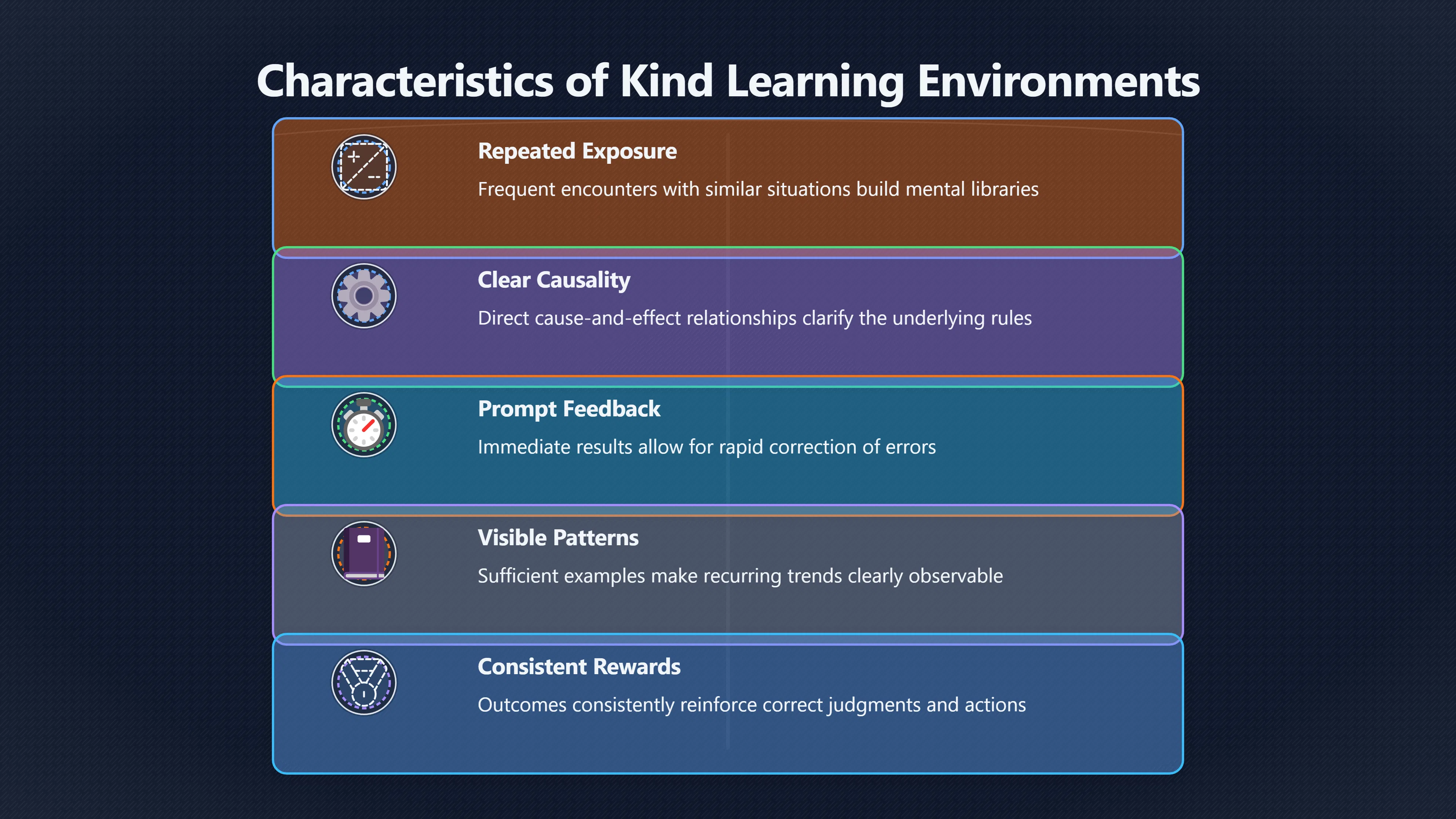
Kind environments typically have several characteristics:
- repeated exposure to similar situations
- clear cause-and-effect relationships
- prompt, accurate feedback
- enough examples for patterns to become visible
- consequences that consistently reward correct judgement
Examples include learning to cook, diagnosing common mechanical faults, reading musical notation, recognising normal driving hazards or playing chess. Mistakes become obvious relatively quickly, making experience genuinely educational.
Wicked environments look very different. Outcomes may depend heavily on chance, important information may be hidden, and feedback often arrives months or years later—or never arrives at all. In these settings, people frequently remember successes while explaining away failures, producing unwarranted confidence instead of expertise. [faculty.weber.edu]faculty.weber.eduhogarth (2005pdfby RM Hogarth — In Hogarth (2001), I noted that tacit learning can take place in environments that are kind or wicked. Kind and wicked…
The crucial point is that intuition is not universally trustworthy or untrustworthy. Its reliability depends heavily on the learning environment that created it.
How feedback transforms experience into skill
Experience alone is surprisingly poor at creating expertise. Repetition without correction simply repeats existing habits.
High-quality feedback teaches intuition in several ways.
First, it strengthens associations between genuine predictive cues and successful outcomes. A skilled electrician, for example, gradually learns which combinations of sounds, smells and measurements indicate specific faults because each repair immediately confirms or disproves the diagnosis.
Second, feedback removes misleading patterns. People naturally notice memorable coincidences, but repeated correction teaches which apparent relationships are unreliable.
Third, rapid feedback improves calibration. Skilled decision-makers not only become more accurate but also learn when they should feel uncertain. Their confidence becomes better matched to reality rather than simply becoming stronger. [ResearchGate]researchgate.netResearchGate(PDF) Conditions for Intuitive ExpertiseThis article reports on an effort to explore the differences between two approaches t…
Poor feedback creates the opposite effect. Delayed outcomes, selective memory and inconsistent consequences allow incorrect intuitions to survive for years.
Everyday situations where intuition earns trust
Most people develop pockets of genuine intuitive expertise in ordinary life. [scribd.com]scribd.comConditions for Intuitive Expertise | PDF | Decision MakingThis article aims to compare and reconcile two perspectives on intuition and ex…
Intuition is more likely to be dependable when you have:
- Long practical experience. Years of repeated exposure create a large mental library of patterns.
- Direct outcome feedback. You usually discover whether your judgement was correct.
- Stable conditions. The underlying rules do not change dramatically from one situation to another.
- Focused practice. You actively compare expectations with outcomes instead of simply accumulating time.
Common examples include:
Driving. Experienced drivers often recognise developing hazards before consciously identifying them because they have repeatedly seen similar situations unfold.
Cooking. Experienced cooks often detect problems through smell, colour or texture long before recipes would explicitly recommend acting.
Healthcare within familiar routines. Experienced clinicians sometimes recognise a patient who “doesn’t look right” before identifying the precise diagnosis. However, responsible clinical practice still combines this recognition with systematic testing rather than relying on intuition alone. [ResearchGate]researchgate.netResearchGate(PDF) Conditions for Intuitive ExpertiseThis article reports on an effort to explore the differences between two approaches t…
Skilled trades. Electricians, plumbers and mechanics often identify likely causes rapidly because countless previous repairs have created strong associations between symptoms and faults.
In these domains, intuition usually serves as rapid recognition, while deliberate reasoning verifies the response before irreversible action.
When confidence is not evidence of trained skill
Some domains feel intuitive while offering poor conditions for learning. [scribd.com]scribd.comConditions for Intuitive Expertise | PDF | Decision MakingThis article aims to compare and reconcile two perspectives on intuition and ex…
Hiring decisions often seem to produce strong first impressions, yet later job performance depends on many hidden factors and feedback is slow and noisy.
Financial investing presents another challenge. A successful trade may result from luck rather than skill, while a sound decision may lose money because of unpredictable market movements. This makes it difficult for experience alone to teach accurate intuition. Kahneman and Klein specifically identified such environments as poor candidates for dependable intuitive expertise. [ResearchGate]researchgate.netResearchGate(PDF) Conditions for Intuitive ExpertiseThis article reports on an effort to explore the differences between two approaches t…
Similarly, judging personalities after brief encounters, predicting long-term relationship outcomes or forecasting major economic events rarely provides the immediate, unambiguous feedback needed to train reliable gut feelings.
These are situations where analysis, evidence gathering and deliberate checking should play a larger role than instinct.
A practical test before trusting your gut
Rather than asking whether intuition feels strong, ask how it was trained.
Useful questions include:
- Have I encountered many genuinely similar situations before?
- Did I consistently learn whether my previous judgements were correct?
- Were the lessons driven by reliable patterns rather than luck?
- Would another experienced person recognise the same cues?
- Has the environment stayed reasonably stable since I gained this experience?
If the answer to most of these questions is yes, your intuition is more likely to represent compressed expertise than mere confidence.
If several answers are no, the gut feeling may still be worth noticing, but it should be treated as a hypothesis that deserves careful analysis rather than as a trustworthy conclusion.
Amazon book picks
Further Reading
Books and field guides related to When should you trust your gut?. Use these as the next step if you want deeper reading beyond the article.
The Power of Intuition
Shows how experience and feedback create reliable gut feelings.
Risk Savvy
Connects intuitive judgment with environments where cues are genuinely informative.
eBay marketplace picks
Marketplace Samples
Live-tested eBay searches with available results related to this page.


Endnotes
-
Source: researchgate.net
Link: https://www.researchgate.net/publication/26798603_Conditions_for_Intuitive_ExpertiseSource snippet
ResearchGate(PDF) Conditions for Intuitive ExpertiseThis article reports on an effort to explore the differences between two approaches t...
-
Source: faculty.weber.edu
Title: hogarth (2005)
Link: https://faculty.weber.edu/eamsel/research%20groups/dual%20process%20research/new%20papers/hogarth%20%282005%29.pdfSource snippet
pdfby RM Hogarth — In Hogarth (2001), I noted that tacit learning can take place in environments that are kind or wicked. Kind and wicked...
-
Source: youtube.com
Title: Seeing What Others Don’t by Gary Klein | Complete Book
Link: https://www.youtube.com/watch?v=v0_Txlg0atYSource snippet
Recognition-Primed Decision Model - Gary Klein on Fresh perspectives...
-
Source: youtube.com
Title: Recognition-Primed Decision Model
Link: https://www.youtube.com/watch?v=_BIMU8zPcrM -
Source: scribd.com
Link: https://www.scribd.com/document/689600086/Conditions-for-Intuitive-Expertise-A-Failure-to-DisagreeSource snippet
Conditions for Intuitive Expertise | PDF | Decision MakingThis article aims to compare and reconcile two perspectives on intuition and ex...
Additional References
-
Source: driverlesscrocodile.com
Link: https://www.driverlesscrocodile.com/books-and-recommendations/learning-environments-kind-wicked-and-fiendish/Source snippet
fiendish?31 Jan 2021 — These games are kind learning environments in that they share high levels of constraint, unambiguous success crite...
-
Source: davidepstein.substack.com
Title: kind and wicked learning environments
Link: https://davidepstein.substack.com/p/kind-and-wicked-learning-environmentsSource snippet
substack.com"Kind" and "Wicked" Learning EnvironmentsIn what Hogarth called “kind” learning environments, experience led to predictable i...
-
Source: commoncog.com
Title: ill structured domains not wicked
Link: https://commoncog.com/ill-structured-domains-not-wicked/Source snippet
Ill-Structured Domains Aren't Necessarily Wicked23 Feb 2022 — In his 2001 book Educating Intuition, psychologist Robin Hogarth introduced...
-
Source: scottbarrykaufman.com
Title: Kaufman 2008 Commentary intuition and creative cognition
Link: https://scottbarrykaufman.com/wp-content/uploads/2011/06/Kaufman-2008-Commentary-intuition-and-creative-cognition.pdfSource snippet
We learn the right lessons only in kind environments. Misleadingly, confidence in our...Read more...
-
Source: youtube.com
Title: Recognition Primed Decision Making with Dr. Gary Klein
Link: https://www.youtube.com/watch?v=ASE5tMlKcrUSource snippet
Seeing What Others Don't by Gary Klein | Complete Book Summary & Analysis (The Science of Insight)...
-
Source: davidepstein.substack.com
Link: https://davidepstein.substack.com/p/kind-and-wicked-learning-environments/commentsSource snippet
"Kind" and "Wicked" Learning Environments16 May 2024 — People struggle to navigate wicked environments not just because of heuristics and...
Published: May 2024
-
Source: youtube.com
Title: Intuition Is Experience Speaking — with Gary Klein
Link: https://www.youtube.com/watch?v=BR3kfG6STZISource snippet
Recognition Primed Decision Making with Dr. Gary Klein...
-
Source: youtube.com
Title: Gut instinct: How to actually master your intuition
Link: https://www.youtube.com/watch?v=ELI5zOrxq74Source snippet
Intuition Is Experience Speaking — with Gary Klein...
-
Source: youtube.com
Title: Kind vs. Wicked
Link: https://www.youtube.com/watch?v=uFbxL2JTa6cSource snippet
The Myth of Experience #1In The Myth of Experience, behavioral scientists Emre Soyer and Robin Hogarth take a transformative look at expe...
-
Source: Wikipedia
Title: Gary A. Klein
Link: https://en.wikipedia.org/wiki/Gary_A._Klein
Topic Tree