Within Domain Knowledge
Breaking Problems Down Can Still Fail
A problem can be carefully divided and still misunderstood if the analyst uses the wrong categories from the start.
On this page
- Why decomposition depends on domain knowledge
- Business, policy and history examples
- How to test whether the parts are right
Page outline Jump by section
Introduction
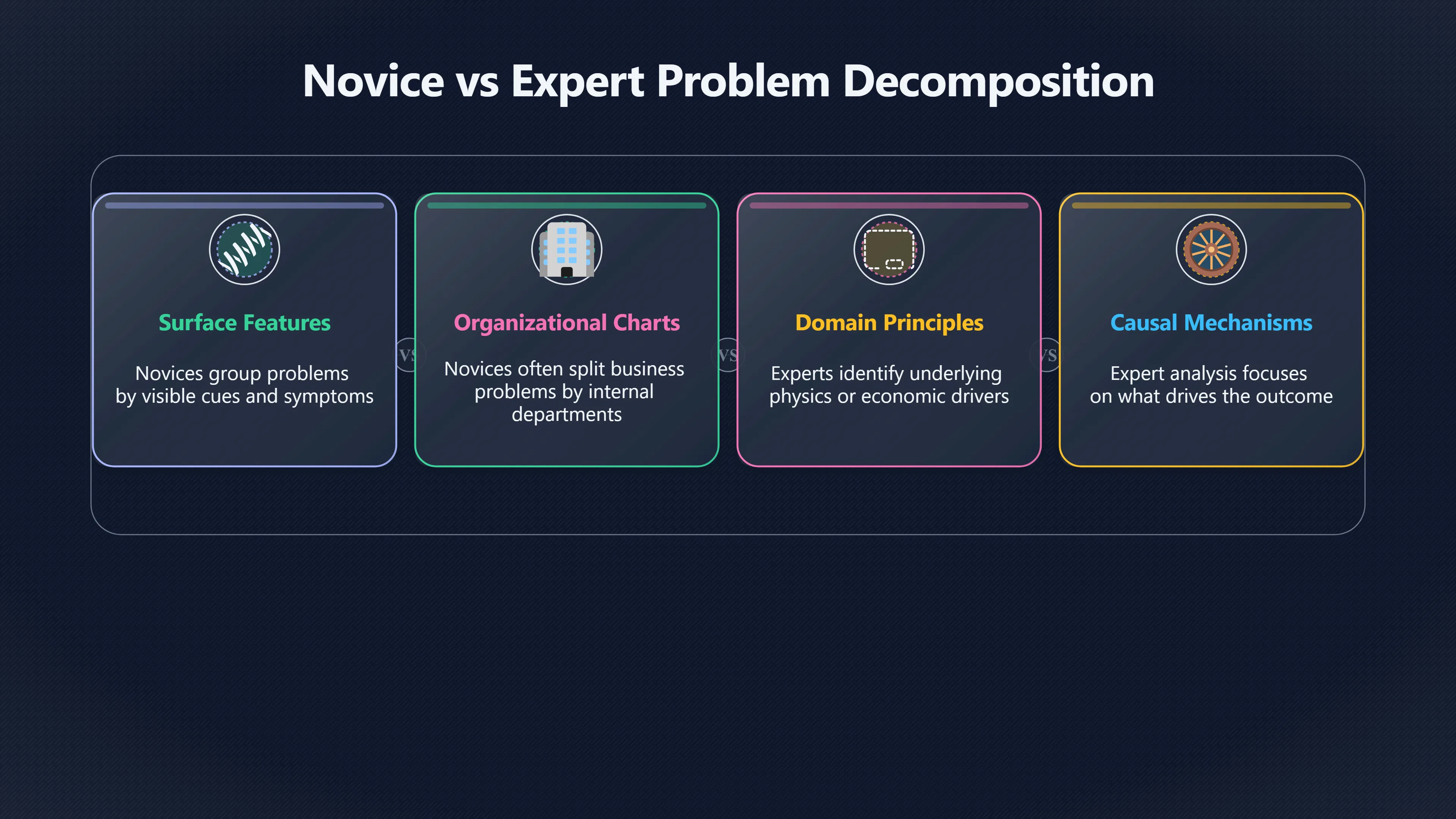
Breaking a problem into smaller pieces can still fail when the pieces are wrong. Novices often decompose problems by what is easiest to see: departments, symptoms, topics, personalities, familiar templates or surface similarities. Experts are more likely to divide the same problem by the hidden structure that drives the outcome: causal mechanisms, constraints, incentives, evidence quality or governing principles. In the classic physics study by Chi, Feltovich and Glaser, novices grouped problems by visible features, while experts grouped them by underlying physics principles.[Carnegie Mellon University]cmu.eduCarnegie Mellon UniversityCategorization and Representation of Physics Problems by…The objective of this study was to test our interpr…
 That finding matters for everyday analysis because “break it down” is not a complete method. The hard part is choosing categories that match the domain. Without enough subject knowledge, a person may create a tidy issue tree, spreadsheet or argument map that looks disciplined but sends attention towards the wrong questions.
Why Decomposition Depends on Domain Knowledge
A useful decomposition is not merely a list of parts. It is a claim about how the problem works. To split a business problem into “marketing, sales, operations and finance” is to assume the organisational chart is the right map. To split a policy problem into “pros and cons” is to assume the main issue is argument balance. To split a historical question into “what each side said” is to assume testimony is self-explanatory. Those may sometimes be useful starts, but they are not automatically the right structure.
Research on expertise helps explain why. The National Research Council’s synthesis of learning research describes experts’ knowledge as organised around meaningful concepts and principles, not just larger piles of facts. Experts also know when particular knowledge applies, which helps them recognise the kind of problem they are facing.[National Academies]nationalacademies.orgNational AcademiesChapter: 2 How Experts Differ from NovicesExperts appear to possess an efficient organization of knowledge with meaning… Novices, by contrast, are more likely to attach new problems to obvious cues because those cues are available before deeper domain structure is understood.
The mechanism is simple: the first categories you choose control what you notice next. If the category is “customer complaints”, you may count complaints. If the better category is “moments where expectation and delivery diverge”, you may examine onboarding, pricing promises, service delays and product fit. Both decompositions are orderly, but only one may expose the cause.
This is also why analogies mislead novices. Studies of analogical problem solving show that people are often reminded of previous cases by surface similarity, while successful transfer depends more on structural similarity. Holyoak and Koh’s work on surface and structural similarity found that retrieving a relevant analogy depends heavily on shared features, while using it well requires seeing the deeper relation between cases.[Springer]link.springer.comSurface and structural similarity in analogical transferby KJ Holyoak · 1987 · Cited by 1605 — Two experiments investigated facto… In practical terms, a novice may say “this looks like the last project”, while an expert asks “does it fail for the same reason?”
The Wrong Parts Usually Look Reasonable
The danger is not that novice decompositions look absurd. They often look impressively organised. The failure is that they are organised around categories that are socially familiar, visually salient or borrowed from another context.
Common wrong-part decompositions include:
- By surface feature rather than principle. In physics, this means grouping by pulleys, ramps or springs rather than conservation of energy or Newton’s laws.[Carnegie Mellon University]cmu.eduCarnegie Mellon UniversityCategorization and Representation of Physics Problems by…The objective of this study was to test our interpr… In business, it may mean grouping by product names rather than margin drivers.
- By institution rather than mechanism. A policy analyst may divide a problem by government department, while the real structure runs across incentives, eligibility rules, enforcement capacity and local implementation.
- By symptom rather than cause. A company may split “declining performance” into low sales, poor morale and operational delays, when all three are downstream of one bottleneck or a mispriced offer.
- By template rather than case logic. Consulting tools such as MECE issue trees can improve clarity, but only when the branches follow the problem’s actual economics or decision structure. A memorised framework can be tidy and still irrelevant.[Independent Management Consultants]umbrex.comOpen source on umbrex.com.
The key distinction is between clean categories and diagnostic categories. Clean categories reduce mess. Diagnostic categories reveal what would change the answer.
Business, Policy and History Examples
In business analysis, the wrong first split often comes from the organisation chart. Suppose a subscription company is losing profit. A novice decomposition might assign workstreams to marketing, product, customer support and finance. That is administratively convenient, but it may miss the economic structure: acquisition cost, conversion rate, retention, price, usage, service cost and gross margin. An issue tree is useful when each branch becomes testable and decision-relevant, not when it merely mirrors internal teams.[Independent Management Consultants]umbrex.comOpen source on umbrex.com.
In policy analysis, the wrong split often comes from debate format. A novice may divide a housing problem into “arguments for building” and “arguments against building”. A more domain-aware decomposition might distinguish planning law, land ownership, infrastructure finance, local political incentives, construction capacity and affordability mechanisms. Policy scholars emphasise that problem definition is not neutral: framing determines which causes and solutions become visible.[FrameWorks Institute]frameworksinstitute.orgOpen source on frameworksinstitute.org. Implementation research makes the same point from another angle: a policy that looks coherent on paper can fail if the analysis has not separated the “what”, “why” and “how” of implementation across real delivery contexts.[wcpp.org.uk]wcpp.org.ukImplementation- minded policy makingImplementation- minded policy making
In historical analysis, the wrong split often comes from treating sources as containers of facts. A novice might divide a question by document: source A says this, source B says that. Historians are trained to use different categories: sourcing, contextualisation and corroboration. That means asking who produced a source, for what audience, under what conditions, and how it compares with other evidence. Studies of historical thinking repeatedly identify these practices as central differences between expert and novice reading of historical documents.[Fulbright Finland Foundation]fulbright.fiOpen source on fulbright.fi.
Across all three examples, the pattern is the same. Novices do not fail because they refuse structure. They fail because they accept the first plausible structure too early.
Why the Error Persists
Wrong decomposition persists because it feels like progress. Once a problem has headings, owners, tables and subquestions, people feel less uncertain. The structure becomes a substitute for understanding.
It also persists because early categories create a search path. After a team splits a problem into “communications, training and compliance”, evidence about incentives, product design or market selection may seem out of scope. This is a cognitive trap as much as a management trap: the chosen decomposition filters attention.
A further problem is that novices often lack contrast cases. Experts have seen enough examples to know that two similar-looking problems can require different structures. In medicine, for example, clinical reasoning research describes the importance of “problem representation”: a concise formulation of the kind of clinical problem being solved. That representation helps clinicians connect a case to relevant illness scripts, rather than merely listing every symptom.[PMC]pmc.ncbi.nlm.nih.govOpen source on nih.gov. The same principle applies outside medicine: the better the initial representation, the better the decomposition that follows.
How to Test Whether the Parts Are Right
The practical lesson is not to abandon decomposition. It is to treat the first decomposition as a hypothesis. The question is not “Is this neat?” but “Would these parts expose the mechanism that matters?”
A stronger test uses five checks:
- Can each part change the answer? If a branch cannot affect the decision, diagnosis or explanation, it may be decorative.
- Do the parts match a causal model? The structure should show how outcomes are produced, not just how information can be filed.
- Would a domain expert use different first-level categories? If so, the novice structure may be surface-level.
- Are symptoms, causes and solutions being mixed? A common weak structure puts “low sales”, “better marketing” and “customer churn” at the same level, even though they are different kinds of thing.
- What evidence would falsify this structure? If no finding could force a different decomposition, the structure is probably a template rather than an analytical tool.
Good decomposition is therefore iterative. Start with the best domain-informed split available, test it against evidence, then revise the parts when they stop explaining the problem. In complex work, the first structure should be treated as scaffolding, not architecture.
The Takeaway
Novices break problems into the wrong parts because they often organise by what is visible, familiar or easy to name. Domain knowledge changes the unit of analysis. It teaches the analyst which distinctions matter, which similarities are misleading, and which categories are likely to reveal cause rather than merely impose order.
The improvement is not simply to “think harder”. It is to learn enough of the domain to recognise better parts: the economic drivers in a business case, the implementation constraints in a policy problem, the source practices in historical reasoning, the underlying principle in a technical problem. Decomposition is powerful only when the pieces belong to the problem itself.
Amazon book picks
Further Reading
Books and field guides related to Breaking Problems Down Can Still Fail. Use these as the next step if you want deeper reading beyond the article.
Thinking in Systems
Shows how to decompose problems according to underlying system structure rather than surface features.
Super Thinking
Introduces frameworks for selecting better problem structures and analytical approaches.
Thinking, Fast and Slow
Provides research on expert versus intuitive reasoning relevant to decomposition.
The Art of Thinking Clearly
Explains reasoning errors that lead people to divide problems incorrectly.
eBay marketplace picks
Marketplace Samples
Example marketplace items related to this page. Use the search link to explore similar finds on eBay.



Endnotes
1.
Source: link.springer.com
Link:https://link.springer.com/article/10.3758/BF03197035
Source snippet
Surface and structural similarity in analogical transferby KJ Holyoak · 1987 · Cited by 1605 — Two experiments investigated facto...
2.
Source: link.springer.com
Link:https://link.springer.com/article/10.3758/BF03197085
3.
Source: link.springer.com
Link:https://link.springer.com/chapter/10.1007/978-3-030-94580
4.
Source: wcpp.org.uk
Title: Implementation- minded policy making
Link:https://wcpp.org.uk/wp-content/uploads/Implementation-Minded-Policy-Making.pdf
5.
Source: fulbright.fi
Link:https://www.fulbright.fi/serve/susanna-soininen-inquiry-project
6.
Source: pmc.ncbi.nlm.nih.gov
Link:https://pmc.ncbi.nlm.nih.gov/articles/PMC5481232/
7.
Source: link.springer.com
Link:https://link.springer.com/rwe/10.1007/978
8.
Source: cmu.edu
Link:https://www.cmu.edu/teaching/resources/Research/cognitive/Chi1981.pdf
Source snippet
Carnegie Mellon UniversityCategorization and Representation of Physics Problems by...The objective of this study was to test our interpr...
9.
Source: nationalacademies.org
Link:https://www.nationalacademies.org/read/9853/chapter/5
Source snippet
National AcademiesChapter: 2 How Experts Differ from NovicesExperts appear to possess an efficient organization of knowledge with meaning...
10.
Source: umbrex.com
Link:https://umbrex.com/resources/frameworks/strategy-frameworks/issue-tree/
11.
Source: frameworksinstitute.org
Link:https://www.frameworksinstitute.org/articles/framing-and-policy-making/
12.
Source: ncbi.nlm.nih.gov
Title: NCBIPrerequisites for Learning Clinical Reasoning
Link:https://www.ncbi.nlm.nih.gov/books/NBK543761/
13.
Source: pmc.ncbi.nlm.nih.gov
Link:https://pmc.ncbi.nlm.nih.gov/articles/PMC5738945/
14.
Source: pubmed.ncbi.nlm.nih.gov
Link:https://pubmed.ncbi.nlm.nih.gov/8691121/
Additional References
15.
Source: asu.elsevierpure.com
Title: categorization and representation of physics problems by experts
Link:https://asu.elsevierpure.com/en/publications/categorization-and-representation-of-physics-problems-by-experts-/
Source snippet
Arizona State UniversityCategorization and representation of physics problems by...by MTH Chi · 1981 · Cited by 9661 — The representatio...
16.
Source: youtube.com
Title: Differences between how novices and experts learn and how to teach them
Link:https://www.youtube.com/watch?v=qwX1jifokRc
Source snippet
Problem Solving. Human Learning and Thinking. Psychology 9/10...
17.
Source: youtube.com
Title: Stop Thinking Like Everyone Else | The Chunking Method
Link:https://www.youtube.com/watch?v=ajlEK5RuRVE
Source snippet
Experts vs Novices sketchnote - YouTube Experts vs Novices sketchnote - YouTube...
18.
Source: youtube.com
Title: Thinking, Problem Solving & Creative Cognition | Chapter 11
Link:https://www.youtube.com/watch?v=yWd3zzNcIoQ
Source snippet
Stop Thinking Like Everyone Else | The Chunking Method...
19.
Source: academia.edu
Link:https://www.academia.edu/31698902/Similarity_and_Analogical_Reasoning
20.
Source: researchgate.net
Link:https://www.researchgate.net/publication/288047613_Analogical_Transfer_in_Problem_Solving
21.
Source: scispace.com
Link:https://scispace.com/pdf/analogical-transfer-from-schematic-pictures-to-problem-4ncr0j4ef6.pdf
22.
Source: semanticscholar.org
Link:https://www.semanticscholar.org/paper/Categorization-and-Representation-of-Physics-by-and-Chi-Feltovich/16ef4cc3a80ee7ba8f59e0a55b2ef134c31e18b3/figure/2
23.
Source: researchgate.net
Link:https://www.researchgate.net/publication/220480253_Categorization_and_Representation_of_Physics_Problems_by_Experts_and_Novices
24.
Source: quizlet.com
Link:https://quizlet.com/463122940/cognitive-psychology-goldstein-4th-ed-chapter-12-flash-cards/
Topic Tree