Within Feedback
When Results Make Decisions Look Smarter
A lucky success can hide weak reasoning, while an unlucky failure can make a sound decision look foolish.
On this page
- Why outcome quality differs from decision quality
- How lucky wins and unlucky losses distort reviews
- Questions that separate reasoning from results
Page outline Jump by section
Introduction
Outcome bias is the tendency to judge whether a decision was good or bad primarily by its result rather than by the quality of the reasoning available when the decision was made. This is a serious obstacle to improving judgement because many important decisions are made under uncertainty. A well-reasoned choice can produce a poor outcome through bad luck, while a careless decision can succeed because circumstances happened to be favourable. Research consistently shows that people rate identical decisions more favourably when they learn that the outcome was positive, even though the decision-maker had exactly the same information in both cases. [PubMed+2PMC]pubmed.ncbi.nlm.nih.govPub Med Outcome bias in decision evaluationJ Pers Soc Psychol. 1988 Apr;54(4):569-79. doi: 10.1037//0022-3514.54.4.569. Authors. J Baron, J C Hershey. Affiliation.Read more…
 For anyone trying to build better analytical skills, the key lesson is simple: results provide evidence, but they do not by themselves measure decision quality. Effective feedback loops therefore evaluate both the reasoning before the decision and the outcome afterwards.
Why outcome quality differs from decision quality
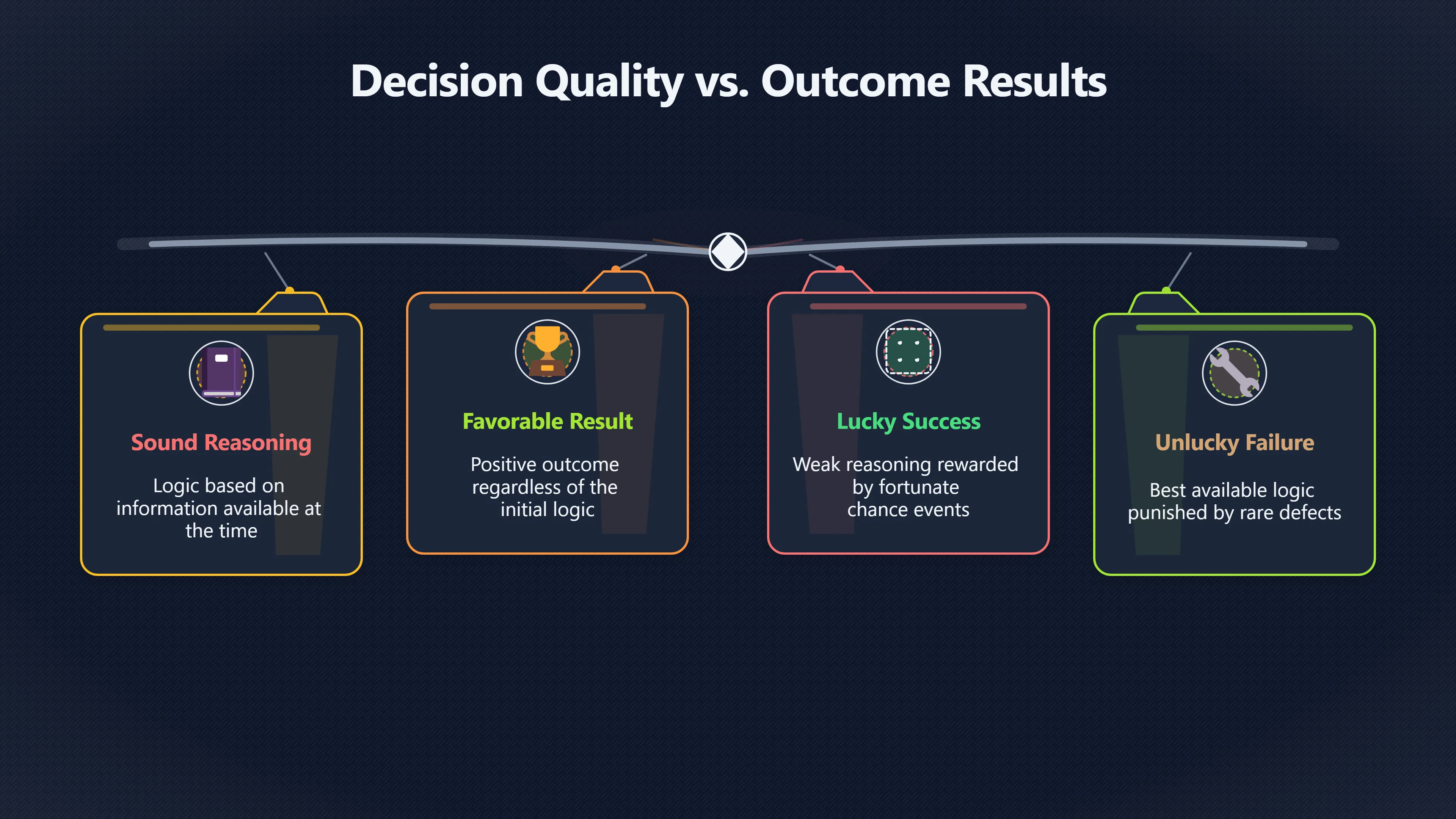
A decision is made with incomplete information. An outcome emerges only after uncertainty, chance events, other people’s actions and changing conditions have all played their part.
This distinction means that two questions should always be kept separate:
- Was the reasoning sound given what was known at the time?
- Did events ultimately produce a favourable result?
Only the second question can be answered by looking at the final outcome alone.
In their classic experiments, Jonathan Baron and John Hershey presented participants with identical decision scenarios but varied only whether the result was good or bad. Participants consistently judged the decision itself more harshly after a bad outcome, despite the fact that the decision process had not changed. This became known as outcome bias and remains one of the foundational findings in judgement and decision research. [PubMed]pubmed.ncbi.nlm.nih.govPub Med Outcome bias in decision evaluationJ Pers Soc Psychol. 1988 Apr;54(4):569-79. doi: 10.1037//0022-3514.54.4.569. Authors. J Baron, J C Hershey. Affiliation.Read more…
A later replication and extension by researchers at the University of Oxford found the same basic pattern decades later, showing that outcome information continues to distort evaluations even when people are instructed to focus only on the original decision. [PMC]pmc.ncbi.nlm.nih.govPMCOutcomes Affect Evaluations of Decision Quality: ReplicationPMCOutcomes Affect Evaluations of Decision Quality: Replication
The practical implication is important: if every unsuccessful decision is treated as evidence of poor thinking, and every successful decision as evidence of good thinking, people receive misleading feedback about how they actually reason.
How lucky wins and unlucky losses distort reviews
Outcome bias affects learning in both directions.
Lucky successes hide weak reasoning
A fortunate outcome often creates the illusion that the decision was skilful.
For example:
- an investor buys a risky stock without proper analysis and earns a large profit;
- a manager hires someone based largely on instinct, and the employee performs well;
- a doctor chooses one of several reasonable treatments and the patient recovers exceptionally quickly.
In each case, success may reinforce habits that were not actually responsible for the good result.
This creates a dangerous learning loop: poor reasoning becomes rewarded because chance happened to cooperate.
Unlucky failures punish sound reasoning
The opposite error is equally damaging.
Imagine that two engineers choose the statistically safest design based on available evidence. An extremely rare manufacturing defect still causes failure. If reviewers judge only the final outcome, they may reject a decision process that was objectively the best available.
Similarly:
- a diversified investment portfolio loses money during an unexpected market crash;
- an emergency response follows established procedures but encounters unprecedented conditions;
- a carefully researched business launch coincides with an unforeseen economic downturn.
These cases illustrate why uncertainty must remain part of any evaluation. A poor outcome does not necessarily reveal a poor decision.

Why outcome bias is especially powerful
Outcome bias is attractive because results are concrete whereas reasoning is often invisible.
Once people know what happened, they naturally construct a coherent story explaining why it happened. This makes the final result seem like obvious evidence about the original decision.
Several psychological mechanisms reinforce this tendency.
- Results are emotionally vivid. Success invites praise, while failure invites blame.
- People simplify uncertainty. Complex probability distributions are mentally replaced by a single realised outcome.
- Hindsight bias reinforces the illusion. After learning the result, people often believe it had been more predictable than it really was, making unsuccessful decisions appear obviously mistaken. [Wiley Online Library+2The Decision Lab]onlinelibrary.wiley.comWiley Online LibraryHindsight bias and outcome bias in judging directors…by N Strohmaier · 2021 · Cited by 30 — Judgments made in hind…
These mechanisms combine to produce reviews that feel fair but actually confuse probability with certainty.
Questions that separate reasoning from results
A better review asks what the decision-maker knew before events unfolded rather than what observers know afterwards.
Useful questions include:
- What information was genuinely available at the time?
- Were important uncertainties identified?
- Were realistic alternatives considered?
- Did the chosen option have the strongest expected value or best evidence, even if it later failed?
- What assumptions proved correct or incorrect?
- Would I recommend the same decision again if faced with identical information?
These questions shift attention from judging luck to judging reasoning.
Organisations that perform effective post-project reviews often reconstruct the original evidence before discussing results, reducing the influence of knowledge gained afterwards. This approach aims to evaluate the quality of the decision process rather than rewarding or punishing chance alone. [decisioneducation.org]decisioneducation.orgDefining Decision QualityThe distinction between a good decision and good outcome is very important. When we face uncertainty, we can mak…

A simple example
Suppose two weather forecasters each predict a 70% chance of rain.
- The first forecast is followed by rain.
- The second is followed by sunshine.
If both forecasters had identical evidence, one should not immediately be judged more competent than the other. A 70% probability explicitly allows for rain to fail to occur around three times in ten.
Evaluating forecasts by isolated outcomes would gradually encourage forecasters to avoid expressing uncertainty honestly. Instead of reporting the best probability estimate, they might begin making predictions that minimise criticism after the fact.
The same principle applies to investment decisions, hiring, medical treatment, product launches and public policy.
Improving judgement without ignoring results
Avoiding outcome bias does not mean ignoring outcomes altogether. Results still matter because they contain information. The challenge is interpreting them correctly.
Strong feedback loops treat outcomes as evidence to investigate rather than verdicts on decision quality.
Helpful habits include:
- recording important assumptions before making decisions;
- writing down expected probabilities instead of categorical predictions;
- reviewing whether reasoning matched the available evidence rather than whether events happened to cooperate;
- looking for repeated patterns across many similar decisions instead of drawing conclusions from a single success or failure.
Over many decisions, sound reasoning tends to outperform poor reasoning, even though individual outcomes remain partly governed by chance. Evaluating the process alongside the result therefore produces more accurate learning than relying on outcomes alone.
The central lesson is that good judgement is not measured by never experiencing failure. It is measured by consistently making decisions that are well supported by the evidence available at the time, while recognising that uncertainty means even the best decisions cannot guarantee the best outcomes.
Amazon book picks
Further Reading
Books and field guides related to When Results Make Decisions Look Smarter. Use these as the next step if you want deeper reading beyond the article.
Superforecasting
Focuses on evaluating reasoning, updating beliefs, and separating process quality from outcomes.
Decisive
Provides practical frameworks for improving decision quality rather than judging decisions solely by results.
Fooled by Randomness
Rating: 4.0/5 from 15 Google Books ratings
Demonstrates how luck and randomness distort perceptions of skill and decision quality.
The Signal and the Noise
Explores evidence, uncertainty, and disciplined reasoning when outcomes alone are misleading.
eBay marketplace picks
Marketplace Samples
Topic-anchored marketplace searches for visual, collectible, or second-hand items related to this page.



Endnotes
-
Source: pmc.ncbi.nlm.nih.gov
Title: PMCOutcomes Affect Evaluations of Decision Quality: Replication
Link: https://pmc.ncbi.nlm.nih.gov/articles/PMC12372742/ -
Source: pmc.ncbi.nlm.nih.gov
Link: https://pmc.ncbi.nlm.nih.gov/articles/PMC8763848/Source snippet
Impact of Cognitive Biases on Professionals' Decision...by V Berthet · 2022 · Cited by 299 — The author reviewed the research on the imp...
-
Source: onlinelibrary.wiley.com
Link: https://onlinelibrary.wiley.com/doi/full/10.1111/jasp.12722Source snippet
Wiley Online LibraryHindsight bias and outcome bias in judging directors...by N Strohmaier · 2021 · Cited by 30 — Judgments made in hind...
-
Source: pmc.ncbi.nlm.nih.gov
Link: https://pmc.ncbi.nlm.nih.gov/articles/PMC3649066/Source snippet
Hindsight Bias and Developing Theories of Mind - PMCby DM Bernstein · 2007 · Cited by 106 — More recent theories maintain that hindsig...
-
Source: decisioneducation.org
Link: https://www.decisioneducation.org/principles-of-decision-quality/defining-decision-qualitySource snippet
Defining Decision QualityThe distinction between a good decision and good outcome is very important. When we face uncertainty, we can mak...
-
Source: pubmed.ncbi.nlm.nih.gov
Title: Pub Med Outcome bias in decision evaluation
Link: https://pubmed.ncbi.nlm.nih.gov/3367280/Source snippet
J Pers Soc Psychol. 1988 Apr;54(4):569-79. doi: 10.1037//0022-3514.54.4.569. Authors. J Baron, J C Hershey. Affiliation.Read more...
-
Source: thedecisionlab.com
Title: The Decision Lab Hindsight Bias
Link: https://thedecisionlab.com/biases/hindsight-biasSource snippet
Hindsight Bias - The Decision LabHindsight bias, or the knew-it-all-along, is the tendency to claim currents events were to happen even t...
-
Source: pubmed.ncbi.nlm.nih.gov
Link: https://pubmed.ncbi.nlm.nih.gov/17835457/Source snippet
under Uncertainty: Heuristics and Biasesby A Tversky · 1974 · Cited by 58427 — A better understanding of these heuristics and of the bias...
-
Source: pmc.ncbi.nlm.nih.gov
Link: https://pmc.ncbi.nlm.nih.gov/articles/PMC4519675/Source snippet
of judgment and decision making quality - PMCby S Ayal · 2015 · Cited by 80 — A framework is presented to better characterize the role of...
-
Source: pubmed.ncbi.nlm.nih.gov
Link: https://pubmed.ncbi.nlm.nih.gov/14645895/Source snippet
bias, outcome knowledge and adaptive learningby K Henriksen · 2003 · Cited by 280 — This paper examines the influence of outcome knowledg...
-
Source: thedecisionlab.com
Link: https://thedecisionlab.com/biases/outcome-biasSource snippet
Outcome bias: Why we blame bad results, not bad reasoningOutcome bias is a cognitive bias where we evaluate decisions primarily by how th...
-
Source: Wikipedia
Title: Hindsight bias
Link: https://en.wikipedia.org/wiki/Hindsight_biasSource snippet
Hindsight biasHindsight bias may cause distortions of memories of what was known or believed before an event occurred and is a signifi...
-
Source: Wikipedia
Title: Outcome bias
Link: https://en.wikipedia.org/wiki/Outcome_biasSource snippet
Outcome biasThe outcome bias is an error made in evaluating the quality of a decision when the outcome of that decision is already kno...
-
Source: investigationsquality.com
Title: Decision Quality
Link: https://investigationsquality.com/2019/11/20/decision-quality/Source snippet
Investigations of a Dog20 Nov 2019 — The six requirements for a good decision are: (1) an appropriate frame, (2) creative alternatives, (...
Additional References
-
Source: merriam-webster.com
Link: https://www.merriam-webster.com/dictionary/decisionSource snippet
DECISION Definition & Meaning3 days ago — 1. a: the act or process of deciding the moment of decision has come b: a determination arriv...
-
Source: linkedin.com
Link: https://www.linkedin.com/pulse/decision-quality-vs-outcome-magdy-reda-stpbfSource snippet
Decision Quality vs. Decision OutcomeEvaluating the quality of a decision based on its outcome can be misleading. A well-informed, carefu...
-
Source: newristics.com
Link: https://newristics.com/heuristics-biases/outcome-biasSource snippet
Definition, Example & How Outcome Bias WorksOutcome bias refers to the tendency to judge a decision or action based on its outcome rather...
-
Source: doaj.org
Link: https://doaj.org/article/b01e7003c5574b1593d8309a66260878Source snippet
Outcomes Affect Evaluations of Decision QualityOutcome bias is the phenomenon whereby decisions which resulted in successful outcomes wer...
-
Source: researchgate.net
Link: https://www.researchgate.net/publication/237441830On_the[AssessmentSource snippet
ResearchGate(PDF) On the Assessment of Decision Qualitygood decision processes are more likely to generate good outcomes. the process-ori...
-
Source: scholarlypublications.universiteitleiden.nl
Link: https://scholarlypublications.universiteitleiden.nl/access/item%3A3160833/downloadSource snippet
bias and outcome bias in judging directors'...by N Strohmaier · Cited by 29 — In a recent study investigating outcome bias in legal deci...
-
Source: hermes.cde.state.co.us
Link: https://hermes.cde.state.co.us/islandora/object/co%3A31690/datastream/OBJ/download/Outcome_bias_in_decision_evaluation.pdfSource snippet
Bias in Decision EvaluationIn all five experiments, researchers found that the outcome was the factor attributed to quality decision maki...
-
Source: facebook.com
Link: https://www.facebook.com/AnnieDukeAuthor/posts/most-leaders-judge-their-decisions-by-outcomes-but-this-is-the-wrong-way-to-appr/1359121649115292/Source snippet
Distinguish Between Decision Quality and Outcome Quality (Avoid "Resulting"): This is perhaps the most...Read more...
-
Source: pmctraining.com
Link: https://pmctraining.com/articles-and-resources/decision-quality-vs-outcome-quality/Source snippet
Decision quality is an assessment of the reasoning process at the moment a decision was made.Read more...
-
Source: researchgate.net
Title: The interaction of process and outcome in evaluations
Link: https://www.researchgate.net/publication/232871620_Good_decisions_bad_decisions_The_interaction_of_process_and_outcome_in_evaluations_of_decision_qualitySource snippet
Decision quality has also been defined in terms of multiple criteria related to both decision outcomes and decision processes, including...
Topic Tree