Within Explain It
How to Check What Your Explanation Missed
The most useful part of no-notes explanation is comparing your answer with a source and finding what went wrong.
On this page
- Missing pieces that break an explanation
- False links between cause and effect
- Blurred boundaries with nearby ideas
Page outline Jump by section
Introduction
Explaining a concept from memory is only half of the exercise. The real improvement comes when you compare that explanation with a reliable source and identify exactly where it failed. Without this checking step, an explanation can sound coherent while quietly omitting essential steps, inventing causal links, or blending together related ideas. Research on retrieval practice, self-explanation and metacognition consistently shows that attempting an explanation and then checking it against authoritative material produces stronger learning than passive review because it exposes misconceptions rather than merely reinforcing familiarity. [PMC]pmc.ncbi.nlm.nih.govPMCUnderstanding Is a ProcessIt depends on learning, interpreting, generalizing, and acting upon information. No…Read more…
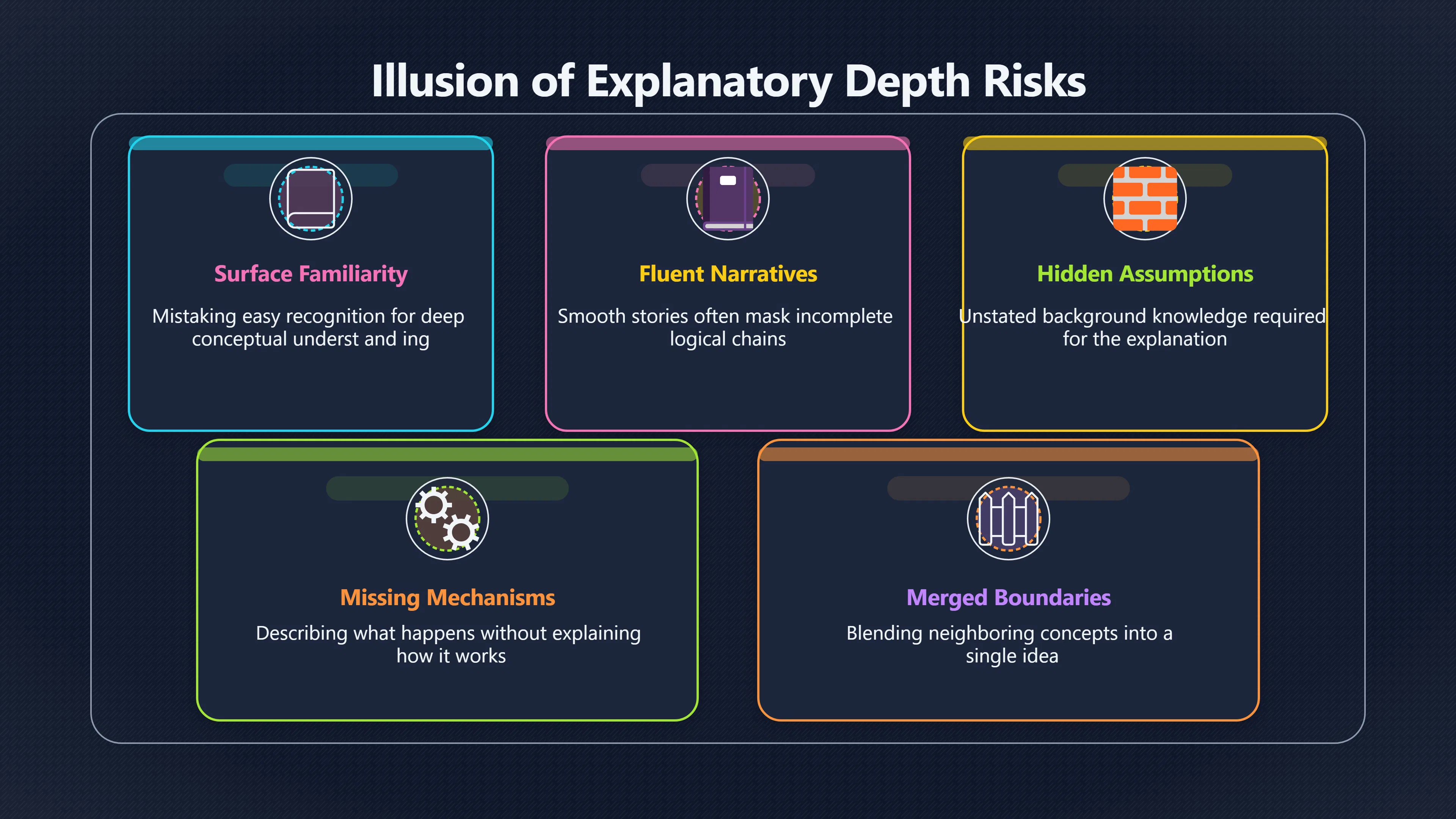
 The aim is not to count small factual errors. It is to diagnose weaknesses in your mental model. A useful gap check asks three questions: What important part is missing? What relationship have I explained incorrectly? Which neighbouring ideas have I accidentally merged together? Those questions reveal whether you genuinely understand a concept or have constructed a convincing but inaccurate story.
Missing pieces that break an explanation
Many explanations fail not because they contain obvious mistakes but because they leave out a step that makes the rest of the account impossible to understand.
People often assume they understand a process until they are asked to reconstruct it in detail. This phenomenon, known as the illusion of explanatory depth, shows that familiarity with a subject is easily mistaken for genuine understanding. When people try to produce a full explanation, they frequently discover that they cannot describe how one stage leads to the next. [Journal of Cognition]journalofcognition.orgJournal of CognitionSubjective Understanding is Reduced by Mechanistic…by JC Zemla · 2024 · Cited by 1 — In two experiments, we found…
When comparing your explanation with a trusted source, look specifically for:
- Missing mechanisms. Did you describe what happens without explaining how or why it happens?
- Hidden assumptions. Did you assume background knowledge that the explanation actually depends on?
- Missing conditions. Does the concept only work under certain circumstances that you never mentioned?
- Absent limitations. Did you describe the rule without mentioning when it stops applying?
For example, imagine explaining retrieval practice simply as “testing yourself helps memory”. A reliable source adds an essential mechanism: actively retrieving information strengthens later recall and also exposes knowledge gaps that passive rereading often hides. Without that mechanism, the explanation captures the outcome but not the reason it occurs. [Frontiers]frontiersin.orgerror conditions, wrong answers, or bad decisions? Explicit Self-explanation has been shown to improve learning and understanding. This…
A productive comparison therefore asks not “Did I remember the main point?” but “Which indispensable links did the source include that I never mentioned?”
False links between cause and effect
An explanation can contain every important fact yet still be wrong because it connects those facts incorrectly.
One of the most common failures is inventing a causal chain that feels plausible but is unsupported. Fluent explanations often encourage this error because a smooth narrative is psychologically satisfying even when its logic is incomplete. Research on understanding and metacognition emphasises that genuine understanding involves correctly grasping relationships, not merely recalling isolated facts. [PMC]pmc.ncbi.nlm.nih.govPMCUnderstanding Is a ProcessIt depends on learning, interpreting, generalizing, and acting upon information. No…Read more…
Common false links include:
- Treating correlation as causation.
- Reversing cause and effect.
- Assuming one factor is sufficient when several interacting factors are required.
- Compressing multiple intermediate stages into a single jump.
- Replacing a mechanism with a label, as though naming something explains it.
Suppose someone explains that retrieval practice improves learning because “students become more confident”. Confidence may increase, but research attributes improved retention primarily to the act of successful retrieval and subsequent feedback, not to confidence itself. Here the explanation substitutes an appealing story for the supported mechanism. [Frontiers]frontiersin.orgerror conditions, wrong answers, or bad decisions? Explicit Self-explanation has been shown to improve learning and understanding. This…
When reviewing your explanation, compare every “because”, “therefore” and “leads to” with the source. Those connecting words often reveal mistaken reasoning more quickly than checking individual facts.

Blurred boundaries with nearby ideas
Another frequent problem is that explanations absorb neighbouring concepts until important distinctions disappear.
A learner may correctly describe several related ideas but fail to separate where one ends and another begins. This creates explanations that appear comprehensive while actually mixing different concepts together.
For example, in learning science:
- Retrieval practice is not the same as rereading.
- Self-explanation is not the same as summarising.
- Recognition is not the same as recall.
- Feeling familiar with information is not the same as understanding it.
Research on the illusion of explanatory depth demonstrates precisely this problem. People often confuse knowing what something is for knowing how it works. More recent work similarly suggests that drawing attention to mechanisms causes people to judge their own understanding more cautiously because they recognise distinctions they had previously overlooked. [Journal of Cognition+2Wikipedia]journalofcognition.orgJournal of CognitionSubjective Understanding is Reduced by Mechanistic…by JC Zemla · 2024 · Cited by 1 — In two experiments, we found…
When checking your explanation, ask:
- Which similar concept did the source distinguish from this one?
- Did I explain where the boundary lies?
- Could a beginner tell the difference after hearing my explanation?
If not, your explanation is probably combining ideas that should remain separate.
A practical method for checking explanations
Checking is most useful when it is systematic rather than impressionistic.
After giving your no-notes explanation:
- Read the original source without trying to defend your answer.
- Highlight every important idea you omitted.
- Circle every causal statement you explained differently.
- Mark every place where the source carefully distinguishes this concept from another.
- Rewrite your explanation immediately while the differences are still visible.
Rather than counting errors, classify them into three groups:
Type of issueTypical symptomWhat it revealsMissing pieceImportant step absentIncomplete mental modelFalse linkIncorrect cause or relationshipFaulty reasoning structureBlurred boundaryRelated ideas merged togetherWeak conceptual discrimination
Over repeated cycles, patterns begin to emerge. Some people consistently omit assumptions. Others repeatedly confuse correlation with causation. Still others know definitions but struggle to reconstruct mechanisms. Recognising these recurring weaknesses is more valuable than achieving a perfect explanation on a single attempt because it identifies the habits that most limit analytical thinking.

Why careful checking improves analytical skill
The purpose of a gap check is not simply to correct today’s explanation. It is to improve the quality of future reasoning.
Analysis depends on building accurate causal models rather than persuasive narratives. Every time you identify a missing mechanism, remove a false causal link or sharpen a conceptual boundary, you refine the internal model you will use in future problems.
This also reduces the illusion of explanatory depth. Studies repeatedly show that generating explanations, comparing them with accurate accounts and revising them produces more realistic judgments about what you genuinely know and what still requires study. Instead of reinforcing misplaced confidence, the checking process turns errors into reliable guides for further learning. [Journal of Cognition+2Frontiers]journalofcognition.orgJournal of CognitionSubjective Understanding is Reduced by Mechanistic…by JC Zemla · 2024 · Cited by 1 — In two experiments, we found…
eBay marketplace picks
Marketplace Samples
Live-tested eBay searches with available results related to this page.



Endnotes
-
Source: pmc.ncbi.nlm.nih.gov
Title: PMCUnderstanding Is a Process
Link: https://pmc.ncbi.nlm.nih.gov/articles/PMC9008134/Source snippet
It depends on learning, interpreting, generalizing, and acting upon information. No...Read more...
-
Source: Wikipedia
Title: Illusion of explanatory depth
Link: https://en.wikipedia.org/wiki/Illusion_of_explanatory_depth -
Source: frontiersin.org
Link: https://www.frontiersin.org/journals/computer-science/articles/10.3389/fcomp.2023.1096257/fullSource snippet
error conditions, wrong answers, or bad decisions? Explicit Self-explanation has been shown to improve learning and understanding. This...
-
Source: journalofcognition.org
Link: https://journalofcognition.org/articles/10.5334/joc.393Source snippet
Journal of CognitionSubjective Understanding is Reduced by Mechanistic...by JC Zemla · 2024 · Cited by 1 — In two experiments, we found...
Additional References
-
Source: researchgate.net
Link: https://www.researchgate.net/publication/398269382_Learning_Science_and_the_Illusion_of_Understanding_Exploring_the_Effects_of_Integrating_Learning_Tasks_after_Explainer_VideosSource snippet
(PDF) Learning Science and the Illusion of UnderstandingThis paper reports two experimental studies examining the immediate and long-term...
-
Source: youtube.com
Link: https://www.youtube.com/watch?v=eVajQPuRmk8Source snippet
If you want to get even more strategies and tips on becoming a more productive, successful student, subscribe to my channel right here...
-
Source: arxiv.org
Title: Why Do Explanations Fail?
Link: https://arxiv.org/html/2405.13474v2Source snippet
A Typology and Discussion on...16 Oct 2025 — The typology decomposes system-specific explanation failures into two categories: (1) misle...
-
Source: youtube.com
Title: The Feynman Technique — Stop Memorizing, Start Understanding
Link: https://www.youtube.com/watch?v=NYSe2Ln0Tf4Source snippet
The Illusion of Explanatory Depth: You Don't Understand It Like You Think - YouTube The Illusion of Explanatory Depth: You Don't Understa...
-
Source: link.springer.com
Link: https://link.springer.com/article/10.1007/s42113-026-00271-1Source snippet
of Understanding in the Sciences - Springer Natureby R Shiffrin · 2026 · Cited by 15 — Most often scientists believe they understand more...
-
Source: gallerix.org
Link: https://gallerix.org/tribune/psy–illyuziya-ponimaniya/Source snippet
The Illusion of Understanding: Why We Think We Know...The brain mistakenly interprets a sense of familiarity with an object as an unders...
-
Source: youtube.com
Title: The Illusion of Explanatory Depth: You Don’t Understand It Like You Think
Link: https://www.youtube.com/watch?v=yDJuCWUC5P8Source snippet
You Don't Know Anything - The Illusion of Explanatory Depth...
-
Source: youtube.com
Title: Videos you might want to watch next
Link: https://www.youtube.com/watch?v=Q1y8c_MZYvESource snippet
"The Most Powerful Way to Remember What You Study: [https://www.youtube.com/watch?v=eVajQPuRmk8..."](https://www.youtube.com/watch?v=eVajQPuRmk8...")...
-
Source: mdpi.com
Link: https://www.mdpi.com/2078-2489/17/3/299Source snippet
Fluency Illusion: A Review on Influence of ChatGPT in...by S Kumar · 2026 · Cited by 3 — Drawing on research from cognitive psychology a...
-
Source: youtube.com
Title: How to Learn Faster with the Feynman Technique
Link: https://www.youtube.com/watch?v=_f-qkGJBPtsSource snippet
The Feynman Technique — Stop Memorizing, Start Understanding...
Topic Tree