Within Myside Bias
When Doubt Works Harder for One Side
Motivated scepticism feels like careful thinking because real flaws are easier to spot in arguments you already dislike.
On this page
- Taber and Lodge's political argument experiments
- Why hostile claims trigger more counterarguments
- How to apply the same searchlight to your own side
Page outline Jump by section
Introduction
Motivated scepticism is the tendency to apply far tougher standards to evidence that challenges a belief than to evidence that supports it. Unlike simple gullibility, it often feels like rigorous critical thinking because the person really is identifying weaknesses, asking probing questions, and demanding better evidence. The catch is that this scrutiny is applied unevenly. Friendly claims are accepted with relatively little resistance, while unwelcome claims face a much higher evidential bar. This mechanism helps explain why intelligent, sincere people can become increasingly confident in their existing views after encountering mixed evidence rather than reconsidering them. [Frank Baumgartner]fbaum.unc.eduAJPS 2006 TaberAuthor(s): Charles S. Taber and Milton Lodge…

When Doubt Works Harder for One Side
Motivated scepticism does not mean that people invent objections out of thin air. Most real arguments contain limitations, uncertainties or alternative explanations. The bias lies in where attention is directed. When evidence threatens an important belief, people instinctively search for every possible weakness. When evidence is reassuring, many of those same questions never arise.
This uneven pattern protects favourite beliefs in three linked stages:
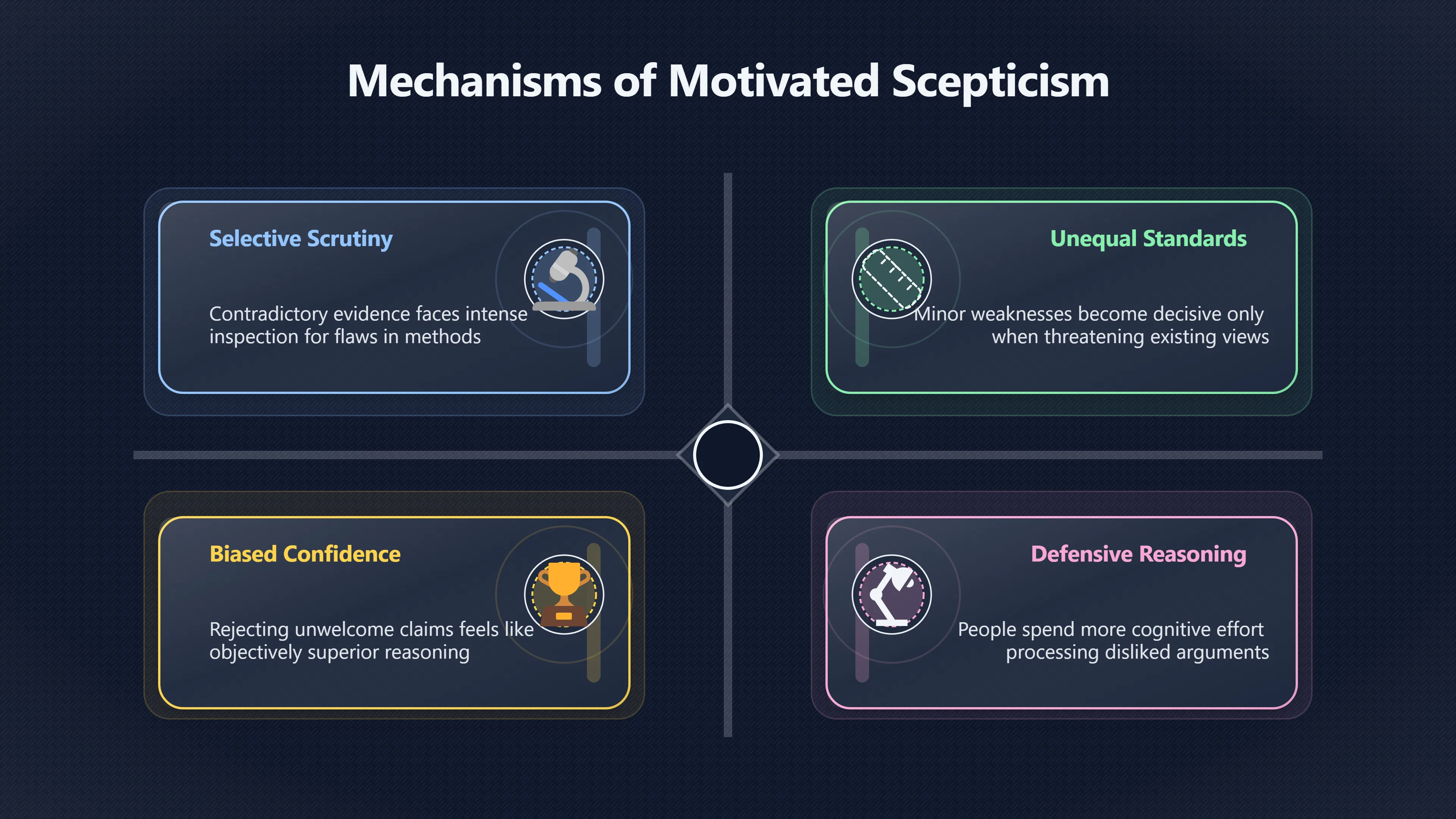
- Selective scrutiny: contradictory evidence is inspected for flaws in methods, motives or assumptions.
- Unequal standards: minor weaknesses become decisive only when they threaten an existing view.
- Biased confidence: because many genuine criticisms have been generated, rejecting the unwelcome claim feels objectively justified rather than emotionally motivated.
The result is not simply rejecting contrary evidence. It is feeling increasingly certain that rejection reflects superior reasoning.
Taber and Lodge’s political argument experiments
Charles Taber and Milton Lodge provided one of the clearest demonstrations of motivated scepticism. In experiments on politically contentious issues including affirmative action and gun control, participants read arguments both supporting and opposing their existing attitudes. Rather than evaluating both sides by identical standards, participants consistently judged congenial arguments as stronger and opposing arguments as weaker. [Frank Baumgartner]fbaum.unc.eduAJPS 2006 TaberAuthor(s): Charles S. Taber and Milton Lodge…
The researchers also observed something especially revealing. Participants spent more cognitive effort processing arguments they disliked than arguments they agreed with. They actively generated counterarguments against opposing evidence while producing relatively few objections to evidence supporting their own position. In other words, people were not thinking less about disagreeable information—they were thinking harder, but in a defensive direction. [Frank Baumgartner]fbaum.unc.eduAJPS 2006 TaberAuthor(s): Charles S. Taber and Milton Lodge…
This distinction matters because it overturns the common assumption that bias comes mainly from laziness or inattention. Here, additional reasoning amplified rather than reduced bias. More mental effort produced better arguments for preserving an existing belief.
Why hostile claims trigger more counterarguments
A claim that threatens an important belief often activates a very different mental process from one that confirms it.
Instead of beginning with the question, “Is this true?”, the mind rapidly begins asking questions such as:
- What is wrong with this study?
- Could the sample be biased?
- Who funded this research?
- Are there alternative explanations?
- Does this contradict something else I know?
These are excellent questions in themselves. The problem is that they are often asked asymmetrically. A supportive study may receive little equivalent interrogation.
Psychologists describe this as motivated reasoning because the goal subtly shifts from discovering the strongest explanation to defending an existing conclusion. Importantly, this need not involve conscious dishonesty. People genuinely experience their objections as evidence of careful analysis because many of the objections are perfectly legitimate. The imbalance lies in when that analytical effort is deployed. [Frank Baumgartner]fbaum.unc.eduAJPS 2006 TaberAuthor(s): Charles S. Taber and Milton Lodge…
This helps explain why debates between thoughtful people frequently produce stalemate rather than convergence. Each side becomes highly skilled at finding defects in the other’s evidence while remaining comparatively forgiving of weaknesses on its own side.

Why it feels like objective thinking
Motivated scepticism is particularly deceptive because it imitates genuine critical thinking.
Someone rejecting an unwelcome claim may correctly identify:
- methodological limitations,
- possible confounding variables,
- missing evidence,
- logical inconsistencies,
- exaggerated conclusions.
Any one of these criticisms could be valid. The illusion arises because the same standards are not consistently applied elsewhere.
Imagine reviewing two studies with similar limitations. If one supports your preferred explanation and the other challenges it, equal scepticism would judge both cautiously. Motivated scepticism instead treats the friendly study as “good enough” while dismissing the hostile study as fundamentally unreliable.
From the inside, this does not feel biased. It feels like being appropriately critical.
How to apply the same searchlight to your own side
The practical goal is not to become less sceptical. It is to distribute scepticism more evenly.
Several habits make motivated scepticism easier to detect:
- Reverse the source. Ask whether you would judge the evidence differently if it supported the opposite conclusion.
- Mirror your objections. After identifying flaws in evidence you dislike, deliberately ask whether comparable flaws exist in evidence you favour.
- Specify disconfirming evidence. Before reading new information, decide what findings would genuinely change your mind.
- Separate quality from conclusion. Evaluate the strength of the evidence before considering whether you like its implications.
- Look for equal standards. If you demand extraordinary proof from one side, ask whether you require equally strong proof from your own.
These habits do not eliminate motivated scepticism, but they make the asymmetry more visible. The key insight is that the strongest protection against myside bias is rarely becoming more critical overall. It is becoming equally critical regardless of which conclusion benefits.
When the same intellectual searchlight illuminates both your own beliefs and your opponents’, scepticism shifts from being a defensive weapon into a genuine tool for finding what is most likely to be true.
Amazon book picks
Further Reading
Books and field guides related to When Doubt Works Harder for One Side. Use these as the next step if you want deeper reading beyond the article.
The Scout Mindset
Directly addresses motivated reasoning, intellectual honesty, and applying equal standards to evidence.
Mistakes Were Made (but Not by Me)
Explains self-justification, motivated reasoning, and why people defend existing beliefs.
The Believing Brain
Explores how beliefs form and why evidence is interpreted asymmetrically.
Rationality
Focuses on better reasoning, evaluating evidence fairly, and overcoming systematic thinking errors.
eBay marketplace picks
Marketplace Samples
Live-tested eBay searches with available results related to this page.




Endnotes
-
Source: fbaum.unc.edu
Title: AJPS 2006 Taber
Link: https://fbaum.unc.edu/teaching/articles/AJPS-2006-Taber.pdfSource snippet
Author(s): Charles S. Taber and Milton Lodge...
Additional References
-
Source: readthesequences.com
Link: https://www.readthesequences.com/Knowing-About-Biases-Can-Hurt-PeopleSource snippet
Knowing About Biases Can Hurt PeopleI'm going to use it all the time!” Taber and Lodge's “Motivated skepticism in the evaluation of polit...
-
Source: academia.edu
Link: https://www.academia.edu/143898119/Motivated_Skepticism_in_the_Evaluation_of_Political_BeliefsSource snippet
Motivated Skepticism in the Evaluation of Political BeliefsThe research indicates motivated skepticism derives from individuals' prior at...
-
Source: researchgate.net
Link: https://www.researchgate.net/profile/Charles-Taber/publication/225756503_The_Motivated_Processing_of_Political_Arguments/links/0deec5203de865394b000000/The-Motivated-Processing-of-Political-Arguments.pdfSource snippet
The Motivated Processing of Political ArgumentsResearch on the motivated processing of political arguments has shown that we should not e...
-
Source: data.gesis.org
Title: reference gesis ssoar 56473 zis TaberLodge2006Motivated outcite
Link: https://data.gesis.org/gesiskg/resource/reference_gesis-ssoar-56473_zis-TaberLodge2006Motivated_outciteSource snippet
gesis.orgreference_gesis-ssoar-56473_zis-...Taber CS and Lodge M (2006) Motivated Skepticism in the Evaluation of Political Beliefs. Ame...
-
Source: data.gesis.org
Title: reference gesis ssoar 83695 zis TaberLodge2006Motivated outcite
Link: https://data.gesis.org/gesiskg/resource/reference_gesis-ssoar-83695_zis-TaberLodge2006Motivated_outciteSource snippet
gesis.orgreference_gesis-ssoar-83695_zis-...Taber CS and Lodge M (2006) Motivated Skepticism in the Evaluation of Political Beliefs. Ame...
-
Source: data.gesis.org
Title: reference gesis ssoar 93713 zis TaberLodge2006Motivated outcite
Link: https://data.gesis.org/gesiskg/resource/reference_gesis-ssoar-93713_zis-TaberLodge2006Motivated_outciteSource snippet
gesis.orgreference_gesis-ssoar-93713_zis-...Taber CS and Lodge M (2006) Motivated Skepticism in the Evaluation of Political Beliefs. Ame...
-
Source: semanticscholar.org
Link: https://www.semanticscholar.org/paper/Motivated-Skepticism-in-the-Evaluation-of-Political-Taber-Lodge/49dc7768eeaf4dd5ae295c3bb353b8d57c12bb54Source snippet
Motivated Skepticism in the Evaluation of Political Beliefs1 Jul 2006 — We propose a model of motivated skepticism that helps explain whe...
-
Source: researchgate.net
Link: https://www.researchgate.net/publication/240604429_Motivated_Skepticism_in_the_Evaluation_of_Political_BeliefsSource snippet
n and why citizens are biased-information processors.Read more...
-
Source: scholar.google.it
Link: https://scholar.google.it/citations?hl=vi&user=9VwvxRIAAAAJSource snippet
TaberMotivated skepticism in the evaluation of political beliefs. CS Taber, M Lodge. American journal of political science 50 (3), 755-76...
-
Source: youtube.com
Link: https://www.youtube.com/watch?v=iQRSZpBWoPESource snippet
False Beliefs in a Post-Truth World: Psychological Causes and Antidotes...
Topic Tree