Within Decision Routines
How do you pause when time is short?
In fast-moving situations, a scaled-down routine can name the goal, biggest risk and next reversible step without freezing action.
On this page
- What crisis conditions do to judgement
- The 90 second decision pause
- Choosing the next reversible step
Page outline Jump by section
Introduction
Emergency decisions are different from ordinary high-stakes choices because waiting for perfect information may itself create harm. In a rapidly changing situation, the aim is not to make the theoretically best decision but to make the best feasible decision quickly enough to protect life, reduce risk and preserve future options. Research on crisis decision-making consistently shows that time pressure, uncertainty and changing conditions interact to strain judgement, making simple, repeatable routines more valuable than complex analytical methods. [PMC]pmc.ncbi.nlm.nih.govPMCDecision-Making During High-Risk EventsNIHby C Reale · 2023 · Cited by 95 — Effective decision-making in crisis events is challenging due to time pressure, Recognition-pr…
 A practical emergency routine therefore scales decision-making down to a few essential questions: What is the immediate goal? What is the greatest current risk? What is the next action that is both useful and, where possible, reversible? This brief pause is not about delaying action. It is about preventing preventable mistakes while maintaining momentum.
What crisis conditions do to judgement
Time pressure changes both what people notice and how they think. Working memory becomes overloaded, attention narrows towards the most obvious threat, and people become more vulnerable to confirmation bias, fixation on an initial explanation and premature commitment. Under severe stress, decision-makers may also struggle to update their understanding as new information arrives. [PMC]pmc.ncbi.nlm.nih.govPMCDecision-Making During High-Risk EventsNIHby C Reale · 2023 · Cited by 95 — Effective decision-making in crisis events is challenging due to time pressure, Recognition-pr…
These effects do not mean that rapid decisions are inevitably poor. Studies of firefighters, emergency physicians, military personnel and incident commanders show that experienced professionals often make remarkably effective decisions without comparing numerous alternatives. Instead, they recognise familiar patterns, identify a plausible response and mentally test it before acting. This approach, known as Recognition-Primed Decision Making (RPD), depends on experience and continuous reassessment rather than intuition alone. [ResearchGate+2White Rose Research Online]researchgate.netResearch Gate A Recognition Primed Decision (RPD) Model of RapidA Recognition Primed Decision (RPD) Model of Rapid…January 1, 1993 — The objective of this study was to examine the way de…
The important distinction is between expert recognition and unexamined instinct. Expertise allows rapid pattern recognition because previous experience has created reliable mental models. In unfamiliar situations, however, even experienced people benefit from a structured pause that checks whether their first impression still fits the available evidence. [PMC]pmc.ncbi.nlm.nih.govPMCDecision-Making During High-Risk EventsNIHby C Reale · 2023 · Cited by 95 — Effective decision-making in crisis events is challenging due to time pressure, Recognition-pr…
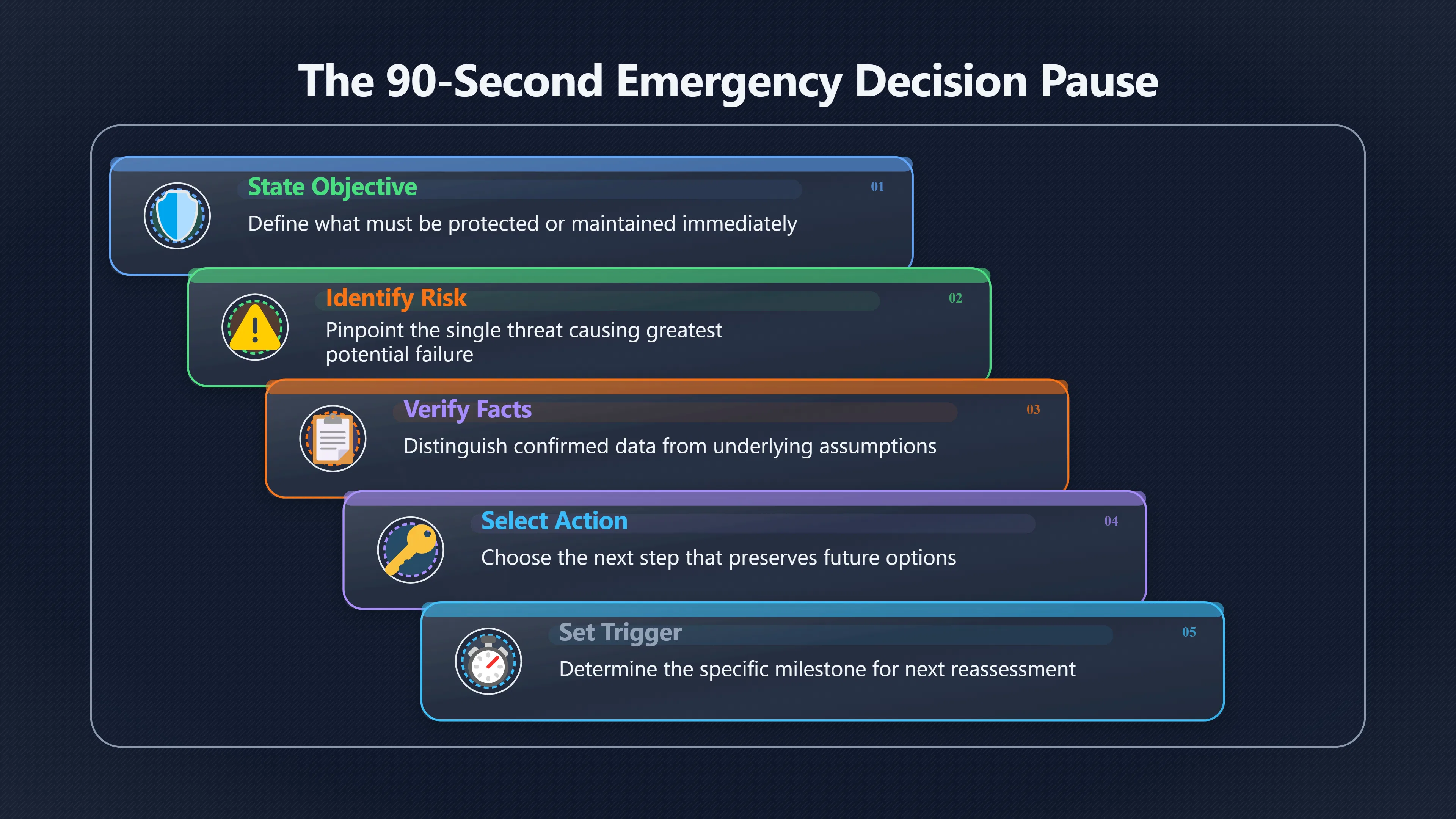
The 90-second decision pause
A useful emergency routine should take well under two minutes. It creates enough distance to avoid automatic reactions while remaining fast enough for genuine emergencies.
A practical sequence is:
- State the immediate objective. What must be protected right now? Is the priority preserving life, preventing escalation, maintaining communication or buying time?
- Identify the greatest current risk. Which single threat could make every later decision worse? What assumption, if wrong, would most quickly cause failure?
- Check what is actually known. Which facts are confirmed? Which important beliefs are assumptions? What information would meaningfully change the next decision?
- Choose the next action, not the entire solution. Select the action that advances the objective while limiting irreversible consequences.
- Set a review trigger. Decide when the situation will be reassessed—for example after five minutes, after new information arrives or after a specific operational milestone.
The pause is deliberately short because emergencies rarely permit complete analysis. Its purpose is to prevent avoidable errors such as pursuing the wrong objective, acting on an untested assumption or overlooking an obvious hazard. [PMC]pmc.ncbi.nlm.nih.govPMCDecision-Making During High-Risk EventsNIHby C Reale · 2023 · Cited by 95 — Effective decision-making in crisis events is challenging due to time pressure, Recognition-pr…
Choosing the next reversible step
One of the most useful principles under extreme time pressure is to favour actions that preserve future choices whenever circumstances allow.
A reversible step typically:
- gathers additional information;
- protects people from immediate harm;
- creates time for better assessment;
- can be adjusted or reversed if the situation changes.
For example, an emergency manager deciding whether to evacuate an area may first reposition resources, improve communications or prepare transport while confirming the evolving threat, rather than committing immediately to actions that are difficult to reverse. Likewise, in organisational crises, temporarily isolating a failing system is often preferable to making irreversible infrastructure changes before the cause is understood.
This principle does not imply hesitation. Some situations—such as immediate threats to life—require decisive irreversible action. Rather, when several actions are available within the available time, preference should usually be given to the one that preserves flexibility without materially increasing danger. [PMC]pmc.ncbi.nlm.nih.govPMCDecision-Making During High-Risk EventsNIHby C Reale · 2023 · Cited by 95 — Effective decision-making in crisis events is challenging due to time pressure, Recognition-pr…
Why experts rarely compare many options
Traditional decision models often assume that people generate multiple alternatives and then compare them systematically. Field studies of emergency responders suggest that this is rarely how experienced professionals operate during genuine crises.
Instead, they typically:
- recognise the situation;
- retrieve the first workable response;
- mentally simulate how it is likely to unfold;
- reject it only if that simulation reveals a serious problem.
This “first workable option” approach is often misunderstood as acting on gut feeling. In reality, the mental simulation stage is crucial. Experts rapidly imagine what will happen next, checking for obvious contradictions, missing resources or dangerous consequences before committing themselves. [ResearchGate+2White Rose Research Online]researchgate.netResearch Gate A Recognition Primed Decision (RPD) Model of RapidA Recognition Primed Decision (RPD) Model of Rapid…January 1, 1993 — The objective of this study was to examine the way de…
For less experienced decision-makers, explicit routines compensate for the absence of extensive pattern recognition by encouraging deliberate checking before action.
Preventing decision paralysis
A common failure during emergencies is not reckless action but decision inertia. Teams become trapped waiting for certainty that cannot arrive before action is required.
Research on emergency management identifies several contributors to this paralysis:
- incomplete or conflicting information;
- uncertainty about authority or responsibility;
- unclear operational priorities;
- concern about making the wrong irreversible decision;
- poor communication between agencies or teams. [Crest Research]crestresearch.ac.uktime pressure, lack of information) or exogenousCrest ResearchDecision making during emergencies: what have we…11 Dec 2017 — Uncertainty during emergencies can be endogenous and spec…
Simple routines reduce paralysis because they replace the impossible question—”What is the perfect decision?”—with a more practical one: “What is the safest useful action that can be taken now?”
Explicitly assigning review points also makes commitment psychologically easier. Teams know that today’s decision is not necessarily permanent if better evidence becomes available.
Applying the routine in teams
Emergency decisions are rarely made by individuals alone. Brief structured communication helps teams maintain a shared understanding without lengthy meetings.
A rapid team check can follow four prompts:
- Situation: What do we believe is happening?
- Goal: What are we trying to achieve first?
- Action: What is the next immediate step?
- Review: What event or information will cause us to reassess?
Studies of emergency command suggest that maintaining shared situational awareness and clear goals improves coordination, especially when different organisations must work together under uncertainty. Communication failures often become more damaging than technical mistakes because different people begin solving different problems without realising it. [Crest Research]crestresearch.ac.uktime pressure, lack of information) or exogenousCrest ResearchDecision making during emergencies: what have we…11 Dec 2017 — Uncertainty during emergencies can be endogenous and spec…
Common pitfalls during time-pressured decisions
Even experienced decision-makers should actively guard against several predictable errors:
- Fixation: Continuing with an initial diagnosis despite contradictory evidence.
- Action bias: Doing something merely to reduce discomfort, rather than because it improves outcomes.
- Tunnel vision: Allowing one threat to obscure equally important developing risks.
- Escalation of commitment: Persisting with a failing course because resources have already been invested.
- Failure to reassess: Treating the first decision as final rather than adapting to changing conditions.
The most effective emergency routines do not eliminate these tendencies. Instead, they create small moments where they are more likely to be noticed before they become costly mistakes. By combining a brief pause, a clear objective, a focus on the greatest current risk and a preference for reversible next steps where feasible, decision-makers can improve judgement without sacrificing the speed that emergencies demand.
Amazon book picks
Further Reading
Books and field guides related to How do you pause when time is short?. Use these as the next step if you want deeper reading beyond the article.
Sources of Power
Directly covers firefighters, commanders, and professionals making rapid decisions in time-pressured real-world settings.
Decisive
Offers memorable tools for avoiding narrow framing and premature commitment even when choices must be made quickly.
Thinking, Fast and Slow
Explains fast thinking, cognitive shortcuts, overconfidence, and why pressure can distort what people notice.
The Checklist Manifesto
Explains how brief structured pauses protect expert teams from avoidable mistakes without slowing action unnecessarily.
eBay marketplace picks
Marketplace Samples
Live-tested eBay searches with available results related to this page.
Endnotes
-
Source: pmc.ncbi.nlm.nih.gov
Title: PMCDecision-Making During High-Risk Events
Link: https://pmc.ncbi.nlm.nih.gov/articles/PMC10564111/Source snippet
NIHby C Reale · 2023 · Cited by 95 — Effective decision-making in crisis events is challenging due to time pressure, Recognition-pr...
-
Source: researchgate.net
Title: Research Gate A Recognition Primed Decision (RPD) Model of Rapid
Link: https://www.researchgate.net/publication/235418838_A_Recognition_Primed_Decision_RPD_Model_of_Rapid_Decision_MakingSource snippet
A Recognition Primed Decision (RPD) Model of Rapid...January 1, 1993 — The objective of this study was to examine the way de...
Published: January 1, 1993
-
Source: eprints.whiterose.ac.uk
Title: EJDP paper final draft updated on 30th September 2014
Link: https://eprints.whiterose.ac.uk/id/eprint/88997/3/EJDP%20paper-%20final%20draft-updated%20on%2030th%20September%202014.pdfSource snippet
White Rose Research OnlineUnderstanding decision making during emergenciesby JL Mishra · 2015 · Cited by 33 — Klein proposed Recognition...
Published: September 2014
-
Source: crestresearch.ac.uk
Title: time pressure, lack of information) or exogenous
Link: https://crestresearch.ac.uk/comment/power-decision-making-emergencies/Source snippet
Crest ResearchDecision making during emergencies: what have we...11 Dec 2017 — Uncertainty during emergencies can be endogenous and spec...
-
Source: pubmed.ncbi.nlm.nih.gov
Title: Pub Medrecognition-primed decision making
Link: https://pubmed.ncbi.nlm.nih.gov/16879547/Source snippet
The literature in...by S Bond · 2006 · Cited by 91 — This paper critics the literature on recognition-primed decision making, with parti...
Additional References
-
Source: thinkinsights.net
Link: https://thinkinsights.net/leadership/recognition-primed-decision-rpd-model -
Source: shadowboxtraining.com
Title: a primer on recognition primed decision making rpd
Link: https://www.shadowboxtraining.com/news/2025/06/17/a-primer-on-recognition-primed-decision-making-rpd/Source snippet
A Primer on Recognition Primed Decision-Making (RPD)17 Jun 2025 — In this article, I'll explain what RPD is, how it works, how it compare...
-
Source: idtips.substack.com
Title: the recognition primed decision model
Link: https://idtips.substack.com/p/the-recognition-primed-decision-modelSource snippet
Recognition-Primed Decision Model: How Experts Make...The RPD model is the most prominent framework within a broader field called Natura...
-
Source: Wikipedia
Title: Recognition primed decision
Link: https://en.wikipedia.org/wiki/Recognition-primed_decisionSource snippet
Recognition-primed decisionRecognition-primed decision (RPD) is a model of how people make quick, effective decisions when faced with...
-
Source: youtube.com
Title: Recognition-Primed Decision Model
Link: https://www.youtube.com/watch?v=_BIMU8zPcrMSource snippet
How do you make better decisions under pressure? - Tim Bradshaw...
-
Source: youtube.com
Title: The RPD Model: An Intro to Recognition Primed Decision Making
Link: https://www.youtube.com/watch?v=6-O5ITf0PzQSource snippet
Recognition-Primed Decision Model - Gary Klein on Fresh perspectives...
-
Source: youtube.com
Title: How do you make better decisions under pressure?
Link: https://www.youtube.com/watch?v=wYn2JT44v5ESource snippet
Crisis Management: Mastering the Art of Quick Decision-Making...
-
Source: arxiv.org
Title: arXiv Prioritizing emergency evacuations under compounding levels of uncertainty
Link: https://arxiv.org/abs/2210.08975 -
Source: youtube.com
Title: How to Make Better Decisions Under Pressure
Link: https://www.youtube.com/watch?v=NDEheQLLeMgSource snippet
The RPD Model: An Intro to Recognition Primed Decision Making...
-
Source: youtube.com
Title: Crisis Management: Mastering the Art of Quick Decision-Making
Link: https://www.youtube.com/watch?v=-05gqlFDxoY
Topic Tree