Within Myside Bias
When Being Correct Feels Like Losing Face
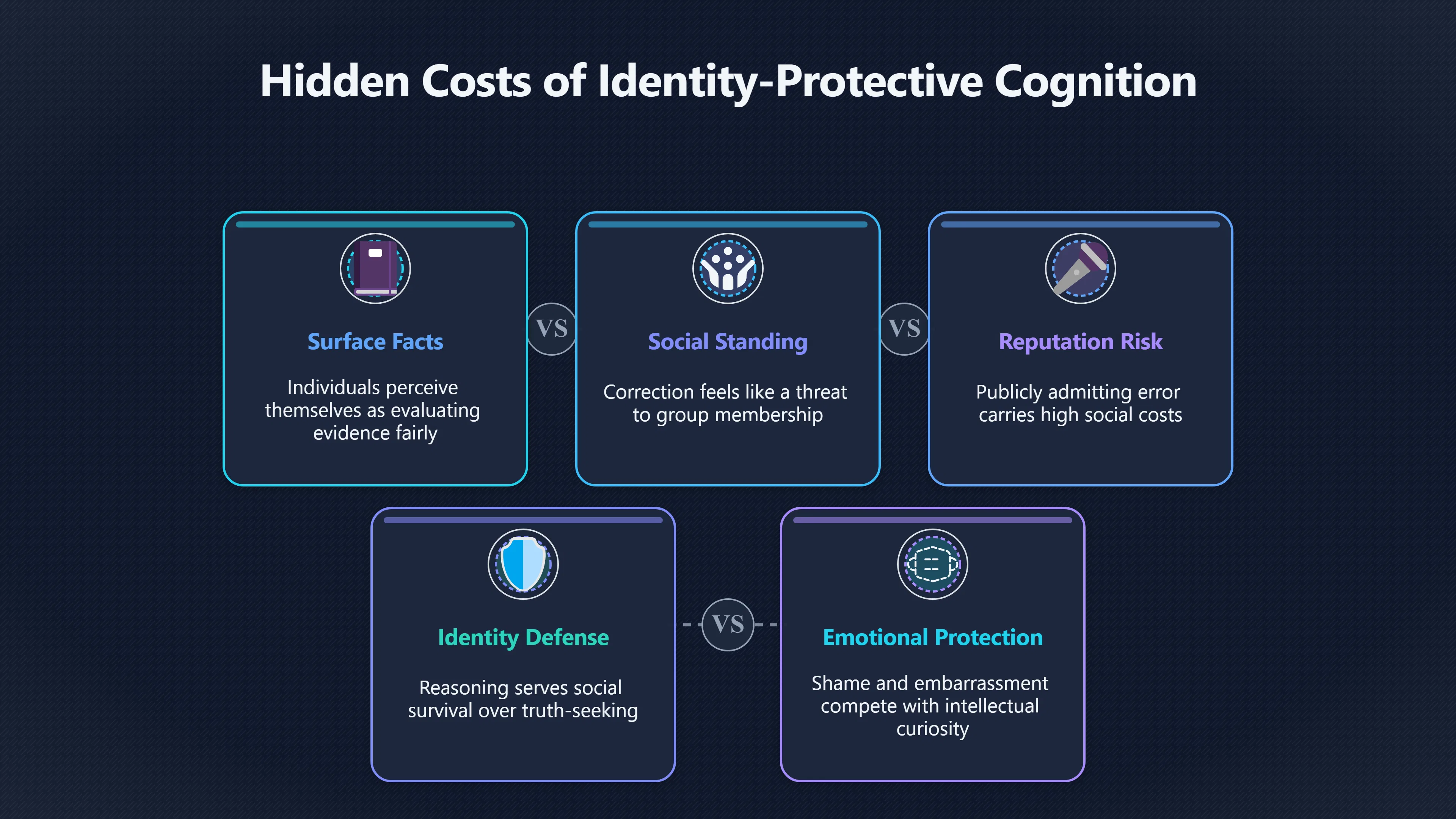
Facts are harder to absorb when changing your mind feels like losing status, betraying a group, or undoing a public commitment.
On this page
- Beliefs tied to group, status and reputation
- Why corrections can fail without factual backfire
- Ways to separate accuracy from humiliation
Page outline Jump by section
Introduction
Changing your mind is not always just an intellectual act. Sometimes it feels like a social loss. A correction can seem to threaten your standing in a group, undermine your professional reputation, contradict a public commitment or call your character into question. When that happens, evidence is no longer processed as neutral information. It is experienced as a challenge to identity, making accurate thinking much harder even when the new facts are strong.
 This mechanism helps explain why myside bias is often most powerful around politics, religion, moral values, professional expertise and lifestyle choices. The central problem is not that people are incapable of understanding evidence. It is that accepting it may carry personal or social costs. Understanding this distinction is essential for improving analytical thinking because it shifts attention from simply presenting better facts to recognising when correction has become psychologically threatening.[SSRN+2University of Houston Law Center]papers.ssrn.comSSRN ID2978536 code45442Misconceptions, Misinformation, and the Logic of Identity-…by DM Kahan · 2017 · Cited by 582 — Identity protective cognition refer…
Beliefs that become part of who you are
Not every belief becomes identity-defining. Many opinions can be revised with little emotional effort. Others become woven into how people understand themselves or signal membership of a valued community.
This often happens when a belief is associated with:
- belonging to a political, religious or cultural group;
- professional expertise or public credibility;
- a moral commitment that reflects personal character;
- a costly past decision involving money, time or reputation;
- repeated public defence of the position.
Once a belief performs one of these social functions, changing it may feel less like updating knowledge and more like admitting disloyalty or incompetence. Researchers studying identity-protective cognition argue that people often evaluate evidence in ways that preserve acceptance within groups whose approval matters to them. Under those conditions, reasoning serves both truth-seeking and social survival, and the two goals can conflict.[SSRN+2Network Dynamics Group]papers.ssrn.comSSRN ID2978536 code45442Misconceptions, Misinformation, and the Logic of Identity-…by DM Kahan · 2017 · Cited by 582 — Identity protective cognition refer…
Historical comparisons illustrate the pattern. Resistance to changing views about smoking, climate risks, vaccination, economic policy or criminal justice has often reflected more than disagreement about evidence. In many cases, particular factual positions became markers of broader political or cultural identity. Accepting contrary evidence risked signalling membership in an opposing camp rather than merely revising a factual judgement.[SSRN]papers.ssrn.comSSRN ID2978536 code45442Misconceptions, Misinformation, and the Logic of Identity-…by DM Kahan · 2017 · Cited by 582 — Identity protective cognition refer…
Why corrections sometimes fail without producing a factual backfire
Popular discussions often claim that correcting misinformation makes people believe it even more strongly. Research has found this dramatic “backfire effect” to be much rarer than originally feared. Large experimental studies have generally failed to find widespread factual backfire, even on politically contentious issues.[Cambridge University Press & Assessment]cambridge.orgby A Guess · 2020 · Cited by 396 — Kahan (Reference Kahan2012) has applied the Theory of Cultural Cognition to public instead to document…
This does not mean corrections always succeed. Instead, identity changes the conditions under which evidence is accepted.
Several mechanisms can operate together:
- Selective scrutiny. Evidence favouring one’s group receives less criticism than evidence supporting outsiders.
- Motivated interpretation. Ambiguous findings are interpreted in ways consistent with existing commitments.
- Reputation management. Publicly acknowledging error may appear more costly than privately recognising uncertainty.
- Emotional self-protection. Feelings of shame, embarrassment or anticipated rejection compete with curiosity.
The result is often partial updating rather than outright rejection. Someone may accept a specific factual correction while leaving the broader identity-linked narrative untouched. For example, they might concede one statistic while preserving the larger worldview that originally made the statistic important. This helps explain why factual agreement and attitude change do not always move together.[Cambridge University Press & Assessment+2SSRN]cambridge.orgby A Guess · 2020 · Cited by 396 — Kahan (Reference Kahan2012) has applied the Theory of Cultural Cognition to public instead to document…
Why status and public commitment raise the stakes
Identity threats become stronger when people have invested publicly in a position.
Public speeches, social media posts, published articles, organisational leadership or years of advocacy all increase the reputational cost of changing course. Revising a belief may appear to invalidate previous advice, disappoint supporters or weaken authority.
This creates an asymmetry between private reasoning and public reasoning. A person may privately recognise weaknesses in their position while hesitating to acknowledge them openly because the social consequences appear larger than the intellectual benefits.
History contains many examples of delayed acceptance of scientific or policy evidence after influential figures had already committed themselves publicly to contrary positions. Although every case has unique political and institutional factors, the underlying psychological pattern is familiar: admitting error becomes intertwined with preserving competence and status.
The more audiences interpret disagreement as evidence of personal weakness rather than intellectual honesty, the more difficult genuine belief revision becomes.

What identity-protective reasoning actually looks like
Identity-protective reasoning does not usually involve conscious deception. People generally experience themselves as evaluating evidence fairly.
Research suggests several characteristic features:
- Questions are framed in ways that favour existing assumptions.
- Weak supporting evidence receives generous interpretation.
- Strong opposing evidence is examined for methodological flaws before its substance is considered.
- Exceptions are treated as isolated anomalies rather than reasons to reconsider broader beliefs.
- Trusted members of one’s own group are considered more credible than equally qualified outsiders.
Studies of social identity threat also show that people rapidly detect information implying negative evaluations of groups they value. This heightened sensitivity means identity-relevant criticism attracts attention quickly and can trigger defensive processing before deliberate reflection begins.[PMC]pmc.ncbi.nlm.nih.govPMCNon-strategic detection of identity-threatening informationby J Abendroth · 2022 · Cited by 14 — The present study expands this research by exploring whether people also non-strategically detec…
Importantly, these reactions are not confined to any particular ideology or community. They reflect general features of human social cognition.
Separating accuracy from humiliation
Because identity threats involve more than factual disagreement, improving analytical thinking requires reducing the perceived personal cost of being wrong.
Several approaches have empirical support or theoretical grounding.
Treat beliefs as hypotheses rather than possessions. Describing conclusions as current best explanations makes later revision feel more natural than presenting them as permanent commitments.
Reward updating instead of consistency alone. Organisations and discussion groups that praise thoughtful revision reduce the reputational penalty associated with changing one’s mind.
Critique claims without attacking character. People are more receptive when evidence challenges a proposition rather than implying stupidity, bad motives or moral failure.
Use self-affirmation. Research on self-affirmation suggests that reminding people of important values or strengths unrelated to the disputed issue can reduce defensiveness. Protecting a broader sense of self-worth can make threatening information easier to evaluate objectively.[OUP Academic+2UCSB Psychology Labs]oxfordre.comOUP AcademicSelf-Affirmation - Oxford Research EncyclopediasThus, when the self is threatened by a health message, the perceived threat c…
Create opportunities for private revision. Individuals often reconsider evidence more readily when they are not forced to admit error in front of an audience whose judgement they fear.
These approaches do not guarantee agreement, nor should they replace careful evaluation of evidence. Their value lies in separating the question “Is this claim true?” from the emotionally loaded question “What does accepting it say about me?”
Why this matters for better thinking
Analytical skill is often imagined as a matter of logic alone. Yet reasoning takes place inside social lives filled with loyalties, reputations and identities. When correction threatens belonging or dignity, even highly intelligent people can devote considerable mental effort to protecting a valued identity instead of evaluating evidence.
Recognising this mechanism makes myside bias easier to understand. The obstacle is frequently not ignorance but the hidden cost attached to being correct. The more thinking can be organised so that changing one’s mind signals intellectual integrity rather than personal defeat, the easier it becomes to let evidence perform its intended role: improving understanding rather than deciding social status.
Amazon book picks
Further Reading
Books and field guides related to When Being Correct Feels Like Losing Face. Use these as the next step if you want deeper reading beyond the article.
Think Again
Directly addresses updating beliefs, identity, and overcoming resistance to being wrong.
Mistakes Were Made (but Not by Me)
Explains why people defend beliefs when corrections threaten identity or reputation.
The Scout Mindset
Focuses on cultivating accuracy over ego and reducing identity-driven reasoning.
The Righteous Mind
Explores how morality, group identity, and social belonging shape belief formation and disagreement.
eBay marketplace picks
Marketplace Samples
Live-tested eBay searches with available results related to this page.




Endnotes
1.
Source: papers.ssrn.com
Title: SSRN ID2978536 code45442
Link:https://papers.ssrn.com/sol3/Delivery.cfm/SSRN_ID2978536_code45442.pdf?abstractid=2973067&mirid=1
Source snippet
Misconceptions, Misinformation, and the Logic of Identity-...by DM Kahan · 2017 · Cited by 582 — Identity protective cognition refer...
2.
Source: pmc.ncbi.nlm.nih.gov
Title: PMCNon-strategic detection of identity-threatening information
Link:https://pmc.ncbi.nlm.nih.gov/articles/PMC8757953/
Source snippet
by J Abendroth · 2022 · Cited by 14 — The present study expands this research by exploring whether people also non-strategically detec...
3.
Source: cambridge.org
Link:https://www.cambridge.org/core/journals/british-journal-of-political-science/article/does-counterattitudinal-information-cause-backlash-results-from-three-large-survey-experiments/526B71F3BB76A39C1101384D576208D4
Source snippet
by A Guess · 2020 · Cited by 396 — Kahan (Reference Kahan2012) has applied the Theory of Cultural Cognition to public instead to document...
4.
Source: labs.psych.ucsb.edu
Title: Psychology Labs6
Link:https://labs.psych.ucsb.edu/sherman/david/sites/labs.psych.ucsb.edu.sherman.david/files/pubs/sherman.gibbs_.binning.inpress.pdf
Source snippet
Self-Affirmation and Intergroup Biases: Changing the...by DK Sherman · Cited by 5 — When people experience or perceive a threat to their...
5.
Source: law.uh.edu
Title: Cultural Cognition of Scientific Consensus by Kahan final
Link:https://law.uh.edu/faculty/thester/courses/Climate-Change-2017/Cultural%20Cognition%20of%20Scientific%20Consensus%20by%20Kahan%20final.pdf
Source snippet
University of Houston Law CenterCultural Cognition of Scientific Consensus by Kahan...by D Kahan · Cited by 2622 — Cultural cognition re...
6.
Source: ndg.asc.upenn.edu
Title: Ideology motivated reasoning
Link:https://ndg.asc.upenn.edu/wp-content/uploads/2017/08/Ideology-motivated-reasoning.pdf
Source snippet
Kahan ・ might treat identity-protective motivated reasoning ・ identity-protective cognition, ideologically or culturally defined affinity...
7.
Source: oxfordre.com
Link:https://oxfordre.com/communication/view/10.1093/acrefore/9780190228613.001.0001/acrefore-9780190228613-e-536
Source snippet
OUP AcademicSelf-Affirmation - Oxford Research EncyclopediasThus, when the self is threatened by a health message, the perceived threat c...
Additional References
8.
Source: researchgate.net
Link:https://www.researchgate.net/publication/259650286_The_Psychology_of_Change_Self-Affirmation_and_Social_Psychological_Intervention
Source snippet
ResearchGate(PDF) The Psychology of Change: Self-Affirmation and...People can import into a threatened domain the sense of personal inte...
9.
Source: research.ou.nl
Link:https://research.ou.nl/en/publications/processing-of-social-identity-threats-a-defense-motivation-perspe/
Source snippet
Open Universiteit research portalProcessing of social identity threats: A defense motivation...by N De Hoog · 2013 · Cited by 101 — Dive...
10.
Source: youtube.com
Title: Facts Do Not Enter Neutral Rooms
Link:https://www.youtube.com/watch?v=6sXKyq6YxqE
Source snippet
The Psychology of Loyal Idiots — What Hannah Arendt Called the Most Terrifying Evil of All...
11.
Source: youtube.com
Link:https://www.youtube.com/watch?v=UNqVbevl7s8
Source snippet
When Interpretation Becomes Defense...
12.
Source: youtube.com
Title: Identity-Protective Cognition: Why We Ignore Facts That Threaten Our Identity
Link:https://www.youtube.com/watch?v=7t9L8mpo2NM
Source snippet
Facts Do Not Enter Neutral Rooms...
13.
Source: youtube.com
Title: When Interpretation Becomes Defense
Link:https://www.youtube.com/watch?v=xiFIhoJd0zM
Source snippet
The Invisible Tax Of Refusing To Fail...
14.
Source: youtube.com
Title: The Invisible Tax Of Refusing To Fail
Link:https://www.youtube.com/watch?v=Nbi6eQCdbWE
Topic Tree