Within Alternatives
A Simple Matrix For Rival Ideas
A lightweight comparison table can reveal which facts support, weaken, or fail to distinguish rival explanations.
On this page
- What intelligence analysis contributes to everyday reasoning
- How to compare evidence across explanations symmetrically
- When a matrix is useful and when it is overkill
Page outline Jump by section
Introduction
When you have several plausible explanations for the same situation, the goal is not to prove your favourite right but to discover which explanation best survives comparison. That is the central idea behind the Analysis of Competing Hypotheses (ACH), a structured technique developed for intelligence analysis that can be adapted into a lightweight tool for everyday decisions. Rather than asking, “Does this explanation fit the facts?”, ACH asks, “Which explanation is least contradicted by the available evidence?” This small change in perspective helps reduce the tendency to give one attractive story all the benefit of the doubt and encourages evidence to compete on equal terms. [ialeia.org]ialeia.orgmends using a matrix to array evidence for and against competing hy-.Read morePDF] The Psychology of Intelligence AnalysisDecember 13, 2005 — Heuer's concept of “Analysis of Competing Hypotheses” (ACH) is among his…
 For ordinary decisions, a simplified version is usually enough. You do not need a complex intelligence workflow or scoring system. A short comparison matrix can make hidden assumptions visible, reveal which facts genuinely distinguish between explanations, and show where more information would actually change your mind.
What intelligence analysis contributes to everyday reasoning
ACH was originally developed by intelligence analyst Richards J. Heuer Jr. for situations where decisions must be made despite incomplete, uncertain, or conflicting information. Instead of accumulating supporting evidence for one preferred theory, analysts deliberately compare every important piece of evidence against every plausible explanation. The emphasis falls on evidence that discriminates between alternatives rather than evidence that is consistent with all of them. [ialeia.org]ialeia.orgmends using a matrix to array evidence for and against competing hy-.Read morePDF] The Psychology of Intelligence AnalysisDecember 13, 2005 — Heuer's concept of “Analysis of Competing Hypotheses” (ACH) is among his…
That principle transfers well to everyday reasoning because many common mistakes follow the same pattern:
- You assume a colleague is ignoring your messages rather than being overloaded.
- You conclude a product is defective rather than considering incorrect use.
- You interpret one poor exam result as lack of ability rather than illness, fatigue, or poor preparation.
- You attribute a friend’s short reply to annoyance rather than distraction or time pressure.
In each case, the first explanation may be reasonable, but it becomes stronger only after surviving comparison with realistic alternatives.
The intelligence version of ACH can be detailed and time-consuming, but its underlying habit—evaluating evidence symmetrically across competing explanations—is the part that remains useful in everyday life. [ptgmedia.pearsoncmg.com]ptgmedia.pearsoncmg.com28 Analysis of Competing HypothesisFebruary 28, 2007 — ACH is a process for refuting hypotheses. • Typical: analysts choose what they int…
How to compare evidence across explanations symmetrically
A simple ACH-style matrix uses explanations as columns and pieces of evidence as rows. The purpose is not to calculate an exact score but to force yourself to ask the same question of every explanation.
EvidenceExplanation AExplanation BExplanation CRecent customer complaintSupportsAlso consistentWeakly inconsistentPrevious positive reviewsWeakensNeutralSupportsDelivery delayNeutralStrongly supportsNeutralMissing documentationSupportsSupportsDoes not distinguish
Notice that not every fact is equally valuable.
Some observations are non-diagnostic: they fit almost every explanation and therefore tell you very little.
Other observations are diagnostic because they strongly favour one explanation while making another less likely. Heuer argued that these discriminating pieces of evidence deserve the greatest attention because they actually separate competing hypotheses. [ialeia.org]ialeia.orgmends using a matrix to array evidence for and against competing hy-.Read morePDF] The Psychology of Intelligence AnalysisDecember 13, 2005 — Heuer's concept of “Analysis of Competing Hypotheses” (ACH) is among his…
When filling in a matrix, three questions are especially useful:
- Does this evidence support the explanation?
- Does it weaken the explanation?
- Would I expect to see this evidence even if another explanation were true?
The third question is often the most revealing because it prevents ordinary facts from being treated as decisive simply because they happen to fit your preferred story.
A practical example
Suppose your car will not start.
Possible explanations might include:
- Flat battery
- Empty fuel tank
- Faulty starter motor
Now compare evidence rather than stories.
ObservationFlat batteryEmpty fuelStarter motorDashboard lights are dimStrong supportWeakensWeak supportEngine does not crankSupportsWeakensStrong supportFuel gauge shows emptyWeakensStrong supportNeutral
Instead of asking which explanation sounds most plausible overall, you identify which observations genuinely distinguish between them. If the dashboard lights are bright but the starter makes only a clicking noise, attention shifts naturally without needing to defend an earlier guess.
Why symmetry matters more than scoring
Many people assume the value of ACH lies in assigning numbers. In practice, the greater benefit often comes from forcing symmetrical evaluation.
Without a structured comparison, people commonly gather evidence in an uneven way:
- They ask, “What supports my idea?”
- They overlook conflicting observations.
- They explain away exceptions.
- They stop searching once a satisfactory explanation appears.
A comparison matrix interrupts this process by requiring every important observation to be considered against every live alternative.
Psychological research on “considering alternatives” likewise suggests that deliberately generating multiple explanations can reduce overconfidence and hindsight bias, provided the alternatives are genuine rather than artificial. [Communication Cache]communicationcache.commultiple explanation a consider an alternative strategy for debiasing judgmentsCommunication CacheA Consider-an-Alternative Strategy for Debiasing Judgmentsby ER Hirt · 1995 · Cited by 469 — Previous research has sug…
When a matrix is useful—and when it is overkill
A lightweight ACH works best when:
- Two or more explanations are genuinely plausible.
- The decision matters enough to justify a few minutes of structured thinking.
- The available evidence is incomplete or ambiguous.
- Confirmation bias is likely because you already have a favourite explanation.
Examples include:
- Deciding why sales suddenly declined.
- Interpreting unexpected behaviour from a colleague.
- Investigating recurring household problems.
- Choosing between competing explanations for project delays.
A matrix is usually unnecessary when:
- One explanation is already overwhelmingly supported.
- The decision is trivial.
- Better evidence can be obtained immediately instead of analysing uncertain evidence.
- There is only one realistic explanation.
The aim is better calibration, not excessive analysis. Spending thirty minutes comparing hypotheses about why someone took ten minutes to reply to a text message is unlikely to improve decisions.

Limits and criticisms of ACH
ACH has become influential, but research suggests it should not be treated as a guaranteed debiasing tool.
Experimental studies involving intelligence analysts have found mixed evidence that formal ACH consistently reduces confirmation bias. Analysts often omit parts of the method, and in some settings the structured process may increase inconsistency or cognitive workload rather than improve accuracy. More recent research has similarly questioned whether matrix structure alone reliably reduces confirmation bias across different tasks. [Strathprints]strathprints.strath.ac.ukStrathprints The “analysis of competing hypotheses” in intelligence analysisThe “analysis of competing hypotheses” in intelligence analysisJuly 26, 2019 — by MK Dhami · 2019 · Cited by 81 — We examined…
These findings point to an important lesson for everyday use: the matrix is a thinking aid, not a substitute for judgement.
The greatest value usually comes from:
- generating genuinely plausible alternatives;
- identifying evidence that discriminates between them;
- recognising which assumptions remain uncertain; and
- being willing to change your preferred explanation when new evidence appears.
Using ACH Lite as a practical habit
For everyday reasoning, an abbreviated process is usually sufficient:
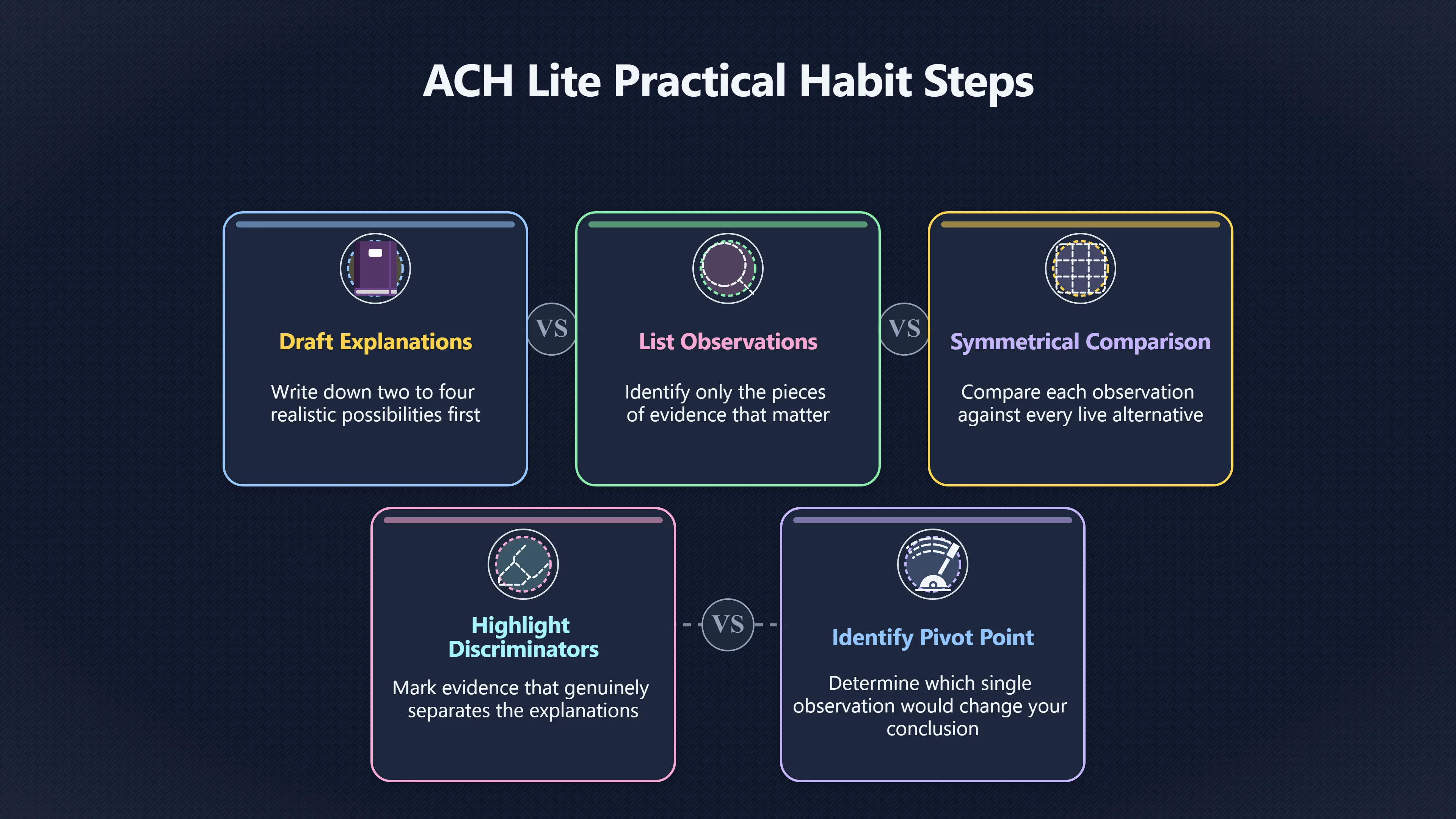
- Write down two to four realistic explanations before deciding.
- List only the observations that matter.
- Compare each observation against every explanation rather than examining one explanation at a time.
- Highlight the evidence that genuinely separates the explanations.
- Ask what single new observation would most change your conclusion.
- Leave open the possibility that none of the current explanations is complete.
This approach preserves the most useful insight from intelligence analysis: explanations should compete on the same evidence under the same standards. When that happens, the strongest explanation is less likely to win because it was your favourite from the beginning, and more likely to win because it best accounts for what you actually know. [Pherson]pherson.orgThis paper identifies three different approaches to Analysis of Competing Hypotheses (ACH) and four major steps in the intelligence analy…
eBay marketplace picks
Marketplace Samples
Live-tested eBay searches with available results related to this page.



Endnotes
-
Source: ialeia.org
Title: mends using a matrix to array evidence for and against competing hy-.Read more
Link: https://www.ialeia.org/docs/Psychology_of_Intelligence_Analysis.pdfSource snippet
[PDF] The Psychology of Intelligence AnalysisDecember 13, 2005 — Heuer's concept of “Analysis of Competing Hypotheses” (ACH) is among his...
Published: December 13, 2005
-
Source: pherson.org
Link: https://pherson.org/wp-content/uploads/2013/06/06.-How-Does-ACH-Improve-Analysis_FINAL.pdfSource snippet
This paper identifies three different approaches to Analysis of Competing Hypotheses (ACH) and four major steps in the intelligence analy...
-
Source: ptgmedia.pearsoncmg.com
Link: https://ptgmedia.pearsoncmg.com/imprint_downloads/ftpress/bookreg/9780131873667/Ch28.pdfSource snippet
28 Analysis of Competing HypothesisFebruary 28, 2007 — ACH is a process for refuting hypotheses. • Typical: analysts choose what they int...
Published: February 28, 2007
-
Source: pherson.org
Link: https://pherson.org/wp-content/uploads/2013/06/Improving-Intelligence-Analysis-with-ACH.pdfSource snippet
Center for the Study of Intelligence, 1999). His book is used throughout.Read more...
-
Source: youtube.com
Title: Intelligence Analysis Skills: Analysis of Competing Hypotheses (Part 1)
Link: https://www.youtube.com/watch?v=J_eDCBf7R2ISource snippet
Analysis of Competing Hypotheses...
-
Source: youtube.com
Title: Analysis of Competing Hypotheses
Link: https://www.youtube.com/watch?v=t6GEvRYMIxsSource snippet
Structured Analytic Techniques: Can One Method Beat Gut Feel?...
-
Source: communicationcache.com
Title: multiple explanation a consider an alternative strategy for debiasing judgments
Link: https://www.communicationcache.com/uploads/1/0/8/8/10887248/multiple_explanation-_a_consider-an-alternative_strategy_for_debiasing_judgments.pdfSource snippet
Communication CacheA Consider-an-Alternative Strategy for Debiasing Judgmentsby ER Hirt · 1995 · Cited by 469 — Previous research has sug...
-
Source: strathprints.strath.ac.uk
Title: Strathprints The “analysis of competing hypotheses” in intelligence analysis
Link: https://strathprints.strath.ac.uk/69049/1/Dhami_etal_ACP_2019_The_analysis_of_competing_hypotheses_in_intelligence.pdfSource snippet
The “analysis of competing hypotheses” in intelligence analysisJuly 26, 2019 — by MK Dhami · 2019 · Cited by 81 — We examined...
Published: July 26, 2019
-
Source: strathprints.strath.ac.uk
Link: https://strathprints.strath.ac.uk/89640/Source snippet
Effects of task structure and confirmation bias in alternative...by MK Dhami · 2024 · Cited by 2 — We empirically examined t...
-
Source: Wikipedia
Title: Analysis of competing hypotheses
Link: https://en.wikipedia.org/wiki/Analysis_of_competing_hypothesesSource snippet
Analysis of competing hypothesesThe analysis of competing hypotheses (ACH) is a methodology for evaluating multiple competing hypothes...
Additional References
-
Source: futuribles.com
Link: https://www.futuribles.com/wp-content/uploads/related-documents/analysis-of-competing-hypotheses.pdf?postId=73706Source snippet
Analysis of Competing HypothesesAnalysis of Competing Hypotheses (ACH) is an intelligence analysis method based on evaluating plausible a...
-
Source: sosintel.co.uk
Link: https://sosintel.co.uk/mastering-the-analysis-of-competing-hypotheses-ach-a-practical-framework-for-clear-thinking/Source snippet
SOS IntelligenceMastering the Analysis of Competing Hypotheses (ACH)20 Jun 2025 — At its core, ACH shifts the analytical focus from provi...
-
Source: researchgate.net
Link: https://www.researchgate.net/publication/331942237_The_analysis_of_competing_hypotheses_in_intelligence_analysisSource snippet
to reduce “confirmation bias.” Fifty intelligence analysts were randomly...Read more...
-
Source: watchmycompetitor.com
Link: https://www.watchmycompetitor.com/resources/a-complete-guide-to-analysis-of-competing-hypotheses-ach/Source snippet
g that helps you identify and evaluate different explanations for a given...
-
Source: youtube.com
Title: Structured Analytic Techniques: Can One Method Beat Gut Feel?
Link: https://www.youtube.com/watch?v=YvuEv-aR97YSource snippet
[Analysis of Competing Hypotheses Matrix] This video on the Analysis of Competing Hypotheses details how to systematically evaluate multi...
-
Source: plato.stanford.edu
Title: Encyclopedia of Philosophy Abduction
Link: https://plato.stanford.edu/entries/abduction/Source snippet
Stanford Encyclopedia of PhilosophyAbduction - Stanford Encyclopedia of Philosophyby I Douven · 2011 · Cited by 1188 — Abduction is norma...
-
Source: repository.mdx.ac.uk
Link: https://repository.mdx.ac.uk/download/56199b865755f7ffe0f2e697a221094d9723cc68c1db2314d90d96fcdd117016/1342655/s41235-024-00560-y.pdfSource snippet
of task structure and confirmation bias in alternative...by MK Dhami · 2024 · Cited by 2 — To our knowledge, no research has yet examine...
-
Source: pmc.ncbi.nlm.nih.gov
Link: https://pmc.ncbi.nlm.nih.gov/articles/PMC11169332/Source snippet
of task structure and confirmation bias in alternative...by MK Dhami · 2024 · Cited by 2 — We empirically examined the effectiveness of...
-
Source: tandfonline.com
Link: https://www.tandfonline.com/doi/full/10.1080/02684527.2022.2076332Source snippet
Full article: Justified true belief theory for intelligence analysisby M Whitesmith · 2022 · Cited by 20 — Valid counter-arguments outsid...
-
Source: youtube.com
Title: This CIA Manual Trains the World’s Sharpest Analytical Minds
Link: https://www.youtube.com/watch?v=NMElghTG_kISource snippet
Intelligence Analysis Skills: Analysis of Competing Hypotheses (Part 1)...
Topic Tree