Within Framing
Before quitting, test the real problem
Experiment framing turns a frightening identity decision into smaller tests that reveal whether the real problem is role, field, workload, or workplace.
On this page
- Why quit or stay framing narrows options
- Small reversible tests that reduce uncertainty
- How to read results without overreacting
Page outline Jump by section
Introduction
When work becomes unsatisfying, people often frame the situation as a dramatic identity decision: Should I quit, or should I stay? That framing is psychologically powerful because it encourages an all-or-nothing choice, amplifies the fear of making a permanent mistake, and hides intermediate options. A more useful frame is to treat career decisions as a series of experiments designed to answer specific questions. Instead of deciding whether an entire career is wrong, ask whether the real problem is the role, the manager, the workload, the organisation, the profession, or something outside work.
 This experimental approach fits a broader principle of better thinking: reduce uncertainty before making irreversible commitments. Rather than trying to predict the future from limited information, design small, low-cost tests that generate better evidence. Research on job crafting, career development and decision-making suggests that proactive changes within a role often improve fit, while also revealing when deeper change is genuinely necessary rather than merely emotionally compelling.[Utrecht University]research-portal.uu.nlUtrecht University From job crafting to job quitting?Testing a wise proactivity…by TL Junker · 2023 · Cited by 22 — Purpose: This study investigates when and for whom job crafting may tur…
Why quit-or-stay framing narrows options
The question “Should I quit?” bundles together several different problems that may have different solutions. Someone who feels exhausted may assume they dislike their profession when the real issue is an unrealistic workload. Another person may blame a toxic manager for a career mismatch, or mistake boredom caused by limited learning opportunities for evidence that the entire industry is unsuitable.
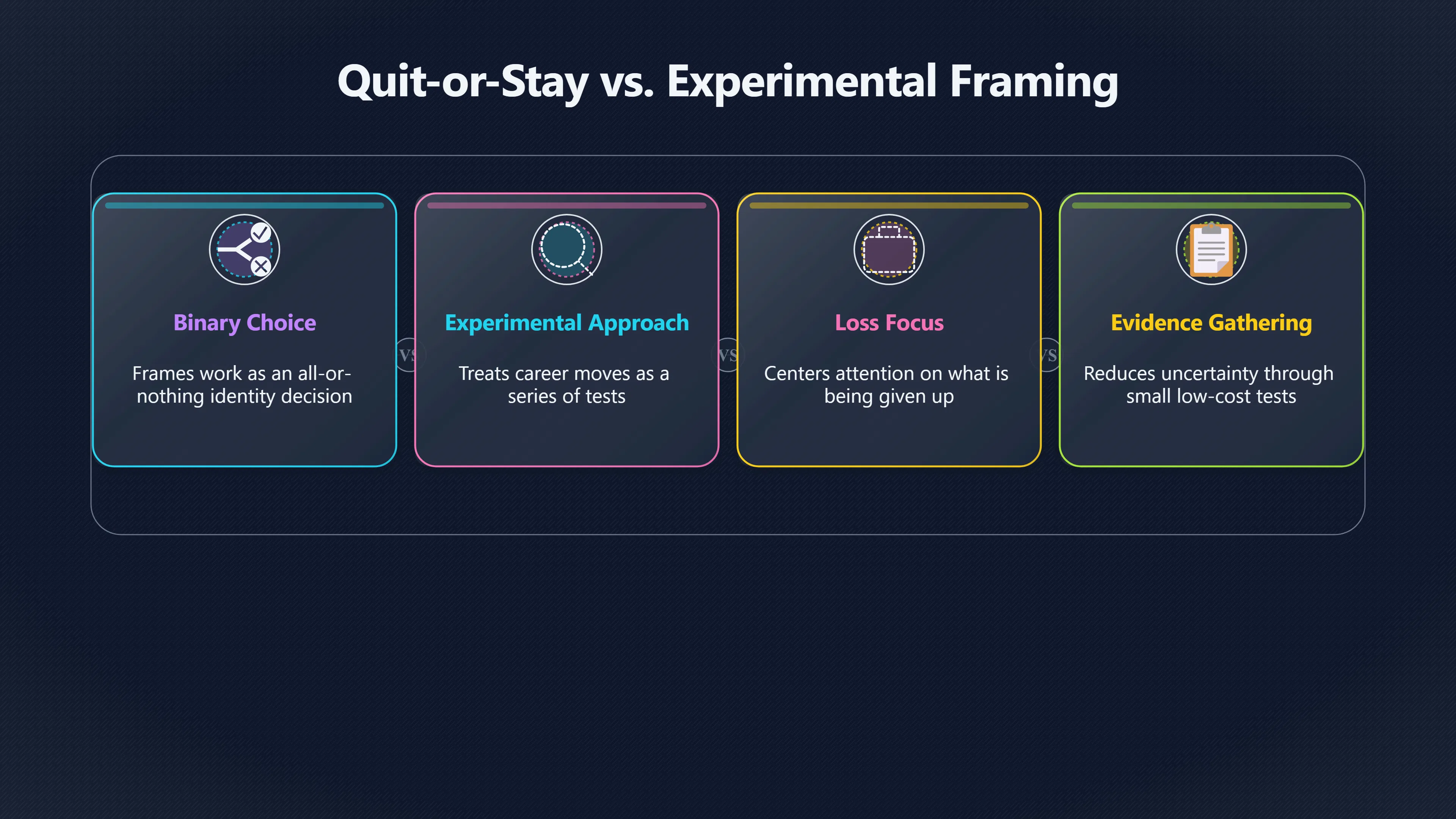
Because the question is framed as a binary choice, attention shifts towards defending one side or the other instead of diagnosing the underlying causes. This creates several thinking traps:
- Identity fusion: “If I leave this job, I am abandoning my career.”
- Loss focus: attention centres on what would be given up rather than what could be learned.
- Premature certainty: people feel pressure to predict years of future satisfaction without collecting new evidence.
- Single-cause thinking: multiple frustrations are treated as one problem requiring one solution.
Experiment framing separates these issues. Instead of asking whether to abandon a career, it asks what information is missing and how that information could be obtained safely.
Small reversible tests that reduce uncertainty
Career experiments are deliberately modest. Their purpose is not to prove that a major change will succeed but to discover whether a particular hypothesis survives contact with reality.
For example:
HypothesisUseful experiment”I dislike software development.”Spend several weeks contributing to a different type of project or technology before concluding the profession is the problem.”Management is more satisfying than technical work.”Lead a temporary initiative, mentor colleagues or cover for a manager during leave.”I need a different industry.”Conduct informational interviews, attend sector events or complete short freelance work within another field.”Remote work is making me unhappy.”Negotiate a temporary hybrid arrangement before assuming the employer or profession must change.”I want more meaningful work.”Volunteer for customer-facing, social-impact or cross-functional projects inside the existing organisation.
These experiments are valuable because they preserve future options. They generate experience rather than relying entirely on imagination.
Research on job crafting shows that employees can proactively reshape aspects of their work by seeking new challenges, building resources, changing relationships or reframing how they understand their role. Longitudinal and intervention studies suggest that constructive forms of job crafting are associated with higher engagement, better performance and greater career satisfaction.[Pure+2Onderhouden]pure.tue.nlPure The value of job crafting for work engagement, taskby L Dubbelt · 2019 · Cited by 366 — The value of job crafting for work engagement, task performance, and career satisfaction: longit…
Importantly, experimenting does not mean indefinitely tolerating harmful workplaces. If there is serious harassment, discrimination, unsafe conditions or sustained abuse, the appropriate response may be to leave rather than optimise. Experiment framing is most useful when uncertainty—not immediate danger—is the central problem.
Test one variable at a time
Experiments become difficult to interpret if everything changes simultaneously.
Suppose someone resigns, relocates to another city, changes profession and begins self-employment within the same month. If life improves—or deteriorates—it becomes impossible to know which change mattered most.
A stronger design changes one important variable while holding others relatively constant. Examples include:
- changing teams while remaining in the same company;
- reducing working hours before changing careers;
- trying consultancy alongside full-time employment;
- completing professional training before deciding whether a field genuinely fits.
This resembles scientific experimentation: isolate the factor you are trying to understand.
Use job crafting before assuming career failure
Many career frustrations arise because the job has gradually drifted away from a person’s strengths, interests or values rather than because the occupation itself is fundamentally unsuitable.
Job crafting provides several practical ways to test this possibility:
- Task crafting: increasing work that develops valued skills while reducing unnecessary activities where possible.
- Relationship crafting: seeking different collaborators, mentors or clients.
- Challenge crafting: volunteering for assignments that increase learning rather than routine repetition.
- Cognitive crafting: deliberately reconnecting everyday work with its wider purpose or beneficiaries.
These changes are experiments rather than permanent commitments. If meaningful improvements occur, the original quit-or-stay question may dissolve because the role itself has evolved.
Research also suggests a more nuanced picture. Employees who actively seek challenge through job crafting sometimes become more likely to leave—not because crafting failed, but because the process clarified that their ambitions exceed what the organisation can offer. In that sense, experimentation may produce either renewed commitment or justified departure. Both outcomes represent better-informed decisions.[Utrecht University]research-portal.uu.nlUtrecht University From job crafting to job quitting?Testing a wise proactivity…by TL Junker · 2023 · Cited by 22 — Purpose: This study investigates when and for whom job crafting may tur…
How to read results without overreacting
Experiments only improve decisions if their results are interpreted carefully.
One positive week does not prove a career has been rescued, just as one frustrating networking conversation does not prove another profession is unsuitable.
Instead, look for consistent patterns across several questions:
- Has energy improved?
- Is curiosity returning?
- Are difficult days becoming more manageable?
- Do the frustrations involve the same underlying cause?
- Would repeating this experiment probably produce similar results?
The goal is not emotional certainty but progressively better evidence.
It is also useful to distinguish signal from noise. Temporary deadlines, organisational restructuring or personal stress can distort impressions. A career experiment should usually last long enough for routine work—not only exceptional circumstances—to be experienced.

When experiments indicate it is time to leave
Experiments sometimes confirm that the original intuition was correct.
Signs that repeated experiments point towards leaving include:
- different teams produce the same unhealthy patterns;
- workload adjustments do not reduce chronic exhaustion;
- learning opportunities remain consistently blocked;
- values repeatedly conflict with organisational behaviour;
- alternative projects feel consistently more engaging than the current role.
Notice that the decision is now supported by accumulated observations rather than a single emotional moment.
The psychological difference is important. Instead of concluding, “I suddenly decided to quit,” the reasoning becomes, “I tested several plausible explanations, ruled out simpler causes and found consistent evidence that a different role is likely to fit better.”
Building a habit of experimental career thinking
Viewing careers as experiments encourages a broader mindset of continuous learning rather than permanent identity commitments.
Instead of treating every career move as an irreversible declaration about who you are, it becomes easier to ask practical questions:
- What assumption am I trying to test?
- What is the smallest experiment that could answer it?
- What evidence would change my mind?
- Which options remain open if this experiment fails?
This approach reduces the pressure to predict an uncertain future perfectly. More importantly, it replaces speculative thinking with deliberate evidence gathering. Within the broader study of framing effects, that is the central shift: from seeing careers as binary commitments to seeing them as sequences of informative, increasingly confident decisions.
eBay marketplace picks
Marketplace Samples
Topic-anchored marketplace searches for visual, collectible, or second-hand items related to this page.


Endnotes
1.
Source: research-portal.uu.nl
Title: Utrecht University From job crafting to job quitting?
Link:https://research-portal.uu.nl/en/publications/from-job-crafting-to-job-quittingtesting-a-wise-proactivity-persp/
Source snippet
Testing a wise proactivity...by TL Junker · 2023 · Cited by 22 — Purpose: This study investigates when and for whom job crafting may tur...
2.
Source: pure.tue.nl
Title: Pure The value of job crafting for work engagement, task
Link:https://pure.tue.nl/ws/files/127350950/The_value_of_job_crafting_for_work_engagement_task_performance_and_career_satisfaction_longitudinal_and_quasi_experimental_evidence.pdf
Source snippet
by L Dubbelt · 2019 · Cited by 366 — The value of job crafting for work engagement, task performance, and career satisfaction: longit...
3.
Source: isonderhouden.nl
Link:https://www.isonderhouden.nl/doc/pdf/arnoldbakker/articles/articles_arnold_bakker_395.pdf
Source snippet
OnderhoudenJob crafting and job performance: A longitudinal studyby M Tims · 2014 · Cited by 774 — The findings suggest that employees ca...
4.
Source: research-portal.uu.nl
Link:https://research-portal.uu.nl/files/70515417/Demerouti.pdf
Source snippet
Utrecht UniversityJob Crafting Interventions: Do They Work and Why?by E Demerouti · 2019 · Cited by 113 — The goals of this chapter are (...
Additional References
5.
Source: researchgate.net
Title: Research Gate(PDF) From job crafting to job quitting?
Link:https://www.researchgate.net/publication/374041615_From_job_crafting_to_job_quitting_Testing_a_wise_proactivity_perspective
Source snippet
Testing a wise...10 Oct 2023 — Purpose This study investigates when and for whom job crafting may turn into job quitting. The authors hy...
6.
Source: research.vu.nl
Title: job crafting theory and perspectives
Link:https://research.vu.nl/en/publications/job-crafting-theory-and-perspectives/
Source snippet
Crafting Theory and Perspectivesby M Tims · 2025 — Job crafting refers to self-initiated changes that employees proactively make to their...
7.
Source: arno.uvt.nl
Link:https://arno.uvt.nl/show.cgi?fid=147431
Source snippet
crafting, job crafting interventions and their successfulnessby N Schrijver · 2018 — Job crafting is a relatively new concept with many p...
8.
Source: youtube.com
Title: Stanford Webinar
Link:https://www.youtube.com/watch?v=qOwAkE0Sdbg
Source snippet
You Don't Need to Quit Your Job (You're Just Thinking About It Wrong)...
9.
Source: pmc.ncbi.nlm.nih.gov
Link:https://pmc.ncbi.nlm.nih.gov/articles/PMC8187622/
Source snippet
Career Crafting Training Program: Results of an Intervention...by EH van Leeuwen · 2021 · Cited by 36 — This intervention study examined...
10.
Source: youtube.com
Title: Three design-inspired tools for making big life decisions
Link:https://www.youtube.com/watch?v=B2CUmjiaPW0
Source snippet
Stanford Webinar - Design Your Life: Part II: Prototypes for Personal Success...
11.
Source: repository.tilburguniversity.edu
Link:https://repository.tilburguniversity.edu/bitstreams/557359ad-59d3-4b75-a417-ca007d42f2c6/download
Source snippet
Purpose – This study investigates when and for whom job crafting may turn into job quitting. The authors hypothesize that approach job cr...
12.
Source: youtube.com
Title: Designing Your Life
Link:https://www.youtube.com/watch?v=ZPjoCO5Juj0
Source snippet
How to Quit Your Job (and Find Work You Actually Love)...
13.
Source: youtube.com
Title: You Don’t Need to Quit Your Job (You’re Just Thinking About It Wrong)
Link:https://www.youtube.com/watch?v=9FOhrZDYSlE
Source snippet
Designing Your Life - Bill Burnett...
14.
Source: youtube.com
Title: How to Quit Your Job (and Find Work You Actually Love)
Link:https://www.youtube.com/watch?v=0j3SW7R40SU
Topic Tree