Within Lateral Reading
Why the first search result is not enough
Better lateral reading starts by scanning search results carefully instead of clicking the first familiar or agreeable link.
On this page
- Read domains and snippets before clicking
- Choose sources with knowledge and accountability
- Avoid search paths that reward confirmation bias
Page outline Jump by section
Introduction
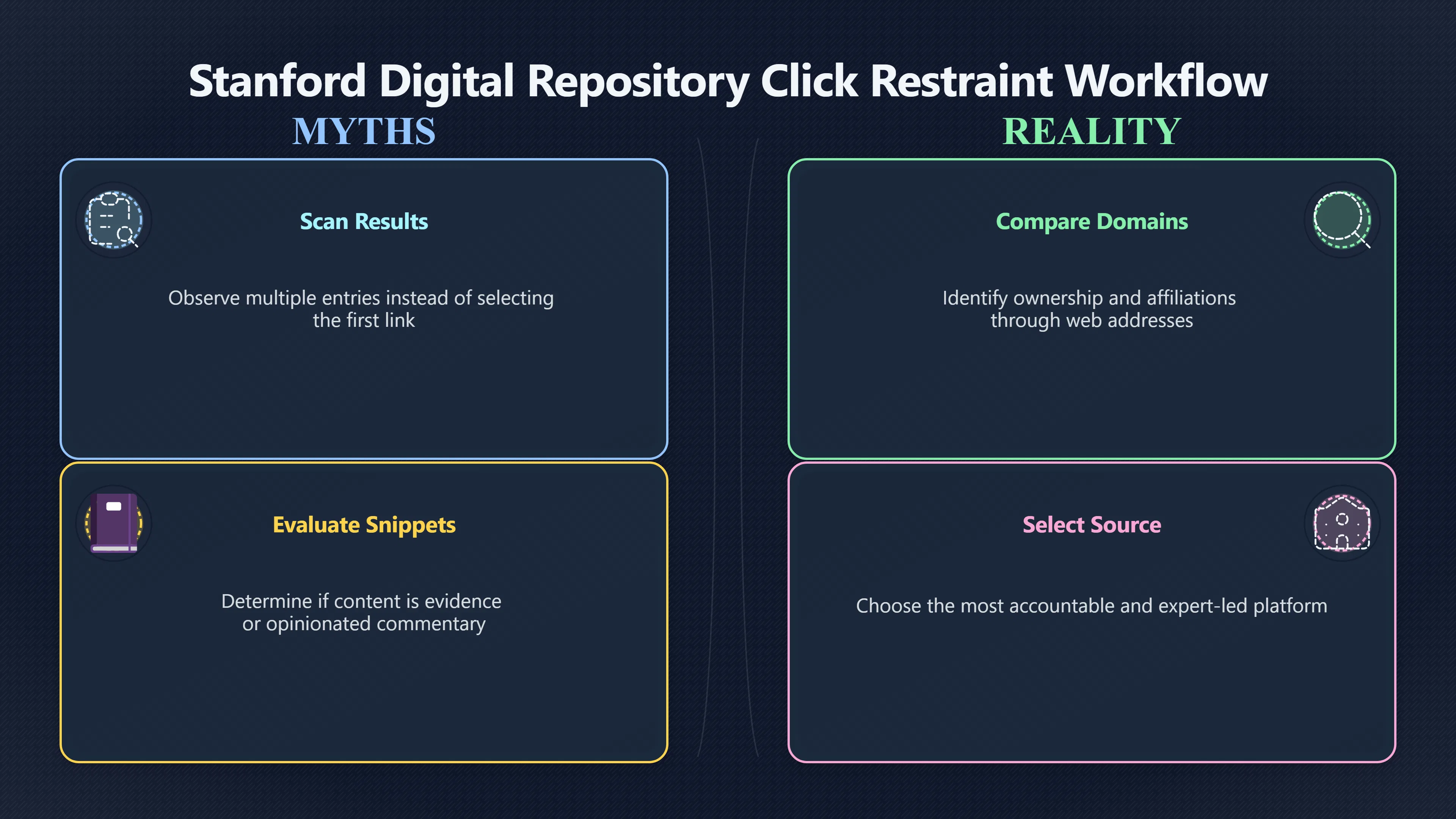
When checking whether a website or claim is trustworthy, one of the most valuable habits is to delay your first click. This practice, often called click restraint, means treating the search results page as a source of information rather than simply a menu of links. Instead of selecting the first familiar-looking result, you pause to compare domains, read snippets, and look for signs that a source has relevant expertise or independent knowledge. Professional fact-checkers consistently use this approach because it helps them reach more accurate conclusions without spending more time reading unreliable pages. [Stanford Digital Repository]stacks.stanford.eduDigital Repository Lateral Reading and the Nature of ExpertiseStanford Digital RepositoryLateral Reading and the Nature of Expertise - Stacks28 Jul 2018 — Click restraint stands in contrast to whimsi…
 Click restraint is a small behavioural change, but it supports the broader practice of lateral reading. Rather than allowing a search engine’s ranking to determine what you read first, you make an active decision about which sources deserve your attention.
Why the first search result is not enough
Search engines rank pages using hundreds of signals, including relevance to the query, popularity, freshness and technical optimisation. A high ranking does not guarantee that a page is the most authoritative, neutral or evidence-based source for your purpose. Well-funded organisations, skilled search engine optimisation (SEO), and strong brand recognition can all influence visibility without guaranteeing reliability. [Stanford Digital Repository]stacks.stanford.eduDigital Repository Lateral Reading and the Nature of ExpertiseStanford Digital RepositoryLateral Reading and the Nature of Expertise - Stacks28 Jul 2018 — Click restraint stands in contrast to whimsi…
Research comparing professional fact-checkers with historians and university students illustrates this difference. Students often clicked one of the first results almost immediately. Fact-checkers, by contrast, paused to examine several results before choosing where to begin. That brief delay often led them towards independent reporting or recognised reference sources instead of advocacy pages or organisations describing themselves. [Stanford Digital Repository]stacks.stanford.eduDigital Repository Lateral Reading and the Nature of ExpertiseStanford Digital RepositoryLateral Reading and the Nature of Expertise - Stacks28 Jul 2018 — Click restraint stands in contrast to whimsi…
The point is not to distrust highly ranked pages. Many deserve their position. The point is to avoid assuming that ranking itself is evidence of credibility.
Read domains and snippets before clicking
The search results page contains more information than many users realise. Before opening any result, quickly compare several entries.
Look for clues such as:
- The organisation behind the page. Is it an official agency, university, established news organisation, professional association or an unfamiliar group?
- The web address. The domain often reveals ownership or affiliation more clearly than the page title.
- The search snippet. Snippets frequently indicate whether a page is reporting evidence, expressing an opinion, selling a product or promoting a campaign.
- Multiple perspectives. If the first page of results contains a mix of official documents, reporting, research and commentary, consider which source is most appropriate for the specific question.
Professional fact-checkers often spend several seconds reading these elements before opening anything. This simple pause helps prevent being drawn into a persuasive but unverified source. [Stanford Digital Repository]stacks.stanford.eduDigital Repository Lateral Reading and the Nature of ExpertiseStanford Digital RepositoryLateral Reading and the Nature of Expertise - Stacks28 Jul 2018 — Click restraint stands in contrast to whimsi…
Choose sources with knowledge and accountability
Click restraint is not about finding a source that agrees with you. It is about selecting sources that have a reason to know and are accountable for what they publish.
For example:
- For medical questions, begin with recognised public health organisations, major medical institutions or peer-reviewed reviews rather than commercial supplement websites.
- For legal or government matters, official documents or court records are generally stronger starting points than blogs discussing them.
- For breaking news, established news organisations with named reporters and corrections policies usually provide more accountable reporting than anonymous social media posts.
- For scientific claims, look for universities, recognised research organisations or journals before turning to commentary.
The search results page often makes these distinctions visible before you click. A government domain, university website or respected news outlet may appear alongside promotional pages covering the same topic. Exercising restraint allows you to make that comparison deliberately. [Butler University Libraries]libguides.butler.eduUniversity Libraries Initial MovesButler University LibrariesInitial Moves - Evaluating Online Sources: A Toolkit19 Dec 2025 — Fact checkers exercise click restraint: they…

Avoid search paths that reward confirmation bias
One reason click restraint matters is that people naturally prefer information supporting what they already believe. If the first search result appears to confirm an existing opinion, it is tempting to stop searching altogether. This reinforces confirmation bias rather than testing the claim. [Wikipedia]WikipediaConfirmation biasConfirmation bias
A more reliable approach is to ask:
- Does another credible source independently support this claim?
- Is there an official or primary source available?
- Are reputable sources reporting important disagreements or limitations?
- Have I only clicked results that reinforce what I expected to find?
Even spending an extra twenty seconds scanning additional results can redirect the search towards stronger evidence instead of the easiest answer.
A practical example
Imagine searching for information about a controversial policy proposal.
The first result belongs to an advocacy organisation directly involved in the debate. The second is an official government publication explaining the proposal. The third is reporting from an established news organisation summarising the arguments from multiple sides. The fourth links to academic research evaluating similar policies.
Without click restraint, you might immediately enter the advocacy site’s framing and spend several minutes reading it before discovering its perspective.
With click restraint, you notice from the search results themselves that different types of sources are available. You can begin with the official document or independent reporting, then return to the advocacy material with better context.
This does not eliminate bias, but it reduces the chance that your first click determines your entire understanding.
Small habit, large effect
Click restraint requires almost no extra time. It replaces an automatic click with a brief evaluation of the search results page itself.
The habit works because it changes the order of decisions:
- Scan several results.
- Compare domains and snippets.
- Choose the source most likely to have relevant expertise or accountability.
- Continue checking across independent sources if the issue is important.
Research on lateral reading suggests that this sequence mirrors the behaviour of experienced professional fact-checkers. They are not necessarily better because they read more carefully within a page, but because they make better decisions before committing to one. By resisting the impulse to click the first familiar or agreeable result, they improve the quality of the information that shapes every later judgement. [Stanford Digital Repository+2SSRN]stacks.stanford.eduDigital Repository Lateral Reading and the Nature of ExpertiseStanford Digital RepositoryLateral Reading and the Nature of Expertise - Stacks28 Jul 2018 — Click restraint stands in contrast to whimsi…
eBay marketplace picks
Marketplace Samples
Live-tested eBay searches with available results related to this page.



Endnotes
-
Source: stacks.stanford.edu
Title: Digital Repository Lateral Reading and the Nature of Expertise
Link: https://stacks.stanford.edu/file/druid%3Ayk133ht8603/Wineburg%20McGrew_Lateral%20Reading%20and%20the%20Nature%20of%20Expertise.pdfSource snippet
Stanford Digital RepositoryLateral Reading and the Nature of Expertise - Stacks28 Jul 2018 — Click restraint stands in contrast to whimsi...
-
Source: papers.ssrn.com
Link: https://papers.ssrn.com/sol3/papers.cfm?abstract_id=3048994Source snippet
Less and Learning More When Evaluating Digital...by S Wineburg · 2019 · Cited by 88 — In contrast, fact checkers read laterally, leaving...
-
Source: libguides.butler.edu
Title: University Libraries Initial Moves
Link: https://libguides.butler.edu/evaluatingonlinesourcesSource snippet
Butler University LibrariesInitial Moves - Evaluating Online Sources: A Toolkit19 Dec 2025 — Fact checkers exercise click restraint: they...
-
Source: Wikipedia
Title: Confirmation bias
Link: https://en.wikipedia.org/wiki/Confirmation_bias
Additional References
-
Source: hendrix.edu
Link: https://www.hendrix.edu/uploadedFiles/Academics/Faculty_Resources/Teaching_and_Learning/EvaluatingDigitalInformation.pdfSource snippet
Hendrix Collegereading less and learning more when evaluating digital...Exhibiting what we call click restraint, she spent nearly 20 sec...
-
Source: youtube.com
Link: https://www.youtube.com/watch?v=ih4dY9i9JKESource snippet
Intro to Lateral Reading - Teaching Online Fact-Checking...
-
Source: poynter.org
Title: Feeling overwhelmed by search results?
Link: https://www.poynter.org/fact-checking/media-literacy/2023/what-is-click-restraint/Source snippet
Use click restraint...20 Sept 2023 — Click restraint is the act of not engaging with the very first results you see when conducting an o...
-
Source: pmc.ncbi.nlm.nih.gov
Link: https://pmc.ncbi.nlm.nih.gov/articles/PMC8981191/Source snippet
Lateral reading and monetary incentives to spot disinformation...by F Panizza · 2022 · Cited by 75 — Lateral reading and click restra...
-
Source: youtube.com
Title: How to Find Better Information Online: Click Restraint
Link: https://www.youtube.com/watch?v=gbPEiCGxVVYSource snippet
Check Yourself with Lateral Reading: Crash Course Navigating Digital Information #3...
-
Source: youtube.com
Title: Click Restraint: Crash Course Navigating Digital Information #9
Link: https://www.youtube.com/watch?v=5tw44SkkXQgSource snippet
How to Find Better Information Online: Click Restraint...
-
Source: youtube.com
Title: Intro to Lateral Reading
Link: https://www.youtube.com/watch?v=as1IzVljNAwSource snippet
Sarah McGrew - "How Do We Know What's True Anymore"...
-
Source: guides.lib.uiowa.edu
Link: https://guides.lib.uiowa.edu/c.php?g=849536&p=6077640Source snippet
Online Information: Lateral Reading - Guides24 Nov 2025 — One strategy that we can use is "lateral reading." Good lateral readers use the...
-
Source: libguides.marian.edu
Link: https://libguides.marian.edu/c.php?g=957928&p=8702722Source snippet
Resources: Click Restraint - LibGuides1 Dec 2022 — Fact checkers exercise click restraint: they recognize that some sources may not be th...
-
Source: youtube.com
Link: https://www.youtube.com/watch?v=Xr4FCiWRLccSource snippet
ring 24 Spotlight Series...
Topic Tree