Within Sharper Thinking
What Are You Giving Up?
Better analysis asks what you gain, what you give up, and which outcome matters most.
On this page
- Why good options still have costs
- Choosing the outcome that matters
- Comparing tradeoffs without false precision
Page outline Jump by section
Introduction
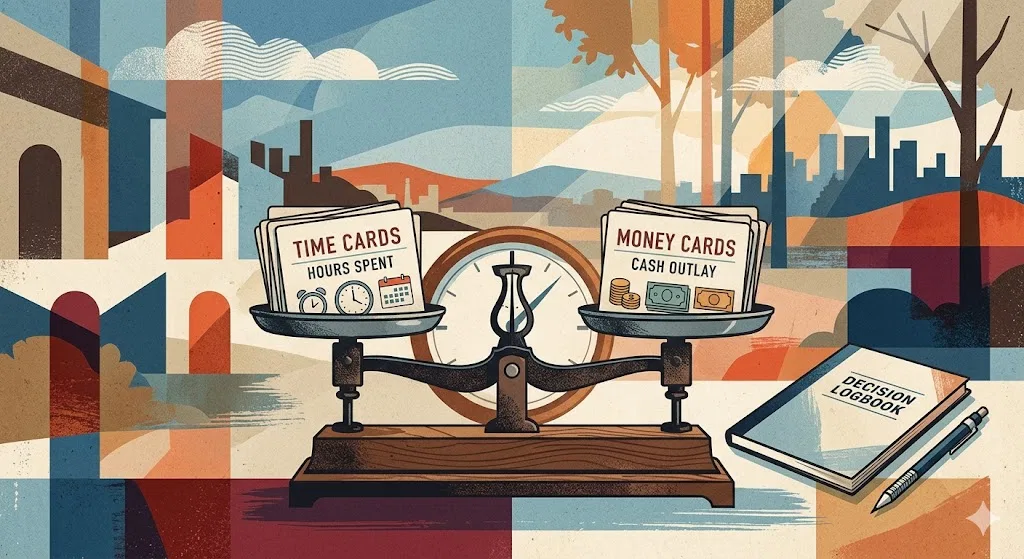
Tradeoff thinking is the habit of asking, “What am I giving up to get this?” It improves analytical skill because realistic choices rarely offer one option that is better on every dimension. A cheaper flat may mean a longer commute. A faster project plan may mean more defects or more stress. A safer policy may cost more money, time or flexibility. The point is not to make every decision mathematical; it is to make the sacrifice visible before you commit. Opportunity cost is the value of the next-best alternative you give up when choosing, and it is central to clear decision-making because scarcity forces choices between competing uses of time, money and attention. [Federal Reserve Education]federalreserveeducation.orgFederal Reserve Education Opportunity CostFederal Reserve EducationOpportunity CostMarch 2, 2026 — Opportunity cost is the value of the next best alternative when someone makes a…
Good tradeoff thinking asks three questions: what outcomes matter, which option advances them, and what cost or risk you are accepting in return. This is different from a simple pros-and-cons list, which can make a long column of minor advantages look more important than one decisive drawback. Structured approaches such as multi-criteria decision analysis are useful when several objectives conflict, but their value lies in clarifying judgement, not pretending uncertainty has disappeared. [analysisfunction.civilservice.gov.uk]analysisfunction.civilservice.gov.ukan introductory guide to mcdaAn Introductory Guide to Multi-Criteria Decision Analysis…1 May 2024 — MCDA is a way of helping decision-makers rationally choose betw…
Why good options still have costs
A common thinking error is treating “good” as if it means “cost-free”. In real decisions, an option can be good and still require a painful sacrifice. A job offer might bring higher pay but reduce autonomy. A university course might be prestigious but poorly matched to the way you learn. A business software tool might save time in one team while increasing complexity for another. Tradeoff thinking starts from the premise that the important question is rarely “Is this good?” but “Good compared with what, and at what cost?”
Economics gives this idea a simple name: opportunity cost. The cost of choosing one path includes the value of the best path not taken, not just the cash spent. The Federal Reserve’s educational materials define opportunity cost as what someone gives up when making a choice; the St Louis Fed similarly frames it as the value of the next-best alternative. [Federal Reserve Education]federalreserveeducation.orgFederal Reserve Education Opportunity CostFederal Reserve EducationOpportunity CostMarch 2, 2026 — Opportunity cost is the value of the next best alternative when someone makes a… That definition matters because many everyday mistakes come from counting visible costs while ignoring displaced alternatives. A meeting that is “only thirty minutes” may still be expensive if it interrupts deep work. A bargain purchase may not be cheap if it consumes storage, maintenance and attention.
This is why realistic analysis often sounds less exciting than motivational advice. “You can have anything” is sometimes true; “you can have everything at once” usually is not. Herbert Simon’s work on bounded rationality challenged the image of decision-makers who can gather all information and optimise perfectly. Instead, people and organisations make choices under limits of information, time, attention and institutional constraint. [Investopedia]investopedia.comHerbert A. Simon: Nobel Economist & AI Pioneer in Bounded RationalitySimon’s work challenged traditional economic views of a fully rational "economic man" and emphasized the social and institutional constra… Tradeoff thinking accepts those limits and asks for the best usable comparison, not an impossible search for the perfect answer.
The practical shift is to name the sacrifice in the same sentence as the benefit:
- “This option gives us speed, but we are giving up testing time.”
- “This option gives me flexibility, but I am giving up predictable income.”
- “This option gives the customer more choice, but we are giving up simplicity.”
- “This option reduces short-term risk, but we are giving up potential upside.”
That wording prevents vague optimism from hiding the bill. It also makes disagreement easier to handle. Two people may both understand the facts and still choose differently because they value the tradeoff differently.
Choosing the outcome that matters
Tradeoffs are confusing when every outcome is treated as equally important. Better analysis begins by separating must-haves from preferences, and preferences from nice extras. In multi-criteria decision analysis, the reason for using a structured method is precisely that decisions often involve several conflicting objectives, mixed types of evidence and different stakeholder views. The UK Civil Service guide describes MCDA as a way to choose between options where several objectives conflict and cannot be compared directly. [analysisfunction.civilservice.gov.uk]analysisfunction.civilservice.gov.ukan introductory guide to mcdaAn Introductory Guide to Multi-Criteria Decision Analysis…1 May 2024 — MCDA is a way of helping decision-makers rationally choose betw…
For personal decisions, the same logic can be used without technical language. Before comparing options, decide what kind of success you are actually trying to protect. A flat search might involve rent, commute, safety, space, noise and access to friends. But not all of those belong in the same category. Some may be thresholds: “I will not choose somewhere unsafe.” Some may be primary outcomes: “I need the commute to be manageable five days a week.” Others may be preferences: “A larger kitchen would be nice.” A decision becomes clearer when you stop letting small preferences compensate for violating a core requirement.
Public decision-making offers a useful concrete example. The UK Treasury Green Book, the government’s guidance on appraisal, defines appraisal as assessing the costs, benefits and risks of different options for achieving objectives. It does not set the political objective; it provides a framework for comparing ways to achieve it. [GOV.UK]assets.publishing.service.gov.ukUK The Green Book – UK government guidance on appraisalUK The Green Book – UK government guidance on appraisal That distinction is powerful for ordinary thinking too. Analysis cannot tell you what to care about most until you state the goal. It can, however, show whether your chosen option actually serves that goal.
A simple implementation routine is:
- State the decision as a choice between options. “Should I move?” is less useful than “Should I stay where I am, move closer to work, or move to a cheaper area?”
- Name the main outcome. Is the priority saving money, reducing stress, building a career, protecting health, improving relationships or preserving flexibility?
- Set non-negotiable thresholds. These are conditions an option must meet before it can compete.
- Compare the serious contenders. Do not spend equal energy on options that already fail the thresholds.
- Say the tradeoff aloud. “I am choosing lower rent over shorter commute” is clearer than “This place feels like a better deal.”
The central benefit is not that you become perfectly objective. It is that you stop smuggling your priorities into the decision unnoticed.
When more options make tradeoffs harder
More choice feels as though it should improve decisions, but it can also make tradeoffs mentally heavier. Research on choice overload examines cases where larger option sets produce difficulty choosing, reduced satisfaction or avoidance. A 2024 review describes choice overload as the negative consequences that can follow from too many options, while also noting that effects depend on moderators such as task complexity and preference uncertainty. [PMC]pmc.ncbi.nlm.nih.govOpen source on nih.gov.
This matters for tradeoff thinking because the burden is not just the number of options. It is the number of comparisons between dimensions. Choosing between two laptops is manageable if one is better and cheaper. It becomes harder when one has better battery life, another has a better screen, a third is lighter, a fourth is cheaper, and the reviews disagree about reliability. The difficulty comes from cross-dimensional sacrifice: you cannot resolve the choice by finding the option with the most positives.
Decision fatigue adds another warning. A conceptual analysis in Psychology Research and Behaviour Management reports that people experiencing decision fatigue show impaired ability to make tradeoffs and may prefer a more passive role in decision-making. [PMC]pmc.ncbi.nlm.nih.govPMCDecision Fatigue: A Conceptual AnalysisPMCDecision Fatigue: A Conceptual Analysis In practical terms, the mind under load often seeks relief: defaulting, delaying, copying someone else’s choice or over-weighting the easiest feature to compare. That can be sensible for low-stakes decisions, but risky when the decision deserves attention.
The antidote is not to research forever. It is to reduce the comparison to the few tradeoffs that could realistically change the answer. For example:
- When choosing a course, compare teaching quality, cost, completion likelihood and career relevance; do not drown the decision in every brochure detail.
- When choosing a project plan, compare delivery date, quality risk, team load and strategic value; do not let a polished slide deck substitute for the real constraints.
- When choosing a purchase, compare total cost, reliability, fit for use and return options; do not treat every feature as equally meaningful.
This is where satisficing can be a strength rather than a failure. Simon’s idea of satisficing means choosing an option that is good enough under real constraints rather than searching indefinitely for the theoretical optimum. Studies by Schwartz and colleagues found that people with stronger maximising tendencies reported lower happiness, optimism, self-esteem and life satisfaction, and were less satisfied with some consumer decisions. [PubMed]pubmed.ncbi.nlm.nih.govOpen source on nih.gov. The lesson is not “settle carelessly”. It is “define good enough before the search becomes the problem”.
Comparing tradeoffs without false precision
Decision matrices can help when a choice has several serious criteria. The basic method is simple: list options, list criteria, weight the criteria, score each option, and compare the totals. Used well, this forces hidden assumptions into the open. Used badly, it creates false precision: a spreadsheet says Option B scored 82.7 and Option C scored 81.9, even though the inputs were rough guesses.
This is why structured decision tools should be treated as scaffolding for judgement, not as machines that manufacture certainty. Multi-criteria decision analysis is designed for decisions involving multiple objectives, but even introductory guides stress that it is a way of supporting decision-makers, especially where criteria conflict, perspectives differ or direct comparison is difficult. [analysisfunction.civilservice.gov.uk]analysisfunction.civilservice.gov.ukan introductory guide to mcdaAn Introductory Guide to Multi-Criteria Decision Analysis…1 May 2024 — MCDA is a way of helping decision-makers rationally choose betw… The output is most useful when it reveals what the decision depends on: “This option wins only if we treat speed as much more important than reliability” or “These two options are effectively tied unless cost is weighted heavily.”
A good tradeoff comparison has three safeguards.
First, separate thresholds from scores. Some criteria should not be averaged away. If a car is unsafe, a low price should not rescue it. If a candidate lacks a required qualification, charm should not compensate. Decision matrices can mislead when many minor positives add up to outweigh a must-have requirement.
Second, use ranges where estimates are uncertain. If you do not really know whether implementation will take four weeks or ten, do not score it as though you know it will take exactly six. Sensitivity analysis, widely used in multi-criteria decision work, asks how much the conclusion changes when inputs or weights shift. Recent MCDA research continues to emphasise uncertainty and robustness because rankings can change when weights, data or assumptions change. [Wiley Online Library]onlinelibrary.wiley.comOpen source on wiley.com.
Third, treat close scores as a prompt for discussion, not a verdict. If two options are close, the useful question is not “Which decimal is bigger?” but “What would make us regret this?” The close result may show that either option is reasonable, or that the current criteria are missing something important.
A compact decision matrix can still be useful if it is modest:
CriterionOption AOption BWhat the tradeoff meansCostBetterWorseB must justify extra spendingSpeedWorseBetterA protects budget but delays benefitReliabilityBetterUncertainB carries execution riskFit with main goalModerateStrongThe decision turns on whether fit is worth the cost
This kind of table does not pretend to know more than it knows. It makes the disagreement visible.
The best tradeoff is often the one you can live with
Analytical skill is not only about selecting the highest-scoring option. It is also about choosing an option whose downside you can realistically absorb. A person with unstable income may rationally choose a less exciting but safer commitment. A team already near burnout may reject a high-upside project because the hidden cost is staff exhaustion. A family may choose a smaller home in a better location because the daily commute cost would otherwise be paid in time, sleep and stress.
Health economics shows this logic in a formal setting. NICE, the National Institute for Health and Care Excellence, uses economic evaluation to compare health technologies by considering costs and health outcomes, including quality-adjusted life years in relevant appraisals. [NICE]nice.org.ukOpen source on nice.org.uk. These decisions are difficult because approving one treatment can mean not funding something else within a limited health budget. The example is more formal than everyday life, but the underlying discipline is the same: benefits must be compared with what else the same resources could achieve.
For ordinary decisions, the human version is regret testing. Before choosing, ask:
- What downside am I accepting?
- Can I afford that downside if it happens?
- Which regret would bother me more: missing the upside, or suffering the cost?
- What would I need to monitor after choosing?
- When would I reverse or revise the decision?
These questions keep tradeoff thinking realistic. They also prevent the common trap of judging a decision only by its outcome. A choice can be well reasoned and still turn out badly because the world is uncertain. Conversely, a lucky outcome does not prove the tradeoff was analysed well.

A practical routine for realistic choices
The simplest useful routine is short enough to use before a real decision, not just after reading about decision-making.
1. Write the live options. Include the status quo. “Do nothing” or “wait” is often an option, but it also has costs.
2. State the main outcome. Choose the outcome that matters most for this decision, not in life generally. The right priority for a house move may be stability; for a work project it may be learning, speed, revenue or risk reduction.
3. Name the opportunity cost. For each serious option, write what it gives up. This is the step most people skip.
4. Identify the decisive tradeoff. Most decisions do not turn on ten criteria. They turn on two or three: cost versus quality, speed versus reliability, autonomy versus security, upside versus risk, simplicity versus customisation.
5. Check for false precision. If the comparison depends on guessed numbers, use ranges and ask whether the conclusion still holds.
6. Choose with a review point. For reversible decisions, set a date or signal for reassessment. For hard-to-reverse decisions, spend more effort on assumptions, thresholds and downside protection.
Tradeoff thinking improves analysis because it makes choice honest. It does not remove uncertainty, emotion or judgement. It gives them a clearer place to stand. The better question is not “Which option has no downside?” but “Which downside is worth accepting for the outcome that matters most?”
Amazon book picks
Further Reading
Books and field guides related to What Are You Giving Up?. Use these as the next step if you want deeper reading beyond the article.
Thinking in Bets
Focuses on making better choices under uncertainty and recognizing tradeoffs.
eBay marketplace picks
Marketplace Samples
Live-tested eBay searches with available results related to this page.




Endnotes
-
Source: analysisfunction.civilservice.gov.uk
Title: an introductory guide to mcda
Link: https://analysisfunction.civilservice.gov.uk/policy-store/an-introductory-guide-to-mcda/Source snippet
An Introductory Guide to Multi-Criteria Decision Analysis...1 May 2024 — MCDA is a way of helping decision-makers rationally choose betw...
Published: May 2024
-
Source: investopedia.com
Title: Herbert A. Simon: Nobel Economist & AI Pioneer in Bounded Rationality
Link: https://www.investopedia.com/terms/h/herbert-a-simon.aspSource snippet
Simon’s work challenged traditional economic views of a fully rational "economic man" and emphasized the social and institutional constra...
-
Source: assets.publishing.service.gov.uk
Title: UK The Green Book – UK government guidance on appraisal
Link: https://assets.publishing.service.gov.uk/media/698dbcd17da91680ad7f4308/The_Green_Book_2026.pdf -
Source: GOV.UK
Title: the green book appraisal and evaluation in central government
Link: https://www.gov.uk/government/publications/the-green-book-appraisal-and-evaluation-in-central-government -
Source: pmc.ncbi.nlm.nih.gov
Title: PMCDecision Fatigue: A Conceptual Analysis
Link: https://pmc.ncbi.nlm.nih.gov/articles/PMC6119549/ -
Source: onlinelibrary.wiley.com
Link: https://onlinelibrary.wiley.com/doi/full/10.1002/mcda.70006 -
Source: onlinelibrary.wiley.com
Link: https://onlinelibrary.wiley.com/doi/10.1111/ijcs.13029 -
Source: investopedia.com
Link: https://www.investopedia.com/terms/o/opportunitycost.asp -
Source: federalreserveeducation.org
Title: Federal Reserve Education Opportunity Cost
Link: https://www.federalreserveeducation.org/resources/infographics/infographic–decision-making.pdfSource snippet
Federal Reserve EducationOpportunity CostMarch 2, 2026 — Opportunity cost is the value of the next best alternative when someone makes a...
Published: March 2, 2026
-
Source: pmc.ncbi.nlm.nih.gov
Link: https://pmc.ncbi.nlm.nih.gov/articles/PMC11111947/ -
Source: pubmed.ncbi.nlm.nih.gov
Link: https://pubmed.ncbi.nlm.nih.gov/12416921/ -
Source: nice.org.uk
Link: https://www.nice.org.uk/process/pmg36/chapter/economic-evaluation-2 -
Source: Wikipedia
Title: Bounded rationality
Link: https://en.wikipedia.org/wiki/Bounded_rationality -
Source: Wikipedia
Link: https://en.wikipedia.org/wiki/Satisficing -
Source: federalreserveeducation.org
Link: https://www.federalreserveeducation.org/teaching-resources/economics/scarcity/opportunity-cost -
Source: federalreserveeducation.org
Link: https://www.federalreserveeducation.org/teaching-resources/economics/scarcity/the-production-possibilities-frontier-increasing-opportunity-cost -
Source: federalreserveeducation.org
Link: https://www.federalreserveeducation.org/teaching-resources/economics/scarcity/opportunity-cost-module -
Source: federalreserveeducation.org
Link: https://www.federalreserveeducation.org/teaching-resources/economics/scarcity/the-production-possibilities-frontier-scarcity-and-opportunity-cost -
Source: valueinhealthjournal.com
Link: https://www.valueinhealthjournal.com/article/S1098-3015%2816%2934130-4/pdf -
Source: frontiersin.org
Link: https://www.frontiersin.org/journals/cognition/articles/10.3389/fcogn.2025.1719312/full -
Source: medium.com
Title: Choice Overload
Link: https://medium.com/%40jodiemshaw/choice-overload-6280f9b8bf29 -
Source: monday.com
Title: decision matrix
Link: https://monday.com/blog/project-management/decision-matrix/ -
Source: pubmed.ncbi.nlm.nih.gov
Link: https://pubmed.ncbi.nlm.nih.gov/18767894/
Additional References
-
Source: thedecisionlab.com
Link: https://thedecisionlab.com/reference-guide/psychology/decision-matrix -
Source: youtube.com
Title: What Leaders Should Do When the Work Won’t Fit [Agile]
Link: https://www.youtube.com/watch?v=y-_a4AhEl9kSource snippet
The video How to Make Complex Decisions: Multi-Criteria Decision Analysis (MCDA) provides an analytical framework for identifying and sco...
-
Source: stlouisfed.org
Title: Federal Reserve Bank of St
Link: https://www.stlouisfed.org/open-vault/2020/january/real-life-examples-opportunity-costSource snippet
LouisReal-Life Examples of Opportunity Cost | St. Louis Fed29 Jan 2020 — “Opportunity cost is the value of the next-best alternative when...
-
Source: youtube.com
Title: How to Make Complex Decisions: Multi-Criteria Decision Analysis (MCDA)
Link: https://www.youtube.com/watch?v=XtupFsSf4AMSource snippet
Multi-Criteria Decision Analysis (MCDA) Explained With Real PMP Question...
-
Source: youtube.com
Title: Multi-Criteria Decision Analysis (MCDA) Explained With Real PMP Question
Link: https://www.youtube.com/watch?v=XUXQaVi0XFUSource snippet
What Leaders Should Do When the Work Won't Fit [Agile]...
-
Source: jsbs.scholasticahq.com
Link: https://jsbs.scholasticahq.com/article/36755-when-good-enough-is-not-enough-the-role-of-maximizing-or-satisficing-decision-making-styles-innovation-behavior-and-entrepreneurial-alertness-in -
Source: researchgate.net
Link: https://www.researchgate.net/publication/357695637_An_Analysis_on_the_Impact_of_Choice_Overload_to_Consumer_Decision_Paralysis -
Source: pempal.org
Link: https://www.pempal.org/sites/default/files/event/attachments/uk-green-book_eng.pdf -
Source: ijircst.org
Link: https://www.ijircst.org/DOC/ebch_1461-22.pdf -
Source: york.ac.uk
Link: https://www.york.ac.uk/media/che/documents/papers/researchpapers/CHERP175_HTA_guidance_NICE.pdf
Topic Tree