Within Better Questions
Can Medical Question Tools Improve Everyday Thinking?
PICO turns loose uncertainty into a structured question by separating the people, option, comparison, and outcome.
On this page
- What PICO adds to everyday questions
- When the structure helps outside healthcare
- Where PICO becomes too rigid
Page outline Jump by section
Introduction
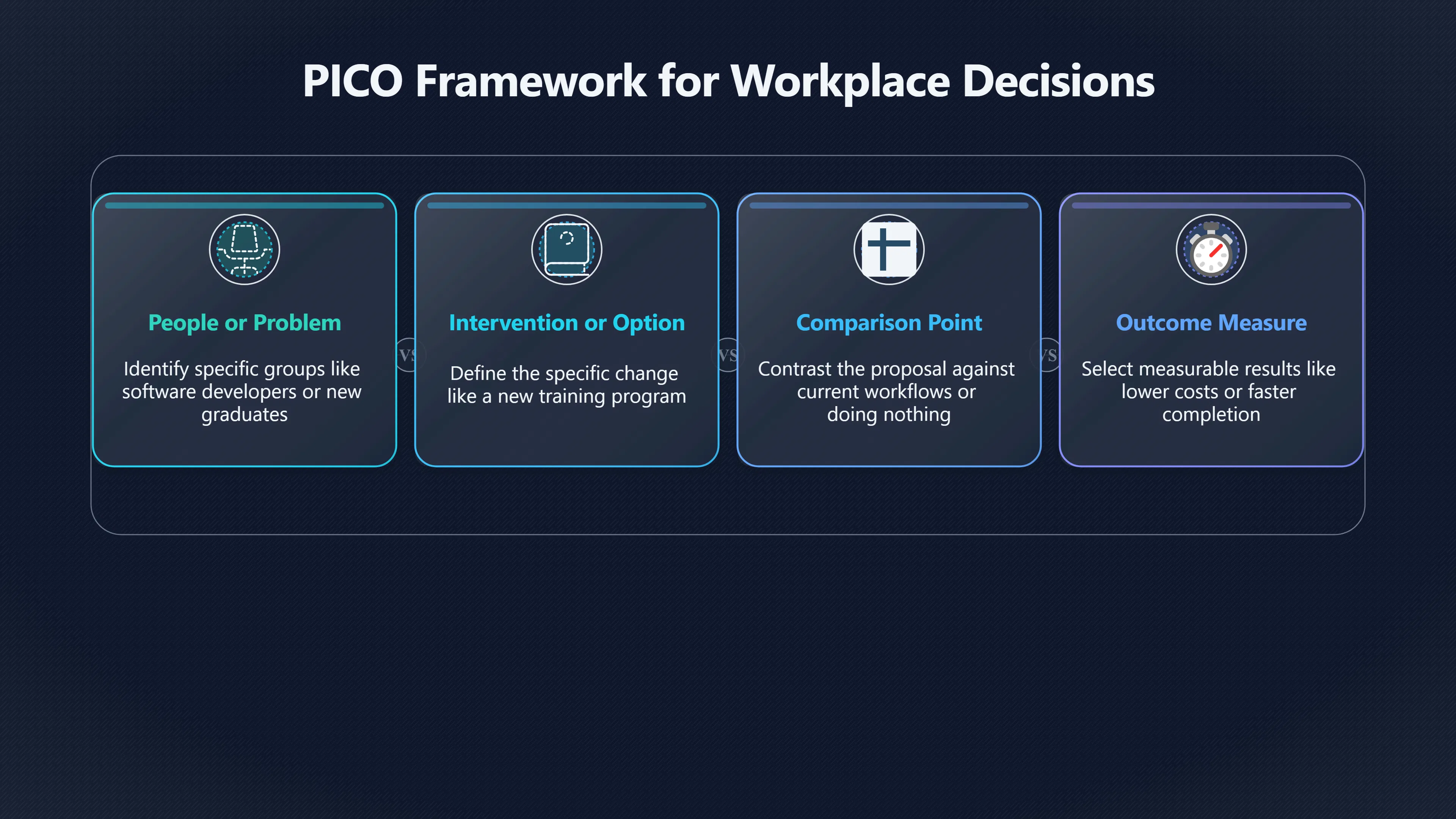
Good thinking starts before you look for answers. One of the most useful ideas borrowed from evidence-based medicine is the PICO framework, which structures a question by identifying the People or Problem, Intervention or Option, Comparison, and Outcome. Although it was developed for clinical decisions, its underlying logic transfers well to workplace choices, learning strategies, policy decisions, and personal projects because it forces vague uncertainties into explicit, testable questions rather than broad opinions. The key is to adapt the language rather than copy medical terminology. Evidence-based organisations increasingly emphasise structured questioning as part of sound decision-making, even outside healthcare. [CIPD+2NICE]cipd.orgEvidence-based practice for effective decision-makingEvidence-based practice for effective decision-makingMay 19, 2025 — Evidence-based practice is an approach for improving decision-mak…

What PICO adds to everyday questions
Outside medicine, PICO is less about finding medical papers and more about improving the quality of thinking before searching for evidence. Each element prevents a different reasoning error.
- People or Problem (P): Who or what decision is being considered? Instead of asking, “Does hybrid working improve productivity?”, specify “software developers in our company” or “new graduates during their first six months”.
- Intervention or Option (I): What change is actually being proposed? This could be a new training programme, a different study method, flexible working, or a budgeting app.
- Comparison (C): Compared with what? Many arguments overlook this step. The relevant comparison may be the current process, another option, or doing nothing.
- Outcome (O): What result matters? Faster completion, lower costs, better retention, fewer mistakes, improved wellbeing, or higher examination scores all represent different outcomes and may point towards different conclusions.
The comparison and outcome are especially valuable because they expose hidden assumptions. A debate that begins with “Which project management software is best?” becomes much more answerable when reframed as: “For small design teams, does software A, compared with our current spreadsheet workflow, reduce missed deadlines over the next six months?” The question now determines which evidence is relevant and which is not. [NICE+2CIPD]nice.org.ukdeveloping review questions and planning the evidence reviewDeveloping NICE guidelines: the manual | Guidance31 Oct 2014 — A helpful structured approach for developing questions about intervent…
This approach also discourages confirmation bias. Once outcomes and comparisons are specified in advance, it becomes harder to cherry-pick favourable anecdotes while ignoring contradictory evidence.
When the structure helps outside healthcare
PICO works best whenever someone is evaluating the effect of one option against another. Many everyday decisions naturally fit this pattern.
Workplace decisions
Suppose a manager wants to introduce weekly team meetings.
Rather than asking:
“Do weekly meetings improve communication?”
a PICO-style question becomes: [journals.lww.com]journals.lww.comce beyond pico a new question simplifies the.19.aspxlww.comCE: Beyond PICO—A New Question Simplifies the Search…by J Waldrop · 2024 · Cited by 29 — This article presents the framework fo…
- Problem: Customer support teams with delayed information sharing.
- Option: Weekly structured meetings.
- Comparison: Existing ad hoc communication.
- Outcome: Reduced customer response times and fewer duplicated tasks after three months.
This structure directs the search towards measurable evidence instead of opinions about meetings in general. It also makes later evaluation much easier because success was defined before implementation.
Evidence-based management organisations encourage decision-makers to combine research evidence with organisational data, professional expertise and stakeholder perspectives rather than relying on intuition alone. Structured questions help organise all four sources of evidence. [CIPD]cipd.orgEvidence-based practice for effective decision-makingEvidence-based practice for effective decision-makingMay 19, 2025 — Evidence-based practice is an approach for improving decision-mak…
Learning and education
Students frequently ask broad questions such as:
“Is note-taking by hand better?”
A more useful version is:
- Problem: First-year university students studying biology.
- Option: Handwritten notes.
- Comparison: Typed notes.
- Outcome: Long-term retention measured in examinations after four weeks.
Even if published evidence remains mixed, the question immediately clarifies what evidence is needed and what counts as success.
Personal decisions
PICO also improves everyday experiments without making them overly scientific.
Instead of:
“Will exercising in the morning help?”
consider:
- Problem: Difficulty maintaining regular exercise.
- Option: Morning workouts.
- Comparison: Evening workouts.
- Outcome: Number of completed sessions over eight weeks.
Notice that the outcome measures adherence rather than weight loss. That distinction matters because the intervention may succeed on one outcome but not another.
Organisational policy
Policy discussions often become stuck because participants mean different things by “better”.
For example:
“Should we allow employees to work remotely?”
can become:
- Problem: Office-based knowledge workers.
- Option: Three remote days each week.
- Comparison: Full-time office attendance.
- Outcome: Productivity, staff retention and customer satisfaction over one year.
The framework does not decide the answer, but it makes disagreements visible by showing whether people disagree about the population, the intervention, the comparison or the desired outcome.
Adapting the language without importing medical jargon
Outside healthcare, the letters remain useful even when renamed.
Many practitioners replace the clinical wording with everyday equivalents:
Traditional PICOEveryday equivalentPopulationPeople affected or situationInterventionOption, action or changeComparisonAlternative or current approachOutcomeResult that matters
This small translation makes the framework feel less technical while preserving its analytical value.
Some users also add a timeframe, producing PICOT, because many practical decisions require specifying when outcomes should be judged. A training programme that appears ineffective after one week may produce meaningful improvements after six months. Timeframes prevent premature conclusions. [PMC]pmc.ncbi.nlm.nih.govBiomedical Research: Formulating a Well-Built and Worth…by Z Bahadoran · 2025 · Cited by 5 — PICOT/PECOT framework describes essent…
Where PICO becomes too rigid
Despite its strengths, PICO is not a universal thinking template.
One limitation is that many important questions are exploratory rather than comparative. If someone asks:
“Why are experienced employees leaving?”
there may be no single intervention or comparison yet. Interviews, observation and qualitative research often begin with open questions instead of testing predefined alternatives.
Critical appraisal guidance therefore notes that PICO is strongest for intervention questions and can fit qualitative or context-sensitive questions less well because it pays relatively little attention to culture, feasibility or lived experience. Alternative frameworks are sometimes preferred for qualitative research. [Casp UK]casp-uk.netpico frameworkIt can be less suitable for other question types (such as qualitative…Read more…
A second limitation is that real-world questions rarely contain every PICO element neatly. Research examining actual clinical questions found that surprisingly few naturally include all four components, suggesting that PICO functions best as a thinking aid rather than a strict template. Forcing every question into four boxes can oversimplify genuine uncertainty. [PMC]pmc.ncbi.nlm.nih.govby X Huang · 2006 · Cited by 1308 — This paper evaluates the adequacy and suitability of PICO frames as a knowledge representation by…
A third limitation is that evidence for PICO as a search tool is more modest than many people assume. Systematic reviews have found relatively little direct evidence that using PICO automatically produces better literature searches than alternative approaches in every situation, although it remains widely valued for clarifying questions before searching. [PMC]pmc.ncbi.nlm.nih.govThe impact of patient, intervention, comparison, outcome…by MB Eriksen · 2018 · Cited by 1680 — This review aimed to determine if t…
Finally, some decisions involve multiple competing outcomes that cannot be reduced to a single measure. Choosing a school, redesigning a city centre or selecting an organisational strategy may require balancing cost, fairness, sustainability, satisfaction and long-term resilience simultaneously. PICO helps define these outcomes, but it cannot resolve value judgements between them.
A practical way to use PICO without overcomplicating thinking
Outside medicine, PICO works best as a quick discipline rather than a formal procedure.
Before searching for evidence, ask four questions:
- Who exactly is affected?
- What change or option am I evaluating?
- What is the realistic alternative?
- Which result will determine whether the option succeeds?
If those questions can be answered clearly, evidence gathering becomes more focused and disagreements become easier to analyse. If they cannot, the problem may not yet be ready for comparison, signalling that exploratory questioning should come first.
Used this way, PICO is less a medical tool than a practical method for turning uncertain decisions into questions that evidence can genuinely address.
Amazon book picks
Further Reading
Books and field guides related to Can Medical Question Tools Improve Everyday Thinking?. Use these as the next step if you want deeper reading beyond the article.
The Pyramid Principle
Demonstrates how to organize questions, arguments, and evidence into clear logical structures.
Super Thinking
Shows structured frameworks for making better decisions beyond any single discipline.
How to Read a Paper
Provides the evidence-based medicine context in which PICO-style question formulation is commonly used.
The Art of Thinking Clearly
Complements structured questioning by explaining cognitive biases and clearer everyday reasoning.
eBay marketplace picks
Marketplace Samples
Topic-anchored marketplace searches for visual, collectible, or second-hand items related to this page.


Endnotes
-
Source: cipd.org
Title: Evidence-based practice for effective decision-making
Link: https://www.cipd.org/uk/knowledge/factsheets/evidence-based-practice-factsheet/Source snippet
Evidence-based practice for effective decision-makingMay 19, 2025 — Evidence-based practice is an approach for improving decision-mak...
Published: May 19, 2025
-
Source: nice.org.uk
Title: developing review questions and planning the evidence review
Link: https://www.nice.org.uk/process/pmg20/chapter/developing-review-questions-and-planning-the-evidence-reviewSource snippet
Developing NICE guidelines: the manual | Guidance31 Oct 2014 — A helpful structured approach for developing questions about intervent...
-
Source: pmc.ncbi.nlm.nih.gov
Link: https://pmc.ncbi.nlm.nih.gov/articles/PMC12127988/Source snippet
Biomedical Research: Formulating a Well-Built and Worth...by Z Bahadoran · 2025 · Cited by 5 — PICOT/PECOT framework describes essent...
-
Source: casp-uk.net
Title: pico framework
Link: https://casp-uk.net/pico-framework/Source snippet
It can be less suitable for other question types (such as qualitative...Read more...
-
Source: pmc.ncbi.nlm.nih.gov
Link: https://pmc.ncbi.nlm.nih.gov/articles/PMC1839740/Source snippet
by X Huang · 2006 · Cited by 1308 — This paper evaluates the adequacy and suitability of PICO frames as a knowledge representation by...
-
Source: pmc.ncbi.nlm.nih.gov
Link: https://pmc.ncbi.nlm.nih.gov/articles/PMC6148624/Source snippet
The impact of patient, intervention, comparison, outcome...by MB Eriksen · 2018 · Cited by 1680 — This review aimed to determine if t...
-
Source: nlm.nih.gov
Title: National Library of Medicine PICO
Link: https://www.nlm.nih.gov/oet/ed/pubmed/pubmed_in_ebp/02-100.htmlSource snippet
P = Patient or Problem. How would you describe the patient? What issue are they experiencing?Read more...
-
Source: pmc.ncbi.nlm.nih.gov
Link: https://pmc.ncbi.nlm.nih.gov/articles/PMC7919603/Source snippet
by MS Cumpston · 2021 · Cited by 130 — In this study, we plan to examine two intertwined aspects of synthesis that commonly challenge...
-
Source: pmc.ncbi.nlm.nih.gov
Link: https://pmc.ncbi.nlm.nih.gov/articles/PMC3140151/Source snippet
by S Aslam · 2010 · Cited by 574 — This article will assist researchers by providing step-by-step guidance on the formulation of a res...
-
Source: pmc.ncbi.nlm.nih.gov
Link: https://pmc.ncbi.nlm.nih.gov/articles/PMC5875219/Source snippet
by A Eldawlatly · 2018 · Cited by 121 — The aim of this study is to investigate the representation of the PICO frame in the title of p...
-
Source: guides.mclibrary.duke.edu
Link: https://guides.mclibrary.duke.edu/ebm/picoSource snippet
It is a mnemonic for the important parts of a well-built clinical question. It also helps formulate the search strategy.Read more...
-
Source: frontiersin.org
Link: https://www.frontiersin.org/journals/digital-health/articles/10.3389/fdgth.2026.1755598/fullSource snippet
PICO-based [assessment]({{ 'assessment/' | relative_url }}) and categorization of evidence...by U Buddrus · 2026 · Cited by 3 — The aim of this study is to develop a framewor...
Additional References
-
Source: researchgate.net
Link: https://www.researchgate.net/publication/354318815_PICO_What_it_is_and_what_it_is_notSource snippet
(PDF) PICO: What it is and what it is notAim To assess the role and effectiveness of the mnemonic PICO (Population, Intervention, Compara...
-
Source: pubrica.com
Link: https://pubrica.com/insights/study-guide/guide-to-evidence-based-research-on-pico-framework/Source snippet
PICO Framework: A Guide to Evidence-based ResearchThis article will discuss the recent advancements in PICO and its applications in evide...
-
Source: linkedin.com
Link: https://www.linkedin.com/posts/amygferguson_exploring-alternatives-to-the-pico-framework-activity-7404176764685754368-fpKQ -
Source: journals.lww.com
Title: ce beyond pico a new question simplifies the.19.aspx
Link: https://journals.lww.com/ajnonline/fulltext/2024/03000/ce__beyond_pico_a_new_question_simplifies_the.19.aspxSource snippet
lww.comCE: Beyond PICO—A New Question Simplifies the Search...by J Waldrop · 2024 · Cited by 29 — This article presents the framework fo...
-
Source: scientific-publishing.webshop.elsevier.com
Link: https://scientific-publishing.webshop.elsevier.com/research-process/clinical-questions-pico-and-peo-research/Source snippet
Questions: PICO and PEO Research | Elsevier BlogA PICO clinical question is tied to quantitative data, whereas a PEO question relates to...
-
Source: researchguides.uic.edu
Link: https://researchguides.uic.edu/ebm/picoSource snippet
Based Medicine: Asking Clinical Questions29 May 2026 — The PICO Model is a format to help define your information need into a clinical qu...
Published: May 2026
-
Source: guides.hsict.library.utoronto.ca
Title: This forms the foundation for quality searching.Read more
Link: https://guides.hsict.library.utoronto.ca/c.php?g=699213&p=5212725Source snippet
for Evidence Based Practice: Using PICO23 Apr 2026 — Evidence Based Practice is a process and the PICO question plays an important role...
-
Source: link.springer.com
Link: https://link.springer.com/article/10.1186/s12913-014-0579-0Source snippet
PICO, PICOS and SPIDER: a comparison study of specificity...by AM Methley · 2014 · Cited by 3476 — The PICO tool focuses on the...
-
Source: youtube.com
Title: How to Use PICO to Refine Your Topic Question
Link: https://www.youtube.com/watch?v=oLshXLw_YxgSource snippet
What is Evidence-Based Management, & Why Should We Use It? Organizational Behavior Mini-Lecture 2...
-
Source: youtube.com
Title: What is evidence-based management and why do we need it?
Link: https://www.youtube.com/watch?v=nwK7IgmygBcSource snippet
Masterclass with Professor Eric Barends and Professor Lisa J. Griffiths...
Topic Tree