Within Problem Parts
What decision are you really trying to make?
A clear decision question turns a messy situation into analysis that can actually change what you do next.
On this page
- Turning vague concerns into answerable questions
- Separating judgement questions from action choices
- Testing whether a sharper frame would change the work
Page outline Jump by section
Introduction
Before you can break a problem into useful parts, you need to know what decision the analysis is supposed to improve. This sounds obvious, but it is one of the most common reasons analytical work becomes unfocused. A vague concern such as “our sales are falling”, “should I change careers?”, or “is this project failing?” is not yet a decision. Until the decision is defined, it is impossible to know what evidence matters, which alternatives deserve comparison, or when the analysis is complete. Decision researchers consistently describe framing as the stage that determines the scope, objectives and alternatives for the rest of the process. [Structured Decision Making]structureddecisionmaking.orgframing the decisionFor example, suppose your car breaks down for good – it's a…Read more…
 A well-defined decision frame does not solve the problem by itself. Instead, it gives every later analytical step a purpose. Rather than collecting information because it seems relevant, you gather information because it could change a specific choice.
What decision are you really trying to make?
Many difficult situations arrive disguised as questions that are too broad to answer directly.
Consider these examples:
- “Our product launch is in trouble.”
- “Should we expand internationally?”
- “My team is underperforming.”
- “AI will affect my career.”
Each statement describes a situation rather than a decision. Several different choices could emerge from the same situation, each requiring different evidence.
For example, a delayed product launch might conceal several distinct decisions:
- Should the launch be delayed?
- Which features should be removed before launch?
- Should additional engineers be hired?
- Should marketing expenditure be reduced?
- Should the product be cancelled entirely?
Although these questions relate to the same situation, they require different comparisons, risks and success measures. Structured decision-making methods therefore begin with “framing the decision”: defining exactly what choice must be made, who is making it, what objectives matter and what alternatives are genuinely available. [Structured Decision Making]structureddecisionmaking.orgframing the decisionFor example, suppose your car breaks down for good – it's a…Read more…
A useful test is simple:
If two people answered your question differently, would they recommend different actions?
If the answer is no, the question is probably describing a situation rather than identifying a decision.
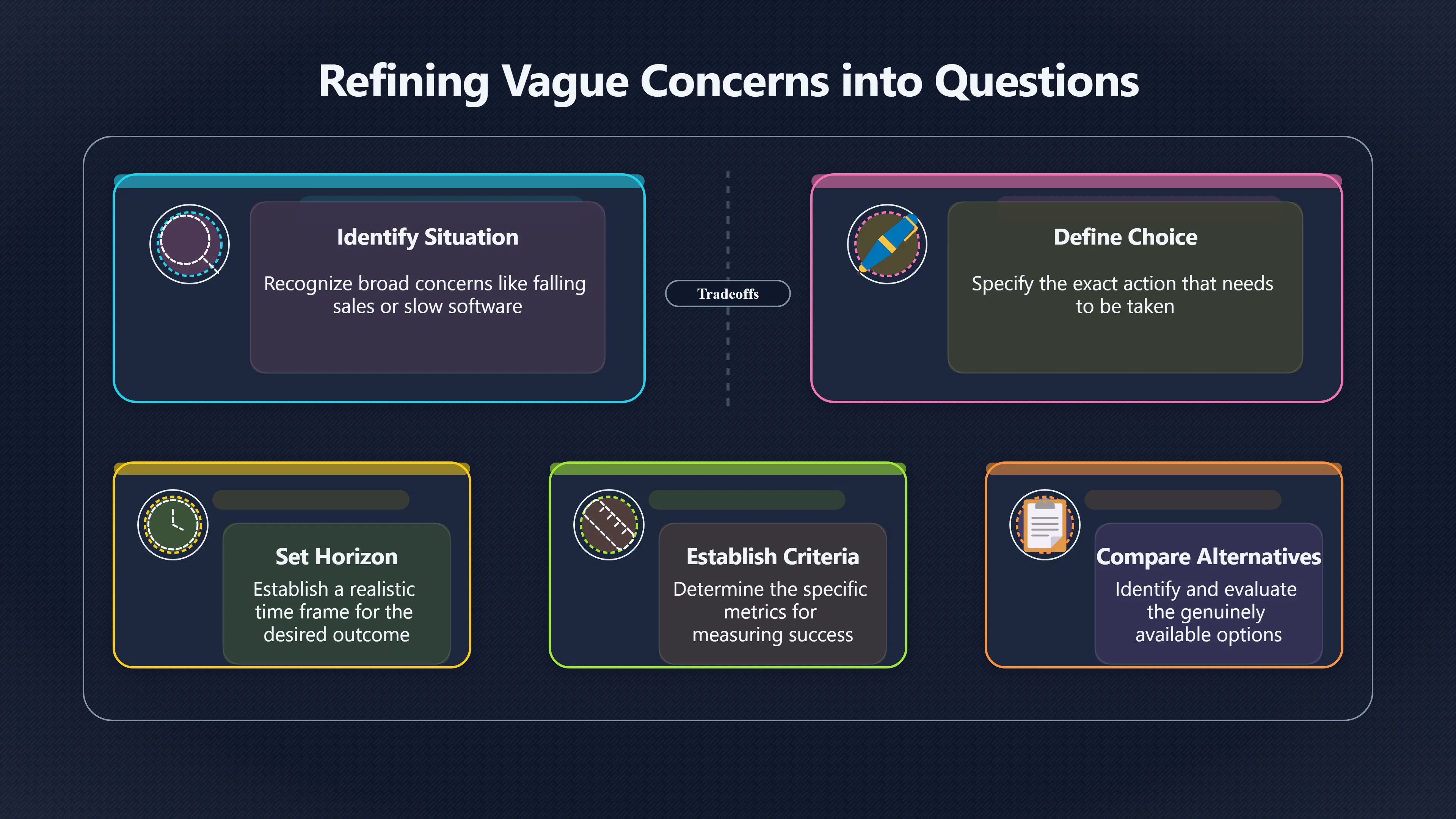
Turning vague concerns into answerable questions
The goal is not to make the question narrower for its own sake. The goal is to make it answerable.
A practical progression often looks like this:
Vague concernBetter decision question”Sales are declining.”“Which intervention is most likely to increase sales within six months?”“Customers are unhappy.”“Which customer problem should we fix first?”“Should I leave my job?”“Given my priorities over the next three years, is changing employers more likely to improve them than staying?”“Our software is slow.”“Which performance improvement produces the greatest user benefit within our engineering budget?”
Notice that the revised questions introduce features absent from the originals:
- a specific choice
- realistic alternatives
- a time horizon
- a criterion for success
- an implied need for comparative evidence
Once these elements exist, analysis becomes easier because irrelevant information naturally falls away.
Design-thinking methods use a similar idea when they convert observations into focused “How Might We…” questions. The intention is not merely to make the problem sound more creative, but to define a challenge that is neither so broad that every idea qualifies nor so narrow that only one solution is possible. [Stanford d.school]dschool.stanford.eduThey are often used for launching brainstorm sessions because they help you look at your idea in new…Read more…
Separating judgement questions from action choices
One of the easiest ways to waste analytical effort is to confuse understanding with deciding.
These are different kinds of questions.
A judgement question asks what is true.
Examples include:
- Why are customer complaints increasing?
- Which explanation best fits the available evidence?
- How likely is a recession?
An action question asks what should be done.
Examples include:
- Should we increase customer support staffing?
- Should we postpone investment?
- Which product should receive funding?
Understanding usually supports action, but they are not identical. You may know with reasonable confidence why a problem exists and still face several possible responses. Likewise, uncertainty about causes does not always prevent action if every plausible explanation points towards the same intervention.
Keeping these questions separate prevents two common mistakes:
- continuing to investigate after enough evidence already exists to act
- making decisions before the factual judgement has been adequately tested
Research on judgement and decision-making also distinguishes between evaluating evidence and choosing between actions because these tasks involve different reasoning processes and different success criteria. [Webspace Science]webspace.science.uu.nlWebspace Science Decoupling Judgment and Decision Making: A Tale of TwoWebspace ScienceDecoupling Judgment and Decision Making: A Tale of Two…January 14, 2024 — by B Oral · Cited by 14 — We examine judgmen…
Ask whether the answer would actually change your next step
A surprisingly effective way to test a decision frame is to imagine receiving a perfect answer.
Ask yourself:
- If I knew the answer with certainty, what would I do differently?
- Would two different answers produce two different actions?
- Would additional evidence change my choice?
If every possible answer leads to the same action, then the question is probably not worth analysing.
For example: [structureddecisionmaking.org]structureddecisionmaking.orgframing the decisionFor example, suppose your car breaks down for good – it's a…Read more…
“I wonder whether customers slightly prefer version A or version B.”
If the company intends to release version B regardless because version A cannot legally be sold, the analysis adds little value.
By contrast:
“Would customer preference be strong enough to justify delaying launch?”
Now different answers clearly lead to different actions.
Decision analysts often describe valuable information as information that has the potential to change a decision rather than merely increase knowledge. Framing the decision first makes this much easier to recognise. [decisionmanagementsolutions.com]decisionmanagementsolutions.comJanuary 11, 2017 — by J TAYLOR · Cited by 6 — By clearly defining the decision-making to be analytically improved and the role of that de…
Avoid framing that quietly chooses the answer
Poor decision frames often contain hidden assumptions.
For example: [structureddecisionmaking.org]structureddecisionmaking.orgframing the decisionFor example, suppose your car breaks down for good – it's a…Read more…
- “How do we convince customers to adopt our new feature?”
- “How can we reduce employee resistance?”
- “Which advertising campaign should we choose?”
Each question assumes something before analysis has begun:
- that adoption is the problem
- that employees are the obstacle
- that advertising is the solution
A better frame postpones those assumptions.
Instead:
- “What prevents customers adopting the feature?”
- “What explains low employee participation?”
- “Which intervention would most increase awareness?”
The difference seems small, but it changes what evidence is collected and which alternatives remain available.
Intelligence analysts use structured analytic techniques partly for this reason: to avoid beginning with a preferred explanation or solution and then searching mainly for confirming evidence. Techniques such as generating multiple hypotheses first are intended to prevent premature narrowing of the analytical frame. [CIA+2Wikipedia]cia.govTradecraft Primer apr09A Tradecraft Primer: Structured Analytic Techniques for…by AT Primer · 2009 · Cited by 60 — This primer highlights structured analy…
Practical tests for a strong decision frame
Before breaking a problem into smaller parts, it is worth checking whether the framing passes a few simple tests.
A strong decision question usually:
- identifies a genuine choice rather than describing a situation
- specifies who is making the decision
- distinguishes facts from actions
- defines what success means
- makes clear what alternatives exist
- would lead to different actions if answered differently
- leaves open the possibility that the initial assumption is wrong
If several of these are missing, further decomposition often becomes confusing because different people unknowingly analyse different questions.
A brief worked example
Imagine a hospital experiencing long waiting times.
An initial question might be:
“Why are patients waiting so long?”
This is useful for diagnosis but not yet for decision-making.
After discussion, the leadership realises the real choice is:
“Which change can reduce average waiting time by 20% within six months without reducing patient safety?”
That sharper frame immediately changes the analysis.
Instead of collecting every possible explanation, the team now focuses on evidence relevant to competing interventions, such as staffing patterns, appointment scheduling, patient flow and diagnostic bottlenecks. Information that cannot affect the choice becomes lower priority.
The problem has not become simpler, but it has become analysable.
Why defining the decision comes before decomposition
Breaking a problem into parts only works when the parts serve a clearly defined decision. Without that anchor, analysis easily becomes an exercise in gathering interesting facts rather than improving judgement.
A precise decision frame determines which questions deserve investigation, which evidence matters, which alternatives should be compared and, crucially, when enough analysis has been done to act. By identifying the real decision first, the later breakdown of causes, constraints, assumptions and options becomes purposeful instead of merely organised.
Amazon book picks
Further Reading
Books and field guides related to What decision are you really trying to make?. Use these as the next step if you want deeper reading beyond the article.
Decisive
Focuses directly on framing decisions, expanding options, and avoiding common decision traps.
Super Thinking
Helps readers apply structured thinking frameworks to clarify problems and decisions.
Smart Choices
Provides structured methods for defining the real decision before evaluating alternatives.
The Art of Thinking Clearly
Highlights reasoning errors that often arise from poorly framed decisions and vague problem definitions.
eBay marketplace picks
Marketplace Samples
Live-tested eBay searches with available results related to this page.




Endnotes
-
Source: dschool.stanford.edu
Link: https://dschool.stanford.edu/tools/how-might-we-questionsSource snippet
They are often used for launching brainstorm sessions because they help you look at your idea in new...Read more...
-
Source: decisionmanagementsolutions.com
Link: https://www.decisionmanagementsolutions.com/wp-content/uploads/2017/01/IIA-Research_Decision-Modeling.pdfSource snippet
January 11, 2017 — by J TAYLOR · Cited by 6 — By clearly defining the decision-making to be analytically improved and the role of that de...
Published: January 11, 2017
-
Source: cia.gov
Title: Tradecraft Primer apr09
Link: https://www.cia.gov/resources/csi/static/Tradecraft-Primer-apr09.pdfSource snippet
A Tradecraft Primer: Structured Analytic Techniques for...by AT Primer · 2009 · Cited by 60 — This primer highlights structured analy...
-
Source: Wikipedia
Link: https://en.wikipedia.org/wiki/Analysis_of_competing_hypothesesSource snippet
Analysis of competing hypothesesThe analysis of competing hypotheses (ACH) is a methodology for evaluating multiple competing hypothes...
-
Source: dschool.stanford.edu
Link: https://dschool.stanford.edu/innovate/toolsSource snippet
Amp up the good, explore the opposite, take it to an extreme—how to use questions to provoke… Systems Design · Tool. Tools in...Read more...
-
Source: hub.make.do
Link: https://hub.make.do/education/steam-design-challenge/design-thinking-processSource snippet
the Stanford Design Thinking ProcessDesign Thinking Process; Empathise. Observe: What are the different parts of the problem?; Define...
-
Source: structureddecisionmaking.org
Title: framing the decision
Link: https://www.structureddecisionmaking.org/the-steps/framing-the-decision/Source snippet
For example, suppose your car breaks down for good – it's a...Read more...
-
Source: webspace.science.uu.nl
Title: Webspace Science Decoupling Judgment and Decision Making: A Tale of Two
Link: https://webspace.science.uu.nl/~telea001/uploads/PAPERS/TVCG24/paper.pdfSource snippet
Webspace ScienceDecoupling Judgment and Decision Making: A Tale of Two...January 14, 2024 — by B Oral · Cited by 14 — We examine judgmen...
Published: January 14, 2024
-
Source: ixdf.org
Title: how might we
Link: https://ixdf.org/literature/topics/how-might-weSource snippet
What is How Might We (HMW)? — updated 2026How Might We is a design thinking method where designers create questions that open up ideation...
-
Source: practices.learningaccelerator.org
Title: stanford d school how might we questions
Link: https://practices.learningaccelerator.org/artifacts/stanford-d-school-how-might-we-questionsSource snippet
d.School: “How Might We” QuestionsThis guide from Stanford d.school will help you translate feedback into a clear problem your design tea...
Additional References
-
Source: futuribles.com
Link: https://www.futuribles.com/wp-content/uploads/related-documents/analysis-of-competing-hypotheses.pdf?postId=73706Source snippet
Analysis of Competing HypothesesAnalysis of Competing Hypotheses (ACH) is an intelligence analysis method based on evaluating plausible a...
-
Source: sebokwiki.org
Link: https://sebokwiki.org/wiki/Decision_ManagementSource snippet
Decision ManagementThe purpose of the decision management process is to provide a structured, analytical framework for objectively identi...
-
Source: sosintel.co.uk
Link: https://sosintel.co.uk/mastering-the-analysis-of-competing-hypotheses-ach-a-practical-framework-for-clear-thinking/Source snippet
Mastering the Analysis of Competing Hypotheses (ACH)20 Jun 2025 — At its core, ACH shifts the analytical focus from proving a favoured hy...
-
Source: medium.com
Link: https://medium.com/%40notoneco/01-00-crafting-hmw-how-might-we-statements-436dd3c66662 -
Source: medium.com
Link: https://medium.com/digital-experience-design/how-to-properly-frame-your-design-challenge-36104910dfc8 -
Source: amanet.org
Link: https://www.amanet.org/assets/1/6/2558_outline.pdfSource snippet
• Define What a Decision Is and How Analytical Reasoning and Decision Making Are Related. • Distinguish Between Two...Read more...
-
Source: youtube.com
Link: https://www.youtube.com/watch?v=51SX9CpFBncSource snippet
How Might We statement builderI will be walking you through the how might we statement builder when teams start to id8 and to come up wit...
-
Source: strukturierteanalysedeutschland.de
Title: the structured analytic technique analysis of competing hypotheses ach
Link: https://strukturierteanalysedeutschland.de/2023/03/14/the-structured-analytic-technique-analysis-of-competing-hypotheses-ach/Source snippet
How to perform an Analysis of Competing Hypotheses?14 Mar 2023 — In this blog post, you will learn how to apply an Analysis of Competing...
-
Source: strathprints.strath.ac.uk
Title: Dhami etal ACP 2019 The analysis of competing hypotheses in intelligence
Link: https://strathprints.strath.ac.uk/69049/1/Dhami_etal_ACP_2019_The_analysis_of_competing_hypotheses_in_intelligence.pdfSource snippet
The intelligence community uses “structured analytic techniques” to help analysts think critically and avoid cognitive bias.Read more...
-
Source: arielsheen.com
Title: notes on structured analytic techniques for intelligence analysis
Link: https://arielsheen.com/index.php/2021/02/11/notes-on-structured-analytic-techniques-for-intelligence-analysis/Source snippet
Notes on Structured Analytic Techniques for Intelligence...11 Feb 2021 — Analysis of Competing Hypotheses: This technique requires analy...
Topic Tree