Within Practice Tests
Self Testing Before Real Decisions
Brief recall before meetings and decisions makes useful frameworks available when the situation is messy.
On this page
- Retrieving criteria before looking at notes
- Using self tests before meetings and proposals
- Keeping practice low pressure and relevant
Page outline Jump by section
Introduction
Many important work decisions are made under time pressure rather than after careful study. A proposal needs reviewing, a meeting starts in five minutes, or a manager asks for a recommendation on the spot. In these moments, better judgement often depends less on reading one more document than on being able to retrieve useful concepts from memory before the discussion begins.
 This is where low-stakes retrieval routines become valuable. Instead of treating self-testing as an academic exercise, you briefly challenge yourself to recall the decision criteria, questions or frameworks you want available during the conversation. Research on retrieval practice consistently shows that actively recalling information strengthens later access to it better than simply rereading notes, especially after a delay. [PsychNet]psychnet.wustl.eduRoediger Karpicke 2006 PPSRoediger Karpicke 2006 PPS For work, the goal is not to achieve a perfect score. It is to make good thinking habits easier to access when situations become messy.
Retrieve your criteria before opening your notes
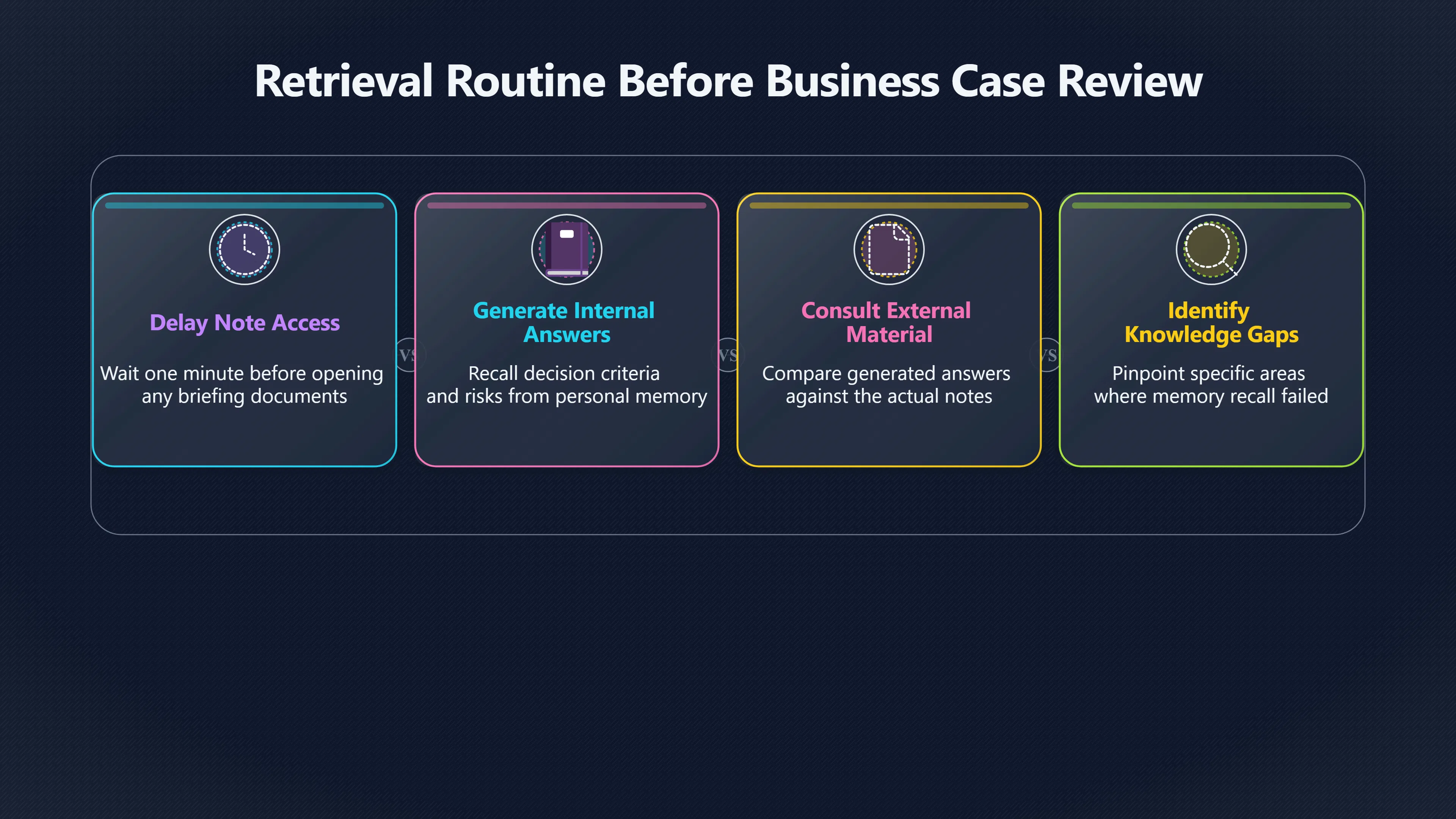
One of the simplest routines is to delay looking at your notes for a minute or two.
Suppose you are about to review a business case. Before opening the briefing document, ask yourself:
- What criteria should guide this decision?
- What risks do I usually forget?
- What evidence would change my mind?
- Which assumptions deserve checking?
Only after generating your own answers should you consult your notes.
This sequence matters because retrieval forces reconstruction rather than recognition. Recognition creates the comfortable feeling that “I know this already”, while retrieval exposes whether the ideas are actually available for use. Studies by Henry Roediger and Jeffrey Karpicke showed that retrieval strengthens later recall more effectively than repeated study alone, even when repeated study feels easier during learning. [PsychNet]psychnet.wustl.eduRoediger Karpicke 2006 PPSRoediger Karpicke 2006 PPS
For workplace decisions, this means your personal checklist becomes something you can actually use during a meeting instead of something that exists only inside a notebook.
Recall frameworks, not scripts
Work decisions rarely repeat themselves exactly.
Rather than memorising specific recommendations, retrieve adaptable frameworks. For example:
- the factors you normally compare when choosing between competing projects
- the questions you ask before accepting numerical claims
- the warning signs that indicate missing evidence
- the trade-offs you usually examine before recommending action
These frameworks can then be adapted to new situations instead of forcing every problem into an old template.
Use brief self-tests before meetings and proposals
A useful retrieval routine should take only a few minutes. If it feels like an examination, people tend to avoid it.
Before an important meeting, try writing answers from memory to prompts such as:
- “List the three strongest arguments likely to appear.”
- “What evidence supports each position?”
- “What objections should I expect?”
- “Which decision principles matter most here?”
Afterwards, compare your answers with your preparation materials.
This serves two purposes. First, it identifies genuine gaps before they matter. Second, it activates information so it is easier to retrieve during discussion. Retrieval-based learning research shows that testing can improve future learning directly, not merely measure what has already been learned. [ERIC]files.eric.ed.govERIC2.27 Retrieval-Based Learning: A Decade of Progress - ERICby JD Karpicke · 2017 · Cited by 376 — A more recent example of the direct…
The same approach works before:
- presenting a proposal
- conducting a hiring interview
- negotiating with a supplier
- discussing budgets
- giving project updates
- reviewing technical documents
The routine stays identical even though the content changes.
Make retrieval part of everyday judgement
Retrieval routines work best when attached to regular work habits rather than reserved for major presentations.
Examples include:
- Before reading performance metrics, predict what trends you expect to see.
- Before opening previous meeting notes, summarise the last discussion from memory.
- Before responding to a difficult email, recall the principles that usually lead to productive replies.
- Before approving a recommendation, list the evidence you expect should exist.
These habits are deliberately low pressure. No one grades them, and most take less than two minutes.
The value comes from repeatedly exercising the mental process required during real decision-making: bringing useful knowledge to mind without external prompts.
Keep practice relevant rather than exhaustive
People often abandon retrieval practice because they try to remember everything.
For work, selective retrieval is usually more effective. Focus on the ideas that repeatedly influence judgement:
- recurring decision criteria
- common cognitive biases
- organisational priorities
- customer needs
- legal or regulatory constraints
- previous lessons from similar projects
By repeatedly retrieving these high-value concepts, they become easier to access under realistic workplace conditions.
Research on retrieval-based learning also shows that retrieval can enhance subsequent learning by making later study more effective. Once gaps become visible, reviewing the relevant material is more targeted than passive rereading. [PMC]pmc.ncbi.nlm.nih.govRetrieval practice enhances new learning: the forward effect of…by B Pastötter · 2014 · Cited by 277 — The review discusses current…
Keep the routine genuinely low stakes
The purpose is to improve thinking, not to create another performance metric.
Several practices help maintain this balance:
- Treat mistakes as information rather than failure.
- Keep retrieval sessions short enough that they remain sustainable.
- Check answers immediately after attempting recall.
- Repeat important decision frameworks over weeks rather than cramming before major events.
Interestingly, research comparing overt retrieval (writing or speaking answers) with covert retrieval (mentally recalling them) suggests that both can improve later retention, although writing answers often provides clearer feedback about what has actually been remembered. [American Psychological Association]apa.orgAmerican Psychological AssociationCovert Retrieval Practice Benefits Retention as Much as…by MA Smith · 2013 · Cited by 198 — Many exp…
For many professionals, this means a silent one-minute mental review before walking into a meeting can still be worthwhile when circumstances prevent writing anything down.
What changes in real decisions
The benefit of these routines is not that they guarantee better decisions every time. Rather, they increase the likelihood that sound analytical habits will be available when decisions become uncertain.
Someone who routinely retrieves their evaluation criteria before reading reports is more likely to notice missing evidence. Someone who recalls likely objections before presenting a proposal is less likely to be surprised during discussion. Someone who mentally reconstructs the previous meeting before reviewing the minutes is more likely to connect new information with existing understanding.
Over time, these small retrieval moments help shift important concepts from being merely familiar to being readily usable—the difference between recognising a good framework when reading about it and actually applying it when the outcome matters.
Amazon book picks
Further Reading
Books and field guides related to Self-Testing Before Real Decisions. Use these as the next step if you want deeper reading beyond the article.
Make It Stick
Directly explains why self-testing and retrieval improve long-term recall and better decision-making.
The Checklist Manifesto
Reinforces the value of recalling critical criteria and using structured routines before important decisions.
Ultralearning
Covers evidence-based learning strategies including active recall and deliberate practice.
Decisive: How to Make Better Choices in Life and Work
Focuses on structured decision-making processes that complement retrieval-based preparation.
eBay marketplace picks
Marketplace Samples
Live-tested eBay searches with available results related to this page.




Endnotes
-
Source: psychnet.wustl.edu
Title: Roediger Karpicke 2006 PPS -
Source: files.eric.ed.gov
Link: https://files.eric.ed.gov/fulltext/ED599273.pdfSource snippet
ERIC2.27 Retrieval-Based Learning: A Decade of Progress - ERICby JD Karpicke · 2017 · Cited by 376 — A more recent example of the direct...
-
Source: pmc.ncbi.nlm.nih.gov
Link: https://pmc.ncbi.nlm.nih.gov/articles/PMC3983480/Source snippet
Retrieval practice enhances new learning: the forward effect of...by B Pastötter · 2014 · Cited by 277 — The review discusses current...
-
Source: apa.org
Link: https://www.apa.org/pubs/journals/features/xlm-10-1037-a0033569.pdfSource snippet
American Psychological AssociationCovert Retrieval Practice Benefits Retention as Much as...by MA Smith · 2013 · Cited by 198 — Many exp...
Additional References
-
Source: researchgate.net
Link: https://www.researchgate.net/publication/244479666_Covert_Retrieval_Practice_Benefits_Retention_as_Much_as_Overt_Retrieval_PracticeSource snippet
Covert Retrieval Practice Benefits Retention as Much as...19 Jan 2016 — Many experiments provide evidence that practicing retrieval bene...
-
Source: youtube.com
Link: https://www.youtube.com/watch?v=G6u9_lbW2hYSource snippet
The Testing Effect & Retrieval practice: the number 1 study hackIn this video I'm going to tell you about retrieval practice (or self-tes...
-
Source: learninglab.psych.purdue.edu
Title: 2025 Karpicke Retrieval Based Learning Review
Link: https://learninglab.psych.purdue.edu/downloads/2025/2025_Karpicke_Retrieval_Based_Learning_Review.pdfSource snippet
purdue.edu4.21 Retrieval-based learningby JD Karpicke · 2025 — Karpicke JD and Roediger HL (2007a) Expanding retrieval practice promotes...
-
Source: mike-taylor.org
Title: take three [practice tests]({{ ‘practice-tests/’ | relative_url }}) (no
Link: https://mike-taylor.org/2025/12/01/the-testing-effect-why-retrieval-practice-is-your-most-powerful-learning-tool/Source snippet
The Testing Effect: Why Retrieval Practice is Your Most...by M Taylor — Henry Roediger and Jeffrey Karpicke ran an experiment that shoul...
-
Source: youtube.com
Title: 5-Minute Retrieval Plan: How to Embed Retrieval Practice
Link: https://www.youtube.com/watch?v=eyjoCCEfyWsSource snippet
Making Retrieval Practice a Classroom Routine...
-
Source: youtube.com
Title: Retrieval principles into practice
Link: https://www.youtube.com/watch?v=a40hPWsC9oASource snippet
How to be good at Problem-Solving, Week 11: Memory and Learning Course...
-
Source: youtube.com
Title: Study Strategies: Retrieval Practice
Link: https://www.youtube.com/watch?v=Pjrqc6UMDKMSource snippet
5-Minute Retrieval Plan: How to Embed Retrieval Practice...
-
Source: donaldclarkplanb.blogspot.com
Title: Roediger and Karpicke
Link: https://donaldclarkplanb.blogspot.com/2021/10/roediger-and-karpicke-retrieval.htmlSource snippet
Testing, even before you have...Read more...
-
Source: youtube.com
Title: How to be good at Problem-Solving, Week 11: Memory and Learning Course
Link: https://www.youtube.com/watch?v=0C8YO0Y7n9o -
Source: youtube.com
Title: Making Retrieval Practice a Classroom Routine
Link: https://www.youtube.com/watch?v=96xBOchLlWkSource snippet
Retrieval principles into practice...
Topic Tree