Within Sharper Thinking
Find the Assumption That Could Break Everything
A conclusion often depends on one fragile assumption that deserves more attention than the rest.
On this page
- How to locate the fragile assumption
- Stress testing plans and arguments
- When a weak link should change the decision
Page outline Jump by section
Introduction
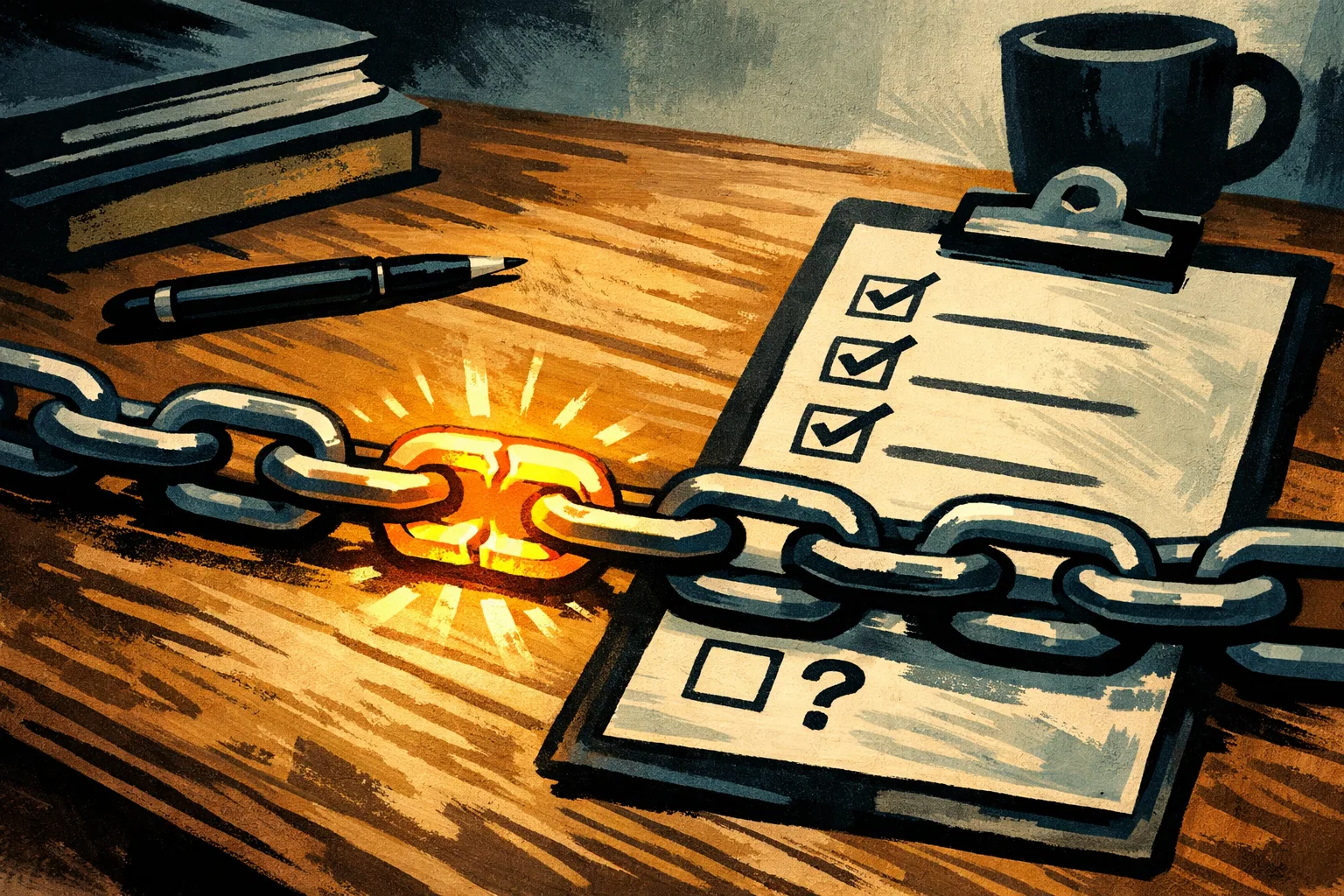
Weakest-link thinking is the habit of asking: “Which assumption, if wrong, would do the most damage to this conclusion?” It is useful because many weak arguments do not fail everywhere. They often rest on several reasonable points plus one fragile bridge: a forecast about demand, an untested causal claim, a hidden definition, a missing alternative, or a belief that everyone involved will behave as expected. In critical thinking, the aim is not to attack every sentence equally. It is to find the load-bearing assumption and test that first.
This matters because ordinary evidence-checking can create false confidence. A plan may contain ten assumptions, nine of which are true, while the tenth makes the whole decision unsafe. Intelligence-analysis guides call this kind of move a “key assumptions check”: identifying the premises on which a judgement depends, especially those that are accepted as true but not routinely questioned. [Department of Statistics]stat.berkeley.eduFor example, military analysis may focus.Read moreDepartment of StatisticsStructured Analytic Techniques for Improving Intelligence…April 28, 2009 — by AT Primer · 2009 · Cited by 62 —… RAND’s assumption-based planning uses the related idea of “load-bearing” and “vulnerable” assumptions in plans, because surprises often come from assumptions leaders either did not see or had stopped noticing. [RAND Corporation]rand.orgCorporation Assumption-Based PlanningRAND CorporationAssumption-Based PlanningFebruary 9, 2022 — Assumption- Based Planning considers them to be assumptions regardless of the…
Why the weakest link is rarely the weakest-looking sentence
The fragile part of an argument is not always the claim that sounds most dramatic. It is the claim with the highest combination of dependency, uncertainty and consequence. A conclusion may survive a minor factual error but collapse if one linking assumption fails. For example, “We should launch this product in September” may depend less on the exact marketing slogan than on the assumption that the supplier can scale production, the customer problem is urgent enough, and a competitor will not neutralise the advantage before launch.
Argument mapping helps because it separates the conclusion, the stated reasons and the hidden warrants that connect them. Argument maps are used in critical thinking to reveal the structure of reasoning, including unstated assumptions, objections and counterarguments. [Wikipedia]WikipediaArgument mapArgument map The practical value is simple: once the argument is visible, you can see whether the conclusion has many independent supports or one narrow bridge pretending to be a broad foundation.
A weak link usually has one of these forms:
- A dependency assumption: “This conclusion only works if X happens.”
- A causal assumption: “Doing A will produce B.”
- A measurement assumption: “This metric really captures what matters.”
- A behavioural assumption: “Customers, rivals, voters, patients, colleagues or regulators will respond in this way.”
- A boundary assumption: “The conditions that made this true before still apply here.”
- A missing-alternative assumption: “No other explanation fits the facts better.”
The mistake is to ask only, “Is this assumption plausible?” Many fragile assumptions are plausible. The sharper question is, “How much of the conclusion depends on this being true?”

How to locate the fragile assumption
The quickest method is to reverse the conclusion and ask what would have to be false for the reversal to become credible. This is different from general scepticism. It is targeted pressure. You are not trying to disbelieve everything; you are trying to discover which premise carries the most weight.
A useful sequence is:
- Write the conclusion as a decision or judgement. “This strategy will reduce churn,” “This candidate is the best hire,” or “This diagnosis explains the symptoms.”
- List the stated reasons. Keep them short enough to inspect.
- Add the missing “because” links. These are often the real assumptions: “because customers leave mainly due to price”, “because interview performance predicts job performance”, “because the symptom pattern is specific enough”.
- Ask which assumption would change the conclusion if denied. This is the first weak-link candidate.
- Rank candidates by uncertainty and impact. A highly uncertain assumption that would barely change the decision is less urgent than a moderately uncertain one that would overturn it.
- Look for evidence that would disconfirm it. Weakest-link thinking becomes powerful when it asks what would break the conclusion, not merely what supports it.
This resembles the “key assumptions check” in structured analytic techniques. A US government tradecraft primer defines a key assumption as a hypothesis accepted as true that forms the basis of an assessment, and notes that hidden assumptions are difficult because they are often held unconsciously and therefore rarely challenged. [Department of Statistics]stat.berkeley.eduFor example, military analysis may focus.Read moreDepartment of StatisticsStructured Analytic Techniques for Improving Intelligence…April 28, 2009 — by AT Primer · 2009 · Cited by 62 —… The same habit scales down to everyday reasoning: before arguing harder for a view, identify what the view quietly needs to be true.
The “will” test
One simple way to find weak links in plans is to search for confident future-tense language: “customers will adopt”, “the team will deliver”, “costs will fall”, “the regulation will not change”, “the model will generalise”. A review of James Dewar’s work on assumption-based planning notes that one method for identifying assumptions is to search a plan for the word “will”, because it often marks a forecast that has been smuggled into the plan as if it were settled fact. [YMAWS]cdn.ymaws.comAssumption Based Planning, by James A DewarAssumption Based Planning, by James A Dewar
The “will” test is not a grammar trick. It catches a common planning failure: treating an expectation as an observation. “We have signed the vendor” is evidence. “The vendor will deliver the integration by August” is an assumption. The second statement may be reasonable, but it deserves a different kind of scrutiny.
The “so what if false?” test
Not every weak assumption is decision-relevant. A good test is to ask: “If this is false, what follows?” If the answer is “we would need to rewrite the plan”, it is load-bearing. If the answer is “we would slightly adjust the estimate”, it may not be the weakest link.
RAND’s assumption-based planning is built around this distinction. It treats assumptions as important when their failure would require significant changes to operations or plans, then looks for signposts, shaping actions and hedging actions. [RAND Corporation]rand.orgOpen source on rand.org. That is the core of weakest-link thinking: do not give equal attention to every uncertainty. Give special attention to the uncertainty that can force a different decision.
Stress-testing plans and arguments
Stress-testing means creating a controlled collision between the conclusion and the conditions under which it might fail. This can be done before a decision, not only after a mistake. The point is to make the argument pay rent: what evidence, event or counterexample would show that the conclusion is weaker than it looks?
A project premortem is one well-known version. Gary Klein’s Harvard Business Review article describes asking a team to imagine that a project has failed and then generate reasons for the failure. [Harvard Business Review]hbr.orgOpen source on hbr.org. Its value is psychological as well as analytical: people who are reluctant to voice doubts during ordinary planning can find it easier to describe failure causes once failure is made hypothetical. [ResearchGate]researchgate.netOpen source on researchgate.net.
For an individual, the same move can be compact:
- Failure story: “It is six months later and this conclusion was wrong. What happened?”
- Missing evidence: “What would I expect to see if my conclusion were true, and is it actually there?”
- Counterfactual edit: “If I remove this one fact or assumption, does the conclusion still stand?”
- Rival explanation: “What else could explain the same evidence?”
- Decision switch: “What single new finding would make me choose differently?”
This last question is especially useful because it exposes whether the conclusion is genuinely evidence-sensitive. If nothing could change the decision, the issue may be identity, politics or preference rather than analysis.
Why confirmation bias makes weak links hard to see
Weakest-link thinking fights a specific human tendency: once we favour a conclusion, we become better at finding support for it than at locating the premise most likely to fail. The classic study by Charles Lord, Lee Ross and Mark Lepper found that people evaluating mixed evidence on capital punishment tended to judge evidence supporting their prior view more favourably than evidence opposing it. [Frank Baumgartner]fbaum.unc.eduFrank Baumgartner Biased Assimilation and Attitude Polarization: The EffectsFrank Baumgartner Biased Assimilation and Attitude Polarization: The Effects Later reviews describe confirmation bias as a broad tendency to search for, interpret and remember information in ways that support existing beliefs. [UC San Diego Pages]pages.ucsd.eduUC San Diego Pages Confirmation Bias: A Ubiquitous Phenomenon in ManyUC San Diego Pages Confirmation Bias: A Ubiquitous Phenomenon in Many
That matters because a weak link often hides behind selective standards. We may demand rigorous proof from objections while accepting friendly assumptions as “common sense”. A team may interrogate a critic’s numbers but wave through its own adoption forecast. A manager may ask for evidence that a plan will fail but not evidence that the plan’s central mechanism will work.
A practical antidote is to separate two tasks that people often blur:
- Support check: “What evidence favours this conclusion?”
- Break check: “What would most seriously damage it?”
The support check helps establish a case. The break check protects against brittle confidence. Good analysis needs both, but weakest-link thinking deliberately gives the second task its own moment.

When a weak link should change the decision
Finding a weak link does not automatically mean abandoning the conclusion. It means the decision should change in proportion to the fragility, the stakes and the cost of testing or hedging. A weak link in a low-stakes choice may simply be noted. A weak link in a costly, irreversible or safety-critical decision should trigger a stronger response.
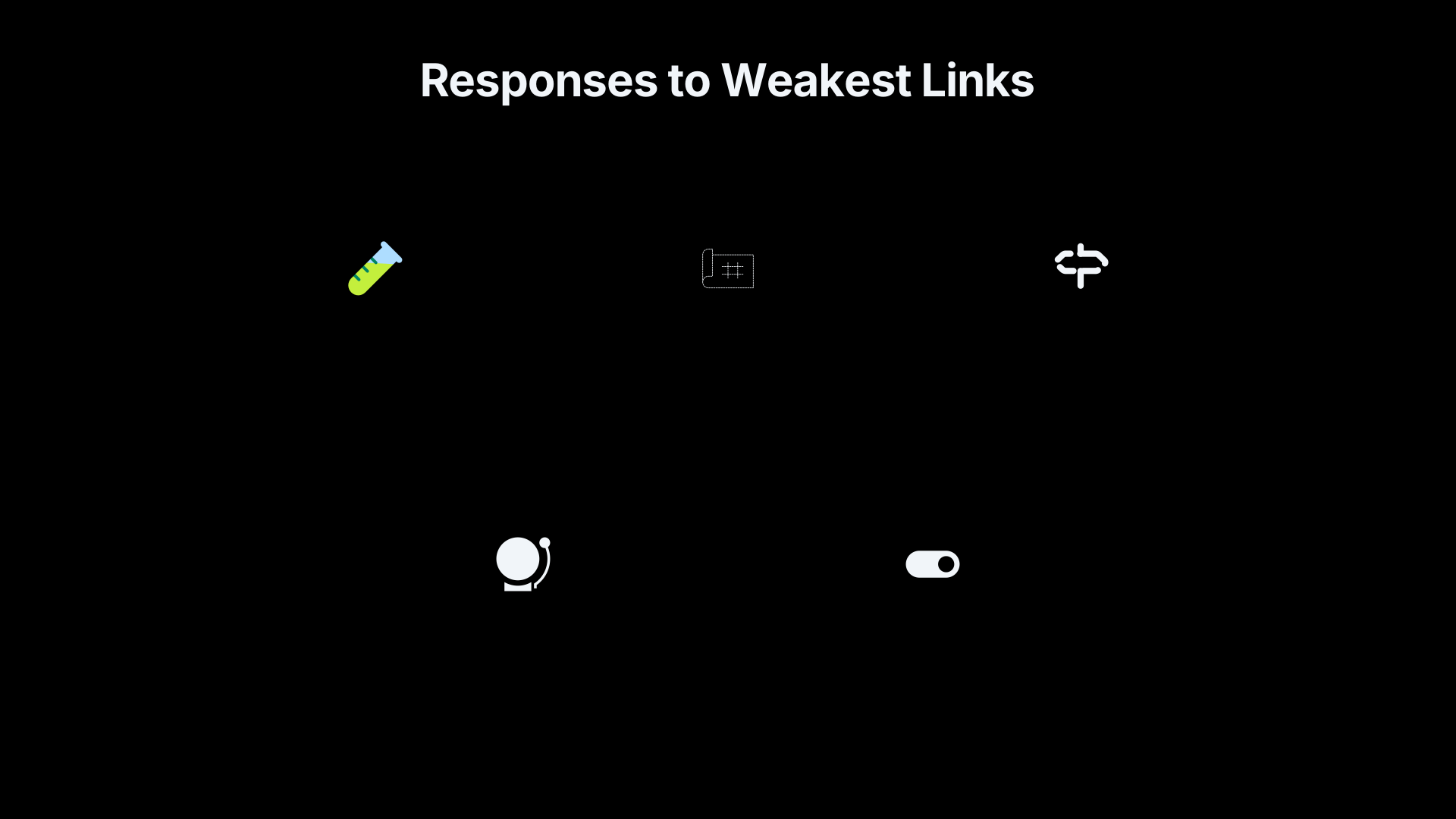
There are four common responses.
Test before committing. If the conclusion depends on customer demand, run a demand test before building the full product. If it depends on a diagnosis, seek the evidence that best separates it from dangerous alternatives. If it depends on a legal, technical or operational interpretation, verify that specific point rather than reviewing the whole plan again.
Redesign to reduce dependence. A plan is more robust when it can succeed under several plausible futures. The UK Ministry of Defence’s red teaming handbook defines red teaming as the independent application of structured, creative and critical thinking techniques to help decision-makers produce better-informed decisions and more robust products. [GOV.UK]assets.publishing.service.gov.ukUK Red Teaming Handbook, 3rd EditionUK Red Teaming Handbook, 3rd Edition In weakest-link terms, robustness means the conclusion no longer depends so heavily on one fragile assumption.
Add signposts and tripwires. RAND-style assumption-based planning looks for indicators that an assumption is failing, so a team can notice early rather than after the damage is done. [betterevaluation.org]betterevaluation.orgOpen source on betterevaluation.org. A signpost might be slower-than-expected trial conversion, supplier delay, staff attrition, competitor pricing, regulator language or a missed technical milestone. A tripwire is the pre-agreed point at which the plan changes.
Choose a reversible option. When a weak link cannot be tested cheaply, the decision should often become smaller, staged or reversible. The analytical question shifts from “Are we right?” to “How much should we risk while we are still uncertain?”
The decision should change most when three conditions coincide: the assumption is not well tested, the conclusion depends heavily on it, and the cost of being wrong is high. That is the danger zone where confidence should be converted into investigation, hedging or delay.
A worked example: the attractive plan with one brittle bridge
Imagine a small company considering a new subscription product. The team’s conclusion is: “We should invest heavily now because this will become our main growth engine next year.” The supporting evidence looks encouraging: existing users like the brand, competitors are growing, the prototype receives positive comments, and the finance model shows strong margins.
Weakest-link thinking asks what has to be true for that conclusion to hold. The list might include:
- enough existing users have the problem often enough;
- they will pay separately for solving it;
- the sales team can explain the product clearly;
- the product can be built without delaying current revenue;
- competitors will not copy the key feature quickly;
- support costs will not erase the margin.
The weakest link may not be the prototype or the market trend. It may be the behavioural assumption that users who praise the idea will actually pay for it. Praise is not the same as demand. If the conclusion depends on willingness to pay, then the next step is not a longer strategy document. It is a test that exposes real commitment: paid pilots, deposits, renewal behaviour, switching data or a deliberately priced trial.
This example shows the discipline of the method. It does not say the plan is bad. It says the argument is currently over-dependent on one bridge. Strengthen the bridge, build a second one, or avoid putting the full weight of the decision on it.
Weakest-link thinking versus ordinary risk lists
A normal risk list can become a dumping ground: everything that might go wrong, ranked loosely by anxiety. Weakest-link thinking is narrower. It asks which uncertainty most threatens the conclusion’s validity.
That distinction prevents two common errors. The first is risk theatre, where teams name many risks but do not connect them to the decision logic. The second is comforting completeness, where a long list creates the impression of rigour even though the central assumption remains untested. A key assumptions check is useful precisely because it links assumptions back to the judgement they support, rather than treating risks as detached hazards. [Department of Statistics]stat.berkeley.eduFor example, military analysis may focus.Read moreDepartment of StatisticsStructured Analytic Techniques for Improving Intelligence…April 28, 2009 — by AT Primer · 2009 · Cited by 62 —…
The difference can be stated plainly:
- A risk is something that could go wrong.
- A weak link is something that, if wrong, makes the conclusion no longer follow.
- A load-bearing assumption is a weak link that supports a plan, forecast or decision.
- A test is evidence designed to put pressure on that assumption.
- A hedge is a change that reduces the damage if the assumption fails.
This is why weakest-link thinking belongs inside analytical skill, not just project management. It improves the relationship between evidence and conclusion.
Common mistakes when using the method
The method is simple, but it can be misused.
Mistake one: confusing doubt with analysis. Saying “anything could happen” is not weakest-link thinking. The useful question is which specific uncertainty would matter most.
Mistake two: attacking the easiest premise. People often challenge the claim they know how to debate, not the one that carries the argument. A small data flaw can distract from a much larger causal assumption.
Mistake three: treating weak links as personal criticism. In group settings, assumptions can feel owned by the person who proposed the plan. Red teaming guidance tries to counter this by making challenge a structured role rather than an interpersonal attack. [GOV.UK]assets.publishing.service.gov.ukUK Red Teaming Handbook, 3rd EditionUK Red Teaming Handbook, 3rd Edition
Mistake four: testing only for confirmation. A test designed to show that the plan can work may not reveal whether it is likely to work. The better test is diagnostic: it should distinguish between “our conclusion is sound” and “our conclusion only looked sound because we ignored a rival explanation”.
Mistake five: refusing to act until every assumption is settled. Weakest-link thinking is not a recipe for paralysis. In uncertain environments, the goal is often to act in a way that buys information, preserves options and limits irreversible harm.
The practical payoff: better confidence, not less confidence
The aim of weakest-link thinking is not to become negative. It is to make confidence more accurate. A conclusion that has survived its best objection deserves more trust than one supported only by friendly evidence. A plan that has identified its load-bearing assumptions is easier to monitor. A decision that has hedges and tripwires is less exposed to surprise.
This is why the method is a useful mechanism for improving thinking and analytical skills. It turns critique from a vague attitude into a focused routine: make the reasoning visible, find the assumption that could break it, test that assumption first, and change the decision when the weak link is too important to ignore.
Amazon book picks
Further Reading
Books and field guides related to Find the Assumption That Could Break Everything. Use these as the next step if you want deeper reading beyond the article.
The Pyramid Principle
Strengthens argument structure by exposing unsupported premises and logical gaps.
Thinking, Fast and Slow
Explains common reasoning errors that make hidden assumptions go unchallenged.
Superforecasting
Shows how to test assumptions and improve forecasts underpinning important decisions.
How to Measure Anything
Demonstrates practical ways to test uncertain assumptions with evidence.
eBay marketplace picks
Marketplace Samples
Live-tested eBay searches with available results related to this page.



Endnotes
-
Source: rand.org
Title: Corporation Assumption-Based Planning
Link: https://www.rand.org/content/dam/rand/pubs/monograph_reports/2005/MR114.pdfSource snippet
RAND CorporationAssumption-Based PlanningFebruary 9, 2022 — Assumption- Based Planning considers them to be assumptions regardless of the...
Published: February 9, 2022
-
Source: Wikipedia
Title: Argument map
Link: https://en.wikipedia.org/wiki/Argument_map -
Source: cdn.ymaws.com
Title: Assumption Based Planning, by James A Dewar
Link: https://cdn.ymaws.com/www.projectmanagement.org.za/resource/resmgr/bookreviews/janfeb05.pdf -
Source: rand.org
Link: https://www.rand.org/topics/assumption-based-planning.html -
Source: betterevaluation.org
Link: https://www.betterevaluation.org/sites/default/files/abp.pdf -
Source: researchgate.net
Link: https://www.researchgate.net/publication/3229642_Performing_a_Project_Premortem -
Source: assets.publishing.service.gov.uk
Title: UK Red Teaming Handbook, 3rd Edition
Link: https://assets.publishing.service.gov.uk/media/61702155e90e07197867eb93/20210625-Red_Teaming_Handbook.pdf -
Source: rand.org
Link: https://www.rand.org/content/dam/rand/pubs/research_reports/RR1400/RR1408/RAND_RR1408.pdf -
Source: researchgate.net
Link: https://www.researchgate.net/publication/285707436_Improving_critical_thinking_using_web_based_argument_mapping_exercises_with_automated_feedback -
Source: researchgate.net
Link: https://www.researchgate.net/publication/28763750_Argument_Maps_Improve_Critical_Thinking -
Source: researchgate.net
Link: https://www.researchgate.net/publication/346677223_Assumption-Based_Planning_A_Tool_for_Reducing_Avoidable_Surprises -
Source: researchgate.net
Link: https://www.researchgate.net/publication/387217073_Adopting_A_Red_Teaming_Mentality_To_Streamline_The_Decision-Making_Process_In_The_Romanian_Armed_Forces -
Source: researchgate.net
Link: https://www.researchgate.net/publication/10961642_Cognitive_forcing_strategies_in_clinical_decisionmaking -
Source: researchgate.net
Link: https://www.researchgate.net/publication/232555483_Biased_assimilation_and_attitude_polarization_The_effects_of_prior_theories_on_subsequently_considered_evidence -
Source: researchgate.net
Link: https://www.researchgate.net/publication/337154064_Structured_Analytic_Techniques_Taxonomy_and_Technique_Selection_for_Information_and_Intelligence_Analysis_Practitioners -
Source: Wikipedia
Title: Confirmation bias
Link: https://en.wikipedia.org/wiki/Confirmation_bias -
Source: Wikipedia
Title: Richards Heuer
Link: https://en.wikipedia.org/wiki/Richards_Heuer -
Source: reasons.io
Title: Critical Thinking with Argument Maps
Link: https://reasons.io/learn/08 -
Source: gary-klein.com
Link: https://www.gary-klein.com/premortem -
Source: stat.berkeley.edu
Title: For example, military analysis may focus.Read more
Link: https://www.stat.berkeley.edu/~aldous/157/Papers/Tradecraft%20Primer-apr09.pdfSource snippet
Department of StatisticsStructured Analytic Techniques for Improving Intelligence...April 28, 2009 — by AT Primer · 2009 · Cited by 62 —...
Published: April 28, 2009
-
Source: hbr.org
Link: https://hbr.org/2007/09/performing-a-project-premortem -
Source: fbaum.unc.edu
Title: Frank Baumgartner [Biased Assimilation]({{ ‘mixed-evidence-accf68/’ | relative_url }}) and Attitude Polarization: The Effects
Link: https://fbaum.unc.edu/teaching/articles/jpsp-1979-Lord-Ross-Lepper.pdf -
Source: pages.ucsd.edu
Title: UC San Diego Pages Confirmation Bias: A Ubiquitous Phenomenon in Many
Link: https://pages.ucsd.edu/~mckenzie/nickersonConfirmationBias.pdf -
Source: criticalthinkingacademy.net
Title: Confirmation bias
Link: https://criticalthinkingacademy.net/blog/confirmation-bias.html
Additional References
-
Source: rationaleonline.com
Link: https://rationaleonline.com/docs/en/tutorials/argument-mappingSource snippet
Argument MappingLooks in more detail at the internal structure of simple arguments. Gives simple guidelines for identifyin...
-
Source: assets.cambridge.org
Link: https://assets.cambridge.org/0521806534/frontmatter/0521806534_frontmatter.pdfSource snippet
Cambridge AssetsAssumption-Based PlanningAssumption-based plan- ning (ABP) is a tool for identifying as many of the assumptions underly...
-
Source: youtube.com
Title: Charting the Thicket: Using Argument Mapping to Explore Controversial Topics
Link: https://www.youtube.com/watch?v=f833pHMlJjkSource snippet
Critical Thinking with Generative AI and Argument Maps...
-
Source: youtube.com
Title: Identify Assumptions: Steps to Question Underlying Beliefs in Decision Making!
Link: https://www.youtube.com/watch?v=fIF0pIx-usISource snippet
Marianne Talbot - Evaluating Arguments Part One...
-
Source: youtube.com
Title: Critical Thinking with Generative AI and Argument Maps
Link: https://www.youtube.com/watch?v=RrihZ3JKZPESource snippet
Identify Assumptions: Steps to Question Underlying Beliefs in Decision Making...
-
Source: youtube.com
Title: Critical Thinking Questions to Test Assumptions
Link: https://www.youtube.com/watch?v=WED3VcgzcYQSource snippet
Charting the Thicket: Using Argument Mapping to Explore Controversial Topics...
-
Source: greydynamics.com
Link: https://greydynamics.com/a-guide-to-structured-analytic-techniques-sats-for-intelligence/ -
Source: dia.mil
Link: https://www.dia.mil/FOIA/FOIA-Electronic-Reading-Room/FileId/161442/ -
Source: cdnmaltego.blob.core.windows.net
Link: https://cdnmaltego.blob.core.windows.net/cdn/Case%20studies/Evaluating_Structured_Analysis_Techniques_AaronDixon.pdf -
Source: managementboek.nl
Link: https://managementboek.nl/boek/9780521001267/assumption-based-planning-james-a-dewar?srsltid=AfmBOoqUxal9V7T7x-v726Bn9mIwC95Lw9r6rmYTBc3laupaw8DqcV2s
Topic Tree