Within Steelman
Would Your Opponent Accept Your Summary?
The opponent's test asks whether a thoughtful rival would recognize your summary before you begin the rebuttal.
On this page
- What the opponent's test checks
- Cartoon, weakest spokesperson, and motive only failures
- How to verify recognition in live and private analysis
Page outline Jump by section
Introduction
The opponent’s test is a simple but demanding standard for fair disagreement: before you criticise an argument, ask whether a thoughtful advocate of that position would recognise your summary as accurate and fair. If the answer is “no”, you are probably arguing against a substitute rather than the real claim. This test is one of the most practical ways to apply steelmanning because it shifts attention from whether you think your summary is reasonable to whether the other side would say, “Yes, that is what I mean.” Closely related ideas appear in the principle of charity, Rogerian argument, and Daniel Dennett’s presentation of Anatol Rapoport’s rules for constructive criticism, all of which treat faithful reconstruction as a prerequisite for meaningful rebuttal. [The Mind Collection+2Wikipedia]themindcollection.comThe Mind Collection Rapoport's Rules: How to Criticise ConstructivelyThe Mind CollectionRapoport's Rules: How to Criticise ConstructivelyApril 28, 2023 — Rapoport's Rules, also known as Dennett's Rules, is…

What the opponent’s test actually checks
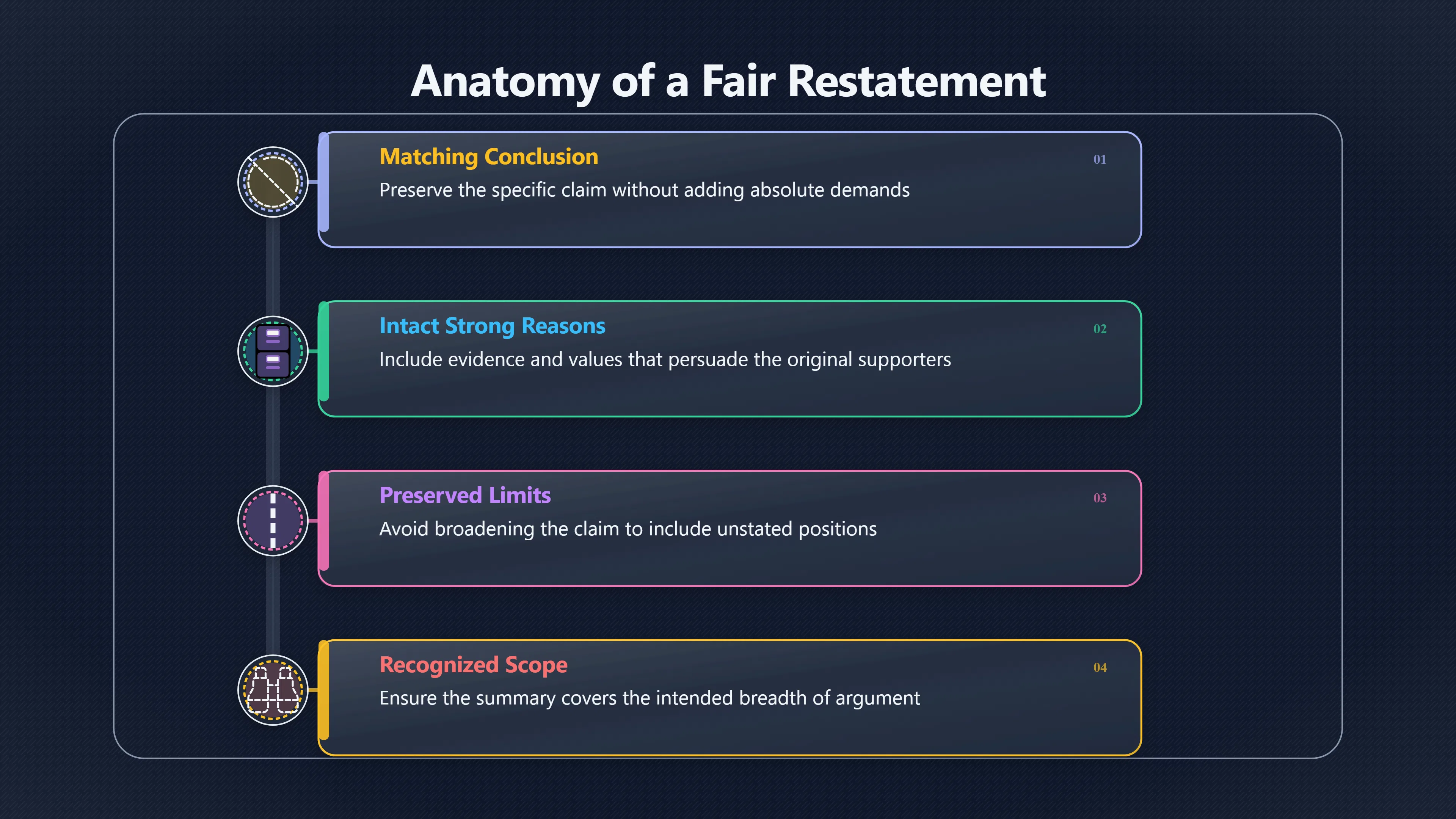
The test is not asking whether your opponent likes your wording or agrees with your conclusions. It checks something narrower and more objective: whether your restatement preserves the claim, the supporting reasons, and the intended scope of the original argument.
A fair restatement should satisfy three conditions:
- The conclusion matches. You have not replaced a qualified claim with an absolute one or a conditional proposal with an unconditional demand.
- The strongest reasons remain intact. You include the evidence, values, or practical concerns that make the position persuasive to its supporters instead of omitting them.
- The limits remain intact. You do not silently broaden the claim to include positions the speaker never defended.
This standard reflects Dennett’s version of Rapoport’s rules, whose first requirement is to restate the opposing position so clearly and fairly that the other person could sincerely thank you for expressing it so well. Only after that recognition comes criticism. [The Mind Collection]themindcollection.comThe Mind Collection Rapoport's Rules: How to Criticise ConstructivelyThe Mind CollectionRapoport's Rules: How to Criticise ConstructivelyApril 28, 2023 — Rapoport's Rules, also known as Dennett's Rules, is…
Importantly, recognition does not require agreement. An opponent may respond, “Yes, that’s my position—and I still think you’re wrong.” That is success. The test concerns faithful representation, not persuasion.
Three common ways the test fails
Cartoon versions
The most familiar failure is the classic straw man: replacing a nuanced argument with an exaggerated or simplistic version that is easier to defeat. Instead of engaging with the strongest available interpretation, the critic invents a weaker target. Philosophers of argument identify this distortion as the defining feature of the straw man fallacy. [Oxford University Press]global.oup.comOxford University PressSupplement: A Summary of the FallaciesStraw man fallacy A fallacy committed when an arguer (a) summarizes his oppo…
For example:
- Original: “The policy should be delayed until independent safety testing is complete.”
- Cartoon: “They oppose all technological progress.”
Almost no careful supporter would recognise the second statement as a fair summary.
Weakest-spokesperson substitution
Another failure is selecting an unusually poor advocate instead of the position itself. Every movement contains people who explain its ideas badly. The opponent’s test asks whether you have represented the strongest ordinary case, not the least informed person you could find.
This failure often appears in public debate when critics quote an isolated social media post, an inexperienced interviewee, or an extreme activist while ignoring more careful statements by recognised advocates. Even if the quotation is genuine, it may not represent the position being criticised.
The test therefore encourages asking, “Would informed supporters regard this as representative?” If not, the criticism should be redirected towards arguments that influential or knowledgeable advocates actually defend.
Motive-only criticism
A third failure occurs when critics replace arguments with psychological speculation.
Examples include:
- “They only support this because they want power.”
- “They just want attention.”
- “Their financial incentives explain everything.”
Motives can sometimes matter when evaluating credibility or conflicts of interest, but they do not automatically answer whether a claim is true. Argumentation texts identify dismissing claims solely by attacking motives as a form of ad hominem reasoning rather than engagement with the argument itself. [Maricopa Open Digital Press]open.maricopa.eduOpen Digital Press Logical Fallacy Master List – English 102: Journey Into OpenMaricopa Open Digital PressLogical Fallacy Master List – English 102: Journey Into OpenJanuary 8, 2021 — The Argument from Motives (also…
Under the opponent’s test, someone should still recognise their reasoning after motives have been discussed. If your summary contains only motives and no actual argument, it has almost certainly failed.

How to verify recognition in live discussion
The opponent’s test works best when recognition can be checked directly.
Before presenting objections, summarise the other person’s position and invite correction. Questions such as:
- “Have I understood your view correctly?”
- “Is there anything important I’ve left out?”
- “Would you state it differently?”
make misunderstanding visible before disagreement escalates.
Corrections should generally be welcomed rather than resisted. If the purpose is to evaluate the strongest version of the argument, improved accuracy benefits everyone involved, including the critic.
This practice mirrors the communicative aim behind Rogerian argument and Rapoport’s rules: demonstrating genuine understanding before attempting refutation reduces unnecessary defensiveness and keeps disagreement focused on substantive issues. [Wikipedia]WikipediaRogerian argumentRogerian argument
Applying the test in private analysis
Often there is no opponent available to confirm your summary—for example, when analysing a published article, historical document, policy proposal, or academic paper.
In those situations, recognition has to be estimated indirectly by checking whether your reconstruction reflects the best available evidence.
Useful checks include:
- Read primary sources before relying on critics’ summaries.
- Compare several respected advocates rather than one isolated quotation.
- Distinguish central claims from rhetorical flourishes.
- Preserve important qualifications such as “sometimes”, “under these conditions”, or “with these exceptions”.
- Ask whether someone knowledgeable on that side would regard your reconstruction as broadly faithful.
If repeated comparison shows that your summary would surprise informed supporters, revise it before evaluating it.
Why the test improves analytical thinking
The opponent’s test slows down a common cognitive shortcut: assuming that the easiest objection is also the strongest one.
Instead of rewarding quick dismissal, it rewards accurate modelling. This has several practical benefits:
- It reduces the risk of defeating arguments that nobody actually holds.
- It separates genuine disagreement from misunderstanding.
- It exposes where the real points of conflict lie.
- It makes successful rebuttals more persuasive because they address recognisable claims rather than invented ones.
Paradoxically, the test often strengthens criticism. When readers see that the opposing case has been presented fairly, they are more likely to trust that any remaining objections engage the real issue rather than exploiting an easy target.
A practical recognition checklist
Before beginning any rebuttal, pause and ask:
- Would a thoughtful advocate recognise this as their position?
- Have I included their strongest supporting reasons rather than only their weakest examples?
- Have I preserved their qualifications and intended scope?
- Am I criticising the claim itself rather than mainly their motives or identity?
- If the other person corrected my summary, would I be willing to revise it before continuing?
If the answer to any of these questions is “no”, the rebuttal is probably premature. Passing the opponent’s test does not guarantee that your criticism is correct, but it greatly increases the chance that it is directed at the argument your opponent is actually making rather than a more convenient substitute.
eBay marketplace picks
Marketplace Samples
Live-tested eBay searches with available results related to this page.


Endnotes
-
Source: Wikipedia
Title: Rogerian argument
Link: https://en.wikipedia.org/wiki/Rogerian_argument -
Source: open.maricopa.edu
Title: Open Digital Press Logical Fallacy Master List – English 102: Journey Into Open
Link: https://open.maricopa.edu/english102open/chapter/logical-fallacy-master-list/Source snippet
Maricopa Open Digital PressLogical Fallacy Master List – English 102: Journey Into OpenJanuary 8, 2021 — The Argument from Motives (also...
Published: January 8, 2021
-
Source: Wikipedia
Title: Association fallacy
Link: https://en.wikipedia.org/wiki/Association_fallacySource snippet
Association fallacyThe association fallacy is a formal fallacy in which it is assumed that if a concept, whether physical or abstract...
-
Source: youtube.com
Link: https://www.youtube.com/watch?v=m8lRxZvRFIQSource snippet
Principle of Charity | Giving Reasons Ch 6...
-
Source: youtube.com
Title: Principle of Charity | Giving Reasons Ch 6
Link: https://www.youtube.com/watch?v=AOBEOsUuFBQSource snippet
The Principle of Charity...
-
Source: youtube.com
Title: The Principle of Charity
Link: https://www.youtube.com/watch?v=LZZ7tQnI2-MSource snippet
(Ninety Second Philosophy)...
-
Source: themindcollection.com
Title: The Mind Collection Rapoport’s Rules: How to Criticise Constructively
Link: https://themindcollection.com/[rapoports-rulesSource snippet
The Mind CollectionRapoport's Rules: How to Criticise ConstructivelyApril 28, 2023 — Rapoport's Rules, also known as Dennett's Rules, is...
Published: April 28, 2023
-
Source: global.oup.com
Link: https://global.oup.com/us/companion.websites/9780199331864/stu/supplement/Source snippet
Oxford University PressSupplement: A Summary of the FallaciesStraw man fallacy A fallacy committed when an arguer (a) summarizes his oppo...
Additional References
-
Source: markmanson.net
Link: https://markmanson.net/logical-fallaciesSource snippet
8 Logical Fallacies That Mess Us All UpThis is called the “straw man” fallacy because, like replacing a real person with a person made of...
-
Source: thinkingispower.com
Link: https://thinkingispower.com/logical-fallacies/Source snippet
Guide to the Most Common Logical FallaciesLogical fallacies are flaws in reasoning that weaken or invalidate an argument. Learning how to...
-
Source: youtube.com
Link: https://www.youtube.com/watch?v=mHkOk3W48gkSource snippet
"Steelmanning the gold bull case, etc.[https://www.youtube.com/watch?v=m8lRxZvRFIQ..."](https://www.youtube.com/watch?v=m8lRxZvRFIQ...")...
-
Source: courses.lumenlearning.com
Title: logical fallacies handlist
Link: https://courses.lumenlearning.com/suny-jeffersoncc-englishcomp2kscopexmaster/chapter/logical-fallacies-handlist/Source snippet
Fallacies Handlist | Research and CompositionFallacies are statements that might sound reasonable or superficially true but are actually...
-
Source: quizlet.com
Link: https://quizlet.com/591152032/32-fallacies-of-relevance-terminology-flash-cards/Source snippet
ant to the conclusion.Read more...
-
Source: youtube.com
Title: The Principle of Charity (Ninety Second Philosophy)
Link: https://www.youtube.com/watch?v=oPB0JOpvg_E
Topic Tree