Within Feedback
Can a Decision Record Beat Hindsight?
A short pre-outcome record makes later feedback compare reality with what you actually believed, not what you remember believing.
On this page
- What to write before the outcome is known
- How records expose rewritten confidence and assumptions
- Examples of useful short decision logs
Page outline Jump by section
Introduction
A decision record is a short note written before an outcome is known that captures what you believe, why you believe it, how confident you are, and what evidence might prove you wrong. Its purpose is not bureaucracy or record-keeping. It is to preserve your original thinking so that later feedback compares reality with what you actually believed, rather than with a memory that has quietly shifted after the result became known.
 This simple habit directly addresses hindsight bias—the tendency to feel that an outcome was more predictable than it really was. Psychological research shows that people often reconstruct memories of their earlier judgements in ways that fit what they now know. A pre-outcome record therefore becomes an external memory that prevents later reinterpretation. Instead of asking, “Didn’t I know this all along?”, you can compare today’s evidence with yesterday’s written reasoning.[PubMed+2Carlson School of Management]pubmed.ncbi.nlm.nih.govHindsight Biasby NJ Roese · 2012 · Cited by 926 — Hindsight bias occurs when people feel that they "knew it all along," that is, wh…
What should you write before the outcome is known?
An effective decision record is deliberately brief. The aim is to capture enough information that your future self cannot unconsciously rewrite the story.
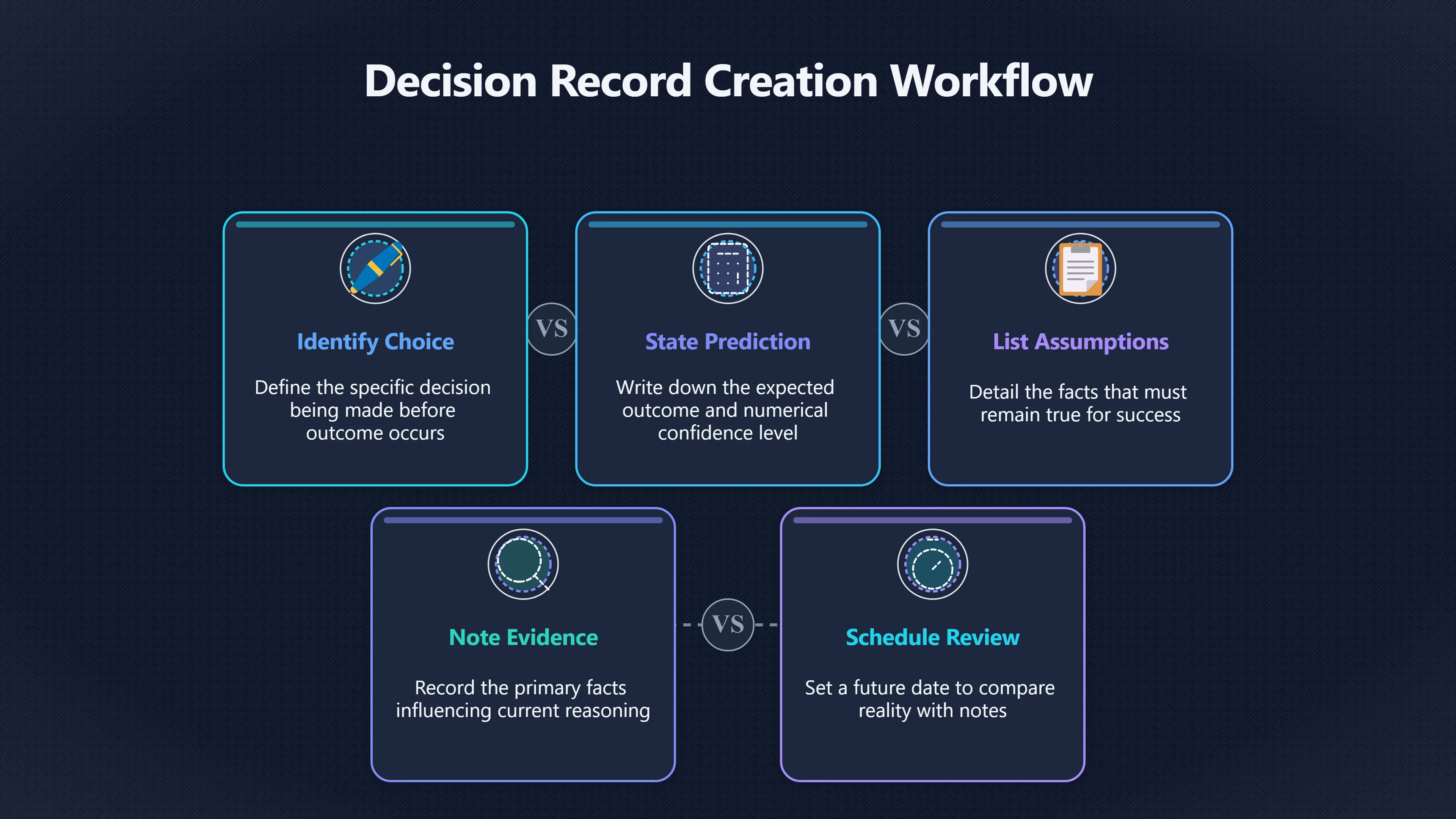
A practical template includes:
- The decision. What choice are you making?
- The prediction. What do you expect to happen?
- Your confidence. Express this numerically where possible, for example 60%, 75% or 90%.
- Key assumptions. What has to be true for your prediction to succeed?
- Main evidence. Which facts influenced you most?
- Alternative explanation. What competing view nearly persuaded you?
- Disconfirming evidence. What future observation would make you conclude you were mistaken?
- Review date. When will you compare prediction with reality?
The discipline lies in writing these points before new information appears. Once the outcome is known, even honest people struggle to separate their original beliefs from reconstructed memories. Research distinguishes hindsight bias not simply as faulty memory, but also as a change in perceived predictability and confidence after the fact.[PubMed+2Carlson School of Management]pubmed.ncbi.nlm.nih.govHindsight Biasby NJ Roese · 2012 · Cited by 926 — Hindsight bias occurs when people feel that they "knew it all along," that is, wh…
How decision records expose rewritten confidence and assumptions
The greatest value of a decision record is not discovering whether you were right. It is discovering whether you remembered your uncertainty accurately.
Without a written record, people commonly make several unconscious revisions:
- They remember having been more confident than they really were.
- They forget evidence that pointed in the opposite direction.
- They remember rejected alternatives as weaker than they originally appeared.
- They compress a messy judgement into a neat story that appears inevitable.
A decision record makes these distortions visible because it preserves the original state of knowledge.
For example, imagine an investment note written before earnings are released:
“I estimate a 65% chance earnings exceed expectations because of improving sales data, although supply costs remain the largest uncertainty.”
If earnings disappoint, hindsight might later produce the feeling that the supply-cost problem had always been obvious. The written note instead reveals that the risk was recognised but judged less likely. This distinction matters because the original reasoning may still have been reasonable even though the prediction failed.
Likewise, if the company exceeds expectations, the note may reveal that success depended on assumptions you only partly anticipated. The outcome does not automatically validate every part of your reasoning.
This separation between decision quality and outcome quality helps reduce outcome bias, where good outcomes make poor reasoning appear wise and bad outcomes make careful reasoning appear foolish.[Wikipedia+2KEVIN DORST]WikipediaOutcome biasOutcome bias
Examples of useful short decision logs
The format should fit the importance of the decision rather than follow a rigid template.
Career decision
- Decision: Accept the new role.
- Confidence: 70% this will improve long-term career opportunities.
- Main assumptions:
Greater autonomy will outweigh higher workload. The manager’s reputation is accurate.
- Biggest uncertainty: Team culture may differ from interviews.
- Review: Reassess after six months.
Later, the review focuses on whether those assumptions proved accurate rather than whether the job simply felt enjoyable.
Project planning
- Prediction: Project completes by 15 October.
- Confidence: 60%.
- Critical assumptions: Supplier delivers on time. Regulatory approval requires one review cycle.
- Early warning signs: Supplier delay exceeding one week. Additional compliance requests.
When delays occur, the record shows whether planning errors came from unrealistic assumptions or from genuinely unpredictable events.
Everyday judgement
- Prediction: The difficult conversation will improve the working relationship.
- Confidence: 55%.
- Reasoning: Previous disagreements came from unclear expectations rather than hostility.
- What would change my mind? Defensive reactions continue over several weeks despite clarification.
Even relatively informal decisions benefit from preserving the reasoning that existed before emotions and outcomes reshape memory.
Common mistakes when keeping decision records
Many decision journals gradually lose value because they become too detailed or are written after the outcome is partly known.
The most common problems include:
- Recording only conclusions instead of underlying assumptions.
- Using vague language such as “fairly confident” instead of explicit probabilities.
- Editing entries after new evidence appears.
- Reviewing only failures while ignoring successful predictions.
- Judging every incorrect prediction as a bad decision instead of asking whether the original evidence justified the judgement.
A useful review asks three separate questions:

- Was my prediction accurate?
- Was my confidence appropriately calibrated?
- Given only the information available at the time, was my reasoning sound?
These questions prevent learning from becoming merely self-congratulation after success or self-criticism after failure.
Making decision records part of a feedback loop
Decision records become increasingly valuable when reviewed repeatedly rather than treated as isolated notes.
Patterns emerge over dozens of decisions. You may discover that you consistently underestimate project times, place excessive weight on recent evidence, or become overconfident whenever a respected colleague agrees with you. Equally, you may find that your cautious 60% predictions succeed around 90% of the time, indicating chronic underconfidence.
This longer-term calibration is difficult to achieve through memory alone because hindsight steadily edits the past. By preserving original beliefs, decision records create an objective baseline against which future judgement can be measured. Over time, they help shift attention from asking, “Was I right?” to the more useful question, “Did I think well given what I knew at the time?” That change in focus is one of the most effective ways to improve analytical judgement under uncertainty. Groningen Research Portal+3PubMed+3Carlson School of Management[pubmed.ncbi.nlm.nih.gov]pubmed.ncbi.nlm.nih.govHindsight Biasby NJ Roese · 2012 · Cited by 926 — Hindsight bias occurs when people feel that they "knew it all along," that is, wh…
Amazon book picks
Further Reading
Books and field guides related to Can a Decision Record Beat Hindsight?. Use these as the next step if you want deeper reading beyond the article.
Superforecasting
Emphasizes recording forecasts, reviewing outcomes and improving judgement through feedback.
The Scout Mindset
Encourages evidence tracking, belief updating and resisting hindsight distortions.
Thinking, Fast and Slow
Explains hindsight bias, overconfidence and memory distortions addressed by decision logs.
Decisive
Supports structured decision processes that pair naturally with written decision records.
eBay marketplace picks
Marketplace Samples
Live-tested eBay searches with available results related to this page.


Endnotes
1.
Source: Wikipedia
Title: Outcome bias
Link:https://en.wikipedia.org/wiki/Outcome_bias
2.
Source: kevindorst.com
Title: 25.9.24 gerken2024
Link:https://www.kevindorst.com/uploads/8/8/1/7/88177244/25.9.24_gerken2024.pdf
Source snippet
Outcome bias and hindsight bias are important in philosophical debates and have wide-ranging implications outside of philosophy.Read more...
3.
Source: pubmed.ncbi.nlm.nih.gov
Link:https://pubmed.ncbi.nlm.nih.gov/26168501/
Source snippet
Hindsight Biasby NJ Roese · 2012 · Cited by 926 — Hindsight bias occurs when people feel that they "knew it all along," that is, wh...
4.
Source: carlsonschool.umn.edu
Title: vohs et al 2012 hindsight bias
Link:https://carlsonschool.umn.edu/sites/carlsonschool.umn.edu/files/2026-01/vohs-et-al-2012-hindsight-bias.pdf
Source snippet
Carlson School of ManagementScience Perspectives on Psychologicalby NJ Roese · 2012 · Cited by 926 — Hindsight bias embodies any combinat...
5.
Source: research.rug.nl
Title: Hindsight bias redefined It s about time
Link:https://research.rug.nl/files/173522109/Hindsight_bias_redefined_It_s_about_time.pdf
Source snippet
Groningen Research PortalHindsight bias redefined: It's about timeby F Fessel · 2009 · Cited by 39 — Four experiments introduced a new co...
Additional References
6.
Source: researchgate.net
Link:https://www.researchgate.net/publication/353386605_Retrospective_and_prospective_hindsight_bias_Replications_and_extensions_of_Fischhoff_1975_and_Slovic_and_Fischhoff_1977
Source snippet
(PDF) Retrospective and prospective hindsight biasHindsight bias refers to the tendency to perceive an event outcome as more probable aft...
7.
Source: semanticscholar.org
Link:https://www.semanticscholar.org/paper/Hindsight-Bias-Roese-Vohs/e3a1affab9b875bdf9889a8f13861991d43e4eed
Source snippet
Hindsight BiasHindsight bias occurs when people feel that they “knew it all along,” that is, when they believe that an event is more pred...
8.
Source: thedecisionlab.com
Link:https://thedecisionlab.com/biases/hindsight-bias
Source snippet
Hindsight BiasHindsight bias, or the knew-it-all-along, is the tendency to claim currents events were to happen even though it was comple...
9.
Source: youtube.com
Title: Before You Make A Hard Decision, Use A Decision Journal (with example)
Link:https://www.youtube.com/watch?v=MbnfgDyz1tQ
Source snippet
How to Calibrate My Decisions | Shane Parrish...
10.
Source: youtube.com
Title: The Ultimate Guide to Using a Decision Journal
Link:https://www.youtube.com/watch?v=ReetUAwTDKk
Source snippet
Before You Make A Hard Decision, Use A Decision Journal (with example)...
11.
Source: pure.mpg.de
Link:https://pure.mpg.de/rest/items/item_2102632_11/component/file_2102631/content
Source snippet
Bias: A By-Product of Knowledge Updating?by U Hoffrage · 2000 · Cited by 464 — Hindsight bias and the knew-it-all-along effect have been...
12.
Source: youtube.com
Title: How to make decisions like the top 1%
Link:https://www.youtube.com/watch?v=KXuncMTGuTo
Source snippet
The Hindsight Bias - I Knew It All Along Phenomenon - Psychology in 5 Minutes...
13.
Source: icheme.org
Link:https://www.icheme.org/media/11758/hazards-26-paper-21-improving-learning-through-interactive-case-studies.pdf
Source snippet
Accounting for hindsight bias: improving learning through...This hindsight bias makes it difficult to objectively review a case study or...
14.
Source: youtube.com
Title: The Hindsight Bias
Link:https://www.youtube.com/watch?v=tjcjSsbjbGc
15.
Source: youtube.com
Title: How to Calibrate My Decisions | Shane Parrish
Link:https://www.youtube.com/watch?v=kwQV4tviN18
Source snippet
How to make decisions like the top 1%...
Topic Tree