Within Sharper Thinking
Why Spacing Practice Makes Thinking Stick
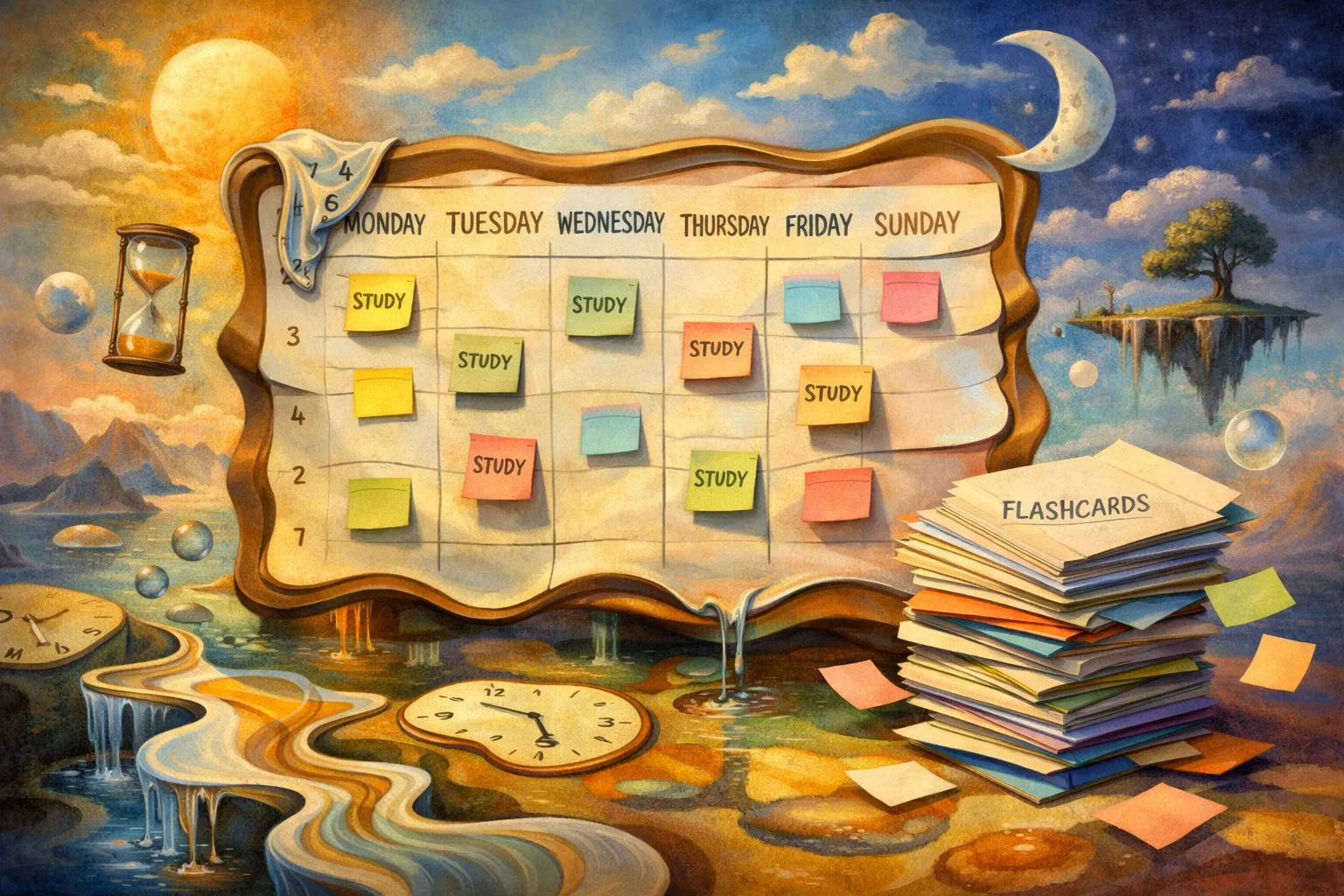
Spacing practice over time builds more durable understanding than cramming everything into one session.
On this page
- How spaced practice works
- Planning short repeated sessions
- Combining spacing with feedback
Page outline Jump by section
Introduction
Distributed practice, often called spacing, means revisiting material across several shorter sessions instead of concentrating the same time into one long burst. For lasting learning, it is one of the most reliable findings in cognitive psychology: information is usually remembered better when study episodes are separated by time, and the best spacing depends on when the learner needs to use the knowledge again. That matters for analytical thinking because reasoning improves when core concepts, examples, methods and counterexamples remain available long after the first lesson, not just during a short period of exam-style fluency. Reviews of learning techniques rate distributed practice highly because it works across many learners, materials and assessment formats, while a large meta-analysis of verbal learning found hundreds of comparisons showing benefits from spacing over massing. [PubMed]pubmed.ncbi.nlm.nih.govImproving Students' Learning With Effective…Practice testing and distributed practice received high utility assessments because…
Spacing is not a magic timetable. It is a way of making learning survive forgetting. A student learning statistics, a manager learning how to read financial reports, or a researcher learning a new analytical method gains more durable skill by returning to the idea after some forgetting has occurred, attempting to reconstruct it, checking errors, and then returning again later. The mental effort is the point: when recall is possible but not effortless, the learner strengthens access to the knowledge they will need for future thinking.
Why spacing beats cramming when the goal is durable thinking
Cramming often feels effective because it creates short-term familiarity. After several hours with the same notes, terms look fluent, examples feel obvious, and the learner can recognise the right answer while the context is still warm. The problem is that this fluency is a poor guide to future availability. Distributed practice interrupts that illusion. By leaving a gap between sessions, it forces the learner to rebuild access to the idea rather than simply continue the same stream of exposure.
That distinction is especially important for thinking and analytical skills. Analysis depends on having useful knowledge ready at the right moment: definitions, distinctions, causal models, base rates, examples, common fallacies, formulae, and procedural steps. If those are learned in one dense block and then disappear, the person may “understand” a concept in the moment but fail to use it when a real problem appears weeks later. Spacing turns learning into repeated re-access, which is closer to the way knowledge is needed in practice.
The evidence base is unusually broad for a learning strategy. Cepeda and colleagues’ 2006 review located 839 assessments from 317 experiments in 184 articles, comparing massed and spaced presentations as well as different spacing intervals. Dunlosky and colleagues’ review of ten learning techniques rated distributed practice and practice testing as high-utility methods because they generalised well across ages, ability levels, tasks and educational settings. [PubMed]pubmed.ncbi.nlm.nih.govDistributed practice in verbal recall tasks: A review and…by NJ Cepeda · 2006 · Cited by 2981 — The authors performed a meta-ana…
The practical takeaway is simple but demanding: do not judge a learning session only by how much is covered. Judge it by whether the learner will be able to use the material after time, interference and partial forgetting. For analytical skills, that means spacing not only facts but also worked examples, explanation prompts, comparison tasks and attempts to solve problems without looking at the solution.
How spaced practice works
Spacing helps because it changes what the learner has to do during the next encounter. A second exposure immediately after the first is easy to process, but that ease can mean shallow processing: the learner recognises the material without needing to reconstruct it. A delayed exposure is harder. It asks the learner to retrieve, compare, repair and reconnect.
Researchers describe several mechanisms that may contribute to the spacing effect rather than one single explanation. The UCLA Bjork Learning and Forgetting Lab summarises the basic finding as repeated information being learned better when presentations are spaced rather than massed, while broader reviews discuss how spacing interacts with retrieval, attention, contextual variation and the difficulty of successful remembering. [Bjork Learning and Forgetting Lab]bjorklab.psych.ucla.eduBjork Learning and Forgetting LabResearchThe spacing effect is the finding that information that is presented repeatedly over spaced inte…
For a learner trying to improve thinking, three mechanisms are especially useful:
- Successful struggle strengthens access. A gap makes recall harder, but if the learner can still recover the idea, that effort improves later access. This is why spacing works best when the delay is challenging but not so long that the learner is lost.
- Repeated contexts build flexible use. Seeing an idea on different days, with different examples and slightly different problems, reduces dependence on one cue. A concept such as “opportunity cost” becomes easier to recognise in a budget, a career choice or a policy debate.
- Forgetting reveals what needs repair. A spaced session exposes weak links. The learner discovers which distinction, step, assumption or example failed to stick, then can correct it before the next session.
This is why spacing is more than “reviewing later”. A weak version of spacing is passive rereading after a delay. A stronger version asks the learner to retrieve first, explain, solve, compare, or predict, then check against feedback. Retrieval practice research shows that testing memory can improve long-term retention relative to repeated studying, and recent reviews treat spacing and retrieval as closely connected strategies for effective learning. [PubMed]pubmed.ncbi.nlm.nih.govOpen source on nih.gov.

The timing question: how far apart should sessions be?
The most common mistake is to ask for one universal spacing interval. The better question is: “When will I need this again?” The optimal gap depends on the desired retention period. If the goal is to remember something next week, the best review interval is shorter than if the goal is to remember it months from now.
A large study by Cepeda and colleagues taught more than 1,350 participants factual material, brought them back for a second learning session after different gaps, and tested them after delays up to a year. The pattern was not “longer is always better”. Performance improved as the gap increased up to a point, then declined when the gap became too long. The optimal gap increased as the final test delay increased; as a proportion of the test delay, it ranged from roughly 20–40 per cent of a one-week delay to about 5–10 per cent of a one-year delay. [PubMed]pubmed.ncbi.nlm.nih.govOpen source on nih.gov.
That finding is useful without turning learning into a precise calendar formula. It suggests that spacing should expand with the time horizon:
- For a discussion, quiz or application later this week, revisit within a day or two.
- For an exam, presentation or decision several weeks away, revisit across multiple weeks.
- For knowledge that should shape long-term judgement, keep returning at wider intervals across months.
The key is to avoid both extremes. Reviewing too soon may create easy familiarity without much strengthening. Waiting too long may make the second session inefficient because the learner has to relearn too much from scratch. Good spacing sits between comfort and collapse.
Planning short repeated sessions
Distributed practice works best when it is built into the learning plan from the start, not treated as emergency revision at the end. A useful routine is to replace one large session with several smaller contacts that each ask the learner to do something active.
For example, someone learning how to evaluate arguments might spread one topic across a week:
- First session: learn the concept and inspect two examples.
- Next day: recall the definition from memory and classify fresh examples.
- Three days later: explain the concept in writing and identify a borderline case.
- One week later: apply the concept to a real article, meeting note or decision memo.
- Later review: revisit mistakes and compare the concept with a nearby one.
This approach is stronger than simply “studying more often” because each session has a retrieval or application demand. The learner is not just refreshing a page; they are practising access and use.
For analytical skills, the best spaced sessions are often short and specific. Ten minutes spent reconstructing a causal diagram, explaining a statistical concept without notes, or identifying the weakest assumption in a decision can be more valuable than an hour of passive rereading. Reviews of effective learning emphasise that spacing and retrieval are underused partly because they feel less fluent than rereading, even though they produce better long-term learning. [ResearchGate]researchgate.netResearch Gate The science of effective learning with a focus on spacingResearch Gate The science of effective learning with a focus on spacing
The planning principle is therefore: schedule the next encounter before the current one feels finished. After learning a concept, decide when it will be recalled, where it will be applied, and what evidence will show that it has survived.

Combining spacing with feedback
Spacing makes weaknesses visible; feedback turns those weaknesses into learning. Without feedback, a learner may repeatedly retrieve the wrong explanation, practise a faulty procedure, or overestimate understanding. With feedback, each spaced attempt becomes a calibration event.
Feedback is especially important for improving thinking because analytical errors are often subtle. A person may remember a term but apply it too broadly, draw a causal conclusion from weak evidence, or confuse correlation with explanation. A spaced practice routine should therefore include checks against answers, worked examples, expert comments, peer critique, or real-world outcomes where available.
Retrieval practice research supports this combination. Roediger and Karpicke’s work helped establish that testing can be more than assessment: the act of retrieval itself improves later retention. Later classroom-focused and review work has stressed that retrieval should be repeated after delays and should include conditions that help learners correct errors, not just produce scores. [PubMed]pubmed.ncbi.nlm.nih.govOpen source on nih.gov.
A practical feedback loop for spaced analytical practice looks like this:
- Try first without notes. Recall, solve, explain or classify before checking.
- Compare with a standard. Use a model answer, rubric, worked solution, expert explanation or reliable source.
- Mark the error type. Was the problem memory, misunderstanding, overconfidence, missing evidence or weak transfer?
- Schedule the next attempt. Bring back the same idea later in a slightly different form.
The final step matters. Feedback received once can feel corrective but still fade. Feedback revisited after a gap becomes part of durable judgement.
What spacing looks like for real thinking tasks
Spacing is often explained with vocabulary lists, but its value is broader. The same principle applies when the goal is to improve reasoning, decision-making or analysis.
A learner working on evidence evaluation might space practice across different source types. On Monday, they judge whether a news claim is supported by the cited data. On Thursday, they inspect a chart and identify what it does not show. The next week, they compare two explanations for the same event. The repeated theme is not a single fact, but a recurring analytical move: ask what evidence would actually support the conclusion.
A student learning statistics might space not only formulae but interpretation. Instead of doing all practice problems on one afternoon, they return to confidence intervals, sampling bias and regression assumptions across several weeks. Each return should include both computation and explanation: what the result means, what it does not mean, and what would make the inference unsafe.
A professional learning a new decision routine might space small applications. First they learn the routine; later they apply it to a low-stakes decision; later still they use it to review a past decision. This matters because workplace feedback is often delayed and noisy. Spacing gives the routine repeated chances to become available before the next pressured judgement.
These examples show why distributed practice belongs inside analytical skill-building rather than only exam preparation. It helps convert isolated insight into usable habit.
Why learners underuse spacing
The main barrier is not that spacing is complicated. It is that it feels worse while it is working. Massed study produces a smooth sense of progress: pages are covered, examples are familiar, and answers come quickly. Spaced practice reintroduces difficulty. The learner may feel slower, less confident and less fluent, even when the method is producing better long-term retention.
Carpenter, Pan and Butler’s review highlights this metacognitive problem: effective learning strategies are often underused because learners have false beliefs about learning, lack awareness of better strategies, or find the strategies counter-intuitive. In other words, people often choose the method that feels good during study rather than the one that supports later performance. [WashU Research Profiles]profiles.wustl.eduWashU Research ProfilesThe science of effective learning with spacing and retrieval…by SK Carpenter · 2022 · Cited by 289 — In this Re…
This matters for any programme aimed at improving thinking. If learners expect progress to feel easy, spacing may look like failure: “I learned this already, so why is it hard to recall?” A better interpretation is: “This is the moment where learning becomes durable.” The difficulty is useful only within limits, but some friction is a feature of the method.
Teachers, trainers and self-directed learners can reduce resistance by making the purpose explicit. A short explanation helps: forgetting is expected, effortful recall is valuable, and mistakes during low-stakes practice are information. Spacing should feel like a manageable challenge, not a punishment for imperfect memory.
Where the evidence is strong, and where caution is needed
The spacing effect is one of the better-supported principles in learning science, but implementation still matters. Laboratory evidence is extensive, and major reviews support distributed practice as a high-utility strategy. At the same time, classroom and workplace conditions are messier than controlled experiments: learners vary, curricula are crowded, feedback quality differs, and “spacing” can mean many different schedules. [PubMed]pubmed.ncbi.nlm.nih.govImproving Students' Learning With Effective…Practice testing and distributed practice received high utility assessments because…
Recent applied reviews point to this tension. Work on classroom learning notes that distributed practice has strong laboratory support, while applied studies must still clarify which designs work best in real courses, with real assessments and competing instructional demands. A systematic review of retrieval, distributed and interleaved practice in classroom settings found more consistent benefits for retrieval and interleaving than for distributed practice alone, partly reflecting the difficulty of isolating spacing in complex classrooms. [PMC]pmc.ncbi.nlm.nih.govPMCThe Distributed Practice Effect on Classroom LearningPMCThe Distributed Practice Effect on Classroom Learning
That caution should not lead to abandoning spacing. It should lead to better design. Spacing is weakest when it becomes a vague reminder to “revise regularly”. It is strongest when paired with active recall, varied examples, feedback and a clear retention goal.
The most defensible claim is therefore measured but useful: distributing practice over time is usually better for long-term retention than massing the same practice into one session, especially when learners must later retrieve and use the knowledge. The exact schedule should be adapted to the material, the learner, the feedback available and the future use case.
A simple spacing policy for learning that lasts
A good spacing policy is a small rule that changes behaviour before motivation runs out. For improving thinking and analytical skills, the rule should cover concepts, procedures and applications, not just facts.
Use this policy:
Every important idea gets at least three later encounters. The first is soon enough to prevent total loss, the second after enough delay to make recall effortful, and the third in a new context where the idea must be used rather than merely recognised.
That policy can be translated into a practical pattern:
- Same day or next day: quick recall of the core idea without notes.
- Several days later: apply it to a fresh example or problem.
- One to two weeks later: explain it, compare it with a related idea, or use it in a realistic task.
- Later still for high-value knowledge: revisit through cumulative practice, not isolated revision.
For thinking skills, the final step is the most important. Cumulative practice prevents old ideas from being sealed inside old lessons. A learner who repeatedly brings back prior concepts while analysing new material is more likely to build a connected toolkit: evidence standards, causal reasoning, probability, trade-offs, uncertainty and decision checks all become easier to call on together.
Spacing makes thinking stick because it respects how memory actually behaves. Understanding gained once is fragile. Understanding returned to, tested, corrected and reused becomes part of how a person thinks.
eBay marketplace picks
Marketplace Samples
Live-tested eBay searches with available results related to this page.


Endnotes
-
Source: bjorklab.psych.ucla.edu
Link: https://bjorklab.psych.ucla.edu/research/Source snippet
Bjork Learning and Forgetting LabResearchThe spacing effect is the finding that information that is presented repeatedly over spaced inte...
-
Source: researchgate.net
Title: Research Gate The science of effective learning with a focus on spacing
Link: https://www.researchgate.net/publication/362093173_The_science_of_effective_learning_with_a_focus_on_spacing_and_retrieval_practice -
Source: pmc.ncbi.nlm.nih.gov
Title: PMCThe Distributed Practice Effect on Classroom Learning
Link: https://pmc.ncbi.nlm.nih.gov/articles/PMC12189222/ -
Source: distributed.net
Link: https://www.distributed.net/ -
Source: researchgate.net
Link: https://www.researchgate.net/publication/7062225_Distributed_Practice_in_Verbal_Recall_Tasks_A_Review_and_Quantitative_Synthesis -
Source: researchgate.net
Link: https://www.researchgate.net/publication/235983059_Using_Spacing_to_Enhance_Diverse_Forms_of_Learning_Review_of_Recent_Research_and_Implications_for_Instruction -
Source: researchgate.net
Link: https://www.researchgate.net/publication/5574966_The_Critical_Importance_of_Retrieval_for_Learning -
Source: researchgate.net
Link: https://www.researchgate.net/publication/303833330_Distributed_Practice_and_Retrieval_Practice_in_Primary_School_Vocabulary_Learning_A_Multi-classroom_Study_Distributed_Practice_and_Retrieval_Practice -
Source: researchgate.net
Link: https://www.researchgate.net/publication/392383866_The_Distributed_Practice_Effect_on_Classroom_Learning_A_Meta-Analytic_Review_of_Applied_Research -
Source: researchgate.net
Title: 23657355 Spacing Effects in Learning A Temporal Ridgeline of Optimal Retention
Link: https://www.researchgate.net/publication/23657355_Spacing_Effects_in_Learning_A_Temporal_Ridgeline_of_Optimal_Retention -
Source: cirtl.ceils.ucla.edu
Title: learning strategies
Link: https://cirtl.ceils.ucla.edu/learning-strategies/ -
Source: pubmed.ncbi.nlm.nih.gov
Link: https://pubmed.ncbi.nlm.nih.gov/26173288/Source snippet
Improving Students' Learning With Effective...Practice testing and distributed practice received high utility assessments because...
-
Source: pubmed.ncbi.nlm.nih.gov
Link: https://pubmed.ncbi.nlm.nih.gov/16719566/Source snippet
Distributed practice in verbal recall tasks: A review and...by NJ Cepeda · 2006 · Cited by 2981 — The authors performed a meta-ana...
-
Source: profiles.wustl.edu
Link: https://profiles.wustl.edu/en/publications/the-science-of-effective-learning-with-spacing-and-retrieval-prac/Source snippet
WashU Research ProfilesThe science of effective learning with spacing and retrieval...by SK Carpenter · 2022 · Cited by 289 — In this Re...
-
Source: pubmed.ncbi.nlm.nih.gov
Link: https://pubmed.ncbi.nlm.nih.gov/20951630/ -
Source: pubmed.ncbi.nlm.nih.gov
Link: https://pubmed.ncbi.nlm.nih.gov/19076480/ -
Source: pmc.ncbi.nlm.nih.gov
Link: https://pmc.ncbi.nlm.nih.gov/articles/PMC2930147/ -
Source: pmc.ncbi.nlm.nih.gov
Link: https://pmc.ncbi.nlm.nih.gov/articles/PMC11078833/ -
Source: pmc.ncbi.nlm.nih.gov
Link: https://pmc.ncbi.nlm.nih.gov/articles/PMC4480221/ -
Source: pmc.ncbi.nlm.nih.gov
Link: https://pmc.ncbi.nlm.nih.gov/articles/PMC6289840/ -
Source: dictionary.cambridge.org
Link: https://dictionary.cambridge.org/dictionary/english/spacing -
Source: edresearch.edu.au
Title: spacing retrieval
Link: https://www.edresearch.edu.au/summaries-explainers/explainers/spacing-retrieval -
Source: psychnet.wustl.edu
Title: Roediger Karpicke 2006 PPS -
Source: education-ni.gov.uk
Title: Retrieval Practice
Link: https://www.education-ni.gov.uk/sites/default/files/2025-04/May%20Newsletter%20-%20Retrieval%20Practice%20%20What%20it%20is%2C%20Why%20it%20Works%20and%20How%20to%20Do%20It%20Better.PDF -
Source: get-alfred.ai
Title: spacing effect
Link: https://get-alfred.ai/blog/spacing-effect -
Source: donaldclarkplanb.blogspot.com
Title: Roediger and Karpicke
Link: https://donaldclarkplanb.blogspot.com/2021/10/roediger-and-karpicke-retrieval.html
Additional References
-
Source: youtube.com
Title: What is spaced practice, and how can it be used as a teaching tool?
Link: https://www.youtube.com/watch?v=9irar_7ceMsSource snippet
Benedict Carey on Study Hacks for Better Learning | Amber Book...
-
Source: youtube.com
Title: Spaced Practice – Helping Students Remember More
Link: https://www.youtube.com/watch?v=LQ56qupqlO0Source snippet
The Most Powerful Way to Remember What You Study | Spaced Repetition (Evidence Based)...
-
Source: youtube.com
Title: Benedict Carey on Study Hacks for Better Learning | Amber Book
Link: https://www.youtube.com/watch?v=5inkPKmC0i4Source snippet
Spaced Practice – Helping Students Remember More...
-
Source: yorku.ca
Link: https://www.yorku.ca/ncepeda/publications/WKWKKF2019.pdf -
Source: ase.org.uk
Link: https://www.ase.org.uk/system/files/17-21%20SSRD%20392%20Bates.pdf -
Source: slideshare.net
Link: https://www.slideshare.net/slideshow/distributed-practice-in-verbal-recall-tasks-a-review-and-quantitative-synthesis/4693541 -
Source: semanticscholar.org
Link: https://www.semanticscholar.org/paper/Distributed-Practice-or-Spacing-Effect-Oxford-of-Carpenter/9f0090444bdf81a74637b4c14fb62d111051c71c -
Source: medium.com
Link: https://medium.com/education-shortform/distributed-practice-bd429fb728a6 -
Source: educationendowmentfoundation.org.uk
Link: https://educationendowmentfoundation.org.uk/projects-and-evaluation/research-agenda-themes-priority-areas/research-agenda-theme-cognitive-science -
Source: evidencebased.education
Link: https://evidencebased.education/resource/retrieval-and-spaced-practice-study-strategies-that-must-be-combined/
Topic Tree