Within Critical Skills
How to Test Claims Without Guessing
Evidence evaluation transfers best when learners practise judging real claims, from health headlines to workplace data and public policy.
On this page
- What counts as evidence in real decisions
- How to separate evidence from assertion
- Practice examples from health, media and work
Page outline Jump by section
Introduction
Learning to evaluate evidence is one of the most practical critical thinking skills because it applies to decisions people make every day, not just to school assignments. Whether reading a headline about a new health treatment, hearing a colleague justify a business decision, or seeing a claim spread on social media, the key question is the same: What evidence supports this claim, and is that evidence strong enough?
 Research suggests that people become better at answering this question when they repeatedly practise evaluating real-world claims rather than memorising abstract rules. Effective teaching focuses on comparing evidence, identifying common reasoning errors, checking sources independently, and deciding how much confidence a conclusion deserves. These habits transfer more readily to everyday life because they mirror the way evidence is encountered outside classrooms, where information is incomplete, persuasive and often contested. [Nature+2stacks.stanford.edu]nature.comEffectiveness of training actions aimed at improving critical…by JM Marcos-Vílchez · 2025 · Cited by 3 — Although evidence suppo…
What counts as evidence in real decisions?
One of the first lessons is that evidence is not the same as confidence. A confident speaker, a professional-looking website or a widely shared post may persuade people, but none of these features prove that a claim is true.
Instead, learners should distinguish between different kinds of support:
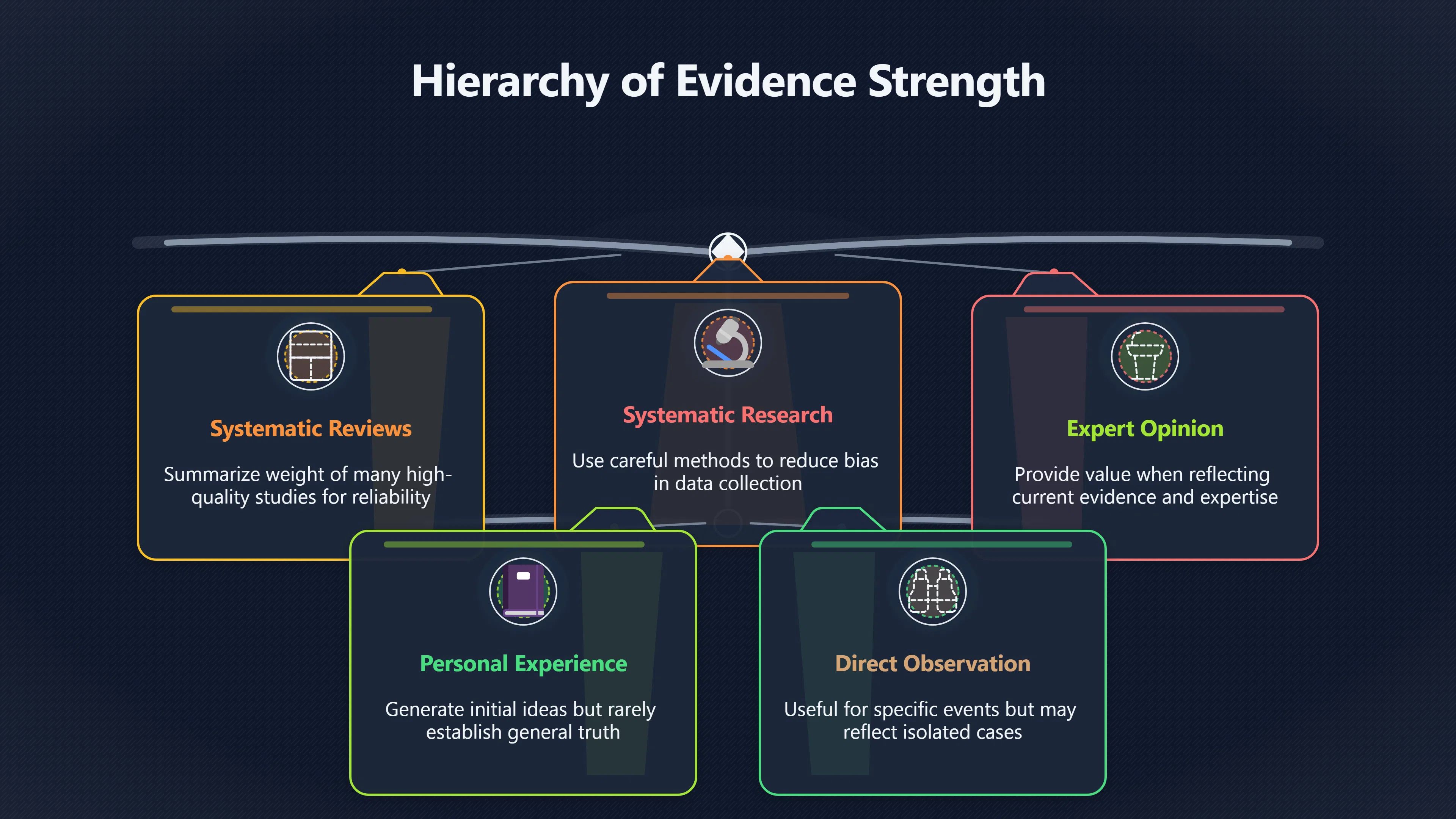
- Direct observations, while useful, may reflect unusual or isolated events.
- Personal experience can generate ideas but rarely establishes general truth.
- Expert opinion is valuable when it reflects expertise and current evidence, but experts can disagree or rely on incomplete information.
- Systematic research usually provides stronger evidence because it attempts to reduce bias through careful methods.
- Reviews that combine many high-quality studies often provide more reliable conclusions than single studies because they summarise the weight of available evidence rather than isolated findings. [UNESCO Document Portal]unesdoc.unesco.orgStudies do not all provide the same level of scientific evidence. This is known as the 'evidence…Read more…
Teaching should avoid suggesting that one type of evidence automatically settles every question. Different decisions require different standards. Choosing a medical treatment, assessing customer satisfaction and estimating future sales all rely on evidence, but they demand different methods and different levels of certainty.
An effective classroom discussion therefore shifts attention away from asking, “Is this evidence?” towards asking, “How much confidence should this evidence give us?”
How to separate evidence from assertion
Many everyday claims mix factual information with interpretation. Learners benefit from practising how to separate the two before deciding whether to believe the conclusion.
A practical sequence includes:
- Identify the exact claim. Vague statements such as “this product works” or “crime is increasing” should be rewritten into precise, testable claims.
- Locate the supporting evidence. Ask what observations, measurements or research are actually presented.
- Judge relevance. Some evidence may be true but unrelated to the claim being made.
- Consider quality. Look for sample size, comparison groups, independent replication and possible sources of bias.
- Ask what evidence would change your mind. This discourages treating belief as a matter of personal loyalty rather than evidence.
This process encourages learners to evaluate reasons instead of reacting to rhetoric. Over time, the routine becomes a habit that can be applied in conversations, meetings and media consumption.
Why source checking works differently online
Digital environments require an additional skill because unreliable information often imitates trustworthy presentation. Professional design, persuasive language and apparent expertise are easy to copy.
Research comparing professional fact-checkers with students found that experts rarely stay on an unfamiliar webpage trying to judge it from appearance alone. Instead, they immediately leave the page to investigate the organisation, author and reputation through independent sources. This strategy, known as lateral reading, consistently outperformed judging websites by surface features. [stacks.stanford.edu]stacks.stanford.eduLateral Reading and the Nature of Expertise28 Jul 2018 — This study compares how professional fact checkers, historians, and first year college students evaluated online info…
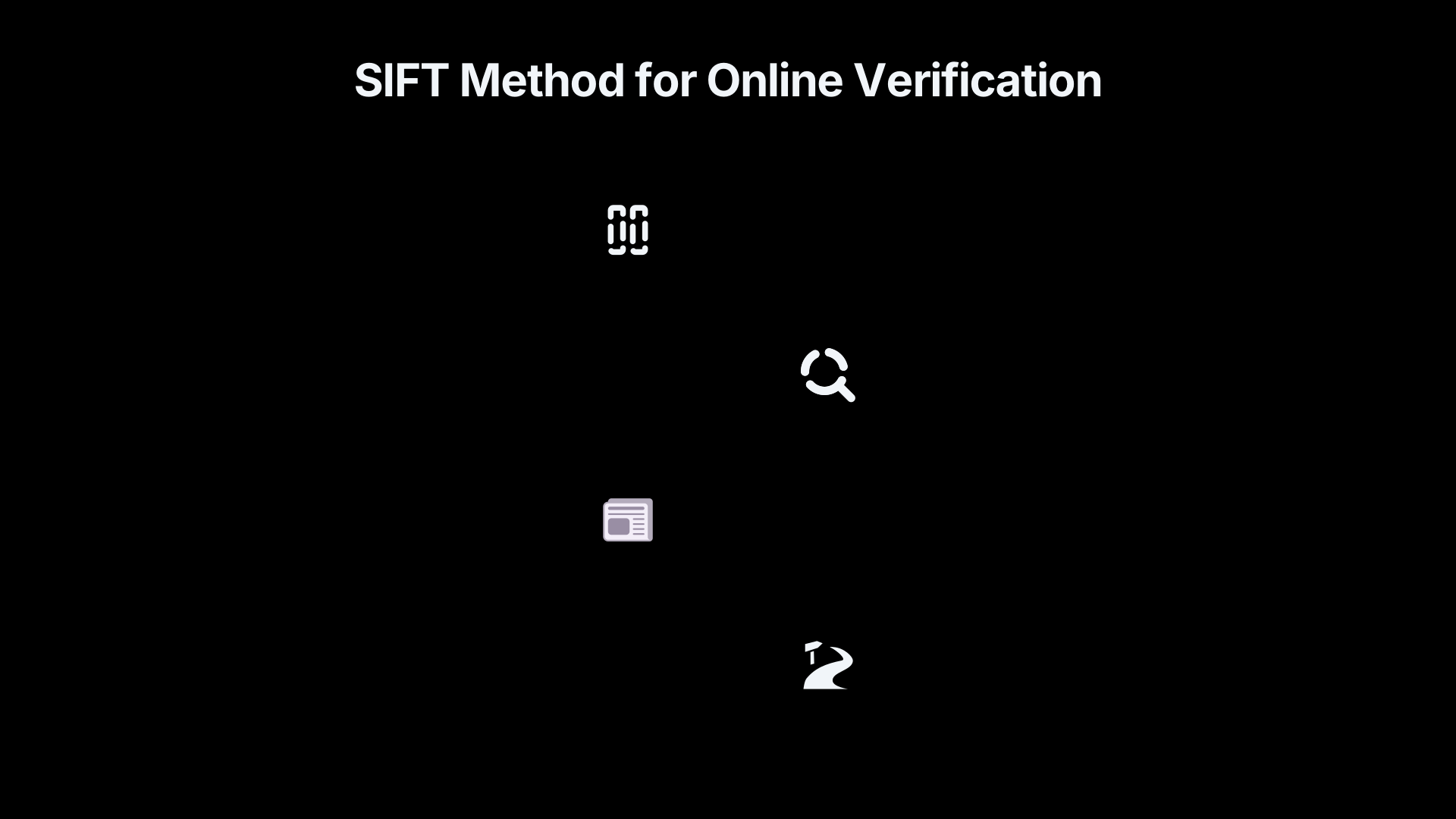
Educational programmes based on lateral reading and the SIFT approach (“Stop, Investigate the source, Find better coverage, Trace claims back to their original context”) have improved learners’ ability to evaluate online information in schools and universities. Gains appear strongest when students repeatedly practise evaluating authentic online content rather than completing isolated lessons about misinformation. [PubMed+2Sage Journals]pubmed.ncbi.nlm.nih.govInterventions to help people read like fact checkersby S McGrew · 2024 · Cited by 70 — This article reviews recent research on inte…
The practical lesson is simple: when encountering an unfamiliar claim online, spend less time inspecting the page itself and more time checking what independent sources say about it.
Practice examples from health, media and work
Teaching transfers best when learners repeatedly examine claims that resemble those they will encounter outside education.
Health headlines
A news story announces that a food “reduces cancer risk by 40%.”
Instead of asking whether the headline is believable, learners examine:
- Was the research conducted in humans or animals?
- Was it an observational study or an experiment?
- How large was the study?
- Does the headline report relative risk while hiding the absolute change?
- Have similar studies reached the same conclusion?
This exercise helps students discover that dramatic headlines often simplify uncertain evidence rather than deliberately mislead.
Media reporting
A viral post claims that “scientists have proved” a controversial position.
Students compare:
- the original study,
- independent reporting,
- expert commentary,
- and whether the post accurately represents the findings.
The aim is not to distrust all media but to understand how information changes as it is summarised and shared.
Workplace decisions
A manager argues that a new process increased productivity because output rose after implementation.
Learners ask:
- Were other changes happening at the same time?
- Was there a comparison group?
- Is the improvement larger than normal variation?
- Would similar results appear across multiple teams?
This introduces the idea that correlation alone does not establish causation while remaining directly relevant to organisational decision-making.
Common mistakes learners should recognise
Evidence evaluation improves when instruction explicitly addresses predictable errors rather than assuming students will avoid them naturally.
Frequent mistakes include:
- treating repeated claims as stronger evidence;
- confusing popularity with accuracy;
- relying on vivid anecdotes instead of representative data;
- accepting evidence that supports existing beliefs while ignoring contradictory findings;
- assuming that correlation proves one event caused another;
- giving equal weight to weak and strong evidence simply because both are presented.
Teaching these mistakes through realistic examples is generally more effective than presenting them as abstract logical fallacies because learners recognise the situations in which they naturally occur. [www.ofcom.org.uk]ofcom.org.ukrea online misinformationThe review is focused on…

Teaching routines that encourage transfer
Transfer improves when evidence evaluation becomes a repeated decision routine rather than a one-off lesson.
Useful classroom routines include asking learners to explain:
- What is the claim?
- What evidence supports it? [nature.com]nature.comEffectiveness of training actions aimed at improving critical…by JM Marcos-Vílchez · 2025 · Cited by 3 — Although evidence suppo…
- How strong is that evidence?
- What alternative explanation exists?
- What additional evidence would increase confidence?
Repeated use of these questions across different topics—health, economics, workplace scenarios, public policy and media stories—helps learners recognise the same reasoning structure beneath different subject matter.
Recent systematic reviews suggest that interventions combining explicit instruction, guided practice and authentic examples are generally more successful than programmes that teach critical thinking only as a collection of abstract principles. Interactive practice, feedback and repeated application appear especially important for improving resistance to misleading claims. [Nature]nature.comEffectiveness of training actions aimed at improving critical…by JM Marcos-Vílchez · 2025 · Cited by 3 — Although evidence suppo…
The goal is calibrated judgement, not permanent scepticism
Good evidence evaluation does not mean rejecting every unfamiliar claim or demanding impossible proof before acting. Everyday decisions often must be made with incomplete information.
The more useful habit is calibrated judgement: matching confidence to the strength of available evidence. Strong, independently replicated evidence justifies greater confidence. Weak, incomplete or conflicting evidence calls for caution and openness to revision.
People who learn this approach become neither unquestioning believers nor reflexive sceptics. Instead, they develop a practical habit of asking whether the available evidence is sufficient for the decision at hand—and of changing their minds when better evidence appears.
Amazon book picks
Further Reading
Books and field guides related to How to Test Claims Without Guessing. Use these as the next step if you want deeper reading beyond the article.
Calling Bullshit
Directly teaches readers how to assess evidence, statistics, and persuasive assertions.
The Skeptics' Guide to the Universe
Covers evaluating evidence, logical fallacies, scientific reasoning, and misinformation.
Thinking, Fast and Slow
Explains cognitive biases and how to evaluate evidence and claims more carefully.
The Demon-Haunted World
Rating: 4.5/5 from 43 Google Books ratings
Promotes skeptical inquiry and evidence-based evaluation of extraordinary claims.
eBay marketplace picks
Marketplace Samples
Live-tested eBay searches with available results related to this page.



Endnotes
-
Source: nature.com
Link: https://www.nature.com/articles/s41599-025-06143-6Source snippet
Effectiveness of training actions aimed at improving critical...by JM Marcos-Vílchez · 2025 · Cited by 3 — Although evidence suppo...
-
Source: stacks.stanford.edu
Title: Civic Online Reasoning
Link: https://stacks.stanford.edu/file/druid%3Axr124mv4805/COR%20Curriculum%20Evaluation.pdfSource snippet
Civic Online Reasoning (COR)—the ability to search for, evaluate, and verify social and political information. available for free a...
-
Source: ofcom.org.uk
Title: rea online misinformation
Link: https://www.ofcom.org.uk/siteassets/resources/documents/research-and-data/online-research/online-nation/2021/rea-online-misinformation.pdf?v=326529Source snippet
The review is focused on...
-
Source: unesdoc.unesco.org
Link: https://unesdoc.unesco.org/ark%3A/48223/pf0000392085Source snippet
Studies do not all provide the same level of scientific evidence. This is known as the 'evidence...Read more...
-
Source: stacks.stanford.edu
Title: Lateral Reading and the Nature of Expertise
Link: https://stacks.stanford.edu/file/druid%3Ayk133ht8603/Wineburg%20McGrew_Lateral%20Reading%20and%20the%20Nature%20of%20Expertise.pdfSource snippet
28 Jul 2018 — This study compares how professional fact checkers, historians, and first year college students evaluated online info...
-
Source: purl.stanford.edu
Link: https://purl.stanford.edu/fv751yt5934Source snippet
Evaluating Information: The Cornerstone of Civic Online...22 Nov 2016 — Stanford History Education Group has prototyped, field tested, a...
-
Source: unesdoc.unesco.org
Link: https://unesdoc.unesco.org/ark%3A/48223/pf0000387547Source snippet
monitoring and evaluation: at the crossroads of...The effectiveness of augmented reality and virtual reality technologies in education...
-
Source: pubmed.ncbi.nlm.nih.gov
Link: https://pubmed.ncbi.nlm.nih.gov/38039950/Source snippet
Interventions to help people read like fact checkersby S McGrew · 2024 · Cited by 70 — This article reviews recent research on inte...
-
Source: journals.sagepub.com
Link: https://journals.sagepub.com/doi/10.1177/23328584211038937Source snippet
Sage JournalsAssociations Between Online Instruction in Lateral...16 Aug 2021 — We examined whether the curriculum improved students' us...
-
Source: scienceofboosting.org
Title: Lateral Reading
Link: https://www.scienceofboosting.org/project/lateral-reading/Source snippet
Boosting4 May 2023 — Lateral reading is a simple heuristic for online fact-checking: Open multiple tabs in your browser and search the We...
Published: May 2023
Additional References
-
Source: researchgate.net
Link: https://www.researchgate.net/publication/371387800_Civic_Online_Reasoning_Across_the_Curriculum_Developing_and_Testing_the_Efficacy_of_Digital_Literacy_LessonsSource snippet
Civic Online Reasoning Across the Curriculum: Developing...27 May 2026 — Civic online reasoning teaches students how to evaluate source...
Published: May 2026
-
Source: eu-jer.com
Link: https://www.eu-jer.com/a-meta-analysis-of-the-effectiveness-of-[problem-based-learningSource snippet
A Meta-analysis of the Effectiveness of Problem-based...by L Lu · 2025 · Cited by 36 — This study investigates two primary questions: fi...
-
Source: oecd.org
Link: https://www.oecd.org/content/dam/oecd/en/publications/reports/2007/06/evidence-in-education_g1gh7fde/9789264033672-en.pdfSource snippet
ic reviews of impact evaluations, and standards...
-
Source: cor.inquirygroup.org
Link: https://cor.inquirygroup.org/Source snippet
Online Reasoning - Digital Inquiry GroupFree lessons and assessments that help you teach students to evaluate online information that aff...
-
Source: oecd.org
Title: 1104143e en
Link: https://www.oecd.org/content/dam/oecd/en/publications/reports/2022/08/policy-responses-to-false-and-misleading-digital-content_598ca9a6/1104143e-en.pdfSource snippet
Policy responses to false and misleading digital content (EN)27 Jul 2022 — This working paper now turns to the emerging risk of false and...
-
Source: files.eric.ed.gov
Link: https://files.eric.ed.gov/fulltext/EJ1323863.pdfSource snippet
Between Online Instruction in Lateral...by JE Brodsky · 2021 · Cited by 76 — Students improved from pretest to posttest in the use of la...
-
Source: youtube.com
Title: Evaluating Evidence: Crash Course Navigating Digital Information #6
Link: https://www.youtube.com/watch?v=hxhbOvR2TGkSource snippet
Critical Thinking; Evidence:- 21. #evidence #critical_thinking...
-
Source: youtube.com
Title: Real Confidence Is Built From a Body of Evidence: A Goju Meandering Episode
Link: https://www.youtube.com/watch?v=vWm2BiPoqLcSource snippet
What is Systematic Reviews by Helen Worthington...
-
Source: youtube.com
Title: Critical Thinking Making evidence-based decisions
Link: https://www.youtube.com/watch?v=vypkOQU1rq8Source snippet
Real Confidence Is Built From a Body of Evidence: A Goju Meandering Episode...
-
Source: youtube.com
Title: Critical Thinking; Evidence:- 21. #evidence #critical_thinking
Link: https://www.youtube.com/watch?v=jbrAe9GSBjASource snippet
Critical Thinking Making evidence-based decisions...
Topic Tree