Within Search Bias
Does AI Search Make Bias Harder to See?
AI search can feel like a balanced synthesis while hiding how prompts, retrieval choices, and citations shaped the answer.
On this page
- Why fluent answers feel more neutral than links
- How prompts shape AI assisted search results
- Checking citations instead of trusting synthesis
Page outline Jump by section
Introduction
AI search can make confirmation bias harder to see because it turns source selection into a hidden step. In traditional search, the user can scan a results page, compare publishers, notice missing viewpoints and decide what to open. In AI-assisted search, the system often gives a polished answer first, with only a small set of visible citations. That answer may feel neutral because it is fluent, concise and apparently sourced, but the user usually cannot see which sources were retrieved, excluded, summarised, down-ranked or blended into the final wording. Research on generative search engines has found that fluent answers can contain unsupported statements and inaccurate citations, while user studies show that AI summaries reduce link-clicking and encourage people to stop at the generated answer.[arXiv]arxiv.orgarXiv Evaluating Verifiability in Generative Search EnginesEvaluating Verifiability in Generative Search EnginesApril 19, 2023…
 For someone trying to improve their thinking, the risk is not simply that AI search may be wrong. The deeper risk is that it can remove the friction that normally exposes bias: competing headlines, unfamiliar sources, awkward counter-evidence and the visible trail of how an answer was assembled.
Why Fluent Answers Feel More Neutral Than Links
A list of search results looks unfinished. It invites judgement: Which source is official? Which one is selling something? Which result is old? Which result disagrees? An AI search answer changes that experience by presenting the output as if the comparison has already been done. Google describes AI Overviews as snapshots of key information with links to explore further, while Ofcom defines generative AI search as direct natural-language responses that may appear instead of, or above, ranked links. Google Search - A new kind of help[search.google]search.googleGoogle SearchGoogle Search
That format is useful, especially for quick orientation. But it also changes the psychology of verification. In Ofcom’s qualitative research with UK adults, participants often found AI search summaries helpful and accurate, and there was a tendency to trust them when the cited links appeared legitimate. The important detail is that legitimacy was often judged from the presence and appearance of sources, not necessarily from close checking of whether each source supported each claim.[www.ofcom.org.uk]ofcom.org.ukwww.ofcom.org.uk Generative AI Search Qualitative Research Reportwww.ofcom.org.uk Generative AI Search Qualitative Research Report
This matters because citations can create what Stanford researchers called a “facade of trustworthiness”. In an evaluation of Bing Chat, NeevaAI, Perplexity and YouChat across 1,450 queries, only 51.5% of generated sentences were fully supported by citations, and only 74.5% of citations supported the sentence they were attached to. The study’s uncomfortable finding was not just that citations sometimes failed; it was that the answers still appeared fluent and useful.[arXiv]arxiv.orgarXiv Evaluating Verifiability in Generative Search EnginesEvaluating Verifiability in Generative Search EnginesApril 19, 2023…
A traditional search result page can still bias the user, but it leaves more of the evidence environment visible. AI search compresses that environment. A user may see three or four citations and infer that the answer represents the broader web, when those citations may be only the small visible end of a much larger retrieval and ranking process.
How Prompts Shape AI-Assisted Search Results
An AI search prompt is not a neutral request for information. It is an instruction that shapes what the system retrieves, how it frames the answer and which sources look relevant. A prompt such as “why is intermittent fasting effective?” invites a different answer from “intermittent fasting evidence benefits risks systematic reviews”. The first asks for a rationale; the second asks for an evidence map.
This is where AI search connects directly to confirmation bias. The parent problem is that people often search in the direction of their existing belief. AI search can intensify that pattern because the system may convert a leading prompt into a coherent answer rather than forcing the user to confront a mixed results page. The user does not merely choose a biased link; they may receive a biased synthesis whose source pathway is mostly hidden.
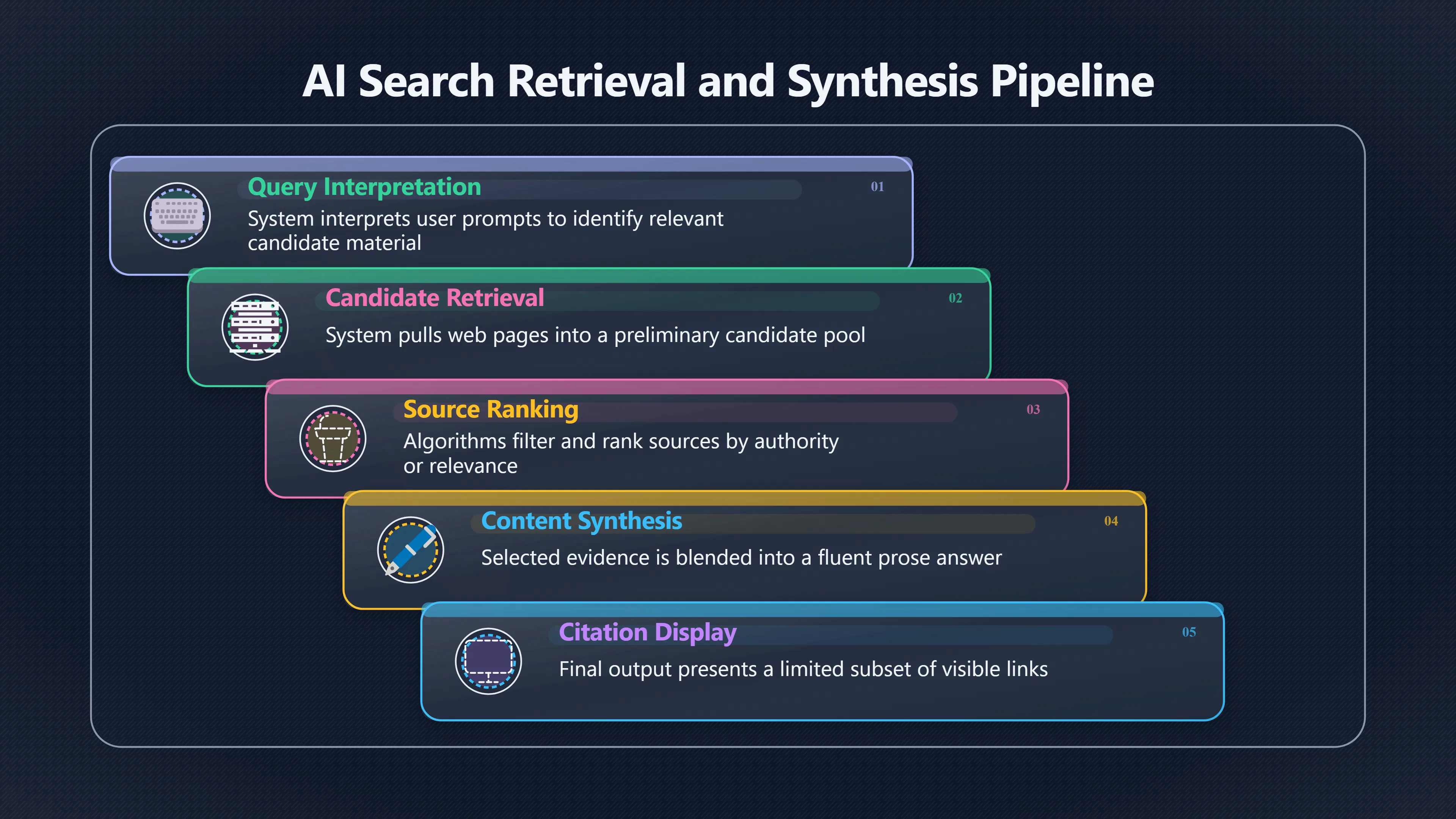
The technical reason is simple enough to understand without knowing the full system. Many AI search tools use some form of retrieval-augmented generation: the system interprets the query, retrieves candidate material, ranks or filters it, and then generates an answer from selected evidence. Google’s documentation for site owners says AI features in Search rely on Google’s systems and links, while answer-engine research has found that systems often cite only a limited subset of the sources they retrieve or display.[Google for Developers]developers.google.comOpen source on google.com.
That means prompt wording can affect several stages at once:
- Retrieval: which pages are considered relevant enough to enter the candidate pool.
- Ranking: which retrieved sources are treated as more useful, authoritative, recent or extractable.
- Synthesis: which claims become part of the final answer.
- Citation display: which sources are shown to the user as support for the answer.
The user sees the last two outputs most clearly: prose and citations. The first two stages, where much of the bias can enter, are usually opaque.

The Citation Is Not the Same as the Evidence Trail
A citation in an AI answer can mean several different things. It may support the exact sentence next to it. It may support only part of that sentence. It may be a general source used somewhere in the answer. It may be relevant but not sufficient. In weaker cases, it may point to a source that does not support the claim at all.
The Columbia Journalism Review tested eight AI search tools on news-related prompts and found widespread citation problems, including tools citing the wrong article or misattributing content. That finding is especially important for search literacy because many users treat a citation as a verification shortcut: if there is a link, the claim feels checked.[Columbia Journalism Review]cjr.orgwe compared eight ai search engines theyre all bad at citing newswe compared eight ai search engines theyre all bad at citing news
The problem becomes sharper when the answer sounds balanced. A synthesis may use phrases such as “some experts argue” or “evidence is mixed” while still drawing from a narrow set of sources. The balance is rhetorical unless the user can inspect whether the source set actually includes the main credible positions, the strongest counter-evidence and the most relevant primary material.
This is not a reason to reject AI search altogether. It is a reason to treat citations as starting points rather than proof. A trustworthy answer should allow the reader to verify three things: where the claim came from, whether the cited source really supports it, and whether important rival sources were left out.
Fewer Clicks Mean Fewer Chances to Notice What Is Missing
AI summaries also change behaviour. Pew Research Center analysed US browsing data from March 2025 and found that users who encountered a Google AI summary clicked a traditional search result in 8% of visits, compared with 15% when no AI summary appeared. Users clicked a link inside the AI summary in only 1% of visits, and they were more likely to end the browsing session after seeing an AI summary.[Pew Research Center]pewresearch.orggoogle users are less likely to click on links when an aigoogle users are less likely to click on links when an ai
That is not automatically bad. Sometimes the generated answer genuinely satisfies the query. But for analytical thinking, fewer clicks mean fewer opportunities to compare source quality, notice disagreement, check dates, inspect methods or find the source that the AI did not choose.
This is why AI search is different from a normal snippet. A snippet sits beside other snippets. An AI answer can become the destination. When the user stops there, the system’s hidden source selection becomes the user’s effective evidence selection.
Checking Citations Instead of Trusting Synthesis
The practical skill is to separate “the answer sounds reasonable” from “the evidence path is strong”. A good AI search habit is not to avoid synthesis, but to audit it.
For everyday searches, three checks catch many problems:
- Open at least two citations. Check whether the linked source actually supports the sentence it is attached to.
- Search for the opposite framing. If the AI answered “why X works”, run “evidence against X” or “X limitations systematic review”.
- Ask for source diversity. A stronger prompt asks for official sources, independent research, recent reporting and credible counterarguments rather than a single smooth summary.
For higher-stakes topics such as health, finance, law, politics or public policy, the standard should be stricter. The user should look for primary sources, dated material, named institutions, methods and clear disagreement. The Guardian’s reporting on health-related AI Overviews, citing SE Ranking research, shows why this matters: source choice in medical queries can raise reliability concerns when popular platforms appear prominently alongside, or above, specialist medical sources.[The Guardian]theguardian.comThe findings concern experts who argue that reliance on popularity-driven platforms over professional medical sources indicates deeper st…
The goal is not to become cynical. It is to restore the missing friction. A fluent AI answer is useful as a map, but it is not the territory. The disciplined reader asks: “What sources did this answer make easy to see, and what sources did it make easy to miss?”
Amazon book picks
Further Reading
Books and field guides related to Does AI Search Make Bias Harder to See?. Use these as the next step if you want deeper reading beyond the article.
The Psychology of Intelligence Analysis
Covers confirmation bias and structured thinking techniques directly applicable to AI-assisted search.
The Skeptics' Guide to the Universe
Explains how to assess evidence, spot misinformation, and avoid cognitive pitfalls when evaluating AI-generated answers.
Calling Bullshit
Helps readers question confident-looking outputs, statistics, and unsupported assertions, including those from AI systems.
Thinking, Fast and Slow
Provides the foundational understanding of confirmation bias and flawed judgment that underpins the article.
eBay marketplace picks
Marketplace Samples
Live-tested eBay searches with available results related to this page.



Endnotes
1.
Source: arxiv.org
Title: arXiv Evaluating Verifiability in Generative Search Engines
Link:https://arxiv.org/abs/2304.09848
Source snippet
Evaluating Verifiability in Generative Search EnginesApril 19, 2023...
Published: April 19, 2023
2.
Source: search.google
Title: Google Search
Link:https://search.google/ways-to-search/ai-overviews/
3.
Source: ofcom.org.uk
Title: user experiences of generative artificial intelligence genai search
Link:https://www.ofcom.org.uk/internet-based-services/technology/user-experiences-of-generative-artificial-intelligence-genai-search
4.
Source: ofcom.org.uk
Title: www.ofcom.org.uk Generative AI Search Qualitative Research Report
Link:https://www.ofcom.org.uk/siteassets/resources/documents/research-and-data/online-research/other/generative-ai-search-qualitative-research-report.pdf?v=403429
5.
Source: developers.google.com
Link:https://developers.google.com/search/docs/appearance/ai-features
6.
Source: arxiv.org
Link:https://arxiv.org/html/2410.22349v1
7.
Source: arxiv.org
Link:https://arxiv.org/html/2605.14021v1
8.
Source: arxiv.org
Link:https://arxiv.org/pdf/2605.23684
9.
Source: docs.perplexity.ai
Link:https://docs.perplexity.ai/docs/cookbook/articles/streaming-citations/README
10.
Source: support.google.com
Link:https://support.google.com/websearch/answer/14901683?co=GENIE.Platform%3DAndroid&hl=en
11.
Source: hai.stanford.edu
Title: generative search engines beware facade trustworthiness
Link:https://hai.stanford.edu/news/generative-search-engines-beware-facade-trustworthiness
12.
Source: youtube.com
Title: How AI search decides who to cite | 4 signals explained
Link:https://www.youtube.com/watch?v=JPdcO-20Qi4
Source snippet
AI Search Trust Crisis: Users Question AI Answers as Brands Chase Visibility | WION...
13.
Source: youtube.com
Link:https://www.youtube.com/watch?v=EE3jkTgfCMI
Source snippet
How AI Search Engines Are Rewriting the Rules of Online Visibility...
14.
Source: youtube.com
Title: How AI Search Engines Are Rewriting the Rules of Online Visibility
Link:https://www.youtube.com/watch?v=qDLXIImovf4
Source snippet
AI and disinformation – How can Europe safeguard trust in the media?...
15.
Source: youtube.com
Title: AI and disinformation – How can Europe safeguard trust in the media?
Link:https://www.youtube.com/watch?v=QniE0-1Xogw
Source snippet
Introduction to Cognitive Bias: Crash Course Scientific Thinking #1...
16.
Source: youtube.com
Link:https://www.youtube.com/watch?v=d2r7Bk1NlgU
17.
Source: pewresearch.org
Title: google users are less likely to click on links when an ai
Link:https://www.pewresearch.org/short-reads/2025/07/22/google-users-are-less-likely-to-click-on-links-when-an-ai-summary-appears-in-the-results/
18.
Source: cjr.org
Title: we compared eight ai search engines theyre all bad at citing news
Link:https://www.cjr.org/tow_center/we-compared-eight-ai-search-engines-theyre-all-bad-at-citing-news.php
19.
Source: theguardian.com
Link:https://www.theguardian.com/technology/2026/jan/24/google-ai-overviews-youtube-medical-citations-study
Source snippet
The findings concern experts who argue that reliance on popularity-driven platforms over professional medical sources indicates deeper st...
Additional References
20.
Source: researchgate.net
Link:https://www.researchgate.net/publication/398001928_Generative_AI_in_Qualitative_Research_and_Related_Transparency_Problems_A_Novel_Heuristic_for_Disclosing_Uses_of_AI
21.
Source: researchgate.net
Link:https://www.researchgate.net/publication/404890793_Measuring_Google_AI_Overviews_Activation_Source_Quality_Claim_Fidelity_and_Publisher_Impact
22.
Source: yext.com
Link:https://www.yext.com/research/ai-citation-behavior-across-models
23.
Source: linkedin.com
Link:https://www.linkedin.com/posts/cyrusshepard_do-google-ai-citations-actually-matter-to-activity-7460020867461468160-p5T5
24.
Source: ziptie.dev
Link:https://ziptie.dev/blog/google-ai-overviews-source-selection/
25.
Source: facebook.com
Link:https://www.facebook.com/searchengineland/posts/would-heavy-ai-use-make-you-trust-a-brand-lessfor-39-of-consumers-the-answer-is-/1424834939686651/
26.
Source: medium.com
Link:https://medium.com/%40digitalromans394/how-google-ai-overviews-choose-which-websites-to-citehow-google-ai-overviews-choose-which-websites-c37e16c6109a
27.
Source: ziptie.dev
Link:https://ziptie.dev/blog/how-perplexity-ai-answers-work/
28.
Source: reddit.com
Link:https://www.reddit.com/r/LanguageTechnology/comments/1twh7cw/p_ai_doesnt_just_fake_citations_it_attaches_real/
29.
Source: research-and-innovation.ec.europa.eu
Link:https://research-and-innovation.ec.europa.eu/document/download/2b6cf7e5-36ac-41cb-aab5-0d32050143dc_en?filename=ec_rtd_ai-guidelines.pdf
Topic Tree