Within Reasoning Chain
Separate Claims, Evidence and Assumptions
A claim-evidence-assumption table helps separate what you believe, what supports it and what could break the conclusion.
On this page
- Why ordinary prose hides weak support
- How to build the table
- Using the table to choose the next test
Page outline Jump by section
Introduction
A claim-evidence-assumption (CEA) table is a practical way to make complex reasoning visible. Instead of mixing opinions, facts and hidden beliefs into a single paragraph, it separates them into distinct columns so each part can be tested independently. This makes it easier to identify weak support, decide what information is still missing, and avoid becoming overly confident in conclusions that rest on unexamined assumptions.
 Within a written reasoning chain, a CEA table sits between the initial claim and the final decision. It does not guarantee a correct answer. Its value is that it exposes exactly why you currently believe something and what would have to change for your conclusion to change. This approach reflects well-established ideas from argumentation theory, particularly the distinction between claims, supporting grounds and the assumptions (or “warrants”) that connect evidence to conclusions. [Purdue OWL]owl.purdue.eduOWLToulmin ArgumentPurdue OWLToulmin Argument - Purdue OWLThe Toulmin method is a style of argumentation that breaks arguments down into six component parts…
Why ordinary prose hides weak support
When people explain difficult decisions in prose, different kinds of statements often become blurred together.
Consider this example:
“We should expand into the new market because demand is growing and our competitors are moving there.”
At first glance, this appears well supported. However, several different elements have been compressed into one sentence:
- Claim: We should expand.
- Evidence: Demand appears to be growing.
- Evidence: Competitors are entering.
- Hidden assumption: Competitors are making good decisions.
- Hidden assumption: Market growth will continue long enough to justify investment.
- Hidden assumption: Our organisation has the capabilities needed to compete successfully.
The problem is not that the assumptions are necessarily wrong. The problem is that they are invisible.
Stephen Toulmin’s model of argumentation emphasises that evidence alone does not produce a conclusion. There is always a connecting principle—a warrant—that explains why the evidence supports the claim. In everyday reasoning these warrants are often left unstated, making weak arguments appear stronger than they really are. [Purdue OWL]owl.purdue.eduOWLToulmin ArgumentPurdue OWLToulmin Argument - Purdue OWLThe Toulmin method is a style of argumentation that breaks arguments down into six component parts…
A CEA table deliberately exposes these hidden links.
How to build the table
A useful claim-evidence-assumption table usually contains four columns. [youtube.com]youtube.comCER - Claim Evidence Reasoning…
ClaimSupporting evidenceAssumptions linking evidence to claimConfidenceWhat am I concluding?What facts support it?What must be true for this evidence to justify the claim?How certain am I?
The process is straightforward.
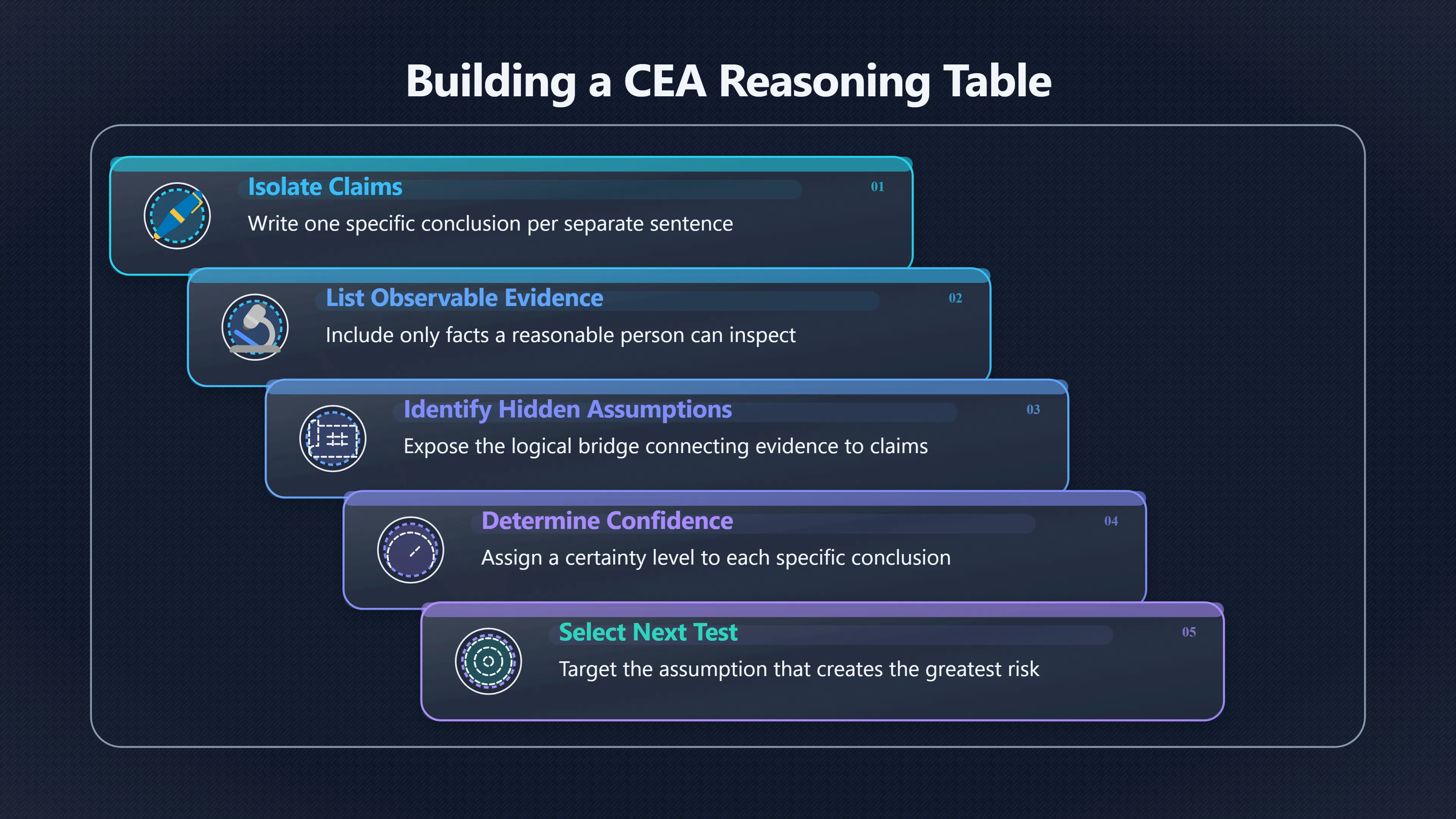
Step 1: Write one claim at a time
Avoid combining several conclusions into one sentence.
Instead of writing:
“Supplier A is cheaper, more reliable and therefore the obvious choice.”
Separate each conclusion:
- Supplier A will reduce project costs.
- Supplier A is likely to deliver on time.
- Supplier A is the preferred supplier.
Each claim can then be examined independently.
Step 2: List only observable evidence
Evidence should answer:
“What would another reasonable person be able to inspect?”
Examples include:
- audited financial figures
- published research
- previous delivery records
- controlled experiments
- customer surveys
- direct observations
Statements such as “everyone knows” or “it feels likely” belong elsewhere. They are not evidence.
Step 3: Identify the assumptions
This is the most valuable part of the exercise.
Ask:
- Why does this evidence support the claim? [youtube.com]youtube.comCER - Claim Evidence Reasoning…
- What belief am I relying on?
- Under what conditions would the evidence stop supporting the conclusion?
For example:
ClaimEvidenceAssumptionRemote working increases productivity.Internal productivity rose 12% after remote work began.The increase was caused mainly by remote working rather than seasonal demand, staffing changes or new software.
Notice that the assumption explains the logical bridge rather than providing another piece of evidence.
This closely mirrors Toulmin’s distinction between “grounds” (evidence) and the “warrant” that connects those grounds to the conclusion. [Purdue OWL]owl.purdue.eduOWLToulmin ArgumentPurdue OWLToulmin Argument - Purdue OWLThe Toulmin method is a style of argumentation that breaks arguments down into six component parts…
Distinguishing evidence from assumptions
Many reasoning mistakes happen because assumptions are accidentally treated as evidence. [youtube.com]youtube.comCER - Claim Evidence Reasoning…
For example:
StatementCategoryCustomer retention improved from 82% to 91%.EvidenceCustomers stayed because of our loyalty programme.AssumptionCustomers reported using loyalty rewards more frequently.EvidenceThe survey accurately represents the entire customer base.Assumption
A useful test is to ask:
Could I independently verify this statement?
If yes, it is probably evidence.
If it explains why evidence should matter, it is probably an assumption.

Using the table to choose the next test
The greatest practical benefit of a CEA table is not documenting current thinking but deciding what to investigate next.
Rather than asking, “What more information can I gather?”, ask:
Which assumption creates the greatest risk if it is wrong?
Imagine two competing projects.
Project A
Claim: [lincoln.edu]lincoln.eduSource details in endnotes.
Proceed immediately.
Evidence:
- Strong projected revenue.
- Experienced management team.
Critical assumption:
- Market demand forecasts remain accurate.
Project B
Claim: [lincoln.edu]lincoln.eduSource details in endnotes.
Delay investment.
Evidence:
- Supplier uncertainty.
- Cash reserves are limited.
Critical assumption:
- Supply disruption will continue for another year.
If market forecasts can be tested quickly while supply disruption cannot, testing Project A’s assumption may reduce uncertainty far more efficiently than collecting additional financial reports.
This changes evidence gathering from indiscriminate information collection into targeted learning.
A worked example
Suppose a company is deciding whether to launch a new software product.
ClaimEvidenceAssumptionPossible testThe product will achieve profitable sales.Customer interviews show interest.Interviewed customers represent the wider market.Conduct larger market survey.Development will finish on schedule.Previous projects finished close to target dates.Current project has similar complexity.Independent technical review.Customers will pay the planned price.Competitors charge similar prices.Buyers perceive equal value.Pricing experiment or pilot launch.
Notice how the final column naturally emerges from the assumptions rather than the evidence.
Evidence tells you why you currently believe something.
Assumptions tell you what to test next.
Common mistakes
Several recurring problems reduce the usefulness of CEA tables.
Using opinions as evidence
Statements such as “the team is enthusiastic” or “experts agree” require supporting evidence before they can justify important claims.
Collecting more evidence instead of examining assumptions
Large quantities of evidence cannot compensate for a false assumption. Ten studies supporting one mistaken interpretation still leave the interpretation vulnerable.
Treating assumptions as embarrassing weaknesses
Every complex decision depends on assumptions. Good reasoning makes them explicit rather than pretending they do not exist.
Writing vague claims
A claim such as “this is better” cannot be evaluated effectively.
More useful claims specify: [mhcc.pressbooks.pub]mhcc.pressbooks.pubAnalysis (Claims and Data)This unit explores a method of argument analysis, developed by philosopher Stephen E. Toulmin, that analyzes ar…
- better than what
- according to which criteria
- over what period
- with what trade-offs
How CEA tables improve analytical thinking
A CEA table is not simply a note-taking format. It changes the way decisions are evaluated.
Instead of asking whether a conclusion sounds convincing, it encourages four separate questions:
- What exactly is being claimed?
- What evidence actually supports that claim? [youtube.com]youtube.comCER - Claim Evidence Reasoning…
- Which assumptions connect the evidence to the conclusion?
- Which assumption should be tested before committing to the decision?
This separation makes reasoning easier to inspect, revise and discuss. It also reduces the tendency to defend conclusions simply because they have already been stated. In complex choices—where evidence is incomplete and certainty is impossible—the table becomes a practical tool for identifying the weakest link in the reasoning chain and directing attention towards the next piece of information that would most improve the decision. Argumentation research likewise treats practical reasoning as a process of testing and refining justified claims rather than merely accumulating supporting facts. [ResearchGate+2Wikipedia]researchgate.netFrom Arguments to Decisions: Extending the Toulmin ViewThis paper presents a view of argumentation based decision making that…
Amazon book picks
Further Reading
Books and field guides related to Separate Claims, Evidence and Assumptions. Use these as the next step if you want deeper reading beyond the article.
Asking the Right Questions
Directly teaches separating claims, evidence, assumptions, and evaluating arguments.
A Rulebook for Arguments
Provides practical techniques for distinguishing conclusions, premises, and supporting evidence.
The Pyramid Principle
Shows how to organize reasoning so claims and supporting evidence are clearly structured.
The Art of Thinking Clearly
Covers cognitive biases that become easier to detect when claims and evidence are separated.
eBay marketplace picks
Marketplace Samples
Live-tested eBay searches with available results related to this page.



Endnotes
-
Source: owl.purdue.edu
Title: OWLToulmin Argument
Link: https://owl.purdue.edu/owl/general_writing/academic_writing/historical_perspectives_on_argumentation/toulmin_argument.htmlSource snippet
Purdue OWLToulmin Argument - Purdue OWLThe Toulmin method is a style of argumentation that breaks arguments down into six component parts...
-
Source: researchgate.net
Link: https://www.researchgate.net/publication/225977147_From_Arguments_to_Decisions_Extending_the_Toulmin_ViewSource snippet
From Arguments to Decisions: Extending the Toulmin ViewThis paper presents a view of argumentation based decision making that...
-
Source: Wikipedia
Title: Stephen Toulmin
Link: https://en.wikipedia.org/wiki/Stephen_Toulmin -
Source: Wikipedia
Title: Argument map
Link: https://en.wikipedia.org/wiki/Argument_map -
Source: youtube.com
Title: Toulmin Method
Link: https://www.youtube.com/watch?v=GWnEbMZ0IaASource snippet
Toulmin Model for Argumentation...
-
Source: lincoln.edu
Link: https://www.lincoln.edu/_files/_pdfs/Guide-to-Writing-and-Analyzing-an-Argument.pptx
Additional References
-
Source: rationaleonline.com
Link: https://rationaleonline.com/forums/feature-requests/topic/ghy46csu/warrant-feature/Source snippet
"Warrant" FeatureWarrant usually are not elaborate with specific evidence or detailed subreasons. They are just alluded to externally val...
-
Source: statisticssolutions.com
Link: https://www.statisticssolutions.com/expanding-on-the-basic-toulmin-model-when-writing-a-literature-review/Source snippet
Expanding on the Basic Toulmin ModelThe Toulmin model of argumentation contains six elements: Claim, Grounds, Warrant, Qualifier, Backing...
-
Source: open.ocolearnok.org
Link: https://open.ocolearnok.org/englishcomposuokc/chapter/using-the-toulmin-system-to-build-an-argument/Source snippet
of Argumentation – First-Year English CompositionThe Toulmin model is based on inductive reasoning, but expands and clarifies some elemen...
-
Source: ciris.info
Link: https://www.ciris.info/learningcenter/toulmins-model/ -
Source: mhcc.pressbooks.pub
Link: https://mhcc.pressbooks.pub/2ndwr122/chapter/8/Source snippet
Analysis (Claims and Data)This unit explores a method of argument analysis, developed by philosopher Stephen E. Toulmin, that analyzes ar...
-
Source: learn.academy4sc.org
Title: the toulmin model of argumentation claims data and warrants oh my
Link: https://learn.academy4sc.org/video/the-toulmin-model-of-argumentation-claims-data-and-warrants-oh-my/Source snippet
Toulmin Model of Argumentation: Claims, Data, and...Toulmin identified six elements of an effective argument: claims, data, warrants, ba...
-
Source: youtube.com
Title: Toulmin Model for Argumentation
Link: https://www.youtube.com/watch?v=eJ5vPqggmjMSource snippet
Stop Making Bad Decisions: How to Question Assumptions & Think Critically (2025 Guide)...
-
Source: youtube.com
Link: https://www.youtube.com/watch?v=1dOXSjk-eOYSource snippet
CER - Claim Evidence Reasoning...
-
Source: youtube.com
Link: https://www.youtube.com/watch?v=5KKsLuRPsvUSource snippet
How Do You Know Which Argument to Believe? ([Critical Thinking]({{ 'critical-skills/' | relative_url }}) Skills)...
-
Source: youtube.com
Title: How Do You Know Which Argument to Believe? (Critical Thinking Skills)
Link: https://www.youtube.com/watch?v=Lkce1lagTAI
Topic Tree