Within Domain Knowledge
Why Experts See Different Problems
Experts often see the real structure of a problem because their knowledge is organised around principles, not surface clues.
On this page
- Surface features versus underlying principles
- What the Chi physics study reveals
- How to practise principle based sorting
Page outline Jump by section
Introduction
One of the clearest differences between experts and novices is not how much they know, but how they organise what they know. Experts tend to classify problems by the underlying principles that determine the solution, whereas novices are more likely to group them by obvious surface features such as familiar objects, settings or vocabulary. This difference matters because good analysis depends on identifying which aspects of a situation are causally important and which are merely incidental. Research from cognitive science shows that expert knowledge is organised around meaningful conceptual structures rather than disconnected facts, allowing experts to recognise when very different-looking problems are actually the same problem in disguise. [Wiley Online Library]onlinelibrary.wiley.comWiley Online LibraryCategorization and Representation of Physics Problems by…The representation of physics problems in relation to the…

Surface features versus underlying principles
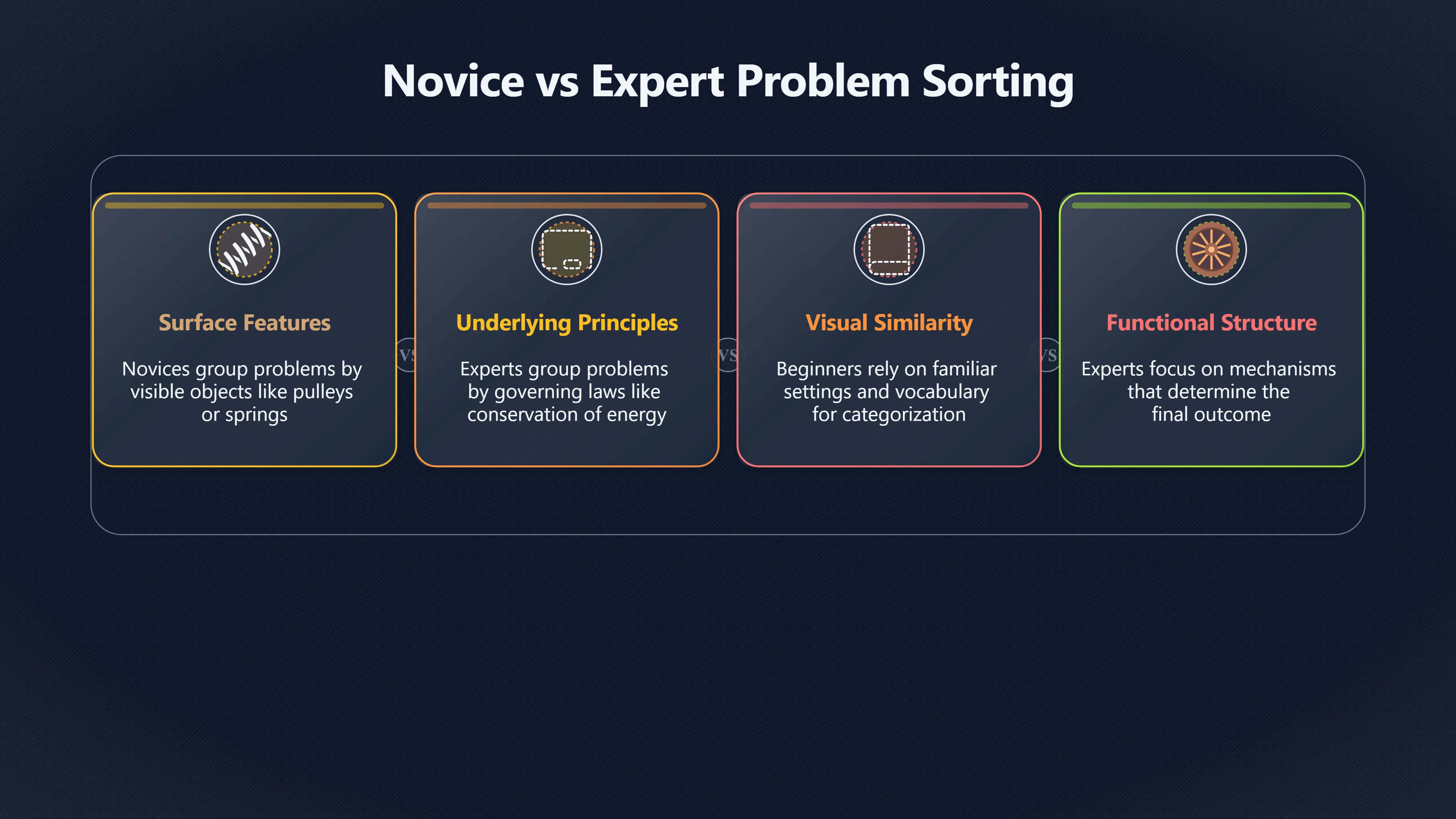
When people first encounter a new domain, they naturally rely on visible similarities. In physics, beginners might group together all questions involving pulleys, springs or inclined planes because those objects stand out. An expert, however, notices that two problems involving completely different objects may both require the same physical principle, such as conservation of energy or Newton’s second law.
This distinction is more than a matter of terminology. Surface features are often poor guides to how a problem should be solved. Underlying principles identify the mechanisms that actually govern what happens. Experts therefore spend less effort on the appearance of a problem and more on its functional structure.
The same pattern appears beyond physics:
- A doctor distinguishes diseases by physiological mechanisms rather than by a single symptom.
- An experienced software engineer groups bugs by architectural causes instead of by the screen where they appear.
- A financial analyst focuses on incentives, cash flows and risk exposures rather than whether two companies operate in the same industry.
- A historian classifies evidence by source reliability, purpose and context rather than simply by document type.
Across these examples, expertise involves recognising the variables that genuinely determine outcomes rather than those that merely accompany them.
What the Chi physics study reveals
The classic study by Michelene Chi, Paul Feltovich and Robert Glaser remains one of the most influential demonstrations of this phenomenon. Participants were given introductory physics problems and asked to sort them into groups according to similarity.
The results showed a striking contrast. Physics novices tended to create categories based on visible characteristics such as “inclined plane problems” or “pulley problems”. Physics experts instead grouped problems according to the physical laws required for solution, such as conservation of momentum or energy conservation, even when the problems looked superficially different. [Wiley Online Library]onlinelibrary.wiley.comWiley Online LibraryCategorization and Representation of Physics Problems by…The representation of physics problems in relation to the…
Importantly, the study was not primarily about solving the problems correctly. It examined how participants represented the problems before attempting a solution. The findings suggested that experts build an internal representation organised around abstract concepts, allowing them to retrieve appropriate methods efficiently. Novices, lacking this conceptual organisation, are more likely to search for familiar-looking examples instead.
Subsequent research has broadly supported the idea that categorising by deep structure is a hallmark of developing expertise, while also showing that expertise exists on a continuum rather than as a simple expert–novice divide. Studies with larger groups of physics students have found considerable variation among learners, with some advanced students already showing principle-based categorisation well before reaching expert level. [arXiv]arxiv.orgarXiv Assessing Expertise in Introductory Physics Using Categorization TaskAssessing Expertise in Introductory Physics Using Categorization TaskFebruary 28, 2016…
Why principle-based sorting improves analysis
Organising knowledge around principles changes how people think before they begin reasoning.
Instead of asking, “What does this problem resemble?”, experts are more likely to ask, “What mechanism is operating here?”
This shift produces several analytical advantages.
It reduces distraction. Surface similarities often encourage misleading analogies. By concentrating on causal principles, experts ignore irrelevant details that would otherwise consume attention.
It improves transfer. Because principles apply across many contexts, experts can recognise similarities between problems that appear unrelated. A mathematical optimisation principle, for example, may apply equally to manufacturing, logistics and biological systems.
It speeds retrieval. Knowledge organised around central concepts is easier to access. Rather than searching through isolated memories, experts retrieve interconnected networks of ideas associated with a governing principle.
It guides evidence collection. Once the relevant principle has been identified, experts know which observations are informative and which measurements are unlikely to change the conclusion.
Research synthesised in How People Learn argues that expert knowledge is not merely larger in quantity. It is organised around key concepts and is “conditionalised”—linked to an understanding of when particular principles apply and when they do not. This conditional organisation helps experts avoid applying familiar ideas in inappropriate situations. [Arizona State University]asu.elsevierpure.comcategorization and representation of physics problems by expertsArizona State UniversityCategorization and representation of physics problems by…by MTH Chi · 1981 · Cited by 9591 — The representatio…
How to practise principle-based sorting
Developing this way of thinking requires deliberate practice rather than simply accumulating more facts.
One useful approach is to compare problems that look different but share the same underlying mechanism. After solving them, ask what common principle made the same solution strategy work in both cases.
Another method is to reverse the process. Instead of labelling a problem by its topic, describe it in terms of the governing process:
- What is being conserved?
- What constraint determines the outcome?
- What incentive drives behaviour?
- What causal mechanism links evidence to conclusion?
Studying contrasting examples is equally valuable. Compare two situations that appear almost identical but require different explanations. This helps separate genuine diagnostic features from superficial similarities.
Finally, explain why a chosen principle applies. Being able to justify the classification often reveals whether the understanding is conceptual or merely based on pattern matching.
What this means for improving analytical skill
The ability to sort problems by deeper principles is not a specialised trick unique to physics. It reflects a broader characteristic of expert thinking: knowledge becomes organised around explanatory structures instead of isolated examples.
As domain knowledge grows, people become better at identifying which features of a problem are genuinely informative. They stop treating every new case as unique and instead recognise recurring mechanisms beneath changing appearances. This is one reason why experts often seem to “see” a different problem from the one visible to a beginner. They are not noticing more details; they are noticing which details matter.
Amazon book picks
Further Reading
Books and field guides related to Why Experts See Different Problems. Use these as the next step if you want deeper reading beyond the article.
How People Learn
Explains how experts organize knowledge around deep conceptual structures rather than surface features.
Peak
Shows how expert performance develops through deliberate practice and richer mental representations.
Thinking, Fast and Slow
Provides broad cognitive foundations for understanding judgment, pattern recognition, and expert thinking.
Make It Stick
Connects evidence-based learning methods to building durable conceptual understanding.
eBay marketplace picks
Marketplace Samples
Live-tested eBay searches with available results related to this page.

Endnotes
-
Source: onlinelibrary.wiley.com
Link: https://onlinelibrary.wiley.com/doi/10.1207/s15516709cog0502_2Source snippet
Wiley Online LibraryCategorization and Representation of Physics Problems by...The representation of physics problems in relation to the...
-
Source: arxiv.org
Title: arXiv Assessing Expertise in Introductory Physics Using Categorization Task
Link: https://arxiv.org/abs/1602.08781Source snippet
Assessing Expertise in Introductory Physics Using Categorization TaskFebruary 28, 2016...
Published: February 28, 2016
-
Source: arxiv.org
Link: https://arxiv.org/abs/1602.08775Source snippet
Categorization of Mechanics Problems by Students in Large Introductory Physics Courses: A Comparison with the Chi, Feltovich, and Gl...
-
Source: chi.com
Link: https://chi.com/?srsltid=AfmBOorEHGRVge1AfiK0lyMShfduHHOGPj3ps1vUQh-4c8Ovn5f-PaWH -
Source: asu.elsevierpure.com
Title: categorization and representation of physics problems by experts
Link: https://asu.elsevierpure.com/en/publications/categorization-and-representation-of-physics-problems-by-experts-/Source snippet
Arizona State UniversityCategorization and representation of physics problems by...by MTH Chi · 1981 · Cited by 9591 — The representatio...
-
Source: merriam-webster.com
Link: https://www.merriam-webster.com/dictionary/chiSource snippet
Definition & Meaning18 Apr 2026 — The meaning of CHI is the 22nd letter of the Greek alphabet...
Additional References
-
Source: cosmeticsnow.com.au
Link: https://www.cosmeticsnow.com.au/items/chi/haircare?srsltid=AfmBOoqYty6cZ2lPnQJghyfEVXnxqGyFmSLAyhtkhSDw_w8wdHZf3FRRSource snippet
CHI (Hair Care) Products | Cosmetics Now AustraliaPurchase CHI products online at Cosmetics Now Australia - CHI stockist, free shipping o...
-
Source: chihaircare.com.au
Link: https://chihaircare.com.au/Source snippet
CHI AUSTRALIACHI shampoos, conditioners and treatments are designed to strengthen the hair, while leaving it soft and shiny. CHI will als...
-
Source: rottentomatoes.com
Link: https://www.rottentomatoes.com/tv/the_chiSource snippet
The ChiThis coming-of-age series focuses on Kevin, a preteen who embraces the normal rites of childhood, Brandon, who makes a leap of fai...
-
Source: oamonitor.ireland.openaire.eu
Link: https://oamonitor.ireland.openaire.eu/national/search/publication?pid=10.1207%2Fs15516709cog0502_2Source snippet
and Representation of Physics Problems by...The representation of physics problems in relation to the organization of physics knowledge...
-
Source: youtube.com
Link: https://www.youtube.com/%40TheChiOnShowtimeSource snippet
The ChiVideos · The Chi Tea | Season 8 Episode 5 | The Dead of Winter · The Chi Season 8 Catch-Up: Must-See Moments · The Chi Tea | Seaso...
-
Source: researchgate.net
Link: https://www.researchgate.net/publication/220480253_Categorization_and_Representation_of_Physics_Problems_by_Experts_and_NovicesSource snippet
[1981] showed that physics novices categorize problems by surface features ("inclined plane problems") while experts categorize by deep s...
-
Source: philpapers.org
Title: Categorization and representation of physics problems by
Link: https://philpapers.org/rec/CHICAR-2Source snippet
The representation of physics problems in relation to the organization of physics knowledge is investigated in experts and novices.Read more...
-
Source: compadre.org
Link: https://www.compadre.org/portal/items/detail.cfm?ID=2341Source snippet
s problems relates to the organization of physics knowledge...
-
Source: per-central.org
Link: https://www.per-central.org/items/detail.cfm?ID=2341Source snippet
s problems relates to the organization of physics knowledge...
-
Source: scirp.org
Title: Chi, M.T., Feltovich, P.J
Link: https://www.scirp.org/reference/referencespapers?referenceid=2345254Source snippet
and Glaser, R. (1981...Chi, M.T., Feltovich, P.J. and Glaser, R. (1981) Categorization and Representation of Physics Problems by Experts...
Topic Tree