Within Real Practice
Write predictions before the outcome arrives
Writing down expectations, reasons and confidence levels makes later review clearer and harder to rationalise away.
On this page
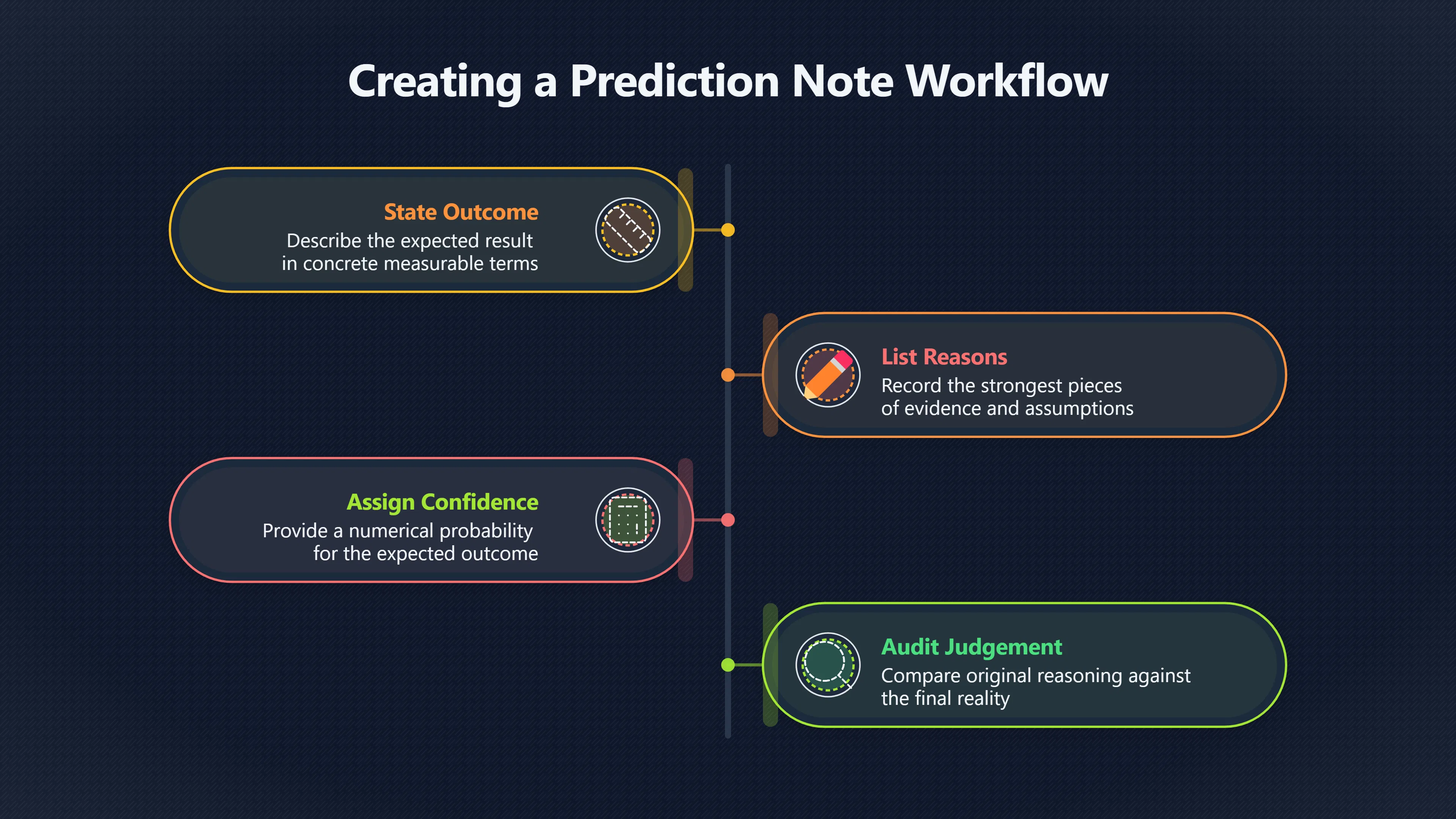
- State the expected outcome clearly
- Record reasons and confidence levels
- Use the note to audit later judgement
Page outline Jump by section
Introduction
Writing a prediction before a decision is made is one of the simplest ways to turn everyday choices into deliberate analytical practice. Instead of relying on memory after the outcome, you create a permanent record of what you expected, why you expected it, and how confident you were. When reality later provides feedback, you can compare the result with your original reasoning rather than with a revised story that unconsciously fits what actually happened.
 This practice matters because people are prone to hindsight bias—the tendency to see outcomes as having been more predictable than they really were. A brief prediction note makes later review more objective, reveals recurring strengths and weaknesses in judgement, and provides material for improving future decisions. It is a practical habit that fits naturally into real-world decision-making rather than being a separate thinking exercise. Research on forecasting, confidence calibration and judgement consistently shows that structured predictions combined with feedback improve analytical performance over time. [Sage Journals+2PubsOnline]journals.sagepub.comSage Journals Forecasting TournamentsTetlock, Barbara A….Aug 4, 2014 — Forecasting tournaments are level-playing-field competitions that reveal which individuals, teams, o…
State the expected outcome clearly
A useful prediction note begins with a statement that can later be checked against reality. Vague expectations such as “this should probably work” are difficult to evaluate because almost any outcome can later be interpreted as consistent with them.
Instead, describe the expected outcome in concrete terms. For example:
- “Customer complaints will fall within one month.”
- “The project will finish before 30 September.”
- “This investment will outperform the market over the next year.”
- “The interview candidate will perform well during the first six months.”
Where possible, include measurable criteria or a deadline. Even when a decision concerns qualitative outcomes, define what success or failure would actually look like before events unfold.
This approach resembles the discipline used in forecasting tournaments, where participants must commit to specific, testable predictions rather than broad opinions. That structure makes later scoring and learning possible. [Sage Journals]journals.sagepub.comSage Journals Forecasting TournamentsTetlock, Barbara A….Aug 4, 2014 — Forecasting tournaments are level-playing-field competitions that reveal which individuals, teams, o…
Record reasons and confidence levels
The prediction itself is only part of the note. The most valuable learning often comes from recording why the prediction seems reasonable at the time.
Include the key assumptions that matter most rather than every supporting detail. A short note might contain:
- Prediction: what you expect to happen.
- Reasons: the two or three strongest pieces of evidence or assumptions.
- Confidence: a numerical estimate or probability.
- Date: when the judgement was made.
For example:
Prediction: Sales will exceed last quarter by around 8% over the next three months. Reasons: Recent product launch has increased enquiries; seasonal demand is usually stronger in this period; competitor has delayed a major release. Confidence: 70%.
Assigning a confidence level is particularly valuable because it exposes overconfidence and underconfidence. If events you labelled “80% likely” occur only half the time, your confidence is poorly calibrated. Conversely, if outcomes you rated at 60% occur close to 60% of the time over many predictions, your judgement is becoming better calibrated.
Studies of geopolitical forecasting have found that training, repeated prediction, and systematic feedback can substantially improve confidence calibration. Better forecasters do not merely become more accurate; they also become better at matching confidence to actual likelihood. [PubsOnline+2Cambridge University Press & Assessment]pubsonline.informs.orgConfidence Calibration in a Multiyear Geopolitical Forecasting…by DA Moore · 2017 · Cited by 114 — This research examines th…

Use the note to audit later judgement
The prediction note achieves its value only when it is revisited after the outcome becomes known.
Rather than asking “Was I right?”, ask several more informative questions:
- Did the predicted outcome occur?
- Which assumptions proved correct?
- Which assumptions failed?
- Was my confidence appropriate?
- What information did I ignore that now seems important?
- Would I make the same decision again knowing only what was available at the time?
The final question is particularly important because it separates the quality of the decision from the quality of the outcome. A sound decision can produce a poor result through chance, while a weak decision can occasionally succeed through luck.
Keeping the original note visible discourages hindsight bias and motivated reasoning. Without a written record, people often remember having been “almost right” or having “known it all along.” The written prediction makes those retrospective adjustments much harder. Research on preregistration in science reflects the same principle: recording expectations before results are known creates a transparent distinction between genuine prediction and explanations constructed afterwards. [Wikipedia]WikipediaPreregistration (sciencePreregistration (science
Make prediction notes practical rather than burdensome
The habit works best when it is lightweight enough to use consistently.
Many people succeed with notes that take less than two minutes to write. For recurring decisions, a simple template is sufficient:
ItemExampleDecisionApprove supplier changeExpected outcomeCosts fall by about 10% within six monthsMain reasonsLower quoted prices; acceptable quality recordConfidence75%Review dateSix months after implementation
Not every choice deserves documentation. Reserve prediction notes for decisions that are uncertain, consequential, repeated, or likely to teach something useful. Recording every trivial judgement creates unnecessary work without adding much learning.
Over time, these notes become a personal dataset. Patterns begin to emerge, such as consistently underestimating project timelines, overestimating first impressions, or placing too much weight on recent events.
Common mistakes
Several habits reduce the value of prediction notes.
Writing predictions after the decision has effectively been made. The prediction should capture genuine uncertainty, not justify an existing outcome.
Using vague language. Statements that cannot clearly be judged as right or wrong provide little feedback.
Recording only conclusions. Without the underlying reasons, later review cannot identify which assumptions succeeded or failed.
Ignoring confidence. Binary predictions conceal whether someone expected an event with 51% confidence or 95% confidence, even though those represent very different judgements.
Reviewing only failures. Successful predictions can also reveal flawed reasoning if the outcome happened for unexpected reasons.
Why this habit strengthens analytical thinking
Prediction notes transform ordinary decisions into structured learning opportunities. Every prediction creates a comparison between expectation and reality, allowing judgement to be refined through repeated feedback instead of relying on memory or intuition alone.
Research from forecasting tournaments suggests that improvement comes not simply from making predictions, but from making explicit probability estimates, receiving feedback, revisiting earlier reasoning and gradually improving calibration. Combined with routine post-decision review, a simple prediction note becomes a practical tool for developing more accurate, transparent and accountable analytical thinking over time. [aiimpacts.org+3Sage Journals+3PubsOnline]journals.sagepub.comSage Journals Forecasting TournamentsTetlock, Barbara A….Aug 4, 2014 — Forecasting tournaments are level-playing-field competitions that reveal which individuals, teams, o…
Amazon book picks
Further Reading
Books and field guides related to Write predictions before the outcome arrives. Use these as the next step if you want deeper reading beyond the article.
Thinking, Fast and Slow
Explains hindsight bias, overconfidence, and judgement errors that prediction notes help expose.
The Signal and the Noise
Covers probabilistic thinking, uncertainty, and evaluating predictions.
How to Measure Anything
Encourages explicit estimates, probabilities, and measurable predictions.
Superforecasting: The Art and Science of Prediction
Directly teaches structured prediction, confidence calibration, and learning from feedback.
eBay marketplace picks
Marketplace Samples
Live-tested eBay searches with available results related to this page.




Endnotes
-
Source: cambridge.org
Link: https://www.cambridge.org/core/journals/judgment-and-decision-making/article/developing-expert-political-judgment-the-impact-of-training-and-practice-on-judgmental-accuracy-in-geopolitical-forecasting-tournaments/123EB18425391D05FA6581FDBB3F309FSource snippet
Cambridge University Press & AssessmentThe impact of training and practice on judgmental accuracy...by W Chang · 2016 · Cited by 147 — T...
-
Source: Wikipedia
Title: Preregistration (science)
Link: https://en.wikipedia.org/wiki/Preregistration_%28science%29 -
Source: aiimpacts.org
Title: who are
Link: https://aiimpacts.org/evidence-on-good-forecasting-practices-from-the-[good-judgmentSource snippet
Evidence on good forecasting practices from the...Tetlock's point here is simply that you should use your judgment about whether to foll...
-
Source: journals.sagepub.com
Title: Sage Journals Forecasting Tournaments
Link: https://journals.sagepub.com/doi/10.1177/0963721414534257Source snippet
Tetlock, Barbara A....Aug 4, 2014 — Forecasting tournaments are level-playing-field competitions that reveal which individuals, teams, o...
-
Source: pubsonline.informs.org
Link: https://pubsonline.informs.org/doi/10.1287/mnsc.2016.2525Source snippet
Confidence Calibration in a Multiyear Geopolitical Forecasting...by DA Moore · 2017 · Cited by 114 — This research examines th...
Additional References
-
Source: forum.effectivealtruism.org
Link: https://forum.effectivealtruism.org/posts/pnpnqA4hijnr59p7d/efforts-to-improve-the-accuracy-of-our-judgments-andSource snippet
to Improve the Accuracy of Our Judgments and...25 Oct 2016 — Evidence indicates that the calibration of judgment can be substantially en...
-
Source: youtube.com
Title: Hindsight Bias: Why Everything Looks Obvious After It Happens
Link: http://www.youtube.com/watch?v=kyfmEIUoDTMSource snippet
"Hindsight bias" decision making forecasting The Hindsight Bias: Understanding Why We Believe We Predicted It All Along Next Level Motiva...
-
Source: harry-cheslaw.medium.com
Title: super forecasting dd146e441c1c
Link: https://harry-cheslaw.medium.com/super-forecasting-dd146e441c1cSource snippet
medium.comSuper-Forecasting. By Philip Tetlock and Dan GardnerCalibration-If you predict something with a 70% accuracy then it will happe...
-
Source: scattered-thoughts.net
Title: notes on superforecasting the art and science of prediction
Link: https://www.scattered-thoughts.net/blog/2016/01/28/notes-on-superforecasting-the-art-and-science-of-predictionSource snippet
Tetlock ran the Good Judgment Project. With large numbers of similar predictions we can...
-
Source: pmc.ncbi.nlm.nih.gov
Link: https://pmc.ncbi.nlm.nih.gov/articles/PMC8074796/Source snippet
survey of human judgement and quantitative forecasting...by M Zellner · 2021 · Cited by 125 — We survey literature on human judgement an...
-
Source: onlinelibrary.wiley.com
Link: https://onlinelibrary.wiley.com/doi/10.1111/risa.12776Source snippet
of Superforecasting: The Art and Science...16 Mar 2017 — Review of Superforecasting: The Art and Science of Prediction. Philip, E. Tetlo...
-
Source: youtube.com
Title: What are the Benefits of a [Decision Journal]({{ ‘decision-journal/’ | relative_url }})? | Shane Parrish
Link: http://www.youtube.com/watch?v=CDgfvQtnrUUSource snippet
The Ultimate Guide to Using a Decision Journal...
-
Source: conversationswithtyler.com
Title: Philip E
Link: https://conversationswithtyler.com/episodes/philip-e-tetlock/Source snippet
Tetlock on Forecasting and Foraging as a Fox (Ep....22 Apr 2020 — The best forecasters aren't just intelligent, but fox-like integrative...
-
Source: thedecisionlab.com
Link: https://thedecisionlab.com/thinkers/political-science/philip-tetlock -
Source: youtube.com
Title: Decision Making Framework | Shane Parrish
Link: http://www.youtube.com/watch?v=WBz7VB4vA1kSource snippet
Hindsight Bias: Why Everything Looks Obvious After It Happens...
Topic Tree