Within Metacognition
Why Does This Feel So Certain?
Confidence is safest when it is matched to evidence, not merely to how fluent or familiar an explanation feels.
On this page
- How fluency and partial knowledge inflate certainty
- Questions that reveal whether confidence is earned
- When to seek more evidence before deciding
Page outline Jump by section
Introduction
Confidence is useful only when it reflects the quality of the evidence rather than the ease with which an explanation comes to mind. One of the most common failures in analytical thinking is premature closure: stopping the search for evidence because a story already feels complete. That feeling of certainty is often driven by familiarity, fluency or partial understanding rather than genuine knowledge. Research in cognitive psychology shows that people routinely overestimate how well they understand complex systems until they are asked to explain them in detail. [PMC]pmc.ncbi.nlm.nih.govby L Rozenblit · 2002 · Cited by 1459 — We argue that the illusion of depth seen with explanatory knowledge is a separate phenomenon f…
 Within metacognition, a confidence check is not about becoming sceptical of everything. It is about asking whether your level of certainty has actually been earned. The goal is better calibration: matching confidence to the available evidence instead of to the subjective feeling that “this makes sense”.
Why does a coherent explanation feel more convincing than it deserves?
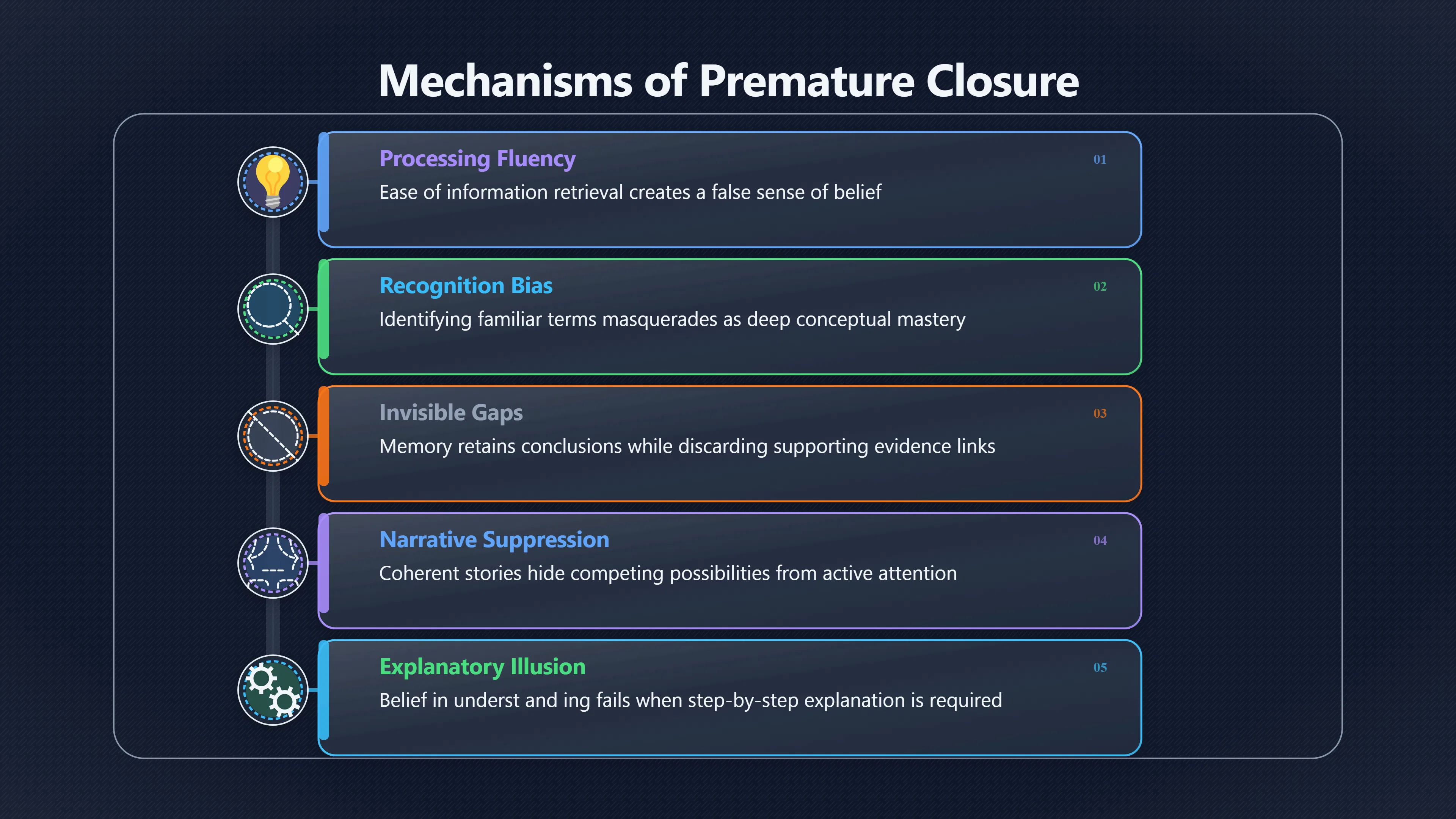
The human mind uses mental shortcuts to judge whether an idea is likely to be correct. One of those shortcuts is processing fluency—the ease with which information is read, remembered or understood. When information is fluent, it often feels more believable, more familiar and more complete than it really is.
This creates a subtle trap. As soon as an explanation fits together without obvious contradictions, the brain often treats the problem as solved. The absence of mental effort is mistaken for the presence of understanding.
A closely related phenomenon is the illusion of explanatory depth. People frequently believe they understand how familiar objects or systems work until they are asked to explain the underlying mechanisms step by step. Confidence typically drops once those missing links become visible. The effect is particularly strong for explanations of causal systems rather than for simple factual recall. [PMC+2Wiley Online Library]pmc.ncbi.nlm.nih.govby L Rozenblit · 2002 · Cited by 1459 — We argue that the illusion of depth seen with explanatory knowledge is a separate phenomenon f…
This distinction matters because many analytical tasks involve causal reasoning:
- Why did sales decline?
- Why did a software failure occur?
- Why is a policy succeeding or failing?
A plausible narrative may feel complete long before it actually explains the relevant mechanisms.
How fluency and partial knowledge inflate certainty
Premature confidence rarely appears because people possess no knowledge at all. It usually appears because they possess enough knowledge to build a convincing story.
Several mechanisms contribute:
- Recognition masquerades as understanding. Recognising terminology or concepts can create the impression of mastery even when detailed understanding is absent.
- Familiarity reduces perceived uncertainty. Seeing an explanation repeatedly increases its subjective credibility even without new supporting evidence.
- Gaps become invisible. People often remember conclusions while forgetting which assumptions or evidence originally supported them.
- Coherent narratives suppress alternative explanations. Once events fit together into one account, competing possibilities receive less attention.
These mechanisms explain why experts often recommend explaining an idea in detail rather than merely summarising it. Producing a complete explanation forces missing causal links into view, making overconfidence easier to detect. [Cambridge University Press & Assessment]cambridge.orgCambridge University Press & AssessmentExplaining an unrelated phenomenon exposes the illusion…by EA Meyers · 2023 · Cited by 12 — Rec…
Questions that reveal whether confidence is earned
A confidence check works best when it focuses on evidence instead of emotion. Rather than asking “Do I feel certain?”, ask questions that expose the basis of that certainty.
Useful questions include:
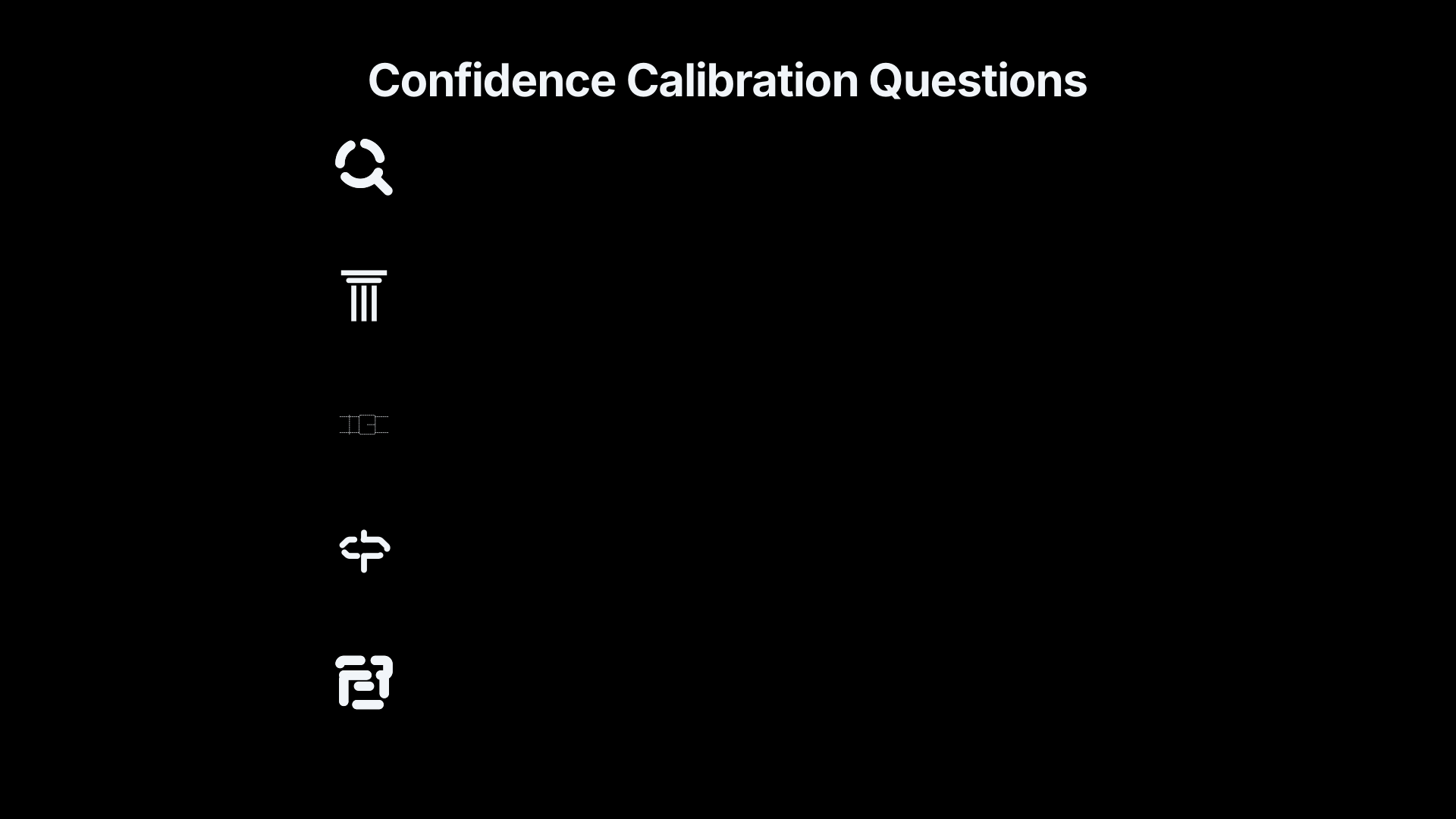
- What evidence would change my mind? If no realistic evidence could reduce confidence, the judgement may already be insulated from evaluation.
- Which assumptions must be true for this conclusion to hold? Hidden assumptions often carry most of the argument’s weight.
- Could I explain the mechanism from beginning to end without skipping steps? Difficulty doing so often reveals shallower understanding than expected.
- What competing explanation currently fits the evidence? Generating plausible alternatives reduces the tendency to stop after finding the first coherent account.
- Am I recalling evidence, or merely recalling that I once felt convinced? Memory for confidence can outlast memory for supporting reasons.
Notice that none of these questions asks whether you are intelligent or knowledgeable. They assess whether your current confidence matches your current evidence.
When should you deliberately seek more evidence?
Not every decision deserves extensive investigation. Analytical skill includes recognising when additional evidence is likely to improve the decision.
Additional checking is especially worthwhile when:
- the consequences of being wrong are substantial;
- several explanations remain plausible;
- important assumptions have not been directly tested;
- most supporting evidence comes from a single source;
- the explanation relies heavily on intuition rather than observable facts;
- confidence rose unusually quickly after encountering one persuasive narrative.
By contrast, gathering endless information after evidence has clearly converged can become its own error. The objective is proportionality: confidence should increase as independent evidence accumulates, not simply because thinking has become easier.
A practical example of premature closure
Imagine a project misses an important deadline.
An immediate explanation might be:
“The team lacked motivation.”
The explanation feels satisfying because it is simple and psychologically familiar. A confidence check interrupts that feeling before it hardens into belief.
Instead of accepting the first account, you might ask:
- Which observations specifically support low motivation?
- Could insufficient staffing explain the delay equally well?
- Were project requirements changed during development?
- Was there evidence of technical obstacles?
- What evidence would distinguish motivation problems from planning failures?
Only after examining these competing possibilities does confidence become linked to evidence rather than narrative coherence.
Building better calibration instead of lower confidence
The aim of confidence checking is not permanent self-doubt. Well-calibrated thinkers are capable of both strong confidence and genuine uncertainty because both are tied to evidence.
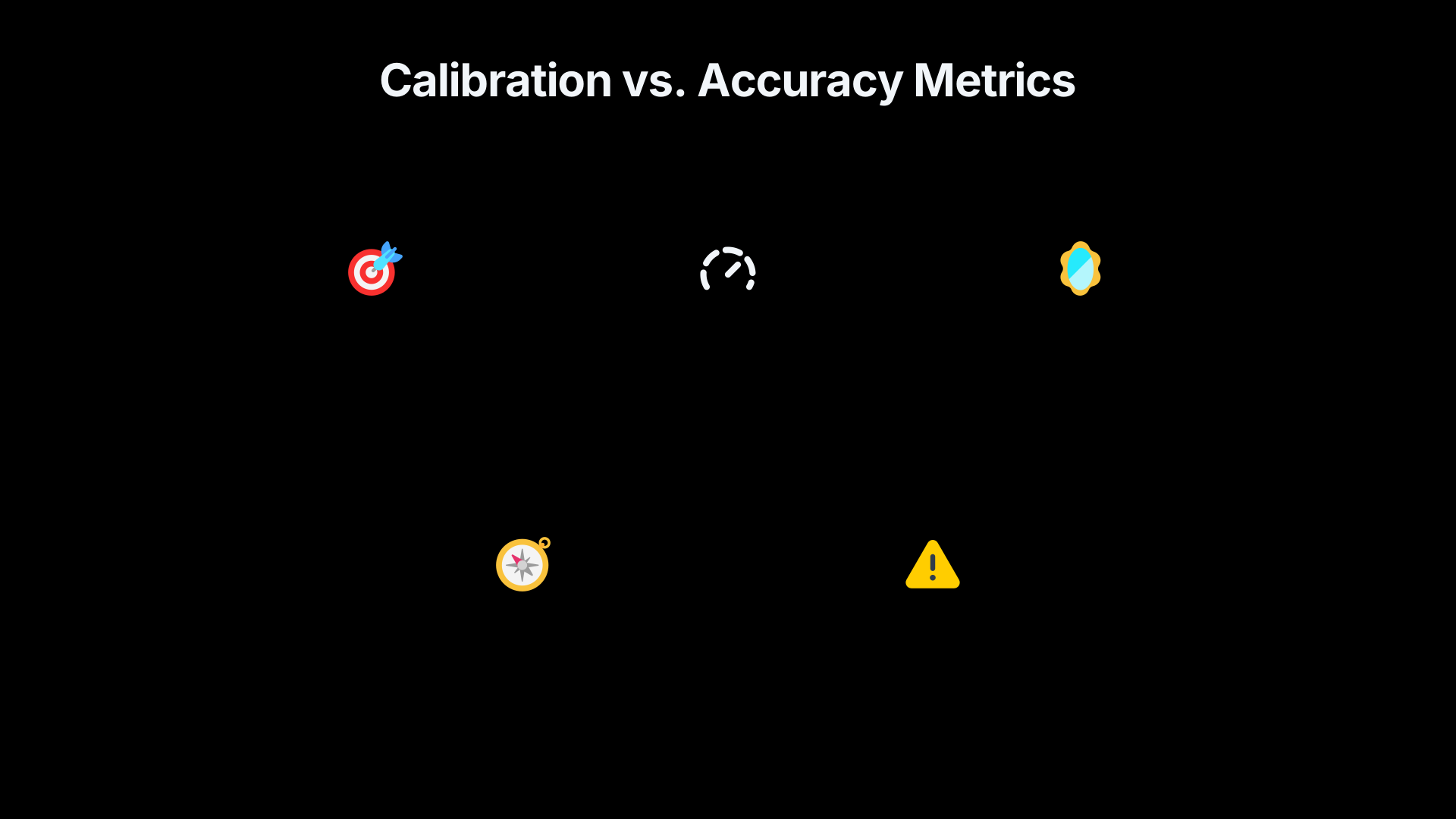
Research on metacognition consistently distinguishes accuracy from calibration. Someone can occasionally be wrong while remaining well calibrated if their confidence appropriately reflects uncertainty. Conversely, someone can be frequently overconfident despite possessing considerable knowledge if fluency consistently substitutes for evidence. [PMC]pmc.ncbi.nlm.nih.govby L Rozenblit · 2002 · Cited by 1459 — We argue that the illusion of depth seen with explanatory knowledge is a separate phenomenon f…
In practice, better calibration comes from habits such as:
- delaying commitment until key assumptions have been tested;
- attempting detailed explanations rather than relying on recognition;
- actively searching for disconfirming evidence;
- separating observations from interpretations; and
- treating confidence as something that should be justified, not simply experienced.
These habits slow the transition from “this explanation feels right” to “this conclusion is probably correct”. That small pause is often enough to prevent premature closure and produce reasoning that is not only more accurate but more appropriately confident.
Amazon book picks
Further Reading
Books and field guides related to Why Does This Feel So Certain?. Use these as the next step if you want deeper reading beyond the article.
The Scout Mindset
Focuses on calibrating confidence, updating beliefs, and seeking evidence before reaching conclusions.
Superforecasting
Shows how well-calibrated confidence and continual evidence gathering improve judgment.
Mistakes Were Made (but Not by Me)
Explains self-justification and overconfidence that reinforce unwarranted certainty.
How to Know a Person
Encourages curiosity over premature certainty and models better questioning and understanding.
eBay marketplace picks
Marketplace Samples
Live-tested eBay searches with available results related to this page.




Endnotes
-
Source: pmc.ncbi.nlm.nih.gov
Link: https://pmc.ncbi.nlm.nih.gov/articles/PMC3062901/Source snippet
by L Rozenblit · 2002 · Cited by 1459 — We argue that the illusion of depth seen with explanatory knowledge is a separate phenomenon f...
-
Source: onlinelibrary.wiley.com
Link: https://onlinelibrary.wiley.com/doi/abs/10.1207/s15516709cog2605_1Source snippet
Wiley Online LibraryThe misunderstood limits of folk science: an illusion...by L Rozenblit · 2002 · Cited by 1458 — We demonstrate the i...
-
Source: cambridge.org
Link: https://www.cambridge.org/core/journals/judgment-and-decision-making/article/broad-effects-of-shallow-understanding-explaining-an-unrelated-phenomenon-exposes-the-illusion-of-explanatory-depth/9B9B8927C3E530EBCF0453504730E3F3Source snippet
Cambridge University Press & AssessmentExplaining an unrelated phenomenon exposes the illusion...by EA Meyers · 2023 · Cited by 12 — Rec...
-
Source: Wikipedia
Title: Illusion of explanatory depth
Link: https://en.wikipedia.org/wiki/Illusion_of_explanatory_depth
Additional References
-
Source: thedecisionlab.com
Link: https://thedecisionlab.com/biases/the-illusion-of-explanatory-depthSource snippet
The Illusion of Explanatory DepthThe illusion of explanatory depth (IOED) describes our belief that we understand more about the world th...
-
Source: researchgate.net
Link: https://www.researchgate.net/publication/352704150_Illusion_of_explanatory_depth_and_social_desirability_of_historical_knowledgeSource snippet
Illusion of explanatory depth and social desirability...Jun 23, 2021 — The Illusion of Explanatory Depth (IOED) occurs when people overe...
-
Source: linkedin.com
Title: [illusion explanatory]({{ ‘false-fluency-4a90fc/’ | relative_url }}) depth fereshte akhoundi wl98e
Link: https://www.linkedin.com/pulse/illusion-explanatory-depth-fereshte-akhoundi-wl98eSource snippet
"illusion of explanatory depth"18 Nov 2024 — The illusion of explanatory depth is a cognitive bias where people believe they understand a...
-
Source: structural-learning.com
Link: https://www.structural-learning.com/post/metacognitive-monitoring-fixing-studentSource snippet
Structural LearningMetacognitive Monitoring: Fixing Student Overconfidence...4 Mar 2026 — Research consistently shows that most learners...
-
Source: time.com
Link: https://time.com/wp-content/uploads/2015/02/ioed_proofs.pdf_1.pdfSource snippet
e a novel method for measuring overconfidence in these...Read more...
-
Source: jarango.com
Title: the illusion of explanatory depth
Link: https://jarango.com/2019/02/06/the-illusion-of-explanatory-depth/Source snippet
Feb 6, 2019 — The Illusion of Explanatory Depth leads us to make less-than-optimal decisions. Intervening in a complex system while think...
-
Source: journals.sagepub.com
Link: https://journals.sagepub.com/doi/10.1177/0956797620975779Source snippet
Than You Think: How Outside Assistance Leads to...17 Mar 2021 — However, in many domains, people remain oblivious to the shallowness of...
-
Source: youtube.com
Title: The Ladder of Inference Creates Bad Judgment
Link: https://www.youtube.com/watch?v=K9nFhs5W8o8Source snippet
How Assumptions and Overthinking Sabotage Decision Making Under Pressure...
-
Source: pages.stern.nyu.edu
Link: https://pages.stern.nyu.edu/~aalter/jpspioed.pdfSource snippet
Construal Level Account of the Illusion of Explanatory Depthby AL Alter · Cited by 261 — An illusion of explanatory depth (IOED) occurs w...
-
Source: papers.ssrn.com
Link: https://papers.ssrn.com/sol3/Delivery.cfm/6554985.pdf?abstractid=6554985&mirid=1Source snippet
Bite-Sized Content Creates a False Sense of LearningUnlike prior work examining isolated metacognitive illusions, this framework integrat...
Topic Tree