Within Lateral Reading
Pause before sharing emotional viral claims
Strong emotional reactions are a useful warning signal to pause, leave the page and check whether better sources support the claim.
On this page
- Treat emotion as a verification cue
- Search for the source, not just the headline
- Check whether credible sources trace the evidence
Page outline Jump by section
Introduction
Emotional viral posts are designed to provoke fast reactions before careful thinking has a chance to catch up. Whether a claim triggers outrage, fear, delight, pride or a strong sense that it confirms what you already believe, that emotional response is often a signal to pause rather than to share. Lateral reading helps by shifting attention away from the post itself and towards independent evidence. Instead of arguing with the content inside the original page or social media thread, you leave it, search for the original source, and see whether credible organisations can independently support the claim. Research on professional fact-checkers consistently shows that this habit of checking across sources is more reliable than trying to judge credibility from a post’s appearance alone. [Stanford Education]ed.stanford.eduit doesn t take long learn how spot misinformation online stanford study findsStanford EducationIt doesn't take long to learn how to spot misinformation online…19 Apr 2022 — There may be new hope for helping youn…

Treat emotion as a verification cue
A strong emotional reaction is not proof that a claim is false. Many genuine events are upsetting, surprising or inspiring. The problem is that emotional intensity makes people more likely to react quickly, remember a story vividly and pass it on before checking whether it is accurate.
Viral content often succeeds because it combines emotional language with urgency. Phrases such as “share before this is deleted”, “the media won’t tell you”, or “everyone needs to know immediately” encourage people to bypass the normal habit of verification. Modern social platforms also reward content that generates engagement, meaning emotionally charged posts are more likely to be widely distributed regardless of their accuracy. [PMC]pmc.ncbi.nlm.nih.govPMC(Why) Is Misinformation a Problem?by Z Adams · 2023 · Cited by 147 — Answers in the literature reveal that advancements in information technology are the commonly suspe…
A practical mindset is to treat your own emotions as information about yourself, not about the truth of the claim. If a post makes you feel angry, frightened or triumphantly validated, use that feeling as the prompt to stop and begin lateral reading.
Search for the source, not just the headline
The first question should not be “Does this sound convincing?” but “Where did this information come from?”
Instead of searching the exact headline, search for:
- the organisation or person making the claim
- the key factual claim without emotional wording
- distinctive quotations
- the event or location mentioned
- whether reputable reporting has independently covered the same story
This approach avoids becoming trapped inside a network of reposts that all repeat the same unsupported assertion. Multiple accounts sharing identical text do not create independent evidence; they may all trace back to a single unreliable source.
For example, imagine a viral post claims that a shocking photograph proves a recent event. Rather than debating comments beneath the image, search for reporting on the alleged event from established news organisations, official agencies or recognised specialists. If nobody with direct access to the facts is reporting the same information, that absence becomes an important clue deserving further investigation rather than immediate belief. The SIFT framework explicitly recommends leaving the original page, investigating the source, finding better coverage and tracing claims back to their original context. [Media Helping Media+2Hapgood]mediahelpingmedia.orgsift for fact checkingMedia Helping MediaSIFT for fact-checking30 Mar 2025 — All the methods mentioned above are designed to help journalists weed out misinfor…
Check whether credible sources can trace the evidence
Many viral claims fail because they contain no verifiable chain of evidence.
When reading laterally, ask:
- Can you identify the original source rather than a screenshot or repost?
- Does the claim rely on named documents, official statements or identifiable witnesses?
- Are multiple credible organisations independently reporting the same facts?
- If a statistic is quoted, can you find where it was originally published?
Be cautious when every article links back to another secondary article instead of to original evidence. A claim may appear widely repeated while still resting on one weak or inaccurate source.
This is particularly important for images and videos. Authentic media can be paired with false captions, presented as recent when they are years old, or relocated from one event to another. Tracing the media back to its earliest identifiable appearance, or checking whether professional fact-checkers and reputable news organisations have already investigated it, often reveals whether the emotional narrative matches the available evidence. Educational research on lateral reading and reverse image searching shows that these techniques improve people’s ability to verify visual claims, although confidence can sometimes increase faster than actual skill, making intellectual humility an important companion to verification. [DIVA Portal]diva-portal.orgDIVA Portal Boosting fact-checking in the classroom: verifying warDIVA PortalBoosting fact-checking in the classroom: verifying war…September 20, 2025 — by T Nygren · 2025 · Cited by 5 — This study in…
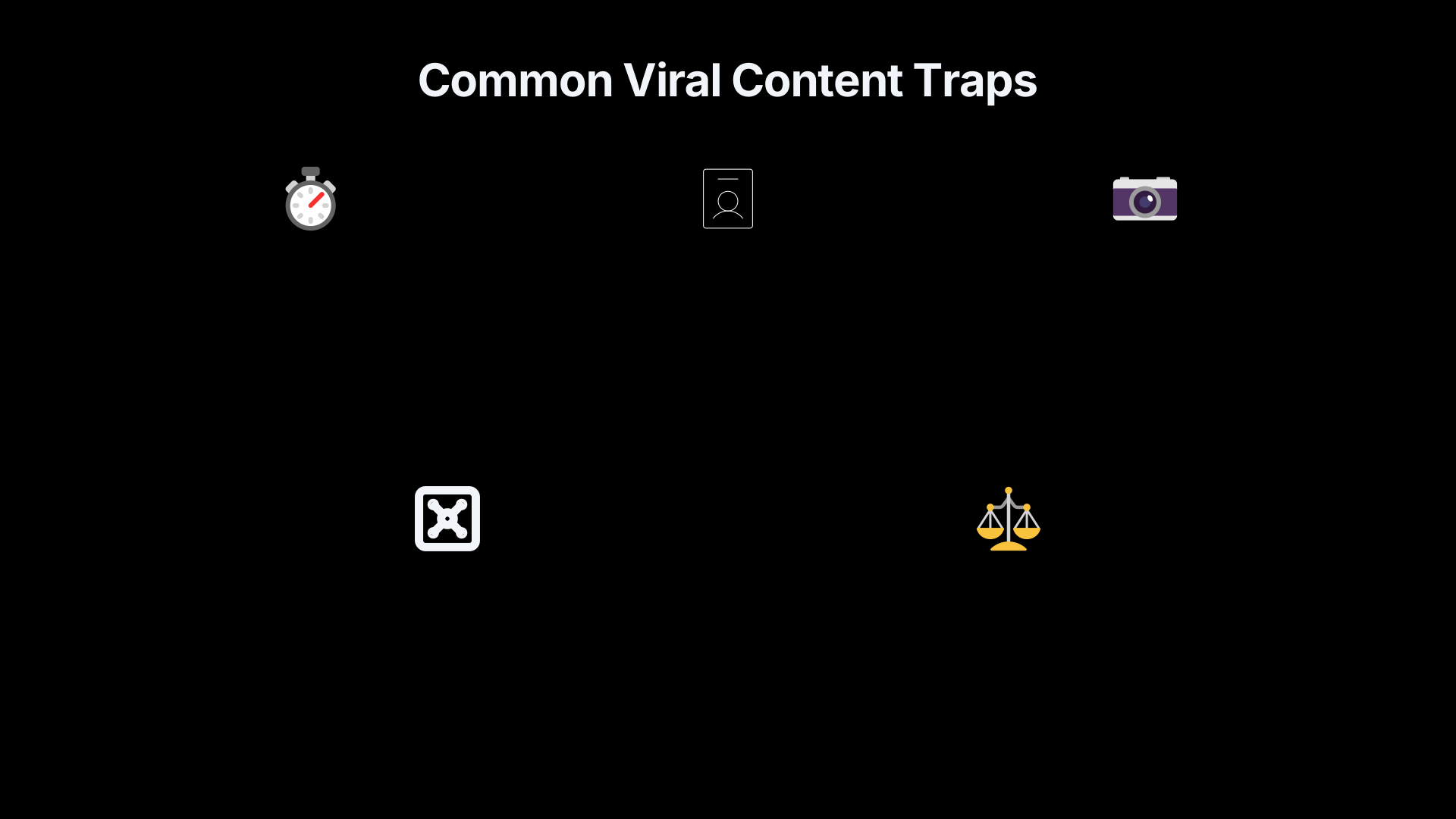
Common traps that emotional posts exploit
Emotionally persuasive posts often rely on recurring patterns rather than unique deception.
Some warning signs include:
- Artificial urgency. Claims that insist there is no time to verify before acting.
- Identity reinforcement. Messages suggesting that believing or sharing proves you belong to the “right” group.
- Outrage without evidence. Strong accusations supported only by screenshots, anonymous anecdotes or cropped images.
- False exclusivity. Statements implying that only one hidden source knows the truth while every established source is deliberately concealing it.
- Emotional substitution. Encouraging readers to judge a claim by how it feels rather than by whether independent evidence supports it.
None of these patterns proves a claim is false, but each justifies spending a minute checking outside the original post before accepting it.
A practical pause before sharing
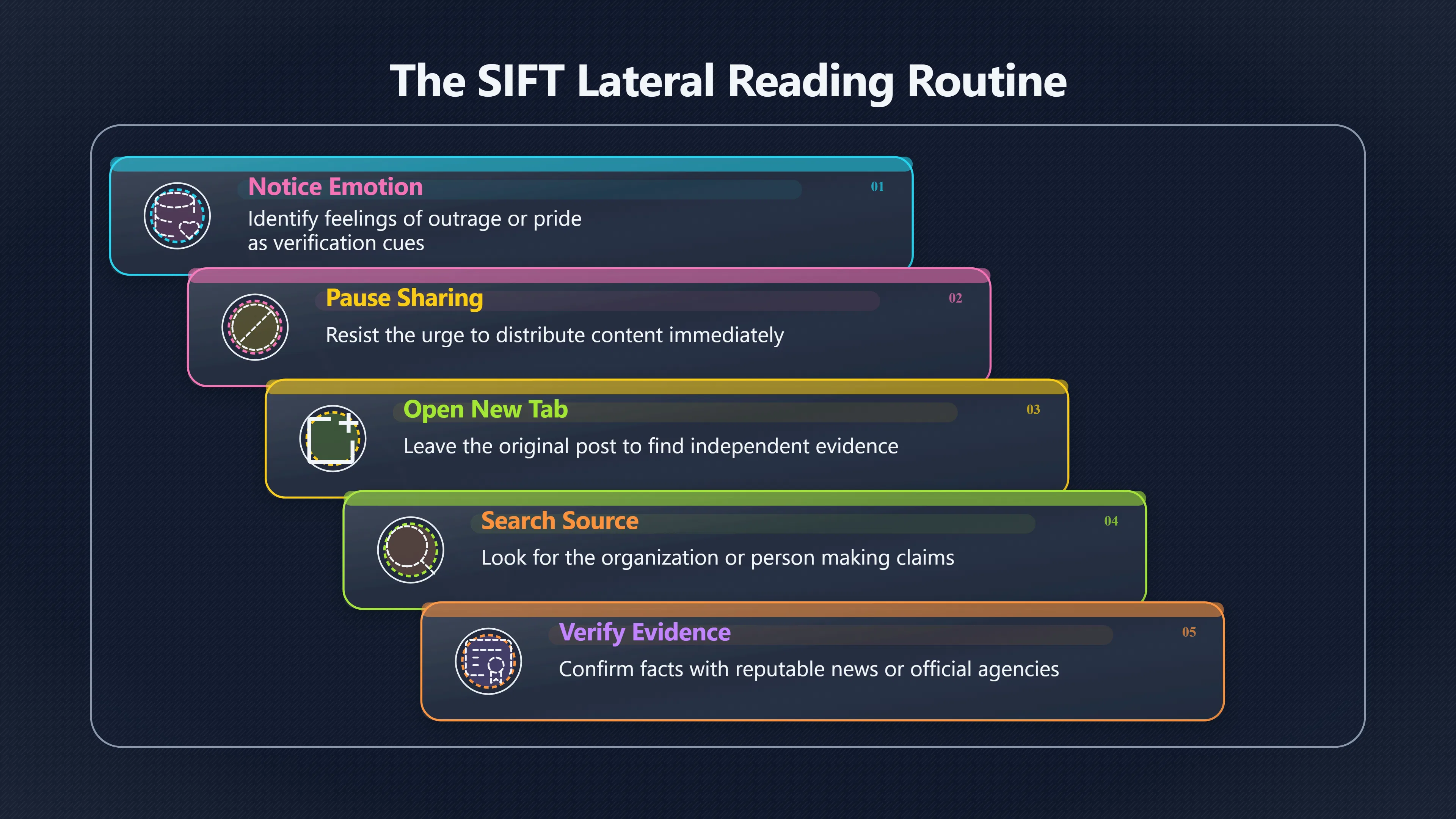
A useful routine takes less than two minutes:
- Notice your emotional reaction.
- Resist sharing immediately.
- Open a new tab instead of remaining inside the original post.
- Search for the source or the central factual claim.
- Look for independent confirmation from organisations with relevant expertise.
- If the evidence remains unclear or contradictory, treat the claim as unverified rather than deciding it must be true or false.
Professional fact-checkers routinely leave the original page because credibility depends less on how persuasive a claim appears than on whether independent evidence supports it. Making that brief pause automatic transforms emotion from something that drives impulsive sharing into a reliable cue to investigate first. [Hapgood+2Stanford Education]hapgood.usSIFT (The Four MovesSIFT (The Four Moves) - Hapgood19 Jun 2019 — […] the amount of misinformation and disinformation kids can access today. “If you do…
eBay marketplace picks
Marketplace Samples
Live-tested eBay searches with available results related to this page.
![Listing image for NCT 127 [FACT CHECK] 5th Album EXHIBIT HAECHAN Ver/CD+4 Post Card+Card+Sticker](/assets/images/marketplace-covers/87d0da3e264b1b11f013.jpg)
![Listing image for NCT 127 [FACT CHECK] 5th Album EXHIBIT JUNGWOO Ver/CD+4 Post Card+Card+Sticker](/assets/images/marketplace-covers/56882ab3f02073dbc060.jpg)

Endnotes
-
Source: ed.stanford.edu
Title: it doesn t take long learn how spot misinformation online stanford study finds
Link: https://ed.stanford.edu/news/it-doesn-t-take-long-learn-how-spot-misinformation-online-stanford-study-findsSource snippet
Stanford EducationIt doesn't take long to learn how to spot misinformation online...19 Apr 2022 — There may be new hope for helping youn...
-
Source: hapgood.us
Title: SIFT (The Four Moves)
Link: https://hapgood.us/2019/06/19/sift-the-four-moves/Source snippet
SIFT (The Four Moves) - Hapgood19 Jun 2019 — […] the amount of misinformation and disinformation kids can access today. “If you do...
-
Source: diva-portal.org
Title: DIVA Portal Boosting fact-checking in the classroom: verifying war
Link: https://www.diva-portal.org/smash/get/diva2%3A2005750/FULLTEXT01.pdfSource snippet
DIVA PortalBoosting fact-checking in the classroom: verifying war...September 20, 2025 — by T Nygren · 2025 · Cited by 5 — This study in...
Published: September 20, 2025
-
Source: pmc.ncbi.nlm.nih.gov
Title: PMC(Why) Is Misinformation a Problem?
Link: https://pmc.ncbi.nlm.nih.gov/articles/PMC10623619/Source snippet
by Z Adams · 2023 · Cited by 147 — Answers in the literature reveal that advancements in information technology are the commonly suspe...
-
Source: mediahelpingmedia.org
Title: sift for fact checking
Link: https://mediahelpingmedia.org/basics/sift-for-fact-checking/Source snippet
Media Helping MediaSIFT for fact-checking30 Mar 2025 — All the methods mentioned above are designed to help journalists weed out misinfor...
-
Source: Wikipedia
Link: https://en.wikipedia.org/wiki/Fact-checking -
Source: libguides.butler.edu
Link: https://libguides.butler.edu/evaluatingonlinesourcesSource snippet
Moves - Evaluating Online Sources: A Toolkit19 Dec 2025 — Lateral reading is used commonly by fact checkers. These strategies... Misinfo...
Additional References
-
Source: unesdoc.unesco.org
Link: https://unesdoc.unesco.org/ark%3A/48223/pf0000265552Source snippet
unesco.orgJournalism, fake news & disinformation: handbook for...it takes time to assess, measure and formulate responses. There is inev...
-
Source: facebook.com
Link: https://www.facebook.com/unitednations/posts/not-everything-we-see-online-is-trueand-misinformation-can-spread-rapidly-especi/1386443580178330/Source snippet
How to verify online information before sharingBefore sharing anything, it's crucial to pause, double- check the source, and verify the f...
-
Source: libguides.ucmerced.edu
Title: The SIFT Method is complementary to Lateral Reading. Both
Link: https://libguides.ucmerced.edu/news/evaluation/sift-methodSource snippet
Evaluation & [News Sources]({{ 'news-sources/' | relative_url }}): The SIFT Method - LibGuides13 May 2026 — What to do about Fake News: Web Evaluation & News Sources: The SIFT...
Published: May 2026
-
Source: ejournals.eu
Link: https://ejournals.eu/pliki_artykulu_czasopisma/pelny_tekst/eb50e776-1534-4c89-a10b-44f3b21eae48/pobierzSource snippet
n the tunnel and a perfect guide for journalists, media researchers and Internet users...
-
Source: guides.lib.uchicago.edu
Title: Library Guides The SIFT Method
Link: https://guides.lib.uchicago.edu/c.php?g=1241077&p=9082322Source snippet
UChicago Library GuidesThe SIFT Method - Evaluating Resources and Misinformation30 Jun 2025 — Evaluating Resources and Misinformation · T...
-
Source: centralmethodist.libguides.com
Title: lateral reading and sift
Link: https://centralmethodist.libguides.com/fake_news/lateral_reading_and_siftSource snippet
Reading and the SIFT Method - Fake News & Digital...deepfakes · digital media literacy · disinformation · evaluating sources · fake news...
-
Source: youtube.com
Link: https://www.youtube.com/watch?v=GoQG6Tin-1ESource snippet
Evaluating Photos & Videos: Crash Course Navigating Digital Information #7...
-
Source: tandfonline.com
Link: https://www.tandfonline.com/doi/full/10.1080/21670811.2025.2492209Source snippet
How News Users' Cognitive Traits Guide Their Responses...by EJ Lee · 2025 · Cited by 3 — The current study examined how the truth bias m...
-
Source: youtube.com
Title: Intro to Lateral Reading
Link: https://www.youtube.com/watch?v=as1IzVljNAwSource snippet
Check Yourself with Lateral Reading: Crash Course Navigating Digital Information #3...
-
Source: youtube.com
Title: Evaluating Photos & Videos: Crash Course Navigating Digital Information #7
Link: https://www.youtube.com/watch?v=p7uvqb8fcdASource snippet
How to Think Like a Fact-Checker with Joel Breakstone...
Topic Tree