Within Steelman
When Evidence Makes Both Sides Dig In
Mixed evidence can make opposing sides more confident when each side scrutinises unwelcome facts more harshly.
On this page
- What biased assimilation looks like
- The capital punishment evidence example
- How steelmanning interrupts selective scrutiny
Page outline Jump by section
Introduction
Biased assimilation is the tendency to interpret the same body of mixed evidence in ways that reinforce what you already believe. Rather than moving people towards a common conclusion, balanced or inconclusive evidence can leave supporters and opponents of a disputed position more convinced that they were right all along. This matters because many real-world debates—from criminal justice to public policy and emerging technologies—rarely produce a single decisive study. Instead, people encounter competing findings of varying quality, creating opportunities for selective scrutiny rather than impartial evaluation. Research on biased assimilation helps explain why disagreements can persist even when both sides claim to be “following the evidence”, and why steelmanning an opposing argument can improve analytical thinking by interrupting this pattern. [Frank Baumgartner+2Frank Baumgartner]fbaum.unc.eduFrank Baumgartner Biased Assimilation and Attitude Polarization: The EffectsFrank BaumgartnerBiased Assimilation and Attitude Polarization: The Effects…February 2, 2005 — by CG Lord · 1979 · Cited by 7418 — In…

What biased assimilation looks like
Biased assimilation does not usually involve inventing facts or refusing to read opposing evidence. The bias appears in how people evaluate evidence once they have seen it.
When people encounter findings that support their existing position, they often judge the evidence as methodologically sound, representative and persuasive with relatively little effort. When they encounter evidence pointing the other way, they become much more critical. They search for flaws in the sample, statistical methods, assumptions or interpretation. Those questions may be perfectly legitimate, but they are applied asymmetrically. The result is that the same standards are not applied to both sides of the evidence. [Frank Baumgartner]fbaum.unc.eduFrank Baumgartner Biased Assimilation and Attitude Polarization: The EffectsFrank BaumgartnerBiased Assimilation and Attitude Polarization: The Effects…February 2, 2005 — by CG Lord · 1979 · Cited by 7418 — In…
Several mechanisms contribute to this pattern:
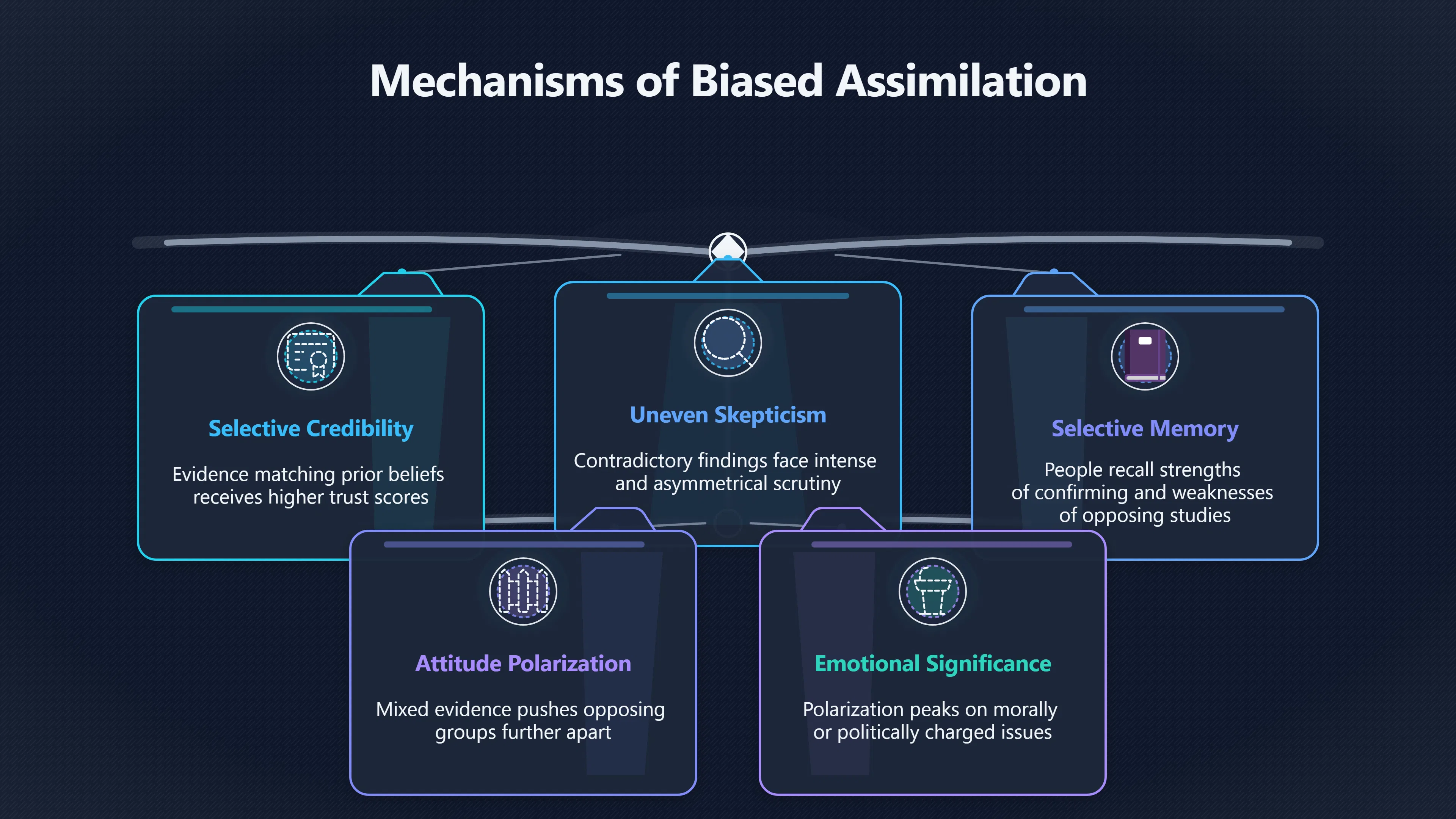
- Selective credibility: evidence consistent with prior beliefs is judged more trustworthy.
- Uneven scepticism: contradictory evidence receives far more intensive criticism.
- Selective memory: people remember the strengths of confirming studies and the weaknesses of disconfirming ones.
- Attitude polarisation: after reviewing the same mixed evidence, opposing groups may become further apart rather than closer together. [Frank Baumgartner+2Frank Baumgartner]fbaum.unc.eduFrank Baumgartner Biased Assimilation and Attitude Polarization: The EffectsFrank BaumgartnerBiased Assimilation and Attitude Polarization: The Effects…February 2, 2005 — by CG Lord · 1979 · Cited by 7418 — In…
Importantly, this is most likely to occur on issues that are politically, morally or emotionally significant. When beliefs are weak or people have little personal investment, mixed evidence is less likely to produce strong polarisation. [Cambridge University Press & Assessment]cambridge.org0753FAC7590FC8D7F99ED413B367E74BCambridge University Press & AssessmentConfronting Core Issues: A Critical Assessment of Attitude …by YR VELEZ · 2025 · Cited by 53 — I…
The capital punishment evidence example
The classic demonstration comes from a widely cited 1979 experiment by psychologists Charles Lord, Lee Ross and Mark Lepper.
Participants who already favoured or opposed capital punishment read two apparently scientific studies on whether the death penalty deterred murder. One study appeared to support deterrence; the other appeared to reject it. Participants also received methodological details and criticisms of both studies, making the evidence deliberately mixed rather than one-sided. [Frank Baumgartner]fbaum.unc.eduFrank Baumgartner Biased Assimilation and Attitude Polarization: The EffectsFrank BaumgartnerBiased Assimilation and Attitude Polarization: The Effects…February 2, 2005 — by CG Lord · 1979 · Cited by 7418 — In…
If people processed evidence impartially, one might expect both groups to become somewhat less certain because the evidence pointed in opposite directions. Instead, the opposite happened.
Supporters of capital punishment generally rated the pro-deterrence study as better designed and more convincing while finding substantial flaws in the anti-deterrence study. Opponents reversed this pattern, praising the anti-deterrence research and criticising the pro-deterrence research. After reviewing exactly the same material, both groups typically reported stronger confidence in their original position than before reading the evidence. [Frank Baumgartner]fbaum.unc.eduFrank Baumgartner Biased Assimilation and Attitude Polarization: The EffectsFrank BaumgartnerBiased Assimilation and Attitude Polarization: The Effects…February 2, 2005 — by CG Lord · 1979 · Cited by 7418 — In…
The study became influential because it illustrated a counterintuitive point: more information does not automatically produce convergence. Under some conditions, additional evidence can increase disagreement because people evaluate evidence through the lens of existing theories rather than using the evidence to revise those theories. [Frank Baumgartner]fbaum.unc.eduFrank Baumgartner Biased Assimilation and Attitude Polarization: The EffectsFrank BaumgartnerBiased Assimilation and Attitude Polarization: The Effects…February 2, 2005 — by CG Lord · 1979 · Cited by 7418 — In…
Later research on motivated reasoning found similar patterns in political and policy judgements, with people tending to evaluate arguments that align with their prior attitudes as stronger than equally plausible opposing arguments. [Frank Baumgartner]fbaum.unc.eduAJPS 2006 TaberAuthor(s): Charles S. Taber and Milton Lodge…

How steelmanning interrupts selective scrutiny
Steelmanning does not eliminate biased assimilation, but it changes the sequence in which reasoning occurs.
Instead of immediately asking, “What is wrong with this evidence?”, steelmanning requires first reconstructing the strongest reasonable case for the opposing interpretation. That changes the evaluator’s task from defending an identity or position to accurately representing another person’s reasoning.
This practice helps in several ways.
First, it encourages symmetrical standards. If you must explain why intelligent people find the opposing evidence persuasive, it becomes harder to dismiss it with objections that you would never apply to evidence supporting your own view.
Second, it separates evaluation from advocacy. Rather than treating every contradictory finding as something to defeat, steelmanning asks whether it genuinely raises a challenge that your current position must answer.
Third, it reveals hidden assumptions. Many disagreements arise not because people disagree about individual studies but because they weigh methodological limitations differently. Restating the strongest opposing interpretation makes those assumptions explicit, allowing them to be examined directly instead of remaining implicit.
Finally, steelmanning promotes what researchers call actively open-minded thinking: a disposition to consider evidence against one’s preferred conclusion, tolerate uncertainty and revise beliefs when warranted. People scoring higher on measures of actively open-minded thinking generally report greater willingness to consider contradictory evidence rather than treating belief revision as a personal failure. [PMC]pmc.ncbi.nlm.nih.govPMCActively Open-Minded Thinking and Its Measurementby KE Stanovich · 2023 · Cited by 133 — Actively open-minded thinking (AOT) is measured by items that tap the willingness to consider…
In practice, this means asking questions such as:
- Would I raise this methodological criticism if the study supported my own position?
- What is the strongest interpretation that an informed opponent could reasonably draw from these results?
- Which pieces of evidence genuinely challenge my preferred explanation?
- If the ideological positions were reversed, would I judge the evidence differently?
These questions do not guarantee agreement, but they reduce the tendency for mixed evidence to become fuel for automatic confirmation.
What this means for analytical thinking
The central lesson from biased assimilation is not that evidence is useless, but that evidence alone is often insufficient when people evaluate it through strong prior commitments.
Improving analytical thinking therefore requires more than collecting additional studies. It requires evaluating supportive and contradictory evidence by the same standards. Steelmanning serves this goal because it forces temporary suspension of defensive reasoning. Before asking whether an opposing argument is wrong, it asks whether you have understood the strongest version of it. That shift makes selective scrutiny more visible and gives mixed evidence a better chance of changing beliefs when the evidence genuinely warrants it. [Frank Baumgartner+2PMC]fbaum.unc.eduFrank Baumgartner Biased Assimilation and Attitude Polarization: The EffectsFrank BaumgartnerBiased Assimilation and Attitude Polarization: The Effects…February 2, 2005 — by CG Lord · 1979 · Cited by 7418 — In…

Amazon book picks
Further Reading
Books and field guides related to When Evidence Makes Both Sides Dig In. Use these as the next step if you want deeper reading beyond the article.
Mistakes Were Made (but Not by Me)
Directly addresses self-justification and belief persistence.
The Skeptics' Guide to the Universe
Discusses cognitive biases affecting evidence evaluation.
eBay marketplace picks
Marketplace Samples
Live-tested eBay searches with available results related to this page.


Endnotes
-
Source: pmc.ncbi.nlm.nih.gov
Title: PMCActively Open-Minded Thinking and Its Measurement
Link: https://pmc.ncbi.nlm.nih.gov/articles/PMC9966223/Source snippet
by KE Stanovich · 2023 · Cited by 133 — Actively open-minded thinking (AOT) is measured by items that tap the willingness to consider...
-
Source: cambridge.org
Link: https://www.cambridge.org/core/journals/american-political-science-review/article/confronting-core-issues-a-critical-[assessmentSource snippet
Cambridge University Press & AssessmentConfronting Core Issues: A Critical Assessment of Attitude...by YR VELEZ · 2025 · Cited by 53 — I...
-
Source: cambridge.org
Link: https://www.cambridge.org/core/journals/judgment-and-decision-making/article/actively-openminded-thinking-about-evidence-aote-scale-adaptation-and-evidence-of-validity-in-a-brazilian-sample/DA50D65EB28BE38A2BA5FA4EA33B4B58Source snippet
Actively Open-Minded Thinking About Evidence (AOT-E)...by A Bonafé-Pontes · 2025 · Cited by 5 — This cognitive style reflects how people...
-
Source: fbaum.unc.edu
Title: Frank Baumgartner Biased Assimilation and Attitude Polarization: The Effects
Link: https://fbaum.unc.edu/teaching/articles/jpsp-1979-Lord-Ross-Lepper.pdfSource snippet
Frank BaumgartnerBiased Assimilation and Attitude Polarization: The Effects...February 2, 2005 — by CG Lord · 1979 · Cited by 7418 — In...
Published: February 2, 2005
-
Source: fbaum.unc.edu
Title: AJPS 2006 Taber
Link: https://fbaum.unc.edu/teaching/articles/AJPS-2006-Taber.pdfSource snippet
Author(s): Charles S. Taber and Milton Lodge...
-
Source: pubmed.ncbi.nlm.nih.gov
Link: https://pubmed.ncbi.nlm.nih.gov/22232418/Source snippet
Motivated reasoning and public opinionby AA Strickland · 2011 · Cited by 241 — These motivated biases strongly influence the way pe...
-
Source: helda.helsinki.fi
Title: fi Actively open-minded thinking
Link: https://helda.helsinki.fi/bitstreams/acfce61e-9176-4d02-b620-0b65b4c1ded8/downloadSource snippet
open-minded thinking - Helda - University of Helsinkiby AM Svedholm-Häkkinen · Cited by 158 — Actively open-minded thinking: development...
Additional References
-
Source: sjdm.org
Link: https://sjdm.org/dmidi/Actively_Open-Minded_Thinking_Beliefs.htmlSource snippet
Actively Open-Minded Thinking Beliefs (AOT)People should take into consideration evidence that goes against conclusions they favor. (2)...
-
Source: economics.yale.edu
Link: https://economics.yale.edu/sites/default/files/dubra_-_attitiudepolmarch15.pdfSource snippet
(1979) took two groups of subjects, one which believed in the deterrent effect of the death penalty and one which...Read more...
-
Source: philarchive.org
Link: https://philarchive.org/archive/STARTP-7Source snippet
change their positions about specific socio-political issues after considering many different reasons meant to.Read more...
-
Source: researchgate.net
Title: 240604429 Motivated Skepticism in the Evaluation of Political Beliefs
Link: https://www.researchgate.net/publication/240604429_Motivated_Skepticism_in_the_Evaluation_of_Political_BeliefsSource snippet
Motivated Skepticism in the Evaluation of Political Beliefs6 May 2026 — We propose a model of motivated skepticism that helps explain whe...
Published: May 2026
-
Source: alexandercoppock.com
Title: Does Counter-Attitudinal Information Cause Backlash?
Link: https://alexandercoppock.com/guess_coppock_2020_appendix.pdfSource snippet
Lord, Charles S., L. Ross and M. Lepper. 1979. “Biased Assimilation and Attitude Polar- ization: The Effects of Prior Theories on Subsequ...
-
Source: ndg.asc.upenn.edu
Link: https://ndg.asc.upenn.edu/wp-content/uploads/2017/08/Ideology-motivated-reasoning.pdfSource snippet
upenn.eduIdeology, motivated reasoning, and cognitive reflectionby DM Kahan · 2013 · Cited by 2137 — Biased assimilation and attitude pol...
-
Source: researchgate.net
Link: https://www.researchgate.net/publication/232555483_Biased_assimilation_and_attitude_polarization_The_effects_of_prior_theories_on_subsequently_considered_evidenceSource snippet
xamine relevant empirical evidence in a biased manner.Read more...
-
Source: youtube.com
Title: “Feedback, Dynamics, and Safety in Machine Learning Systems” by Sarah Dean
Link: https://www.youtube.com/watch?v=TUkgiylW6joSource snippet
Why You Keep Proving Yourself Right Even When You're Miserable: The Psychology of Confirmation...
-
Source: youtube.com
Link: https://www.youtube.com/watch?v=cdxC_Ysy65sSource snippet
The (Social) Psychology of an Attack on Capitol...
-
Source: academia.edu
Link: https://www.academia.edu/80715337/Biased_assimilation_and_attitude_polarization_The_effects_of_prior_theories_on_subsequently_considered_evidenceSource snippet
Biased assimilation and attitude polarization: The effects of...The study shows that participants often interpret mixed evidence to rein...
Topic Tree