Within Sharper Thinking
Why Writing Makes Thinking Clearer
Writing down your reasoning turns private impressions into claims you can inspect, test, and revise.
On this page
- The question to answer chain
- How written reasoning exposes gaps
- Templates for everyday decisions
Page outline Jump by section
Introduction
Writing down a reasoning chain is a practical way to make thinking clearer because it turns a vague impression into a sequence of claims that can be checked. Instead of jumping from “this feels right” to “therefore I will do it”, a written chain records the question, the evidence, the assumptions, the alternatives and the point where uncertainty is highest. That matters because many errors in judgement are not failures of intelligence; they are failures of visibility. The weak link stays hidden until the decision is already made.
The method is simple: put the conclusion on paper, then write the route that supposedly supports it. Research on metacognition, self-explanation, argument mapping and debiasing all points in the same direction: people reason better when they are prompted to explain, monitor and revise their own thinking, especially when the task is complex enough for intuition to outrun scrutiny.[PMC+2Springer]pmc.ncbi.nlm.nih.govStrong metacognitive skills have the power to impact student learning and performance.Read more…
The question-to-answer chain
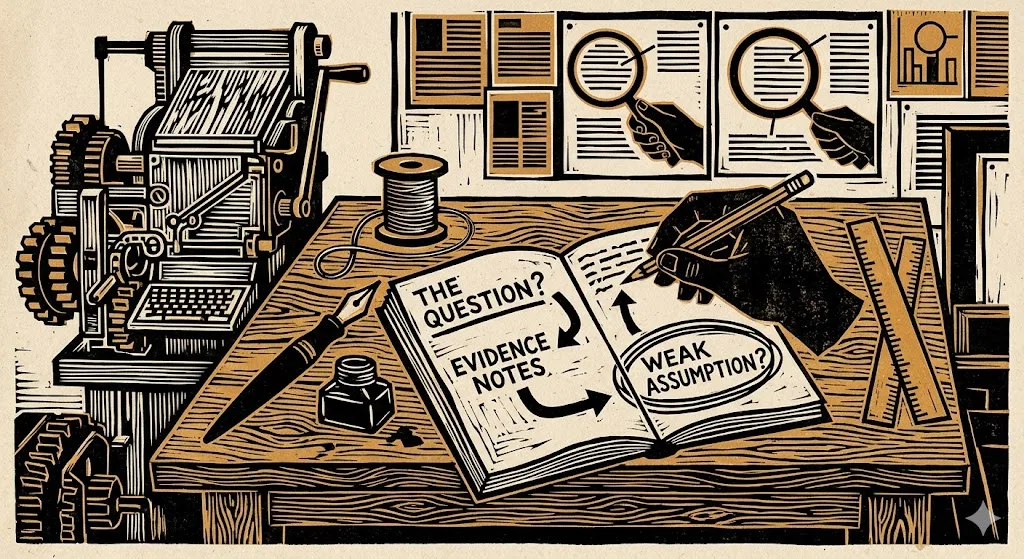
A reasoning chain is not a diary of every thought that passes through the mind. It is a compact written path from a question to a provisional answer. The goal is not to make thinking ornate, but to make it inspectable.
A useful chain has five parts:
- Question: What exactly am I trying to decide, explain or predict?
- Claim: What answer am I leaning towards?
- Reasons: Why do I think that answer is plausible?
- Evidence: What facts, observations or data support those reasons?
- Weak link: Which assumption would most damage the answer if it were false?
This structure matters because ordinary prose can hide the difference between a claim, a reason and evidence. The University of Pittsburgh’s guide to argument describes an argument as claims backed by reasons, with reasons supported by evidence; that distinction is the backbone of visible reasoning. Without it, “I think this project will work because the team is excited” can look like analysis, when it may be only a mood report unless linked to evidence about capacity, demand, cost, risk and alternatives.[Department of Communication]comm.pitt.eduArgumentation is a social process of two or more people making argumentsDepartment of CommunicationArgument: Claims, Reasons, Evidence - CommunicationArguments are claims backed by reasons that are supported b…
A written chain also gives the mind a stable object to work on. Research on external representations and cognitive offloading shows why this helps: writing things down can reduce the load on working memory, making it easier to compare several pieces of information at once rather than holding everything internally. Cognitive offloading is not laziness when it supports the task; it can free mental capacity for checking relationships, spotting contradictions and improving the next step.[PMC+2Evidence Based Education]pmc.ncbi.nlm.nih.govby AB Morrison · 2020 · Cited by 104 — Instead, our findings suggest that cognitive offloading may be a valid compensatory strategy to…
A simple example shows the difference:
Unwritten impression: “This supplier seems reliable.”
Written reasoning chain: “We should choose Supplier A for the first phase because they have delivered two similar projects on time, their quote is within budget, and their support team has named contacts. The main uncertainty is whether their smaller team can handle peak demand. Before signing, we should ask for two references from clients with similar volume.”
The second version is not just longer. It separates conclusion, evidence, assumption and next test. That makes the judgement easier to challenge without turning the conversation into a contest of personalities.

How written reasoning exposes gaps
Writing makes gaps visible because it slows down the move from confidence to conclusion. The gap may be a missing definition, a hidden assumption, a weak comparison, a neglected alternative or a piece of evidence that is doing more work than it can bear.
One of the most important gaps is the difference between explaining and justifying. People can often explain why they like an answer after they have already chosen it. A written chain is more useful when it forces the reasoning to appear before commitment, while there is still room to change course. This is why metacognitive prompts are valuable: they ask the thinker to notice how they arrived at an answer, where they remain unsure and which strategy they are using. Johns Hopkins’ writing guidance makes this point in an educational setting, noting that prompts such as “How did I arrive at this result?” and “Where do I remain confused?” make thinking explicit rather than leaving it implicit.[krieger.jhu.edu]krieger.jhu.eduWriting for Metacognition: Encouraging thinking about thinkingWriting for Metacognition: Encouraging thinking about thinking
Self-explanation research gives a more specific mechanism. When learners explain steps to themselves, they often have to connect new information with prior knowledge, infer missing links and monitor whether the explanation actually makes sense. Reviews of self-explanation find it can support learning, although it is not magic: it works best when prompts are well matched to the material and do not overload the learner or pull attention away from what needs to be learned.[Springer]link.springer.comConstraints on when self-explanation aids learningby B Rittle-Johnson · 2017 · Cited by 135 — Generating explanations for oneself…
The same logic applies outside classrooms. In a hiring decision, a manager may write: “Candidate B is the strongest because they interviewed well.” The chain exposes the gap immediately: interviewed well in what respect? Better evidence would separate communication, relevant experience, work sample quality, references and risk. In a personal finance decision, “This investment feels safe because several friends use it” becomes more testable when rewritten as: “The claim is that this option is low risk; the evidence currently consists of social proof, not independent information about fees, volatility, liquidity or downside cases.”
Written reasoning is especially useful against confirmation bias, the tendency to notice and favour information that fits existing beliefs. A visible chain lets the thinker ask, “Which part of this paragraph would I have written differently if I were trying to prove myself wrong?” That question turns disagreement from an annoyance into an audit tool.[The Decision Lab]thedecisionlab.comOpen source on thedecisionlab.com.
Why the method works best as a small intervention
The value of written chains is not that they replace judgement. It is that they add a small amount of friction at the moment when friction is useful. In low-stakes routine choices, writing everything down would be wasteful. In decisions involving money, risk, people, strategy, diagnosis or long-term consequences, a short written chain can prevent the mind from treating a first answer as a finished answer.
This makes written reasoning a policy intervention as much as a personal habit. A team can decide that certain decisions require a one-page reasoning note before approval. A school can ask students to show the reasoning behind an answer, not just the answer. A clinic can use diagnostic checklists and cognitive forcing strategies that require clinicians to pause, consider alternatives and guard against known pitfalls in judgement. Pat Croskerry’s work on cognitive forcing strategies in clinical decision-making frames this as a metacognitive approach: clinicians can be taught strategies that interrupt latent reasoning errors before they harden into diagnostic mistakes.[PubMed]pubmed.ncbi.nlm.nih.govOpen source on nih.gov.
The same principle appears in evidence-based management. The Chartered Institute of Personnel and Development describes evidence-based practice as decision-making that uses the best available evidence from multiple sources, including scientific research, organisational data, professional expertise and stakeholder evidence. A written chain is the document-level version of that idea: it records which sources are being used, which are missing and how strongly they support the decision.[CIPD]cipd.orgEvidence-based practice for effective decision-makingEvidence-based practice for effective decision-making
The intervention should be light enough to survive contact with real work. A three-hour reasoning ritual will be skipped. A five-minute written chain can become normal. The practical test is whether the format changes behaviour: does it make people define the decision, compare alternatives, name uncertainty and record what would change their mind?
Templates for everyday decisions
The best template is the shortest one that exposes the real risk in the decision. A written chain for choosing lunch does not need the same structure as a written chain for changing jobs, launching a product or making a medical judgement. The aim is to match the amount of writing to the cost of being wrong.
The five-line reasoning chain
Use this for everyday decisions that are meaningful but not life-changing.
- Question: What am I deciding?
- Answer: What do I currently think?
- Reasons: What are the two or three strongest reasons?
- Uncertainty: What am I least sure about?
- Next check: What small action would improve the decision?
Example: “Should I accept this freelance project? I am leaning yes because the work fits my skills, the fee is fair and the deadline is possible. I am least sure about the client’s feedback style. Next check: ask for one example of a previous brief and clarify the number of revision rounds.”
This template works because it prevents the common failure of treating a decision as a single feeling. It breaks the judgement into a claim, reasons and a test. It also creates a record that can be reviewed later, which matters for calibration: over time, a person can see whether their confident reasons were actually predictive.
The claim-evidence-assumption table
Use this when a conclusion depends on several moving parts.
ClaimEvidenceAssumptionHow to test itThis project can launch in SeptemberCurrent prototype is working; two developers availableNo major integration issues will appearRun a technical review before final approvalCustomers will pay for itPositive interview feedbackInterview enthusiasm will convert into purchaseTest pricing with a small paid pilotIt will not delay higher-priority workTeam says workload is manageableThe team is underestimating support timeAsk each lead for a written estimate and risk list
The table is useful because assumptions stop hiding inside confident sentences. It also encourages “live alternatives”: perhaps the project is promising but too early, or commercially attractive but operationally risky. Argument mapping works on a similar principle at a more formal level: it represents claims, reasons, objections and links so that the structure of an argument can be seen rather than inferred from a block of prose. Research and teaching guides on argument mapping emphasise its use for clarifying complex, multi-layer arguments and improving critical thinking practice.[libguides.usask.ca+2Wiley Online Library]libguides.usask.caCritical Thinking Tutorial: Argument MappingCritical Thinking Tutorial: Argument Mapping
The premortem chain
Use this before a significant plan, especially when enthusiasm is high. A premortem asks people to imagine that the project has failed and then write the most plausible reasons why. Gary Klein introduced the project premortem in Harvard Business Review as a way to make dissent safer during planning: instead of asking vaguely what might go wrong, the team assumes failure has happened and works backwards.[Harvard Business Review]hbr.orgHarvard Business Review Performing a Project PremortemHarvard Business Review Performing a Project Premortem
A compact written premortem looks like this:
- “It is six months later and this has failed.”
- “The most likely reasons are…”
- “The warning signs we should watch are…”
- “The changes that would reduce the risk are…”
- “The person responsible for each check is…”
The premortem is powerful because it changes the social meaning of criticism. In a normal planning meeting, pointing out flaws may sound negative. In a premortem, finding flaws is the task. The written chain helps preserve those concerns so they are not softened into vague reassurance once the meeting ends.
The “consider the opposite” chain
Use this when you strongly favour one answer. Write your preferred conclusion, then force a short argument for the opposite. This does not require pretending that all views are equal. It requires giving the rival explanation enough space to reveal whether your own reasoning is brittle.
A useful version has three prompts:
- What would a reasonable critic say is wrong with my conclusion?
- What evidence would make the critic’s view stronger?
- Which part of my view survives that challenge, and which part needs revision?
Research on “consider the opposite” and related alternative-generation strategies suggests that prompting people to formulate alternative hypotheses can reduce some judgement biases. The effect depends on context and execution, but the practical lesson is sound: a reasoning chain that contains no serious alternative may be less an analysis than a defence brief.[Sage Journals]journals.sagepub.comOpen source on sagepub.com.
Where written chains can mislead
Writing does not automatically make reasoning good. It can make poor reasoning look polished. A long explanation may still be selective, circular or built on weak evidence. The danger is especially high when the writer is trying to defend a conclusion rather than test it.
There are three common failure modes.
First, rationalisation. The chain is written after the answer has already been chosen, and its real job is to make the decision sound reasonable. This is why timing matters. The most valuable chains are written before commitment or during review, not merely after the outcome needs defending.
Second, false precision. A neat table can make uncertainty look more controlled than it is. If the evidence is thin, the chain should say so directly. Evidence-based decision-making does not mean every decision has strong evidence; it means the decision-maker is explicit about the quality, source and limits of the evidence being used.[CIPD]cipd.orgEvidence-based practice for effective decision-makingEvidence-based practice for effective decision-making
Third, overload. Self-explanation can backfire when prompts are too broad, too frequent or poorly matched to the learner’s level. Reviews of self-explanation warn that it can improve some aspects of learning while reducing others if it diverts attention or imposes too much cognitive demand. For practical reasoning, this means the template should stay lean: the point is to expose the structure, not to produce paperwork for its own sake.[Springer]link.springer.comConstraints on when self-explanation aids learningby B Rittle-Johnson · 2017 · Cited by 135 — Generating explanations for oneself…
A modern caution comes from artificial intelligence. “Chain-of-thought” prompting in large language models can improve performance on multi-step reasoning tasks, but visible reasoning traces are not always faithful records of how an answer was formed. Recent work on reasoning traces warns that visible steps can become performative or misaligned with the underlying answer process. For human learners, the lesson is not that written reasoning is useless; it is that a written chain should be treated as an object to test, not as proof that genuine understanding has occurred.[arXiv]arxiv.orgarXiv Chain-of-Thought Prompting Elicits Reasoning in Large Language ModelsarXiv Chain-of-Thought Prompting Elicits Reasoning in Large Language Models

Making the habit stick
The easiest way to build the habit is to attach written reasoning to moments that already matter. Before a recommendation, write the claim and the weakest link. Before a meeting, write the decision question and the alternatives. After an outcome, compare what happened with the reasons recorded at the time.
For individuals, the most useful routine is a small decision journal. Record important choices in a consistent format: date, decision, expected outcome, confidence level, main reasons, assumptions and review date. The value appears later. Without a record, people tend to remember their old reasoning as cleaner and more accurate than it was. With a record, they can see recurring patterns: overconfidence in timelines, underweighting maintenance costs, trusting social proof too much, or failing to ask what evidence would change their mind.
For teams, the habit works best when it is built into decision rights. A manager can require a short reasoning note for irreversible or expensive decisions. A project lead can ask for a premortem before launch. A review group can separate “Do we understand the reasoning?” from “Do we agree with the conclusion?” This distinction reduces defensiveness because people can improve the chain without immediately losing face.
For learners, written chains turn answers into teachable evidence. The Education Endowment Foundation describes metacognition and self-regulation as approaches that help pupils plan, monitor and evaluate their learning more explicitly; written reasoning prompts are one concrete way to do that. The point is not to reward verbosity, but to help learners notice what they know, what they inferred and where the next question lies.[EEF]educationendowmentfoundation.org.ukOpen source on educationendowmentfoundation.org.uk.
A good written reasoning habit therefore has a modest standard: the chain should be clear enough that another person can find the claim, inspect the support, question the assumption and suggest a better test. When thinking is visible in that way, improvement becomes possible.
Amazon book picks
Further Reading
Books and field guides related to Why Writing Makes Thinking Clearer. Use these as the next step if you want deeper reading beyond the article.
The Pyramid Principle
Directly teaches how to organise reasoning into clear, inspectable written arguments.
Thinking, Fast and Slow
Explains common reasoning errors and why deliberate, structured thinking improves decisions.
Super Thinking
Provides frameworks that pair naturally with writing out reasoning chains and evaluating assumptions.
The Sense of Style
Shows how clear writing reflects and reinforces clear thinking and logical communication.
eBay marketplace picks
Marketplace Samples
Live-tested eBay searches with available results related to this page.


Endnotes
1.
Source: pmc.ncbi.nlm.nih.gov
Link:https://pmc.ncbi.nlm.nih.gov/articles/PMC8734377/
Source snippet
Strong metacognitive skills have the power to impact student learning and performance.Read more...
2.
Source: link.springer.com
Link:https://link.springer.com/article/10.3758/s13423
Source snippet
Constraints on when self-explanation aids learningby B Rittle-Johnson · 2017 · Cited by 135 — Generating explanations for oneself...
3.
Source: pmc.ncbi.nlm.nih.gov
Link:https://pmc.ncbi.nlm.nih.gov/articles/PMC6942100/
Source snippet
by AB Morrison · 2020 · Cited by 104 — Instead, our findings suggest that cognitive offloading may be a valid compensatory strategy to...
4.
Source: wexler.free.fr
Title: zhang (0) the nature of external representations in problem solving
Link:https://wexler.free.fr/library/files/zhang%20%280%29%20the%20nature%20of%20external%20representations%20in%20problem%20solving.pdf
5.
Source: krieger.jhu.edu
Title: Writing for Metacognition: Encouraging thinking about thinking
Link:https://krieger.jhu.edu/writing-program/writing-in-the-majors/teaching-writing/writing-for-metacognition/
6.
Source: pmc.ncbi.nlm.nih.gov
Link:https://pmc.ncbi.nlm.nih.gov/articles/PMC3786644/
7.
Source: cipd.org
Title: Evidence-based practice for effective decision-making
Link:https://www.cipd.org/uk/knowledge/factsheets/evidence-based-practice-factsheet/
8.
Source: libguides.usask.ca
Title: Critical Thinking Tutorial: Argument Mapping
Link:https://libguides.usask.ca/CriticalThinkingTutorial/ArgumentAnalysis/ArgumentMapping
9.
Source: onlinelibrary.wiley.com
Link:https://onlinelibrary.wiley.com/doi/10.1111/hequ.70063
10.
Source: arxiv.org
Title: arXiv Chain-of-Thought Prompting Elicits Reasoning in Large Language Models
Link:https://arxiv.org/abs/2201.11903
11.
Source: arxiv.org
Link:https://arxiv.org/abs/2605.11746
12.
Source: educationendowmentfoundation.org.uk
Link:https://educationendowmentfoundation.org.uk/education-evidence/teaching-learning-toolkit/metacognition-and-self-regulation
13.
Source: educationendowmentfoundation.org.uk
Link:https://educationendowmentfoundation.org.uk/education-evidence/guidance-reports/metacognition
14.
Source: link.springer.com
Link:https://link.springer.com/article/10.1007/s11097-022-09827-5
15.
Source: reasons.io
Title: Critical Thinking with Argument Maps
Link:https://reasons.io/learn/01
16.
Source: my.chartered.college
Title: using evidence based practices that support metacognition
Link:https://my.chartered.college/impact_article/using-evidence-based-practices-that-support-metacognition/
17.
Source: arxiv.org
Link:https://arxiv.org/html/2510.01569v3
18.
Source: minerva-access.unimelb.edu.au
Link:https://minerva-access.unimelb.edu.au/handle/11343/214519
19.
Source: gse.harvard.edu
Title: how argue class
Link:https://www.gse.harvard.edu/ideas/[usable-knowledge
20.
Source: comm.pitt.edu
Title: Argumentation is a social process of two or more people making arguments
Link:https://www.comm.pitt.edu/argument-claims-reasons-evidence
Source snippet
Department of CommunicationArgument: Claims, Reasons, Evidence - CommunicationArguments are claims backed by reasons that are supported b...
21.
Source: evidencebased.education
Title: cognitive offloading what is it and why is it important 2
Link:https://evidencebased.education/resource/cognitive-offloading-what-is-it-and-why-is-it-important-2/
22.
Source: thedecisionlab.com
Link:https://thedecisionlab.com/biases/confirmation-bias
23.
Source: journals.sagepub.com
Link:https://journals.sagepub.com/doi/10.1177/0032258X211038888
24.
Source: pubmed.ncbi.nlm.nih.gov
Link:https://pubmed.ncbi.nlm.nih.gov/12514691/
25.
Source: hbr.org
Title: Harvard Business Review Performing a Project Premortem
Link:https://hbr.org/2007/09/performing-a-project-premortem
26.
Source: dst.defence.gov.au
Title: DST Group TR 3335
Link:https://www.dst.defence.gov.au/sites/default/files/publications/documents/DST-Group-TR-3335.pdf
27.
Source: pmc.ncbi.nlm.nih.gov
Link:https://pmc.ncbi.nlm.nih.gov/articles/PMC9162080/
28.
Source: pmc.ncbi.nlm.nih.gov
Link:https://pmc.ncbi.nlm.nih.gov/articles/PMC11306497/
29.
Source: pmc.ncbi.nlm.nih.gov
Link:https://pmc.ncbi.nlm.nih.gov/articles/PMC5165179/
30.
Source: assets.publishing.service.gov.uk
Link:https://assets.publishing.service.gov.uk/media/61702155e90e07197867eb93/20210625-Red_Teaming_Handbook.pdf
31.
Source: meded.dom.pitt.edu
Title: Thinking about Thinking Improving Clinical Decision Making in Everyday Practice
Link:https://meded.dom.pitt.edu/wp-content/uploads/2022/11/Thinking-about-Thinking-Improving-Clinical-Decision-Making-in-Everyday-Practice.pdf
32.
Source: ajet.org.au
Link:https://ajet.org.au/index.php/AJET/article/view/1154/402
33.
Source: thedecisionlab.com
Link:https://thedecisionlab.com/big-problems/guiding-effective-group-decision-making-strategies
34.
Source: thedecisionlab.com
Link:https://thedecisionlab.com/reference-guide/neuroscience/distributed-cognition
35.
Source: youtube.com
Title: Consider the Opposite
Link:https://www.youtube.com/watch?v=ieVaeYVaOrc
36.
Source: britannica.com
Title: confirmation bias
Link:https://www.britannica.com/science/confirmation-bias
37.
Source: thirdspacelearning.com
Title: cognitive offloading
Link:https://thirdspacelearning.com/blog/cognitive-offloading/
38.
Source: teachingchannel.com
Title: argument mapping
Link:https://www.teachingchannel.com/k12-hub/blog/argument-mapping/
Additional References
39.
Source: youtube.com
Title: What is metacognition? (Exploring the Metacognition Cycle)
Link:http://www.youtube.com/watch?v=HZrUWvfU6VU
Source snippet
Argument mapping visible thinking reasoning chains Unit 2.2: Argument [Diagrams]({{ 'diagrams/' | relative_url }}) Michael FitzGerald...
40.
Source: youtube.com
Title: Evaluating a source’s reasoning and evidence | Reading | Khan Academy
Link:http://www.youtube.com/watch?v=v4HhzvSgUpU
Source snippet
What is metacognition? (Exploring the Metacognition Cycle)...
41.
Source: academia.edu
Link:https://www.academia.edu/2174559/_Distributed_cognition_as_a_framework_for_understanding_writing
42.
Source: researchgate.net
Link:https://www.researchgate.net/publication/10961642_Cognitive_forcing_strategies_in_clinical_decisionmaking
43.
Source: researchgate.net
Link:https://www.researchgate.net/publication/233503192_Distributed_cognition_representation_and_affordance
44.
Source: researchgate.net
Link:https://www.researchgate.net/publication/3229642_Performing_a_Project_Premortem
45.
Source: researchgate.net
Link:https://www.researchgate.net/publication/315976805_Making_Students%27_Metacognitive_Knowledge_Visible_Through_Reflective_Writing_in_a_Mathematics-for-Teachers_Course
46.
Source: reasoninglab.com
Link:https://www.reasoninglab.com/wp-content/uploads/2013/10/Argument-Maps-the-Rules.pdf
47.
Source: reasoninglab.com
Link:https://www.reasoninglab.com/research-on-critical-thinking-argument-mapping/
48.
Source: researchgate.net
Link:https://www.researchgate.net/publication/227451403_Assumptions_in_Decision_Making_Scholarship_Implications_for_Business_Ethics_Research
Topic Tree