Within Expert Gut
When Doctors Should Trust Their First Impression
Medical pattern recognition can save time, but diagnosis still needs checks for alternatives, bias, and missing feedback.
On this page
- Pattern recognition in emergency diagnosis
- How premature closure turns fluency into error
- Practical checks that keep intuition honest
Page outline Jump by section
Introduction
Clinical intuition is one of medicine’s greatest strengths, but it is safest when treated as the beginning of reasoning rather than its endpoint. Experienced clinicians often recognise familiar patterns within seconds: a patient’s appearance, the rhythm of a history, or a cluster of examination findings may immediately suggest a likely diagnosis. In emergencies, this rapid pattern recognition can save lives. The danger arises when the first plausible explanation becomes the only explanation considered. This is known as diagnostic premature closure—ending the diagnostic process before competing possibilities have been adequately explored. Research on diagnostic error consistently identifies premature closure as one of the most common cognitive failures in medicine, particularly when it combines with biases such as anchoring and confirmation bias.[PMC+2Merck Manuals]pmc.ncbi.nlm.nih.govPMCThe challenge of cognitive science for medical diagnosisby P Croskerry · 2023 · Cited by 55 — A common cause of diagnostic error is “premature closure” when the clinician makes a premature d…
 The lesson for improving thinking is not to distrust intuition. Instead, clinicians learn to use intuitive impressions as efficient hypotheses while deliberately building small checks that prevent confidence from becoming overconfidence.
Pattern recognition in emergency diagnosis
Pattern recognition is indispensable in acute care because many decisions cannot wait for complete information. Experienced emergency physicians, intensive care specialists, and paramedics often identify serious illness from combinations of subtle cues that novices may overlook. A patient who appears unusually pale, breathes with unexpected effort, or has a characteristic posture may trigger immediate concern long before laboratory results arrive.
This rapid recognition reflects accumulated experience rather than guesswork. Thousands of previous encounters create mental models—sometimes called “illness scripts”—that allow clinicians to match new patients to familiar presentations. Rather than comparing every possible diagnosis from first principles, experts recognise a likely pattern and then mentally test whether it fits the current patient. This approach resembles recognition-primed decision making observed in other high-stakes professions.[PMC]pmc.ncbi.nlm.nih.govPMCThe challenge of cognitive science for medical diagnosisby P Croskerry · 2023 · Cited by 55 — A common cause of diagnostic error is “premature closure” when the clinician makes a premature d…
Importantly, experienced clinicians do not rely solely on the initial impression. They continue gathering information while treating time-critical problems. A patient suspected of having sepsis, stroke, or myocardial infarction may receive urgent treatment immediately, but the diagnosis remains open to revision as new evidence emerges.
How premature closure turns fluency into error
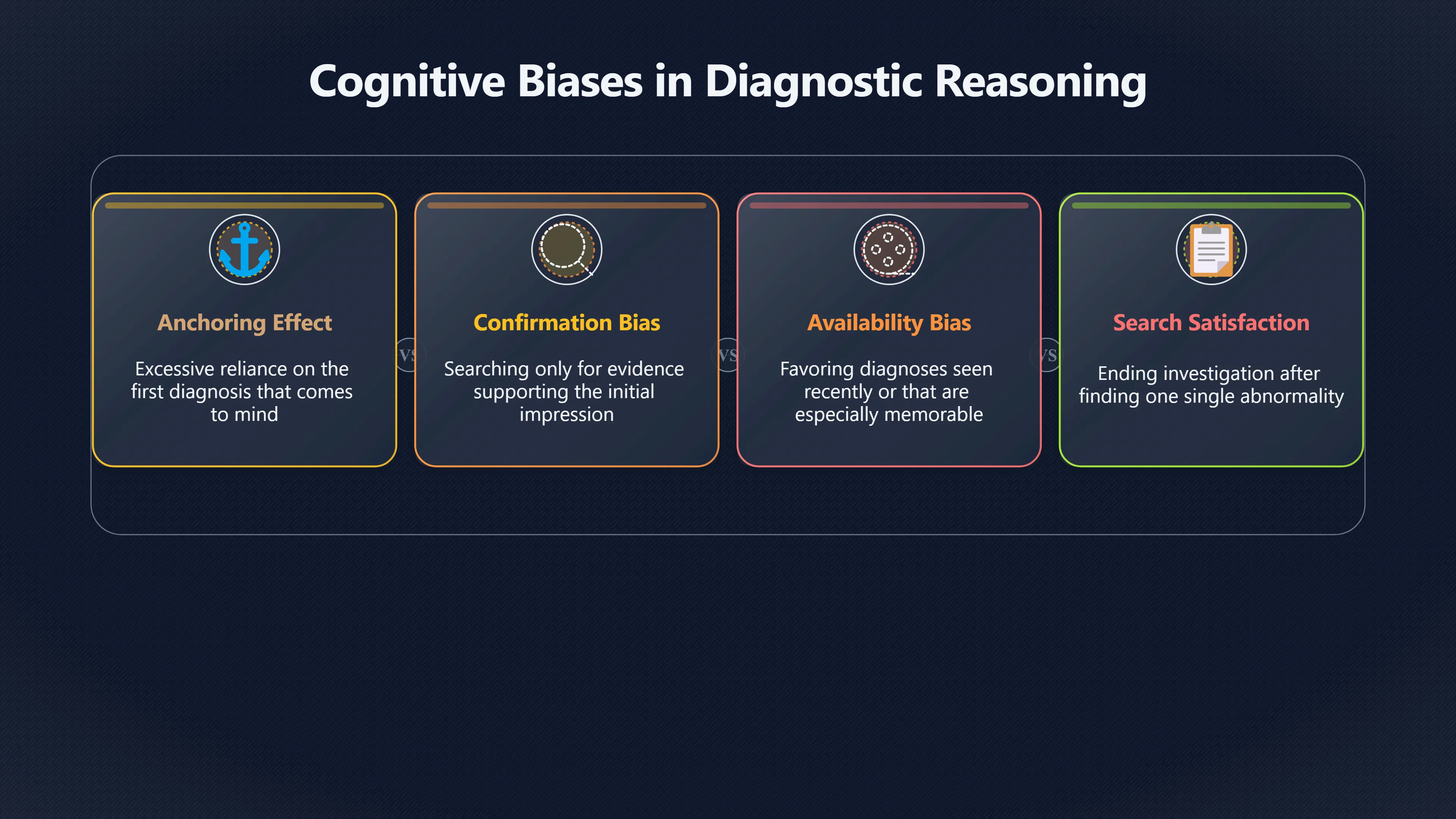
Premature closure occurs when the diagnostic search stops too early because one explanation feels sufficiently convincing. The problem is rarely that clinicians recognise patterns quickly; it is that fluency creates an illusion that no further thinking is necessary.
Several cognitive mechanisms commonly reinforce premature closure:
- Anchoring: excessive reliance on the first diagnosis that comes to mind.
- Confirmation bias: searching mainly for evidence that supports the initial impression while overlooking contradictory findings.
- Availability bias: favouring diagnoses that have been seen recently or are especially memorable.
- Search satisfaction: ending the investigation after finding one abnormality, even if it does not explain the entire clinical picture.[PMC+2Merck Manuals]pmc.ncbi.nlm.nih.govConfirmation bias Seeking or prioritising information…
These biases often interact. A clinician who initially labels a patient as having influenza because of fever and muscle aches may unconsciously interpret later findings through that frame, delaying recognition of bacterial sepsis, meningitis, pulmonary embolism, or another serious condition.
Research examining diagnostic reasoning repeatedly identifies premature closure as a major contributor to diagnostic error. Rather than reflecting lack of medical knowledge, many errors arise because reasoning ends before contradictory evidence has been fully considered.[PMC+2PubMed]pmc.ncbi.nlm.nih.govPMCThe challenge of cognitive science for medical diagnosisby P Croskerry · 2023 · Cited by 55 — A common cause of diagnostic error is “premature closure” when the clinician makes a premature d…
Why experts are still vulnerable
Experience improves intuition but does not eliminate cognitive bias. In fact, experts may sometimes be more susceptible to premature closure precisely because their pattern recognition is so efficient.
Rapid recognition usually succeeds because most cases resemble previous ones. The difficulty comes when an unusual disease imitates a common one, or when several conditions occur simultaneously. Familiarity can therefore become a strength that occasionally creates blind spots.
Clinical environments also encourage rapid closure. Emergency departments involve interruptions, heavy workloads, incomplete information, fatigue, and pressure to make decisions quickly. Under these conditions, intuitive reasoning becomes increasingly attractive, while deliberate reconsideration becomes harder. Reviews of diagnostic error consistently find that the opening and closing phases of diagnostic reasoning are particularly vulnerable to bias.[BMJ Open]bmjopen.bmj.comCognitive biases developed early in the process lead to errors at…
Practical checks that keep intuition honest
The most effective clinicians rarely replace intuition with lengthy analysis. Instead, they interrupt automatic thinking briefly at moments where diagnostic error is most likely.
Useful habits include:
- Pause before commitment. Ask, “What else could reasonably explain these findings?” before recording the working diagnosis.
- Look for disconfirming evidence. Rather than collecting only supportive findings, actively search for observations that would make the preferred diagnosis less likely.
- Maintain a differential diagnosis. Even if one diagnosis appears overwhelmingly likely, keep one or two credible alternatives until important evidence has been reviewed.
- Reassess after new information. Laboratory tests, imaging, and changes in the patient’s condition should update the diagnosis rather than merely reinforce earlier assumptions.
- Pay attention to mismatches. A finding that does not fit the expected pattern deserves explanation instead of being dismissed as an exception.
- Use colleagues strategically. A second opinion is most valuable before the team has fully committed to one explanation, because fresh observers are less affected by the original frame.[Swiss Medical Weekly+2PMC]smw.chPremature closure is a particularly important event in this sequence to diagnostic error. It happens when the physician accepts a diagnos…
These practices function as cognitive “guard rails”. They preserve the speed advantages of intuition while reducing the chance that the first explanation becomes immune to revision.
Feedback is what makes intuition trustworthy
Reliable intuition depends on learning from both successes and mistakes. Medicine presents a challenge because clinicians do not always discover whether their initial diagnosis was correct. Patients may be transferred, discharged, or lost to follow-up, limiting the feedback needed to refine judgement.
Hospitals increasingly use approaches such as diagnostic case reviews, morbidity and mortality conferences, and “cognitive autopsies” of diagnostic failures to reconstruct how reasoning unfolded. The objective is not simply to identify the wrong diagnosis but to understand where thinking narrowed prematurely and which warning signs were overlooked. Such structured reflection strengthens future intuitive judgement because it links experience with accurate feedback rather than mere repetition.[Cureus+2Europe PMC]cureus.com54547 a cognitive autopsy approach towards explaining diagnostic failureA Cognitive Autopsy Approach Towards Explaining…9 Aug 2021 — We sought to identify concurrent EPCs and any evidence of cognitive…
What this teaches about trusting intuition
Clinical medicine illustrates a broader principle about expert thinking. Intuition is most valuable when it serves as a fast pattern detector rather than a final decision-maker. A seasoned clinician’s first impression often deserves respect because it reflects years of accumulated experience. It does not deserve unquestioning acceptance.
The practical goal is therefore neither blind faith in instinct nor exhaustive analysis of every possibility. Instead, experts cultivate a disciplined balance: recognise familiar patterns quickly, act promptly when necessary, and deliberately create opportunities for competing explanations to survive until the available evidence has genuinely earned confidence. This combination allows intuition to accelerate good decisions without allowing premature closure to turn fluency into error.

Amazon book picks
Further Reading
Books and field guides related to When Doctors Should Trust Their First Impression. Use these as the next step if you want deeper reading beyond the article.
How Doctors Think
Focuses directly on clinical reasoning, diagnostic error, intuition, and strategies to improve medical decision-making.
Thinking, Fast and Slow
Explains when intuitive thinking succeeds and how biases such as anchoring and premature closure can mislead clinicians.
The Checklist Manifesto
Demonstrates how simple verification processes help counter overconfidence and prevent avoidable errors.
Clinical Reasoning in the Health Professions
Provides comprehensive coverage of diagnostic reasoning, pattern recognition, and reflective practice.
eBay marketplace picks
Marketplace Samples
Live-tested eBay searches with available results related to this page.



Endnotes
1.
Source: pmc.ncbi.nlm.nih.gov
Title: PMCThe challenge of cognitive science for medical diagnosis
Link:https://pmc.ncbi.nlm.nih.gov/articles/PMC9911579/
Source snippet
by P Croskerry · 2023 · Cited by 55 — A common cause of diagnostic error is “premature closure” when the clinician makes a premature d...
2.
Source: pmc.ncbi.nlm.nih.gov
Link:https://pmc.ncbi.nlm.nih.gov/articles/PMC8520040/
Source snippet
Confirmation bias Seeking or prioritising information...
3.
Source: bmjopen.bmj.com
Link:https://bmjopen.bmj.com/content/2/5/e001539
Source snippet
Cognitive biases developed early in the process lead to errors at...
4.
Source: pmc.ncbi.nlm.nih.gov
Title: PMCClinical reasoning in dire times
Link:https://pmc.ncbi.nlm.nih.gov/articles/PMC8742156/
Source snippet
Analysis of cognitive biases in...by M Coen · 2022 · Cited by 26 — They concluded that premature closure (72.2%), anchoring (61.1%), and...
5.
Source: cureus.com
Title: 54547 a cognitive autopsy approach towards explaining diagnostic failure
Link:https://www.cureus.com/articles/54547-a-cognitive-autopsy-approach-towards-explaining-diagnostic-failure
Source snippet
A Cognitive Autopsy Approach Towards Explaining...9 Aug 2021 — We sought to identify concurrent EPCs and any evidence of cognitive...
6.
Source: europepmc.org
Link:https://europepmc.org/books/n/aps2/a2444/
Source snippet
Europe PMCDiagnostic Failure: A Cognitive and Affective Approachby P Croskerry · Cited by 186 — A retrospective analytical process, the c...
7.
Source: merckmanuals.com
Link:https://www.merckmanuals.com/professional/special-subjects/clinical-decision-making/cognitive-errors-in-clinical-decision-making
Source snippet
This is one of the most common errors; clinicians make an initial diagnosis (often...Read more...
8.
Source: smw.ch
Link:https://smw.ch/index.php/smw/article/download/1609/2103?inline=1
Source snippet
Premature closure is a particularly important event in this sequence to diagnostic error. It happens when the physician accepts a diagnos...
9.
Source: pubmed.ncbi.nlm.nih.gov
Title: Among them, premature closure is a key factor triggering a diagnostic error
Link:https://pubmed.ncbi.nlm.nih.gov/22818221/
Source snippet
Premature diagnostic closure: an avoidable type of errorby M Vázquez-Costa · 2013 · Cited by 17 — The main cause of failures in cli...
Additional References
10.
Source: coverys.com
Link:https://www.coverys.com/expert-insights/the-dangers-of-intuitive-thinking-in-the-diagnostic-process
Source snippet
The Dangers of Intuitive Thinking in the Diagnostic ProcessCognitive biases impact practitioners' decision-making ability and can lead to...
11.
Source: iap-aus.org.au
Link:https://iap-aus.org.au/wp-content/uploads/2025/04/Pattern-recognition-diagnostic-reasoning-cognitive-bias-further-resources.pdf
Source snippet
"Campbell. 'A Cognitive Autopsy Approach Towards Explaining. Diagnostic Failure.' Cureus 13, no. 8 (2021): e17041. [https://doi.org...Read..."](https://doi.org...Read...")...
12.
Source: fhea.com
Title: cognitive errors in clinical diagnosis availability bias and premature closure
Link:https://www.fhea.com/resource-center/cognitive-errors-in-clinical-diagnosis-availability-bias-and-premature-closure/
Source snippet
Cognitive Errors in Clinical Diagnosis: Availability Bias and...24 Sept 2021 — Errors in diagnostic reasoning can occur when clinicians...
13.
Source: monashhealth.libguides.com
Link:https://monashhealth.libguides.com/cognitive_-_bias
Source snippet
Guides: Cognitive Bias Resource Guide - Library9 Feb 2026 — Premature closure A failure to consider other possibilities...
14.
Source: codex.ucsf.edu
Title: primer 3 role clinical reasoning diagnostic excellence
Link:https://codex.ucsf.edu/primer-3-role-clinical-reasoning-diagnostic-excellence
Source snippet
3: The Role of Clinical Reasoning in Diagnostic...25 Jun 2025 — Dual Process Model of Clinical Thinking: Clinical reasoning involves two...
15.
Source: britishbryologicalsociety.org.uk
Link:https://www.britishbryologicalsociety.org.uk/wp-content/uploads/2020/12/FB105_The-dual-process-theory-as-applied-to-bryological-identification.pdf
Source snippet
(2009a). Clinical cognition and diagnostic error: applications of a dual process model of reasoning. Advances in Health Science Education...
16.
Source: frontiersin.org
Link:https://www.frontiersin.org/journals/public-health/articles/10.3389/fpubh.2026.1770198/full
Source snippet
losure and related biases are more frequent drivers of diagnostic failure...
17.
Source: researchgate.net
Title: The theory has immediate application to medical decision making.Read more
Link:https://www.researchgate.net/publication/26731481_Clinical_cognition_and_diagnostic_error_applications_of_a_dual_process_model_of_reasoning
Source snippet
applications of a dual process model of reasoningA new, universal model of reasoning and decision making has emerged, Dual Process Theory...
18.
Source: med.virginia.edu
Link:https://med.virginia.edu/faculty-affairs/wp-content/uploads/sites/458/2016/04/Journal-Club-Geoff-Norman.pdf
Source snippet
f working memory, which constrains computational processes...
19.
Source: deltapsychology.com
Title: clinical decision cognitive biases
Link:https://www.deltapsychology.com/articles-for-doctors/clinical-decision-cognitive-biases
Source snippet
Cognitive Biases in Clinical Decision-Making20 Mar 2025 — This article explores common cognitive biases in medical decision-making, how t...
Topic Tree
Follow this branch
Parent topic
Expert Gut When Should You Trust Your Gut?Related pages 5
- Chess Patterns What Chess Masters See That Beginners Miss
- Fire Decisions Why Firefighters Sometimes Know Before They Explain
- Forecast Feedback How Forecasting Makes Confidence Accountable
- Kind vs Wicked When Experience Teaches the Wrong Lesson
- Stats vs Experts When Simple Models Beat Expert Judgement