Within Better Questions
Is Your Question Actually a Decision?
A good decision question names what would actually change, so evidence is gathered for a real choice instead of a loose curiosity.
On this page
- Decision questions versus curiosity questions
- How vague wording hides the real choice
- What would change your mind
Page outline Jump by section
Introduction
A useful question is not simply one that can be answered. It is one whose answer would change a real decision. That distinction separates productive investigation from endless information gathering. Many people begin with broad questions such as “Is this a good idea?” or “Does this method work?”, but these rarely specify what action depends on the answer, what evidence would count, or what outcome matters. As a result, almost any evidence can appear relevant, while conflicting evidence becomes difficult to interpret. Evidence-based practice consistently places careful question formulation before evidence searching because the quality of the question determines the quality of the decision that follows. [NCBI]ncbi.nlm.nih.govNCBIQuestion FormulationThis chapter revolves around the three C's of question formulation: Capture…Read more…
 Rather than asking whether something is “true” in the abstract, effective thinkers ask questions that define a choice, identify what would change if the answer were different, and specify the observations that would justify changing course.
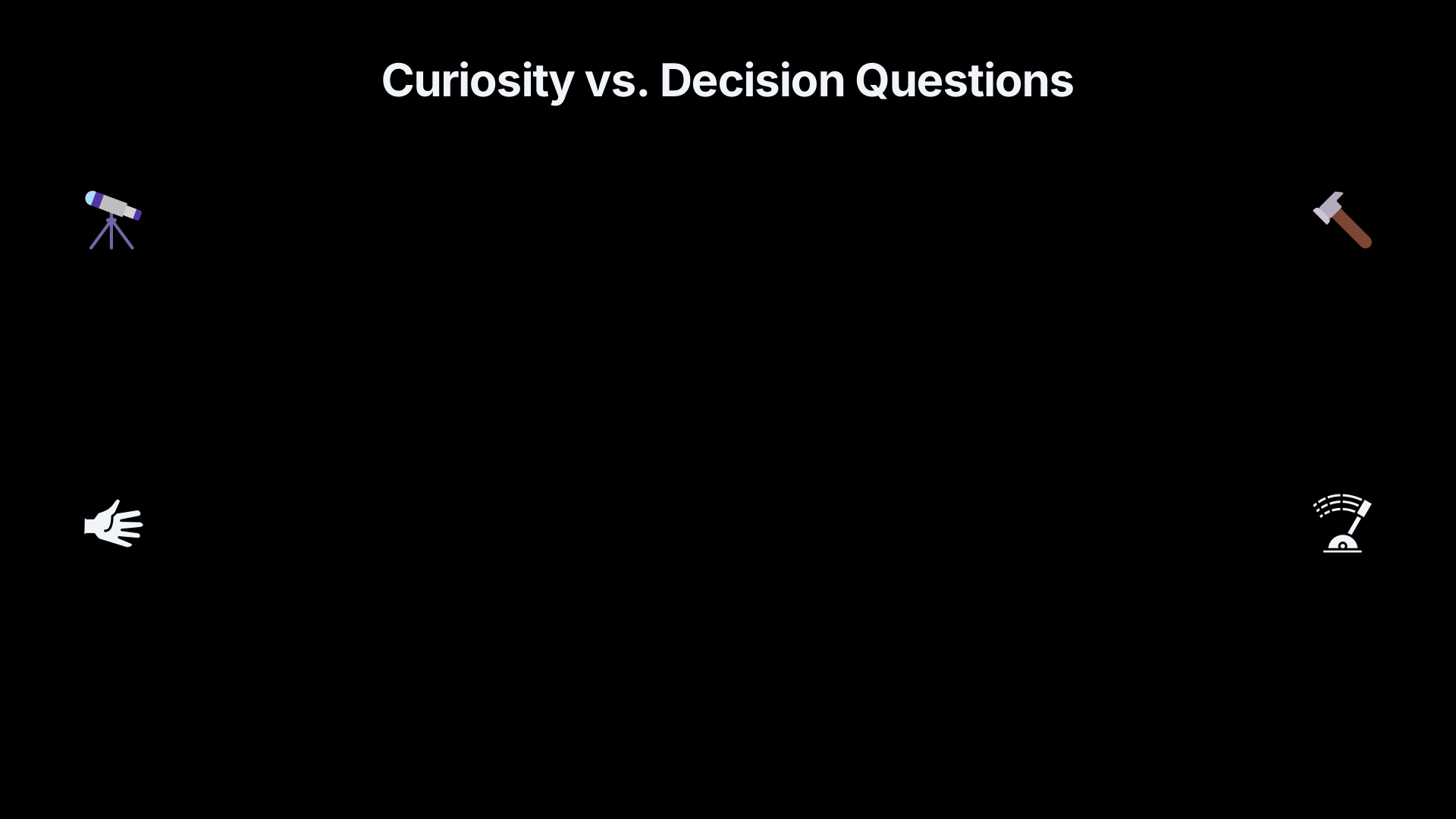
Decision questions versus curiosity questions
Curiosity is valuable, but not every interesting question deserves the same effort. A decision question is tied to a concrete choice. It identifies an action that depends on the answer.
Compare these examples:
Curiosity questionDecision questionIs remote working better?Should our team remain remote or require two office days each week if productivity falls by more than 5%?Is artificial intelligence useful?Should we automate customer support for routine enquiries if customer satisfaction remains above our current level?Is exercise good?Should I replace two weekly strength sessions with running if my goal is reducing blood pressure over the next six months?
The second column is not necessarily narrower because it is more technical. It is better because every answer has a consequence. If new evidence arrives, you know exactly what it might persuade you to do differently.
Evidence-based practice frameworks formalise this idea by encouraging people to specify the population or situation, the intervention or option, the comparison, and the outcome before searching for evidence. This prevents a search from becoming an unfocused collection of interesting facts. [libguides.mssm.edu]libguides.mssm.eduOpen source on mssm.edu.
How vague wording hides the real choice
Many apparently simple questions contain several hidden decisions.
Consider:
“Should we buy electric vehicles?”
This appears straightforward, but it conceals multiple unanswered questions:
- Compared with replacing the fleet with newer petrol vehicles or keeping existing vehicles?
- Judged by purchase price, lifetime cost, emissions, reliability or maintenance?
- Over what ownership period?
- For which vehicles rather than every vehicle?
Without these details, different people naturally answer different questions while believing they disagree about the same one.
Vague language often relies on words such as:
- Better
- Faster
- Worthwhile
- Effective
- Successful
- Safe
- Expensive
- Efficient
These words only become meaningful once they are attached to measurable outcomes or explicit comparisons.
This is why guidance on structured questioning warns that broad, poorly framed questions waste time and produce unfocused searches, whereas specific questions generate more relevant evidence and clearer search strategies. [ciap.health.nsw.gov.au]nsw.gov.auFormulating a question using PICOVague, broad, poorly framed questions will most likely result in lost time and an inability to locate useful evidence
What would change your mind?
Perhaps the most powerful test of a decision question is asking:
“What evidence would cause me to make a different decision?”
If there is no imaginable observation that could alter your conclusion, you are not really investigating—you are defending an existing belief.
For practical decisions, this does not require philosophical certainty. It simply requires identifying a decision threshold before collecting evidence.
For example:
- “If customer complaints increase by more than 10%, we will abandon the new process.”
- “If the investment underperforms the benchmark for three consecutive years, we will reconsider the strategy.”
- “If no measurable improvement appears after twelve weeks, we will stop the intervention.”
These thresholds make learning possible because success and failure are defined in advance rather than explained away afterwards.
This approach echoes a broader principle from the philosophy of science: valuable hypotheses expose themselves to the possibility of being wrong by implying observations that would contradict them. Although everyday decisions are usually less formal than scientific theories, adopting the same habit encourages intellectual honesty and reduces motivated reasoning. [Wikipedia]WikipediaOpen source on wikipedia.org.
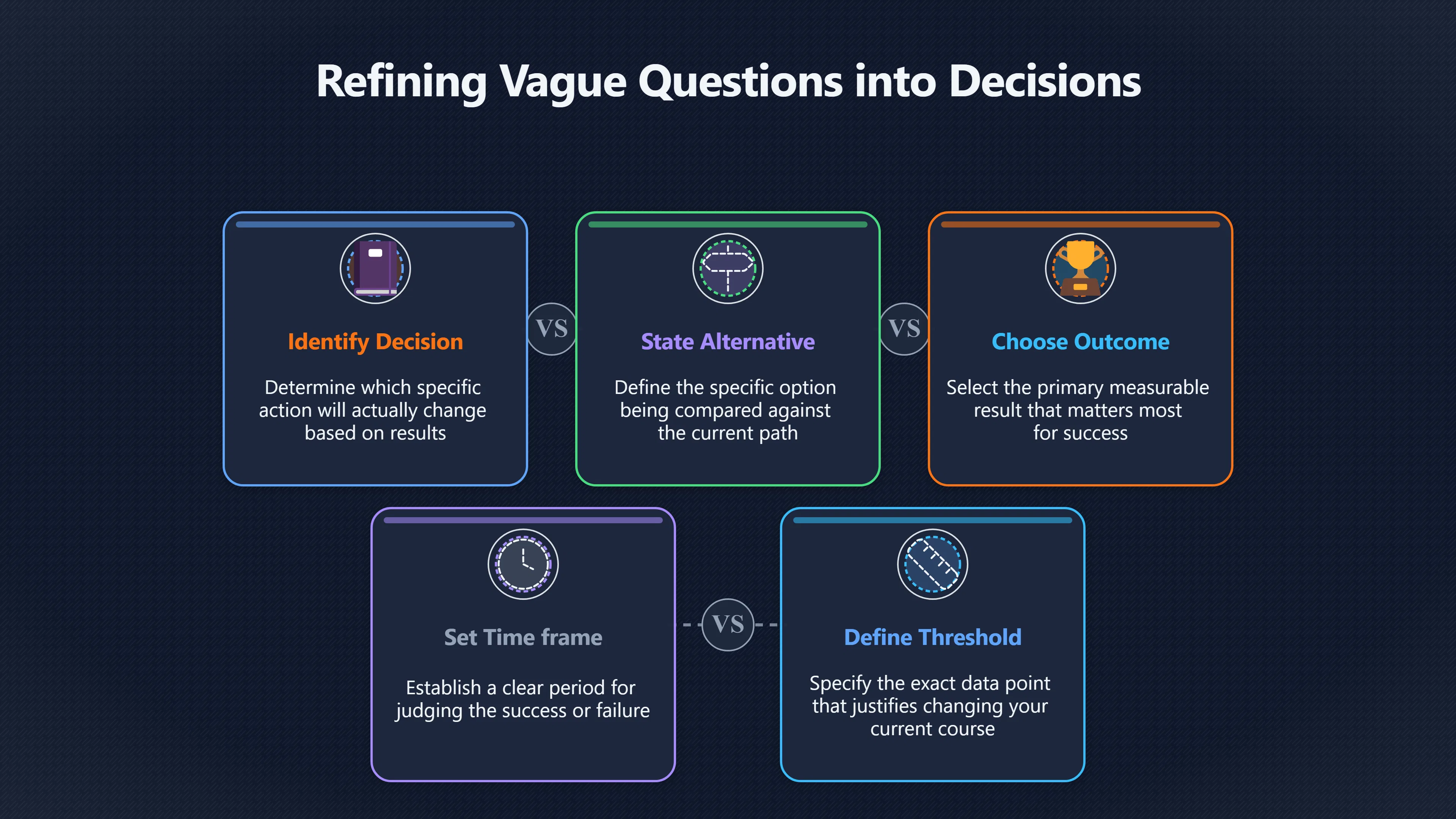
A simple method for turning vague questions into testable decisions
Most everyday questions can be strengthened through a short sequence of revisions.
- Identify the decision. What action might actually change?
- State the alternative. Compared with doing what instead?
- Choose the outcome. [What result matters most?]ciap.health.nsw.gov.aueful evidence…
- Set the timeframe. When should success or failure be judged?
- Define the threshold. What result would justify changing your decision?
For example:
Original question
“Should I learn Python?”
Improved version
“Compared with continuing to learn spreadsheets only, will spending five hours per week learning Python save me at least three hours of repetitive work each week within six months?”
Now the search becomes far more productive. Instead of collecting general opinions about programming, you seek evidence directly related to time savings, learning curves and similar users.
A worked example
Imagine a manager considering a new training programme.
The vague question is:
“Does the training work?”
Almost every piece of evidence appears relevant:
- Participants enjoyed it.
- Attendance was high.
- Managers liked the presenter.
- The course received excellent reviews.
Yet none necessarily answers the decision.
A stronger version might be:
“Compared with our current onboarding process, does the new programme reduce first-month customer service errors by at least 15% within eight weeks without increasing supervisor workload?”
This revised question changes the entire investigation.
Instead of relying on satisfaction surveys, the manager now looks for:
- comparable groups,
- error-rate measurements,
- implementation costs,
- supervisor time,
- performance over the specified period.
Evidence that once looked persuasive may now be irrelevant because it no longer addresses the decision.

Common mistakes when designing decision questions
Several patterns repeatedly weaken practical reasoning.
Searching before defining success. People often begin gathering evidence before deciding what outcome matters, making it easy to favour whichever evidence appears first.
Using undefined comparison groups. Asking whether something is “good” ignores that every decision replaces an alternative.
Changing the standard after seeing results. When success criteria shift after evidence appears, poor decisions become difficult to recognise.
Confusing measurement with consequence. Some measures are easy to collect but have little relationship to the actual decision. High satisfaction scores, for example, may not predict improved performance.
Treating every uncertainty as equally important. Not every unknown deserves investigation. Focus first on uncertainties capable of changing the decision.
Why this habit improves analytical thinking
Turning vague questions into testable decisions changes thinking in several important ways.
It forces assumptions into the open rather than leaving them hidden inside ambiguous language. It separates evidence that genuinely informs a choice from information that is merely interesting. It also makes disagreement more productive because people can identify whether they differ about the evidence, the desired outcome, the comparison, or the threshold for changing their minds.
Perhaps most importantly, it creates a habit of intellectual flexibility. Instead of asking, “Can I find support for my view?”, the better question becomes, “What observation would justify making a different choice?” That shift transforms question design from a preliminary step into one of the most valuable analytical skills in its own right.
Amazon book picks
Further Reading
Books and field guides related to Is Your Question Actually a Decision?. Use these as the next step if you want deeper reading beyond the article.
Decisive
Focuses on turning vague dilemmas into concrete decisions supported by evidence.
Smart Choices
Introduces practical frameworks for defining choices and evaluating alternatives.
Super Thinking
Encourages using structured mental models to clarify decisions and evidence.
The Book of Beautiful Questions
Shows how refining questions leads to better decisions and more productive inquiry.
eBay marketplace picks
Marketplace Samples
Topic-anchored marketplace searches for visual, collectible, or second-hand items related to this page.


Endnotes
-
Source: ncbi.nlm.nih.gov
Title: NCBIQuestion Formulation
Link: https://www.ncbi.nlm.nih.gov/books/NBK603122/Source snippet
This chapter revolves around the three C's of question formulation: Capture...Read more...
-
Source: ciap.health.nsw.gov.au
Link: https://www.ciap.health.nsw.gov.au/training/ebp-learning-modules/module2/formulating-a-question-using-[picoSource snippet
eful evidence...
-
Source: libguides.mssm.edu
Link: https://libguides.mssm.edu/ebm/ebp_pico -
Source: Wikipedia
Link: https://en.wikipedia.org/wiki/Falsifiability -
Source: unimelb.libguides.com
Title: Frame Your Question
Link: https://unimelb.libguides.com/EvidenceBasedPractice/FrameYourQuestionSource snippet
libguides.comEvidence-based practice: Frame an answerable question13 May 2026 — These questions are typically structured using the PICO f...
Published: May 2026
-
Source: youtube.com
Link: https://www.youtube.com/watch?v=uhB8YMBTWhkSource snippet
"4 Ask people for opinions, not facts.[https://www.youtube.com/watch?v=cafztS23hg4..."](https://www.youtube.com/watch?v=cafztS23hg4...")...
-
Source: pmc.ncbi.nlm.nih.gov
Link: https://pmc.ncbi.nlm.nih.gov/articles/PMC3140151/Source snippet
by S Aslam · 2010 · Cited by 575 — This article will assist researchers by providing step-by-step guidance on the formulation of a res...
-
Source: guides.mclibrary.duke.edu
Link: https://guides.mclibrary.duke.edu/ebm/picoSource snippet
It is a mnemonic for the important parts of a well-built clinical question. It also helps formulate the search strategy.Read more...
Additional References
-
Source: tees.ac.uk
Link: https://tees.ac.uk/lis/learninghub/cinahl/pico.pdfSource snippet
side UniversityDeveloping Your Search Question using PICO/PIO/PEOFor Evidence Based Practice (EBP) searches, you will often be expect...
-
Source: covidence.org
Link: https://www.covidence.org/blog/how-to-formulate-the-review-question/Source snippet
stematic review of intervention...
-
Source: libguides.exeter.ac.uk
Link: https://libguides.exeter.ac.uk/c.php?g=666944&p=4728848Source snippet
Formulating answerable questions - Finding and using...15 May 2026 — PICO helps to break down a clinical scenario and turn it into an an...
Published: May 2026
-
Source: youtube.com
Title: Evidence-Based Practice, Step 1: Asking the Clinical Question
Link: https://www.youtube.com/watch?v=PJhnN7sjPBgSource snippet
3 EBP - Creating an Answerable Clinical Question...
-
Source: youtube.com
Title: How To Ask Questions That Prompt [Critical Thinking]({{ ‘critical-skills/’ | relative_url }})
Link: https://www.youtube.com/watch?v=H3IwnZgfdFoSource snippet
2 Evidence-Based Practice, Step 1: Asking the Clinical Question...
-
Source: youtube.com
Title: The Art of Asking Better Questions | Dave Rogers | TEDx Wolverhampton
Link: https://www.youtube.com/watch?v=6qNLPyqWoOU -
Source: youtube.com
Link: https://www.youtube.com/watch?v=cafztS23hg4Source snippet
5 The Art of Asking Better Questions | Dave Rogers | TEDxWolverhampton...
Topic Tree