Within Decision Journal
What should a decision journal entry include?
The best template is short enough to complete before a real choice but specific enough to make later review honest.
On this page
- The minimum useful fields before deciding
- How to avoid vague escape hatch wording
- When to use a longer entry for high stakes choices
Page outline Jump by section
Introduction
The most effective decision journal templates are surprisingly small. People rarely abandon the practice because they disagree with its value; they abandon it because the form takes too long to complete before a real decision. The templates that survive repeated use share a common design principle: they capture enough information to make later review honest, while remaining short enough to fill in when time is limited. This balance is reflected in widely used approaches from decision practitioners such as Farnam Street and Annie Duke, which emphasise recording explicit predictions, uncertainty and reasoning before acting rather than producing lengthy essays.[Farnam Street+2Coda]fs.blogIn this episode, she explains why most people confuse luck with skill, how to think in bets, and…Read more…
 A practical decision journal should therefore function as a commitment device. It should preserve what you genuinely believed at the time, making it difficult for hindsight to rewrite your reasoning after the outcome is known.
The minimum useful fields before deciding
A useful template should take only a few minutes to complete for an ordinary decision. If every entry becomes a miniature report, most people stop using the journal altogether.
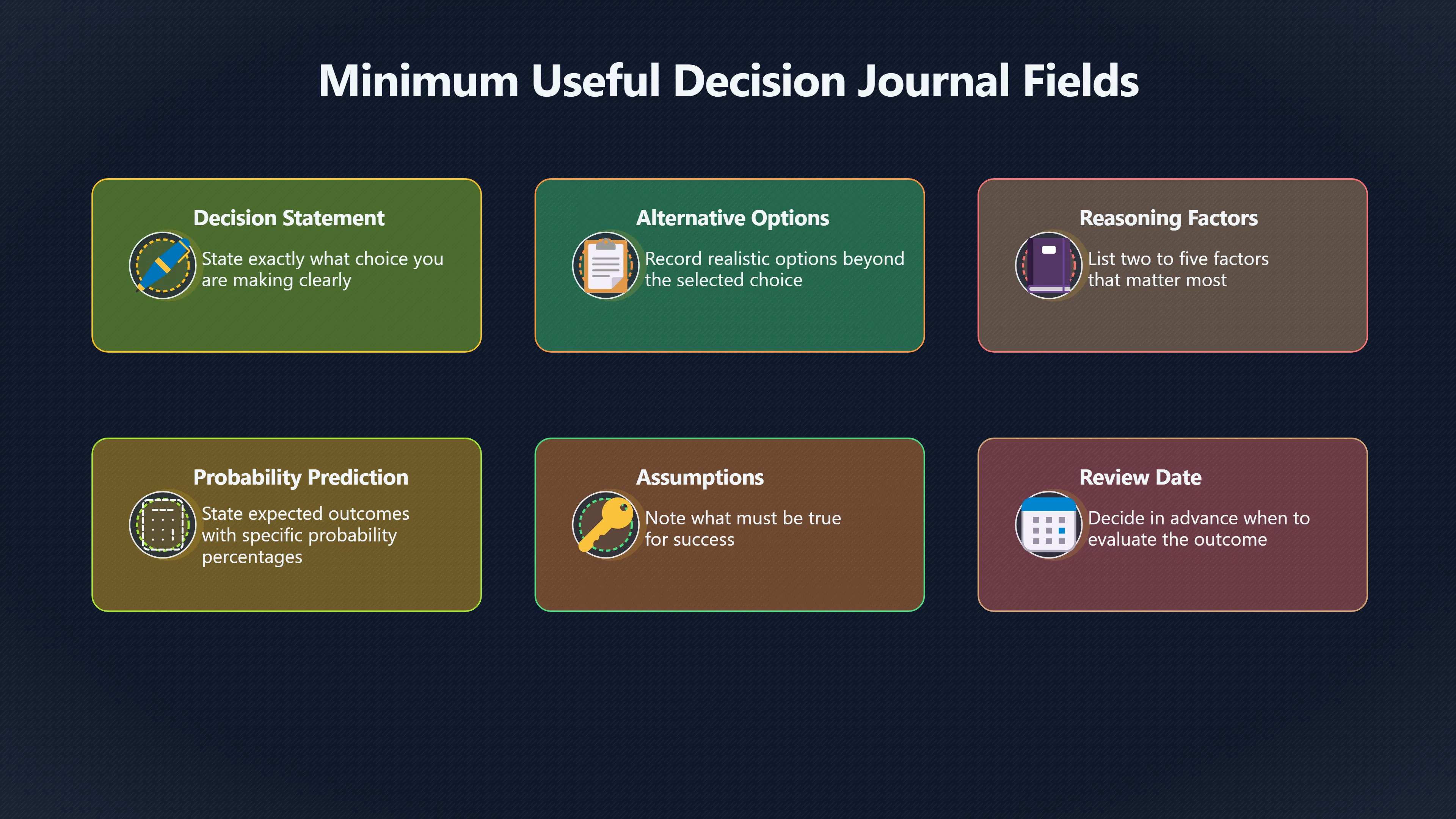
A practical minimum contains six elements:
- The decision. State exactly what choice you are making.
- The alternatives considered. Record the realistic options, not only the one you selected.
- Your reasoning. List the two to five factors that matter most, avoiding long narratives.
- Your prediction. State what you expect to happen and, where possible, attach probabilities rather than certainty.
- Key assumptions. Note what must be true for your decision to work.
- Review date. Decide in advance when the outcome should be evaluated.
This structure mirrors the recurring features found across widely used decision-journal examples. Rather than collecting every possible detail, they focus on preserving the information that memory is most likely to distort later: expectations, confidence and assumptions.[Coda]coda.ioHow to make better decisions: Practical exercises from…A companion toolkit for my book "How to Decide: Simple Tools for Making Bet…
A concise entry might look like this:
FieldExampleDecisionAccept Job A rather than Job BMain reasonsBetter manager; stronger learning opportunities; slightly lower salaryExpected outcomeI expect to remain satisfied after one yearConfidenceApproximately 70%Biggest uncertaintyTeam culture after the probation periodReviewTwelve months after starting
The important feature is not the wording but the commitment to recording beliefs before the result is known.
How to avoid vague escape-hatch wording
Most failed decision journals do not fail because the predictions are wrong. They fail because the predictions are impossible to evaluate.
Statements such as “this feels like the right choice”, “I think it will probably work” or “there are many variables” allow future-you to reinterpret almost any outcome as consistent with the original prediction.
Instead, replace vague language with measurable claims.
Rather than writing:
- “The project should succeed.”
Write:
- “I estimate a 60% chance that the project launches before 1 October.”
- “I expect customer retention to improve by at least 10% within six months.”
- “If revenue has not reached £250,000 after twelve months, I will regard this assumption as wrong.”
Probability estimates are especially valuable because they acknowledge uncertainty instead of pretending certainty exists. Annie Duke argues that expressing beliefs as probabilities forces people to distinguish between confidence and certainty, producing decisions that are easier to evaluate honestly afterwards.[Farnam Street+2Coda]fs.blogIn this episode, she explains why most people confuse luck with skill, how to think in bets, and…Read more…
Another useful habit is to separate facts, assumptions and interpretations. For example:
- Fact: Three competitors entered the market this year.
- Assumption: Demand will continue growing despite increased competition.
- Interpretation: Our existing customer relationships reduce competitive risk.
This separation makes it much easier to discover later whether poor results came from bad evidence, faulty interpretation or simple bad luck.
When to use a longer entry for high-stakes choices
Not every decision deserves the same amount of effort.
Routine decisions—choosing software, buying inexpensive equipment or accepting a meeting invitation—gain little from elaborate documentation. A short template is sufficient because the cost of being wrong is low.
Longer entries become worthwhile when decisions are:
- difficult to reverse
- expensive
- strategically important
- emotionally charged
- likely to be reviewed months or years later.
For these cases, expand the template rather than replacing it.
Useful additional sections include:
- Objectives. What outcome are you actually trying to achieve?
- Rejected alternatives. Why were other options declined?
- Evidence supporting the decision.
- Evidence against the decision.
- Base rates. What usually happens in comparable situations?
- Potential failure modes. What would cause this decision to fail?
- Signals to monitor. What early evidence would suggest the decision should be reconsidered?
- Conditions for changing course. What evidence would make you reverse or revise the decision?
These additions remain focused on improving later review rather than justifying the decision after the fact. They also reduce the temptation to defend sunk costs because they establish, before acting, what evidence would count as a reason to change direction. Annie Duke’s practical decision tools similarly encourage making important assumptions explicit before commitment instead of relying on memory or intuition afterwards.[Coda+2Behavioral Scientist]coda.ioHow to make better decisions: Practical exercises from…A companion toolkit for my book "How to Decide: Simple Tools for Making Bet…
Keep the template stable
One overlooked feature of successful decision journals is consistency.
If the template changes every month, comparisons become difficult. A fixed set of questions gradually produces a personal dataset that reveals recurring patterns, such as:
- consistently overestimating success probabilities
- underestimating completion times
- relying too heavily on one source of evidence
- ignoring the same warning signs repeatedly.
The journal becomes less a diary than a calibration tool. Because every entry answers the same core questions, patterns emerge that would be invisible in free-form notes.
Many experienced practitioners therefore recommend keeping one standard template for ordinary decisions and one expanded version for high-stakes choices. The simplicity encourages regular use, while the additional fields remain available when the consequences justify extra effort.[Coda]coda.ioHow to make better decisions: Practical exercises from…A companion toolkit for my book "How to Decide: Simple Tools for Making Bet…
Amazon book picks
Further Reading
Books and field guides related to What should a decision journal entry include?. Use these as the next step if you want deeper reading beyond the article.
Thinking in Bets
Explains decision quality, probabilistic thinking, and the value of recording reasoning before outcomes are known.
Superforecasting
Supports journal fields such as predictions, probabilities, assumptions, and later review.
Decisive
Provides practical frameworks for structuring decisions and avoiding common thinking traps.
The Decision Book
Offers concise decision frameworks that pair naturally with structured journal entries.
eBay marketplace picks
Marketplace Samples
Example marketplace items related to this page. Use the search link to explore similar finds on eBay.


Endnotes
1.
Source: fs.blog
Link:https://fs.blog/knowledge-project-podcast/annie-duke/
Source snippet
In this episode, she explains why most people confuse luck with skill, how to think in bets, and...Read more...
2.
Source: coda.io
Link:https://coda.io/%40annie-duke/how-to-make-better-decisions-practical-exercises-from-professional-poker
Source snippet
How to make better decisions: Practical exercises from...A companion toolkit for my book "How to Decide: Simple Tools for Making Bet...
3.
Source: behavioralscientist.org
Title: practical tools for better decisions a qa with annie duke on how to decide
Link:https://behavioralscientist.org/practical-tools-for-better-decisions-a-qa-with-annie-duke-on-how-to-decide/
Source snippet
Behavioral ScientistPractical Tools for Better Decisions: A Q&A with Annie...16 Nov 2020 — Annie Duke wants you to make better decisions...
Additional References
4.
Source: advanced-hindsight.com
Link:https://advanced-hindsight.com/behavioral-design-podcast/making-better-decisions-with-annie-duke/
Source snippet
Making Better Decisions with Annie DukeShe has made it her pursuit to help us understand how we make decisions and provide us with concre...
5.
Source: annieduke.com
Title: article decision making by thinking in bets annie duke
Link:https://www.annieduke.com/article-decision-making-by-thinking-in-bets-annie-duke/
Source snippet
Article: Decision making by Thinking in Bets: Annie Duke30 Mar 2020 — You will realize that you can become good at decision making · You...
6.
Source: lennysnewsletter.com
Title: Discover how to make better choices and improve
Link:https://www.lennysnewsletter.com/p/making-better-decisions-annie-duke
Source snippet
Lenny's NewsletterA framework for making better decisions | Annie Duke...2 May 2024 — Learn from Annie Duke's expertise on decision-maki...
Published: May 2024
7.
Source: open.spotify.com
Title: 3jw0nb MVq Gq Nqtmt QJLt1R
Link:https://open.spotify.com/episode/3jw0nbMVqGqNqtmtQJLt1R
Source snippet
Tools for Deciding Better Every Day with Annie Duke18 Nov 2025 — Annie is a former professional poker player turned decision strategist w...
8.
Source: podcasts.happyscribe.com
Title: 37 annie duke getting better by being wrong
Link:https://podcasts.happyscribe.com/the-knowledge-project-with-shane-parrish/37-annie-duke-getting-better-by-being-wrong
Source snippet
What I used to say is that the players who weren't so good at the beginner levels...Read more...
9.
Source: youtube.com
Title: Before You Make A Hard Decision, Use A Decision Journal (with example)
Link:https://www.youtube.com/watch?v=MbnfgDyz1tQ
Source snippet
How to make better decisions with this framework and Notion template...
10.
Source: youtube.com
Link:https://www.youtube.com/watch?v=IQrHM6wnjiw
Source snippet
My 2023 Obsidian Workflow for Note-Taking and Templated Thinking...
11.
Source: youtube.com
Title: How to make better decisions with this framework and Notion template
Link:https://www.youtube.com/watch?v=kLiLQbNvKOc
Source snippet
Top 10 must have FREE notion templates you need...
12.
Source: podcasts.apple.com
Link:https://podcasts.apple.com/ie/podcast/37-annie-duke-getting-better-by-being-wrong/id990149481?i=1000416546154
Source snippet
apple.com37 Annie Duke: Getting Better…–The Knowledge Project25 Jul 2018 — What drew Annie into such a high stakes, time-pressured enviro...
13.
Source: youtube.com
Title: Top 10 must have FREE notion templates you need
Link:https://www.youtube.com/watch?v=Q_zJLpk7cE8
Source snippet
How To Use Obsidian for Decision Making 2026 (Step-By-Step)...
Topic Tree